
Key takeaways
What's inside
Best home gym cycle shopping goes wrong at the first step, because indoor cycles, uprights, recumbents, folding bikes and air bikes put you in five different positions. Type decides comfort before any specification does. These six cover all five types, with adjustment ranges and footprints listed for each.
As an Amazon Associate we earn from qualifying purchases at no extra cost to you. Product prices and availability are accurate as of the date shown and are subject to change.

#1 Pick

#2 Pick

#3 Pick

#4 Pick

#5 Pick

#6 Pick

#7 Pick

As an Amazon Associate we earn from qualifying purchases at no extra cost to you. Product prices and availability are accurate as of the date shown and are subject to change.
By Chris Parker
🛒 Best Price Today on Amazon
Prime members get fast, free shipping on everything above, plus member-only deals. New members get a 30-day free trial — cancel anytime.
How to Choose the Best Home Gym Cycle for Your Body and Room
Fit is the specification that decides whether the best home gym cycle gets ridden, and it is the one buyers check last. The four criteria below start with riding position, then work through adjustment ranges, footprint and what eventually wears out.
Bike Type Sets Your Riding Position
The best home gym cycle for road riders puts you forward over the bars with the saddle high, mimicking a road bike. That position suits interval work and riding out of the saddle, but it puts weight on the hands and takes some adaptation if you have not ridden before.
Uprights sit you more vertically with the pedals below rather than in front, which is easier on the wrists and better suited to long steady sessions. Recumbents place you in a seat with back support and the pedals ahead, removing hand and saddle pressure entirely.
Folding uprights trade rigidity for storage, and air bikes sit upright with moving handles that recruit the upper body. Choose the position first; every other specification is negotiable in a way that the riding position simply is not.
Fit Ranges: Inseam, Reach and Q-Factor
The useful numbers on any best home gym cycle listing are the supported rider height range and whether the saddle adjusts both vertically and horizontally. Four-way saddle adjustment plus two-way handlebars covers a far wider range of bodies than a simple up-and-down seatpost.
Measure your inseam and compare it against the seat height range in inches or centimetres rather than trusting a general height claim. Riders at either end of a stated range are usually the ones who find a bike uncomfortable within a fortnight.
Q-factor is the distance in millimetres between the crank arms. Narrower spacing keeps the feet closer to the frame centreline and feels natural to road riders; wider spacing is common on budget bikes and noticeably changes how the pedals sit underfoot.
Footprint, Weight Limits and Where It Lives
Indoor cycles occupy roughly 4 x 2 ft (122 x 61 cm), uprights slightly less, and recumbents considerably more because the seat sits behind the pedals. Folding bikes collapse to a fraction of that, which is their entire reason for existing.
User weight limits typically run from 250 to 350 lb (113 to 159 kg), and they are always worth checking rather than assuming, particularly on folding frames, where the published limit is usually lower than on an otherwise comparable fixed frame.
Measure the actual dimensions of the space you plan to use before ordering, including clearance behind the saddle for mounting and the ceiling height if you ride out of the saddle. Standing on the pedals adds more head height than people expect.
Resistance, Maintenance and What Wears
Magnetic resistance makes no contact with the flywheel, so there is nothing to wear and nothing to replace. Felt friction pads press directly on the wheel, wear down steadily over time, squeak as they age and need periodic replacement.
Belt drives run quieter than chains and need no lubrication at all, which matters in a room next door to somewhere people sleep. Chains last well but require occasional lubrication and add mechanical noise throughout every session.
The mid price tier is where the combination worth having appears: magnetic resistance, a belt drive and four-way saddle adjustment. Below that band you generally accept a friction pad, two-way adjustment, or both, which is a fit and maintenance decision rather than a small saving.
Top Picks: 6 Options for the Best Home Gym Cycle
One or two best home gym cycle representatives per bike type, so the list should contain a reasonable match whichever riding position suits you best. The table pairs each bike with its type, its adjustment range and the footprint it claims.
| Bike | Type | Resistance | Adjustment | Footprint |
|---|---|---|---|---|
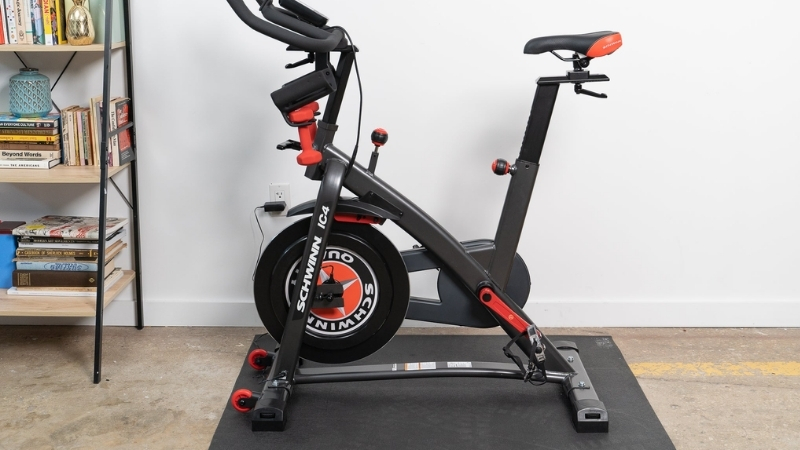
| Schwinn IC4 | Indoor cycle | Magnetic, 100 levels | 4-way seat, 2-way bars | ~4 x 2 ft (122 x 61 cm) |
| YOSUDA Indoor Cycling Bike | Indoor cycle | Felt friction | 2-way seat and bars | ~4 x 2 ft (122 x 61 cm) |
| Schwinn 170 Upright | Upright | Magnetic, 25 levels | Seat height and fore-aft | Compact, fixed |
| Marcy ME-709 | Recumbent | Magnetic, 8 levels | Sliding seat rail | Longest of the six |
| Exerpeutic folding upright | Folding upright | Magnetic, 8 levels | Seat height only | Folds away |
| Schwinn Airdyne AD6 | Air bike | Fan, scales with effort | Seat height and fore-aft | Wide, fixed |
1. Schwinn IC4
The best fit range here by some distance. Four-way saddle adjustment and two-way handlebars accommodate a genuinely wide spread of riders, and 100 magnetic micro-adjustment levels let you reproduce a resistance setting exactly between sessions.
The stock saddle is one most riders replace within a few months, and the bundled console is basic enough that most people prop a tablet on the holder instead. It is heavier and more expensive than budget cycles and takes a proper mat underneath.
2. YOSUDA Indoor Cycling Bike
The budget route into the forward riding position, with a felt friction pad and a lighter flywheel. It gets a beginner onto the correct bike type at a fraction of the price of a magnetic cycle, which is a reasonable trade for a first bike.
The friction pad wears, squeaks as it ages and makes contact noise throughout every ride, which rules it out above a sleeping neighbour. Two-way adjustment covers a narrower range of riders, so check the stated height range carefully.
3. Schwinn 170 Upright Bike
The comfortable middle position: pedals below you rather than out in front, less weight carried through the hands, and magnetic resistance across 25 numbered levels, which makes structured interval sessions repeatable without guesswork.
The upright position is less efficient for hard interval work than a proper indoor cycle, and you cannot ride out of the saddle in the same way. The console is more elaborate than most riders will ever use, and the frame does not fold away.
4. Marcy ME-709 Recumbent Bike
Back support and a step-through frame make this the accessible option, removing hand and saddle pressure entirely. The sliding seat rail adjusts easily between users, which suits a household where several people ride at different heights.
It has the largest footprint of the six because the seat sits well behind the pedals, so it needs a permanent home rather than a spare corner. Eight resistance levels set a fairly modest ceiling that stronger riders will reach quickly.
5. Exerpeutic Folding Magnetic Upright
The only bike here that disappears between sessions, which makes it the practical answer for a room that cannot host a bike full time. Magnetic resistance across eight levels keeps it quiet enough for a flat with neighbours below.
Seat adjustment is height only, so the fit range is the narrowest of the six, and the lighter frame gives a less solid feel under hard efforts. User weight limits on folding frames are generally lower, so check the figure before ordering.
6. Schwinn Airdyne AD6
Air resistance scales with your own effort, so the ceiling is your output rather than a setting, and moving handles bring the upper body into the work. Nothing on it can become obsolete over time, and the calibration never drifts.
It is the loudest option by design, because the fan creating resistance also creates the noise, which rules it out for early mornings in a flat. The upright position is also less comfortable than a proper cycle over long steady rides.
Frequently Asked Questions
Most questions about the best home gym cycle come down to which bike type suits you and whether a given frame will actually fit your body. Each answer below works from published adjustment ranges and stated limits rather than from general advice.
Indoor Cycle, Upright or Recumbent?
Indoor cycles suit interval work and riders comfortable leaning forward. Uprights suit longer steady sessions with less pressure through the hands. Recumbents suit anyone who wants back support and a step-through frame. Position, not resistance, should decide this.
How Do I Check a Bike Will Fit Me?
Compare your inseam against the published seat height range rather than relying on a general rider height claim, and favour four-way saddle adjustment if you are near either end of that range. Two-way adjustment fits a much narrower band of bodies.
What User Weight Limit Should I Look For?
Limits usually run from 250 to 350 lb (113 to 159 kg). Leave headroom rather than buying at the edge of the rating, and check folding frames specifically, since their limits are typically lower than those of comparable fixed bikes.
How Much Maintenance Does a Bike Need?
Magnetic belt-drive bikes need little beyond wiping sweat off the frame and checking bolts occasionally. Friction bikes need pad replacement as it wears, and chain-driven bikes need periodic lubrication. Sweat is the main enemy of any console or bearing.
See More:
- Best changeable dumbbells
- Best rated yoga mat
- Best mat yoga
- Best home gym equipmen
- Best fitness equipment for home gym
Final Thoughts
Choosing the best home gym cycle means picking the riding position first, then checking your inseam against the published seat range before anything else. Favour magnetic resistance with a belt drive, confirm the weight limit, and measure the clearance behind the saddle.

Write Your Review
No reviews yet. Be the first to share your experience!