
Key takeaways
What's inside
Best home gym workout equipment is easier to choose once you stop shopping by product category and start shopping by movement pattern. Six patterns need loading, most kit covers two or three, and the overlap is where money gets wasted. This roundup maps six picks onto those patterns and shows what each one leaves uncovered.
As an Amazon Associate we earn from qualifying purchases at no extra cost to you. Product prices and availability are accurate as of the date shown and are subject to change.


#2 Pick

#3 Pick

#4 Pick

#5 Pick

#6 Pick

#7 Pick

As an Amazon Associate we earn from qualifying purchases at no extra cost to you. Product prices and availability are accurate as of the date shown and are subject to change.
By Chris Parker
🛒 Best Price Today on Amazon
Prime members get fast, free shipping on everything above, plus member-only deals. New members get a 30-day free trial — cancel anytime.
How to Choose the Best Home Gym Workout Equipment by Pattern
Two sets of the best home gym workout equipment costing the same can differ completely in what they train. The four criteria below check coverage first, then load, then the practical questions of where each piece lives and what actually holds it up when you pull on it.
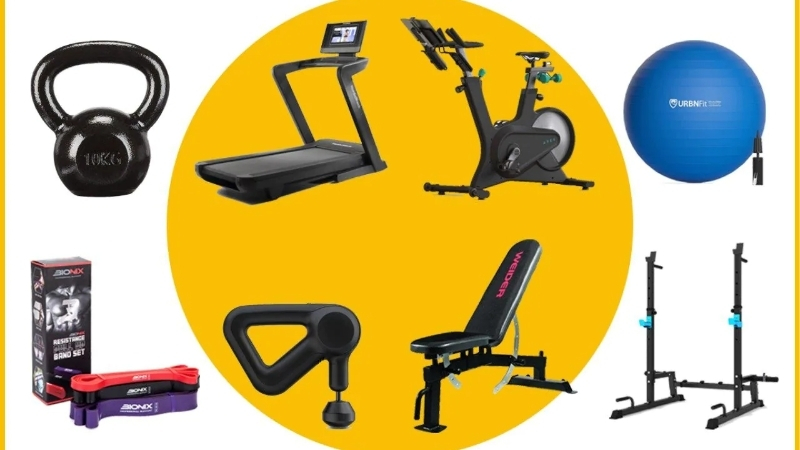
Cover the Six Patterns Before Adding Duplicates
The best home gym workout equipment has to load six patterns: horizontal push, horizontal pull, vertical push, vertical pull, hinge and squat, with conditioning sitting alongside them. Mark which ones your current kit already loads before buying anything, because duplication is the most common mistake in a home setup.
Adjustable dumbbells cover four patterns immediately and part of a fifth. The vertical pull is the gap almost everyone has, and it is the pattern that needs either a bar overhead or a suspension system anchored to something solid.
The World Health Organization advises adults to include at least two muscle-strengthening sessions each week alongside regular aerobic activity. Two sessions covering six patterns is a coverage problem before it is a motivation problem, which is exactly what equipment selection solves.
Load Ceiling Against Load Increment
Two numbers describe any piece of the best home gym workout equipment: the most it can add, and the smallest amount it can add. A kettlebell has a fixed load and no increment. Adjustable dumbbells have both. Bands have a ceiling that varies through the range rather than a fixed figure.
Beginners are limited by increment; experienced lifters are limited by ceiling. A 2.5 lb (1.1 kg) jump matters enormously on a first overhead press and not at all on a heavy row, which is why one set of kit rarely suits both ends of a household.
Body-weight tools such as pull-up bars and suspension trainers have a ceiling set by your own mass. Adding load means a weighted vest or a dip belt rather than a bigger tool, which is worth knowing before the tool arrives rather than afterwards.
Footprint in Use and in Storage
Every item has two footprints, and product listings publish only one. A folding bench claims about 4 sq ft in use and under 2 sq ft standing against a wall. A doorway pull-up bar claims no floor at all but blocks the doorway it is mounted in.
Conditioning tools are the extreme case. A jump rope stores in a pocket but needs roughly 8 x 8 ft (2.4 x 2.4 m) of clear floor and about 9 ft (274 cm) of ceiling to use properly without catching the rope on a light fitting or a doorframe.
Measure the actual dimensions of the space you intend to train in before ordering, ceiling height included, and check doorframe depth if anything mounts in a doorway. Assembled sizes are always published; usable clearance almost never is.
Anchor Points and What Holds the Load
Anything that pulls needs something to pull against. Doorway bars rely on leverage against the frame and a moulding above it, so hollow frames, sliding doors and architrave-free openings rule them out. Check the frame before buying the bar.
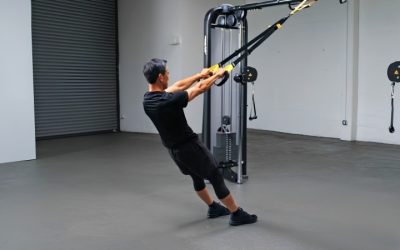
Suspension trainers can anchor over a door, but the door must open away from you and be solid rather than hollow. Ceiling and wall anchors need a joist or a masonry fixing rather than plasterboard, and that usually means drilling.
Load ratings on anchors describe static hanging weight, not dynamic force. A kipping pull-up or a hard band snap generates well above body weight momentarily, so treat published ratings as an absolute ceiling rather than as a target to train toward.
Top Picks: 6 Pieces of the Best Home Gym Workout Equipment
Each of the best home gym workout equipment picks below owns a movement pattern rather than duplicating one, and together they cover all six plus conditioning in a room that has another job. The table maps each item to the pattern it loads and to where it lives once the session is over.
| Item | Patterns covered | Load type | Stored | Needs |
|---|---|---|---|---|
| PowerBlock Elite EXP | Push, pull, hinge, squat | 5-50 lb (2.3-22.7 kg) per hand | Shelf or corner | Floor space only |
| ProsourceFit Chin-Up Bar | Vertical pull | Body weight | Stays in the doorway | Solid frame and moulding |
| Bowflex 5.1S Stowable Bench | Press angles, rows | Bench support | Folds upright | ~4 sq ft in use |
| Cast iron kettlebell | Hinge, carry, squat | Fixed weight | Corner or shelf | Mat underneath |
| Assisted pull-up bands | Assistance, accessory | Variable resistance | Small bag | Anchor point |
| Speed jump rope | Conditioning | Body weight | A pocket | 9 ft (274 cm) ceiling |
1. PowerBlock Elite EXP Adjustable Dumbbells
The most pattern coverage per square foot available. One pair handles pressing, rowing, hinging and single-leg squatting from 5 to 50 lb (2.3 to 22.7 kg) per hand, and the block format stores in roughly 12 in (30 cm) of shelf depth rather than 17 in.
The square cage around the handle restricts wrist position on a few movements and takes getting used to, and the pin-and-adder change is a step slower than a dial. Like all selectorised sets, it cannot be dropped or rested on its ends.
2. ProsourceFit Multi-Grip Chin-Up Bar
The cheapest fix for the pattern almost every home setup is missing. Multiple grip positions cover pull-ups, chin-ups and neutral grip, it mounts and removes in seconds, and it claims no floor space in a room that is already crowded.
It depends entirely on the doorframe, so hollow frames, missing mouldings and wide openings rule it out, and it can mark paintwork over time. Kipping or explosive work generates forces well beyond the rating and should be avoided on a leverage-mounted bar.
3. Bowflex 5.1S Stowable Bench
A bench roughly doubles what dumbbells can do, unlocking incline and decline pressing plus supported rows. This one folds upright and rolls away, which keeps a shared room usable and removes the main excuse for leaving equipment out permanently.
The pad is firm and narrower than a commercial bench, which some find uncomfortable on longer pressing sets, and the folding frame flexes slightly more than a fixed one under heavy dumbbells. Both are fair trades for reclaiming the floor afterwards.
4. A Cast Iron Kettlebell
Fixed weight, no mechanism, nothing to break. A single bell in the right weight covers swings, goblet squats, carries and presses, and the hinge pattern in particular is far more natural with a bell than with a dumbbell held at the hip.
Fixed weight is also the limitation: progressing means buying another bell rather than turning a dial, and each one occupies its own corner. Set it down rather than dropping it, and keep matting underneath if the floor is tile or laminate.
5. Assisted Pull-Up Band Set
The bridge between not being able to do a pull-up and doing several. Looped bands take a portion of body weight at the bottom of the movement where it is hardest, and the same bands also cover pull-aparts, hip work and warm-up sets before pressing.
Resistance is variable, so assistance fades exactly as you approach the bar, and latex degrades with sunlight, heat and time whether used or not. Inspect for surface cracking regularly and replace rather than waiting for a failure under tension.
6. A Speed Jump Rope
The most conditioning per pound of equipment anywhere. It stores in a pocket, costs less than a single plate, and loads the calves and shoulders while raising heart rate faster than most machines that occupy twenty times as much floor.
It needs roughly 9 ft (274 cm) of ceiling and a forgiving surface, and the repeated impact transmits straight through joists to any flat below. Cable ropes also mark walls and skirting boards for a while, until your technique settles down.
Frequently Asked Questions
Choosing the best home gym workout equipment raises the same questions about coverage, anchoring and sequencing every time. Each answer below is given against published load ratings and real measurements rather than general encouragement.
What Should I Buy First?
Adjustable dumbbells, then a bench. That pair covers four and a half of the six patterns in under 6 sq ft and works whether or not anything else follows. A pull-up bar is the logical third purchase because it fills the gap dumbbells leave.
Are Doorway Pull-Up Bars Safe?
On a solid frame with an intact moulding above the opening, leverage-mounted bars are rated for controlled body-weight work. Hollow frames, sliding doors and wide openings are not suitable, and explosive or kipping movements exceed what leverage mounting was designed for.
Do I Need a Doctor’s Clearance?
If you have an injury, a joint condition or any medical concern, speak to a doctor or a certified trainer before starting a new programme. Equipment guidance describes what a product does mechanically, not what any particular person should be doing with it.
Can Bands Replace Dumbbells?
Not for progressive loading. Band resistance is lightest at the start of the range, where many lifts are hardest, and it cannot be measured reliably session to session. They are excellent for assistance, accessory volume and warm-ups alongside a loadable tool.
See More:
- Best changeable dumbbells
- Best rated yoga mat
- Best mat yoga
- Best home gym equipmen
- Best fitness equipment for home gym
Final Thoughts
The best home gym workout equipment is whatever fills the movement patterns you cannot currently load, at increments small enough to progress. Check anchor points and doorframes before ordering, measure ceiling height for conditioning work, and add one pattern at a time.

Write Your Review
No reviews yet. Be the first to share your experience!