
Key takeaways
What's inside
Best equipment for at home gym budgets is less about which brand than about which order. Buying the same five items in the wrong sequence leaves gaps for months and produces a room full of kit that covers three movements. This guide stages the spend instead, working from the cheapest useful purchase up to a full barbell setup.
As an Amazon Associate we earn from qualifying purchases at no extra cost to you. Product prices and availability are accurate as of the date shown and are subject to change.

#1 Pick

#2 Pick

#3 Pick

#4 Pick
#5 Pick

#6 Pick

#7 Pick

As an Amazon Associate we earn from qualifying purchases at no extra cost to you. Product prices and availability are accurate as of the date shown and are subject to change.
By Chris Parker
🛒 Best Price Today on Amazon
Prime members get fast, free shipping on everything above, plus member-only deals. New members get a 30-day free trial — cancel anytime.
How to Sequence the Best Equipment for at Home Gym Budgets
Buying the best equipment for at home gym use in stages beats a single large order almost every time, because each purchase teaches you what the next one should be. The four criteria below set the order, then identify the specific points at which spending less quietly costs you more later.
Set the Budget Before the Shopping List
Decide the total spend on the best equipment for at home gym building first, then divide it across stages rather than filling a basket and adding up. Working forward from a list nearly always produces a rack and a bar with nothing left over for plates, which is the most common home setup failure.
Allow roughly a fifth of the whole total for the unglamorous items: flooring, plate storage and a mat. These are the parts people leave out and then buy anyway three months later, usually after damaging something more expensive than the matting would have cost.
Leave the last stage undecided on purpose. After two or three months of training you will know whether the gap is heavy lower-body loading, a pulling station or conditioning, and that answer is far more reliable than any plan made on day one.
Cost Per Movement Pattern
Judge each piece of the best equipment for at home gym use by how many of the six movement patterns it adds, divided by its price. Adjustable dumbbells score highest by a wide margin, adding four patterns for one purchase. A dedicated leg machine scores worst, adding a fraction of one.
Bands together with a doorway bar are by some distance the cheapest way to close the vertical pull, which is the pattern most home setups are missing. Together they usually cost less than a single pair of fixed dumbbells and cover the gap adequately for a year.
Conditioning is the pattern most often left until last, and it is also the cheapest of the six to solve. A jump rope costs almost nothing and needs no storage at all, so there is rarely a good reason to defer it behind a second or third strength purchase in the queue.
Space Cost Alongside Money Cost
Every item has a price in pounds and a price in square feet, and the second one is permanent. A rack costing a moderate amount claims roughly 12 sq ft for as long as you own it, which in a spare bedroom is a substantial share of the room.
Rank candidates by patterns added per square foot occupied as well as per pound spent. Dumbbells, bands and a doorway bar score well on both. Cable machines and full cages score well on capability and poorly on space, which is a real cost.
Measure the actual dimensions of the room before committing to any stage, ceiling height included, and check doorway width for anything freight-delivered. A rack that cannot get up the stairs is an expensive lesson in working clearance.
Where Spending Less Actually Costs You
The mid price tier is where the useful options cluster: steel rather than plastic where it matters, 2.5 lb (1.1 kg) increments at the low end, and parts sold separately. Below that band the trade-offs are specific rather than vague.
Budget adjustable dumbbells generally move to 5 lb (2.3 kg) steps throughout and seal the housing so nothing can be replaced. Budget benches drop the load rating and the number of back positions. Budget bars use thinner sleeves that seize rather than spin.
The two places worth paying up for are flooring and anything carrying load above you. Everything else can start cheap and be upgraded later, because those items resell easily later, while a damaged floor and a failed anchor do not.
Top Picks: 5 Stages of the Best Equipment for at Home Gym Builds
The best equipment for at home gym budgets, ordered as a sequence rather than a ranking, so each stage is useful on its own if the next never happens. The table shows what each stage adds to your movement coverage and what it costs you in floor space.
| Stage | Item | Patterns added | Space cost | Tier |
|---|---|---|---|---|
| 1 | Stackable resistance bands | Pull, assistance, warm-up | A drawer | Budget |
| 2 | Bowflex SelectTech 552 | Push, pull, hinge, squat | Under 2 sq ft | Mid |
| 3 | FLYBIRD adjustable bench | Press angles, rows | ~4 sq ft, folds | Budget to mid |
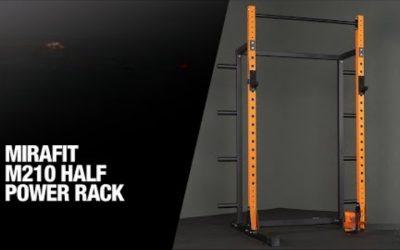
| 4 | Wall-mounted folding rack | Squat, vertical pull | Wall depth when folded | Mid |
| 5 | Olympic bar and plates | Heavy hinge and squat | Tree or wall pegs | Mid to premium |
Stage 1. Stackable Resistance Bands
The cheapest entry that still trains something. Clip-together tubes with a door anchor cover rows, presses, pull-aparts and pull-up assistance, weigh almost nothing, and store in a drawer, which makes them the lowest-risk first purchase available.
Resistance is variable and lightest where most lifts are hardest, so they cannot carry a strength programme alone. Latex degrades with sunlight and age whether used or not, so inspect for surface cracking and treat replacement as a running cost.
Stage 2. Bowflex SelectTech 552 Adjustable Dumbbells
The highest return of any single purchase here. One pair replaces fifteen fixed sets, adjusts from 5 to 52.5 lb (2.3 to 23.8 kg) per hand in 2.5 lb steps up to 25 lb, and adds four movement patterns while occupying under 2 sq ft of storage space.
Above 25 lb the increment widens to 5 lb, the housing is plastic and must not be knocked or dropped, and legs will outgrow the ceiling long before the upper body does. That last point is what eventually justifies stages four and five.
Stage 3. FLYBIRD Adjustable Bench
A bench roughly doubles what the dumbbells can do, unlocking incline and decline pressing plus supported rows and step-ups. It folds flat and stands upright against a wall, so the room quietly returns to its normal use between sessions.
The pad is firmer and narrower than a commercial bench, which some find uncomfortable on longer sets, and the folding frame flexes slightly more than a welded one under heavy dumbbells. Both are reasonable trades at this point in the budget.
Stage 4. A Wall-Mounted Folding Rack
The point at which squatting and pressing safely alone becomes possible without surrendering the room. Mounted into studs or masonry, it folds to a few inches of wall depth between sessions, which is the only way most spare bedrooms take a rack.
It needs a structurally sound wall and the manufacturer’s specified fixings rather than plasterboard anchors, and installation is a drilling job. Check the swing clearance for a 7 ft (213 cm) bar before choosing which wall it goes on.
Stage 5. Olympic Bar and Plate Set
A 7 ft (213 cm), 45 lb (20 kg) bar is the only practical way to load a squat or deadlift past dumbbell range. Buy plates in the same order, because a rack and bar without enough weight covers nothing the bench did not already cover.
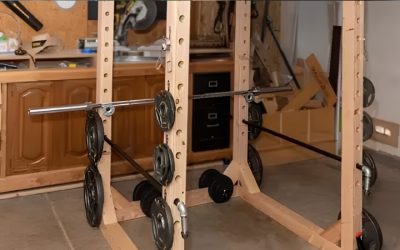
Plates are the real cost and the real storage problem, needing a tree or wall pegs rather than a corner. Add a fractional plate set at the same time; it costs very little and keeps a linear progression running for months longer than 2.5 lb plates alone.
Frequently Asked Questions
Questions about the best equipment for at home gym budgets almost always concern minimum spend, sequencing and where economising is safe. Each answer below is given against the movement patterns covered and the floor space claimed.
What Is a Realistic Minimum Spend?
Bands and a doorway bar cover pulling and assistance for very little. Adding adjustable dumbbells and a folding bench takes you to a complete strength setup covering five of six patterns in under 6 sq ft, which is where most home gyms should start and many should stop.
Should I Buy Everything at Once?
Staging is better in almost every case. Each purchase reveals what the next gap actually is, the cost spreads across months, and nothing becomes an expensive clothes rail because it turned out to duplicate something you already had.
Where Should I Not Economise?
Flooring and anything that carries load above you. Matting protects a floor that costs far more to replace, and racks, anchors and pull-up bars are the components where failure has consequences. Everything else can start cheap and be upgraded later.
Is Buying Second-Hand Sensible?
For bars, plates, kettlebells, racks and benches, usually yes, since these have few failure modes and inspect easily. Be more careful with selectorised dumbbells, cable machines and anything app-dependent, where parts or software support may already have ended.
See More:
- Best changeable dumbbells
- Best rated yoga mat
- Best mat yoga
- Best home gym equipmen
- Best fitness equipment for home gym
Final Thoughts
The best equipment for at home gym building is bought in stages, judged on patterns added per pound and per square foot. Set the total budget first, reserve a share for flooring and storage, and leave the final stage undecided until your training tells you what it needs.

Write Your Review
No reviews yet. Be the first to share your experience!