
Key takeaways
What's inside
Best rated recumbent exercise bike lists tend to reward three things buyers notice within a week: seat comfort, quiet resistance and an assembly that does not ruin a Saturday. This guide compares six models on resistance levels, seat adjustment range, user capacity in lb and kg, console features and the footprint each frame needs against a wall.
As an Amazon Associate we earn from qualifying purchases at no extra cost to you. Product prices and availability are accurate as of the date shown and are subject to change.

#1 Pick

#2 Pick

#3 Pick

#4 Pick

#5 Pick

#7 Pick

#8 Pick
As an Amazon Associate we earn from qualifying purchases at no extra cost to you. Product prices and availability are accurate as of the date shown and are subject to change.
By Chris Parker
🛒 Best Price Today on Amazon
Prime members get fast, free shipping on everything above, plus member-only deals. New members get a 30-day free trial — cancel anytime.
What Makes a Best Rated Recumbent Exercise Bike
Ratings on recumbents cluster around a few repeated complaints and compliments rather than performance numbers. Seat design, resistance smoothness and assembly effort account for most of the gap between a best rated recumbent exercise bike that gets used daily and one that quietly becomes a clothes rail.
Resistance Levels and Console Features
Magnetic resistance is standard on recumbents, so the real difference between models is how many usable levels you actually get. Entry bikes offer eight steps, mid-range models offer between 20 and 25, and that extra granularity is what separates a best rated recumbent exercise bike from a basic one once intervals matter.
Consoles range from a simple LCD showing time, distance and estimated calories to full touchscreens tied to a paid subscription. Estimated calorie figures on any of them are rough approximations, so treat them as a consistency measure across your own sessions rather than as an accurate energy count.
Seat Design, Adjustment Range and Access
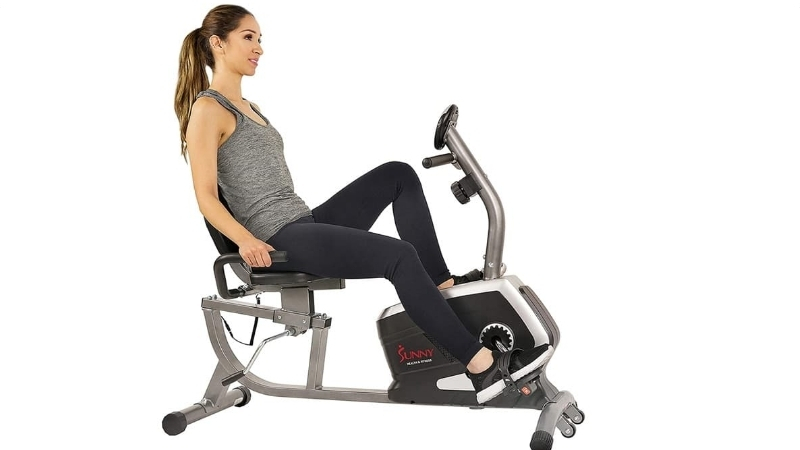
The seat is what recumbent buyers rate hardest in reviews, and it is the single part that decides whether long rides actually happen. Look for a ventilated backrest, a wide base and a rail that slides rather than a fixed pin position, since a rail lets riders of different heights share the same bike without tools.
Step-through height matters just as much for daily use as the padding does. A low frame with a clear path between the seat and the pedals makes getting on and off simple, session after session. If joint pain or a mobility issue is the reason you are considering a recumbent, talk to a doctor or a certified physical therapist before starting.
Footprint, User Capacity and Where the Bike Lives
Recumbent frames are long, typically 55 to 68 in by 22 to 27 in (140 to 173 cm by 56 to 69 cm), because the seat sits behind the pedals rather than directly above them. That means planning for a wall run rather than a corner, plus about 12 in (30 cm) of clearance on the access side.
User capacity runs from 300 lb (136 kg) on most models to 350 lb (159 kg) on the heavier frames, and it is an engineering limit rather than a target to approach. Measure the wall space, the ceiling and every doorway before ordering, since assembled recumbents very rarely pass back through a narrow hallway.
Top Picks: Best Rated Recumbent Exercise Bike Models
Six bikes covering budget through connected, chosen so a best rated recumbent exercise bike for a small flat is not confused with one for a dedicated room. Specifications are manufacturer figures, and cost is described as a tier rather than a number, since discounting here is unpredictable.
| Bike | Resistance levels | User capacity | Console |
|---|---|---|---|
| Schwinn 270 | 25 | 300 lb (136 kg) | Dual LCD, Bluetooth |
| Schwinn 230 | 20 | 300 lb (136 kg) | LCD, 22 programs |
| NordicTrack Commercial R35 | 26 | 350 lb (159 kg) | Touchscreen, iFIT |
| Marcy ME-709 | 8 | 300 lb (136 kg) | Basic LCD |
| Sunny Health SF-RB4880 | 8 | 300 lb (136 kg) | Basic LCD |
| Exerpeutic 400XL | 8 | 300 lb (136 kg) | Basic LCD, folding |
Schwinn 270: Best Overall Balance
25 magnetic resistance levels, 29 built-in programs and a 300 lb (136 kg) user capacity, with a ventilated seat back and a sliding rail that adjusts without any tools. The level count is fine enough for structured intervals, and Bluetooth connectivity feeds session data into third-party apps with no mandatory subscription.
Assembly is the recurring complaint in owner reviews: expect well over an hour of work and a second pair of hands for the heavier sections. The console design also looks dated beside touchscreen bikes, and the media shelf blocks part of the display whenever a tablet is mounted on it during a ride.
Schwinn 230: Best Value in the Same Family
20 resistance levels and 22 built-in programs on the same 300 lb (136 kg) frame rating, aimed at riders who want a comfortable seat and reliable magnetic resistance without paying for the higher specification. For three or four steady sessions a week, the practical difference is barely noticeable.
Five fewer resistance levels means slightly coarser jumps during interval work, and the console reports less data than its higher-specification sibling. Assembly takes a similar length of time either way, so the saving here is purely in specification rather than in any reduction of the setup work involved.
NordicTrack Commercial R35: Best Connected Option
26 digital resistance levels and a 350 lb (159 kg) user capacity, the highest figure here, paired with a large touchscreen and an adjustable console position. For riders who want guided sessions rather than self-directed ones, the trainer-led content is the entire reason this model exists.
Most of that content sits behind an iFIT membership, so check carefully what remains usable if you stop paying before treating the screen as a benefit. It is also the largest and heaviest bike in this comparison, which makes its placement effectively permanent once assembly is complete.
Marcy ME-709: Best Simple Budget Bike
Eight magnetic resistance levels, a step-through frame and a 300 lb (136 kg) user capacity, with a straightforward LCD showing time, speed, distance and estimated calories. For steady seated riding with no apps, accounts or subscriptions involved, it does the job at the lowest complexity of anything in this group, and it assembles faster than the larger frames too.
Eight levels are coarse, so precise interval work is not realistic and the top resistance setting will feel light to stronger riders. The seat padding is also basic compared with mid-range bikes, which becomes noticeable somewhere past the thirty-minute mark on longer steady rides.
Sunny Health SF-RB4880: Best Entry Magnetic Recumbent
Eight levels of magnetic tension on a 300 lb (136 kg) frame with an adjustable seat rail, built for quiet operation in a shared room. Magnetic resistance means nothing wears out over time, and evening sessions stay quiet enough not to carry through a wall into the next room.
The console is minimal, there is no app connectivity at all, and the resistance ceiling suits moderate rather than genuinely hard efforts. Seat adjustment covers average heights well but gets tighter at the extremes, so check the stated inseam range if you are notably tall or short before ordering.
Exerpeutic 400XL: Best Folding Frame
Eight magnetic tension levels and a 300 lb (136 kg) user capacity on a folding frame, which cuts the stored footprint substantially compared with any fixed recumbent here. In a living room that has to return to being a living room each evening, that is usually the deciding feature.
Folding frames flex more than fixed ones under harder pedalling, and the pedal-to-seat geometry is more compromised than it is on a full-size bike. Eight coarse levels also limit interval work, so treat this one as a steady-state machine for moderate sessions rather than hard training.
Frequently Asked Questions
These four questions cover most of what buyers ask before choosing between a budget frame and a mid-range one, and the answers usually settle which best rated recumbent exercise bike belongs in a particular household long before any brand comparison starts.
Are recumbent bikes effective for cardio?
Yes, within their range. The seated position supports the back and removes upper-body stabilisation, so the same effort feels easier and you compensate with more resistance or a longer ride. The World Health Organization’s 2020 guidance of 150 to 300 minutes weekly applies here as it does to any other moderate activity.
How many resistance levels do I need?
Eight levels are workable for steady rides, 20 to 25 make intervals genuinely repeatable week to week, and beyond that point the returns diminish quickly. Most home riders never reach the top of the range on a magnetic recumbent anyway, so level granularity matters far more than the headline maximum resistance figure.
How much space does a recumbent need?
Allow roughly 55 to 68 in by 22 to 27 in (140 to 173 cm by 56 to 69 cm) of floor, plus about 12 in (30 cm) of clearance on the side you step in from. Measure the wall run and the doorway before ordering, since an assembled bike rarely fits back through a narrow hall.
Do I need a subscription?
Only for touchscreen-based models where the guided content is the main feature you are paying for. Bikes with an LCD console run their built-in programs entirely offline, and Bluetooth models feed session data straight into third-party training apps. Check what still works unsubscribed before paying extra for a screen you may rarely use.
See More:
- Hot yoga mat best
- Best dumbbells exercises
- Best workout dumbbells
- Best back exercises using dumbbells
- Best exercise upright bike
- Best exercise stationary bike
Final Thoughts
A best rated recumbent exercise bike earns those ratings on seat comfort, quiet magnetic resistance and manageable assembly rather than on peak specifications. Decide how many resistance levels your training needs, confirm the user capacity, and measure the wall run and doorway before ordering anything this long.


Write Your Review
No reviews yet. Be the first to share your experience!