
Key takeaways
What's inside
Best non skid yoga mat searches are usually about the wrong surface. If the whole mat creeps forward in downward dog on polished floorboards, the problem is the underside and the weight, not the texture your hands are touching, and those two problems are governed by completely different specifications that listings rarely bother to separate.
As an Amazon Associate we earn from qualifying purchases at no extra cost to you. Product prices and availability are accurate as of the date shown and are subject to change.


As an Amazon Associate we earn from qualifying purchases at no extra cost to you. Product prices and availability are accurate as of the date shown and are subject to change.
By Chris Parker
🛒 Best Price Today on Amazon
Prime members get fast, free shipping on everything above, plus member-only deals. New members get a 30-day free trial — cancel anytime.
How to Choose the Best Non Skid Yoga Mat
The best non skid yoga mat is defined at the interface between mat and floor, which almost no product listing describes in any detail. Three things control it: what the underside is made from, how much the mat weighs, and what you are putting it on. Everything else is secondary.
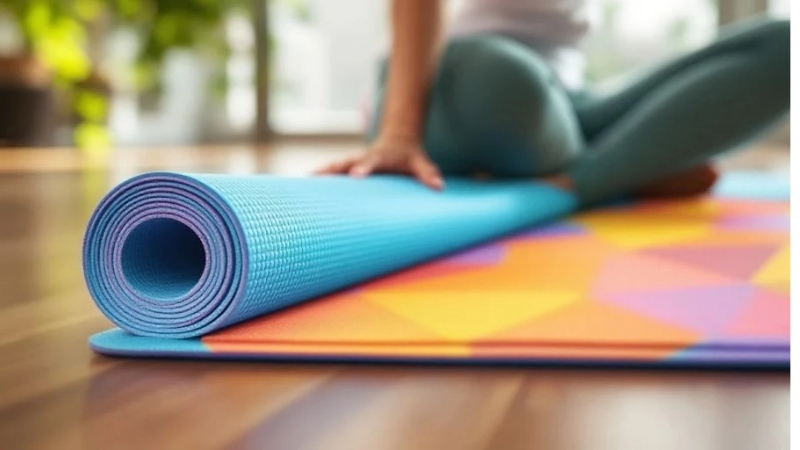
The Slip You Are Solving Is Mat to Floor
There are two independent friction problems in yoga, and mats are usually marketed as if there were one. Hand-to-mat slip is about surface texture and moisture handling. Mat-to-floor slip is about the base material and the downward force holding it there, and a mat can be excellent at one and hopeless at the other.
Diagnose it before you buy. If your hands slide but the mat stays where you put it, you need a grippier top surface. If the mat itself creeps forward during downward dog or shifts in a lunge, you need a heavier mat with a rubber underside, and a new top texture will change nothing at all.
Base Material, Weight and Contact Footprint
The best non skid yoga mat almost always uses natural rubber, which has the highest static friction against hardwood, tile and laminate of any common material, which is why it dominates this category. TPE with a moulded wave or dot pattern comes next, and plain foam is the worst, gliding across polished surfaces almost as if it were designed to.
Weight does the rest of the work. Mats around 5-7.5 lb (2.3-3.4 kg) stay planted through transitions, while travel mats at 2-3 lb (0.9-1.4 kg) move under any lateral force. Footprint interacts too: a 26 in (66 cm) wide mat has more contact area than a 24 in (61 cm) one at equal weight.
Unrolled, plan for 71-74 in by 24-27 in (180-188 x 61-68 cm) of clear floor, roughly 12-13 sq ft (1.1-1.2 sq m). Heavier mats also roll thicker, at 5-6 in (13-15 cm) across. Measure the actual clear floor area and the storage spot before ordering, because these mats are awkward to return.
Why Home Floors Are the Underserved Case
Almost every best non skid yoga mat on sale is designed around a studio floor: sprung timber, swept clean, with nothing underneath. That is a well-behaved surface, and rubber grips it beautifully. It is also not what most people actually have at home, where the choice is tile, laminate, vinyl or a rug.
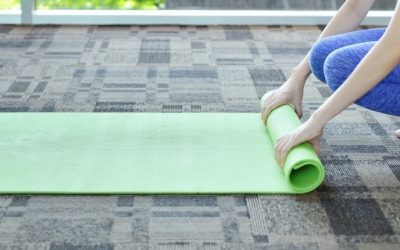
The gap shows up most on carpet, where the problem inverts entirely. Nothing skids on carpet; instead the mat bunches and ripples as the pile shifts underneath it, and the heavier and grippier the mat the worse that becomes. Very few manufacturers acknowledge this, and almost none design for it.
The practical workaround is a thin non-slip rug underlay beneath the mat, which costs very little and solves both the carpet ripple and the vinyl creep. It is an unglamorous answer, but it is more effective than paying a premium for a mat that was optimised for a floor you do not own.
Top Picks: 6 Mats That Hold Their Position
These six are ranked by how well they resist moving across the floor rather than by how they feel under your hands. The best non skid yoga mat here depends heavily on your flooring, so the table lists base material and weight, which are the two figures that actually predict it.
| Mat | Underside | Weight | Best Floor | On Carpet |
|---|---|---|---|---|
| Manduka PRO | Dot-textured PVC | Approx. 7.5 lb (3.4 kg) | Timber, tile, laminate | Bunches, use underlay |
| Jade Harmony | Natural rubber | Approx. 5 lb (2.3 kg) | Timber, tile | Grips too well, ripples |
| Manduka eKO | Natural rubber | Approx. 7 lb (3.2 kg) | Timber, tile, vinyl | Bunches, use underlay |
| Lululemon The Mat 5mm | Natural rubber | Approx. 5.24 lb (2.4 kg) | Timber, laminate | Ripples in transitions |
| Heathyoga Eco Friendly | Textured TPE | Mid weight | Timber, low-pile carpet | Acceptable |
| Toplus Yoga Mat | Smooth-ish TPE | Light | Carpet, rugs | Fine |
Manduka PRO
At roughly 7.5 lb (3.4 kg) this is simply the heaviest mainstream mat, and mass solves the skid problem more reliably than any surface treatment. The dot-textured underside adds mechanical bite on timber and tile, and once it is laid out it does not move through transitions or lateral loading.
The weight that fixes the skid makes it a poor travel mat, and the closed-cell top is slippery until broken in over several weeks. It is also expensive. On carpet the sheer weight works against you, because the pile compresses unevenly and the mat ripples rather than sliding.
Jade Harmony Yoga Mat
Open-cell natural rubber on both faces, which gives it the highest floor friction here relative to its weight. At around 5 lb (2.3 kg) and 4.8 mm it is not heavy, yet it stays put on floorboards and tile better than mats twice its mass, because rubber against a hard floor simply does not want to move.
Rubber is a latex product and unsuitable for anyone with that allergy. It carries a strong smell for the first weeks, degrades in direct sunlight, and dark rubber can leave marks on light vinyl or laminate over long periods, so lift it rather than leaving it down permanently.
Manduka eKO
Natural rubber throughout at 5 mm, combining the floor grip of rubber with a weight closer to 7 lb (3.2 kg). That combination is the most reliable answer here for smooth vinyl and polished laminate, the two surfaces that defeat most mats, and the top surface grips dry hands well from the first session.
It is heavy to carry and, being rubber, shares the latex, smell and sunlight caveats. The closed-cell top layer means wet grip is only fair despite the rubber base, so heavy sweaters will still want a towel. Expect a break-in period of a week or two before the surface reaches its best.
Lululemon The Mat 5mm
The natural rubber base is the relevant part for this article, and it holds position well on timber and laminate at around 5.24 lb (2.4 kg). The 26 in (66 cm) width also puts more contact area on the floor than a standard mat, which helps during wide stances and lateral transitions.
The polyurethane top is what you are really paying for, so if floor skid is the only issue you are solving, this is more mat than you need. It marks easily, requires specific cleaning, and the same latex and sunlight caveats apply to the rubber underneath as to any rubber mat.
Heathyoga Eco Friendly Non Slip Yoga Mat
The budget answer, and better at this job than its price suggests. The underside carries a moulded wave pattern that bites into timber and low-pile carpet, and the 72 x 26 in (183 x 66 cm) footprint spreads that contact over noticeably more area than a standard-width 24 in mat manages on the same floor.
TPE will never match rubber against polished tile or vinyl, so on those surfaces expect some creep during vigorous sequences. It is closed-cell, so wet grip up top is poor. The printed alignment lines fade with cleaning, and heat or direct sun degrades the surface faster than normal use does.
Toplus Yoga Mat
Included as the honest counter-example. Light TPE at 6 mm is comfortable, cheap and easy to carry, and on carpet or a rug it works perfectly well because the pile does the gripping for you. For a spare room with a rug already in it, this is a sensible and genuinely inexpensive choice. There is no reason to spend more.
On polished floorboards, tile or vinyl it is exactly the mat that will creep forward in downward dog, because it is both light and closed-cell underneath. If your floor is hard and smooth, this is the category of mat to avoid rather than the one to buy, whatever the reviews say.
Frequently Asked Questions
Questions about the best non skid yoga mat almost always turn out to be questions about flooring. These four cover the surfaces that cause the most trouble, the role weight plays, and the cheap fix that works better than upgrading the mat itself in most home settings, whatever the reviews happen to suggest.
Why does my mat slide on hardwood?
Because the underside is a sealed foam or TPE and the mat is light. Polished timber and laminate have very low surface roughness, so friction depends almost entirely on the material in contact with them. Natural rubber solves it outright; adding weight helps; changing the top texture does nothing at all.
Does a heavier mat stay put better?
Yes, up to a point. Friction rises with the force pressing the surfaces together, so a 7 lb (3.2 kg) mat resists sliding better than a 3 lb (1.4 kg) one made of the same material. Material still matters more: 5 lb (2.3 kg) of natural rubber outperforms 7 lb (3.2 kg) of foam on polished tile every single time.
What can I put under a mat on carpet?
A thin non-slip rug underlay, cut to the mat size. On carpet the failure mode is bunching rather than sliding, because the pile moves under load, and an underlay gives the mat a stable layer to sit on. It costs a fraction of a premium mat and solves the problem more completely.
Do rubber mats damage floor finishes?
They can, over long periods. Dark natural rubber left in contact with light vinyl, laminate or some sealed timbers may leave a shadow or discolouration after months of continuous contact. Roll the mat up between sessions rather than leaving it permanently in place, and check an inconspicuous corner first.
See More:
- Best home pull-up bar
- Best at home pull up bar
- Best in house pull up bar
- Best rated ab roller
- Best yoga travel mat
Final Thoughts
The best non skid yoga mat is decided by your floor, not your practice. On timber, tile or vinyl, a rubber underside plus at least 5 lb (2.3 kg) stops the creep. On carpet the problem reverses, and a lighter mat over a thin non-slip rug underlay works better than anything heavy. Diagnose the slipping surface first.
Write Your Review
No reviews yet. Be the first to share your experience!