
Key takeaways
What's inside
Best ab workouts on pull up bar are built as circuits rather than as single sets, because grip fails long before the abdominals do. Chaining hanging work with floor work solves that, and it turns a two-minute exercise into a genuine twenty-minute session.
As an Amazon Associate we earn from qualifying purchases at no extra cost to you. Product prices and availability are accurate as of the date shown and are subject to change.
As an Amazon Associate we earn from qualifying purchases at no extra cost to you. Product prices and availability are accurate as of the date shown and are subject to change.


By Chris Parker
🛒 Best Price Today on Amazon
Prime members get fast, free shipping on everything above, plus member-only deals. New members get a 30-day free trial — cancel anytime.
Start 30-Day Prime Free Trial →See Today’s Amazon DealsHow to Structure the Best Ab Workouts on Pull Up Bar
The best ab workouts on pull up bar all solve one structural problem: your hands quit first. Every workout format below is designed around that, alternating hanging movements with floor movements so the grip recovers while the abdominals keep working.
Grip Is the Limiting Factor, Not the Abdominals
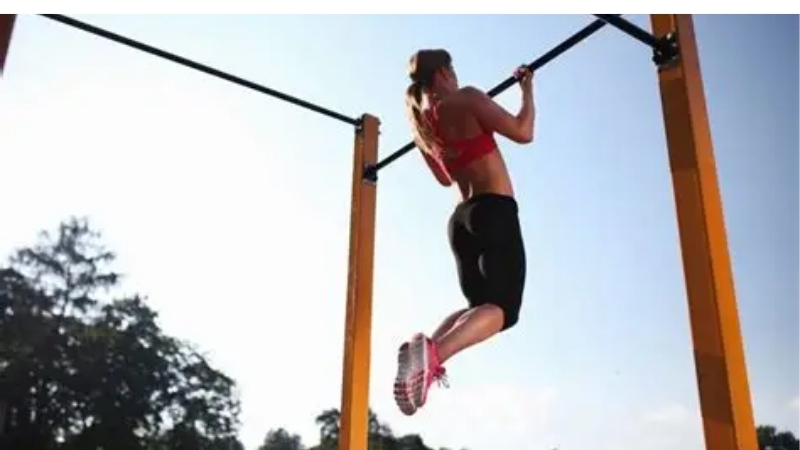
Most people can hang for 30-60 seconds before grip becomes the issue, which is rarely enough to fatigue the core. That single fact determines the structure of every effective session: short hanging sets, frequent alternation, and something to reduce grip demand.
Ab straps remove the grip element entirely by supporting the forearms, which lets a set run to actual core failure. Chalk and grip tape extend a bare-handed hang by a useful margin without changing the exercise itself.
Ceiling Height, Footprint and Swing Clearance
Hanging leg raises need more room than the bar suggests. Allow roughly 8 ft (2.4 m) of ceiling for a doorway bar, plus around 3 ft (0.9 m) of clear space in front and behind, because controlled movements still generate a small swing.
Knees-to-elbows and toes-to-bar need more overhead space again, and a free-standing tower needs a footprint around 4 x 4 ft (1.2 x 1.2 m) at the base. Measure the height with your arm extended above your head rather than to the top of your head.
Circuit Formats That Work
Every-minute-on-the-minute is the most reliable structure. Perform a short hanging set at the top of each minute, rest for the remainder, and repeat for ten to fifteen rounds. Total volume accumulates while no individual set outlasts the grip.
Alternating pairs are the other proven format: one hanging movement followed immediately by a floor movement, three or four rounds. The floor exercise gives the hands a break while keeping the abdominals under tension throughout.
Anti-Swing and Movement Quality
Swinging is the most common fault in hanging core work, and it converts an abdominal exercise into a momentum drill. A deliberate pause at the bottom of each rep eliminates it, at the cost of dropping your rep count sharply.
Bracing before the first rep also matters. Pulling the shoulder blades down and slightly forward before lifting the legs engages the whole trunk rather than letting the hip flexors do the work in isolation.
Pairing Hanging Work With Floor Work
The floor half of the circuit matters as much as the hanging half. Hollow-body holds, dead bugs and reverse crunches keep the abdominals loaded while the hands recover, which is what allows a session to reach a useful total volume.
Pair by direction rather than at random. A hanging knee raise flexes the trunk, so following it with a hollow-body hold, which resists extension, covers both functions inside the best ab workouts on pull up bar without adding equipment.
Market Context for Bars and Accessories
Most equipment in this category still assumes a garage or a wall you may drill into, so genuinely renter-friendly options remain the thinnest part of the shelf. That is why leverage-mounted doorway bars continue to dominate despite their limitations.
Below the mid tier the compromises are consistent: thinner tube walls that flex under heavier users, foam grips that compress flat within months, and welded joints rather than bolted ones. The joint where the bar meets the frame is the point worth inspecting.
The useful development is the free-standing tower, which now sits at mid-tier prices rather than commercial ones. It removes the doorway limitation entirely at the cost of a permanent floor footprint, which suits a spare room rather than a living room.
Gear for the Best Ab Workouts on Pull Up Bar
These seven cover the three bar types, the grip solutions and the timing equipment that makes circuit work measurable. Each entry gives the honest limitation.
| Product | Type | Spec | Solves | Note |
|---|---|---|---|---|
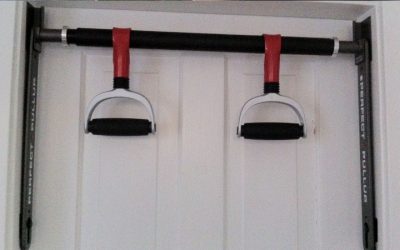
| ProsourceFit Multi-Grip Bar | Doorway bar | 24-36 in frames | No-drill mounting | Marks trim |
| Yes4All Wall Mounted Bar | Wall bar | Lag bolts to studs | Solid high anchor | Permanent |
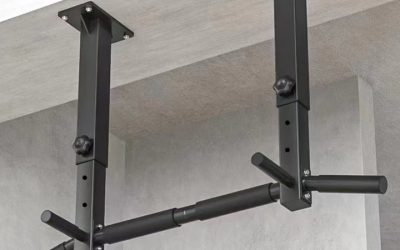
| Sportsroyals Power Tower | Free-standing | About 4 x 4 ft base | No doorway needed | Large footprint |
| Hanging Ab Straps | Accessory | Padded forearm loops | Grip failure | Removes grip training |
| Lizard Skins DSP Grip Tape | Grip | 0.5 to 1.8 mm | Slippery bars | Changes diameter |
| Liquid Chalk | Grip | Small bottle | Sweaty hands | Dries skin |
| GymNext Flex Timer | Interval timer | App controlled | Circuit timing | Needs power |
ProsourceFit Multi-Grip Chin-Up Bar
A leverage-mounted doorway bar rated around 300 lb (136 kg) is the cheapest entry to the best ab workouts on pull up bar. Multiple grip positions matter for core work because a neutral grip is more comfortable to hold through longer hanging sets.
It needs a frame of roughly 24-36 in (61-91 cm) with sound trim, and leverage mounting can dent painted woodwork. It also sits low in a standard doorway, which limits leg-raise range for taller users.
Yes4All Wall Mounted Pull-Up Bar
A wall bar bolted into studs gives clearance a doorway cannot: mount it high enough and full toes-to-bar becomes possible. It also projects far enough from the wall that your body has room to move without contact.
Installation is permanent and requires accurate stud location plus lag bolts, which rules it out for many rented homes. Mounting height is also fixed once drilled, so measuring with an extended arm beforehand is essential.
Sportsroyals Power Tower
A free-standing tower removes the doorway problem entirely and adds dip and knee-raise stations, which broadens the circuit options considerably. For a spare room it is the most versatile single purchase in this category.
The footprint is around 4 x 4 ft (1.2 x 1.2 m) and it is not something you move between sessions. Lighter frames also rock slightly during dynamic movements, which is worth checking against your body weight before ordering.
Hanging Ab Straps
Padded forearm straps take the grip out of the equation, which is the single most effective change you can make to hanging core work. Sets can then run to genuine abdominal failure rather than stopping when the hands give out.
They eliminate grip training entirely, which some people value and others consider a loss. The padding also compresses over time, and cheaper straps develop pressure points at the elbow within a few months of regular use.
Lizard Skins DSP Grip Tape
Polymer grip tape in thicknesses from 0.5 mm to 1.8 mm transforms a slick painted bar into one that holds without chalk. For circuit work it is the cleanest solution because nothing needs reapplying between rounds.
Adding tape increases bar diameter by twice the tape thickness, so 1.8 mm tape adds roughly 3.6 mm overall. On an already thick bar that can make the grip harder rather than easier for smaller hands.
Liquid Chalk
Chalk extends a bare-handed hang by a useful margin, and the liquid form leaves no dust on carpet or furniture, which is what makes it usable indoors rather than only in a garage.
It dries the skin with frequent use and needs a minute to dry before the first round. It also has to be reapplied during longer sessions, which interrupts the rhythm of a timed circuit.
GymNext Flex Interval Timer
Every-minute-on-the-minute work only functions if the intervals are exact, and a phone on the floor is not visible while hanging. A wall-mounted display with audible intervals lets the circuit run without breaking position.
It is single-purpose and needs a wall or shelf with power nearby. A free phone app does the same job less conveniently, so this is a comfort upgrade rather than a requirement.
Frequently Asked Questions
These questions come up as soon as someone tries to run a full core session on a bar rather than a single set of leg raises.
How long should a hanging core session last?
Fifteen to twenty-five minutes of circuit work is plenty. The best ab workouts on pull up bar accumulate volume through short repeated sets, and beyond about twenty-five minutes technique degrades faster than any further benefit accrues.
How often can I train this way?
Two to three sessions a week, with a rest day between. Grip and forearms accumulate fatigue faster than the abdominals do, and those are usually what force an unplanned break rather than core soreness.
Should I use ab straps every session?
Not every session. Straps let you reach genuine core failure, but training bare-handed periodically keeps grip strength developing. Alternating between the two across the week gets both benefits.
Why do I feel leg raises mostly in my hip flexors?
Usually because the pelvis is not tilting. Curling the pelvis toward the ribs at the top of the rep shifts the work to the abdominals, and reducing the range until you can do that reliably is more productive than adding reps.
See More:
- Ankle weights best
- Best rated ankle weights
- Best home workout equipment budget
- Best resistance bands for men
Final Thoughts
The best ab workouts on pull up bar are circuits designed around grip rather than around the abdominals, alternating hanging and floor movements so the hands recover mid-session. A bar, a pair of ab straps and a timer covers all of it. Measure your ceiling height with an arm extended before choosing which bar type fits.

Write Your Review
No reviews yet. Be the first to share your experience!