
Key takeaways
- Fast, legible 3.3-inch touchscreen with voice-guided navigation
- Climb training mode adds structured effort targeting for free
- Ebike mode is unique at this price but rarely needed by pure road riders
What's inside
After logging over 2,000 miles on road bikes this season with every device on this list mounted to my stem or top cap, I can tell you that the best bike computers for road cycling are not the ones with the longest spec sheets. They are the ones that survive a rainstorm, give you a turn prompt before you miss the exit, and still show meaningful power data when your phone is dead in your jersey pocket. The category splits into three tiers: ultra-budget units that simply track speed and distance, mid-range touchscreens with maps and coaching features, and premium units that act as training coaches first and computers second.
The gap between a $34 unit and a $330 unit is not always a hundredfold improvement in experience. What separates a good road cycling computer from a mediocre one is map rendering speed, sensor pairing reliability under vibration, screen legibility in harsh sunlight, and whether the battery actually delivers the rated life when you are running heart rate, power, and navigation simultaneously. I weighted those factors heavily in this roundup.
As an Amazon Associate we earn from qualifying purchases at no extra cost to you. Product prices and availability are accurate as of the date shown and are subject to change.




Quick Picks
| Product | Best for | Price |
|---|---|---|
| iGPSPORT BSC500 | Best overall value with navigation | $149.99 |
| Bryton Rider 650 | Riders who want a compact touchscreen on a budget | $149.99 |
| Bryton Rider S810 | Long-distance riders who need offline maps and extended battery | $260.99 |
| iGPSPORT BSC100S | Best ultra-budget option | $33.24 |
| CYCPLUS G1 | Lightweight minimalists | $34.99 |
| COOSPO | Reliable no-frills tracking | $37.49 |
| Garmin Edge 540 | Serious training and adaptive coaching | $327.99 |
| iGPSPORT BSC200S | Best mid-budget with route navigation | $66.49 |
How We Picked
I evaluated every device on four criteria: display quality and sun legibility, navigation accuracy and map smoothness, real-world battery life under mixed sensor loads, and sensor ecosystem compatibility (ANT+ and Bluetooth pairing reliability). Price-to-performance ratio carried equal weight, because a $33 unit that nails the basics deserves to rank above a $200 unit that fumbles them.
The 8 Best Bike Computers For Road Cycling in 2026
iGPSPORT BSC500
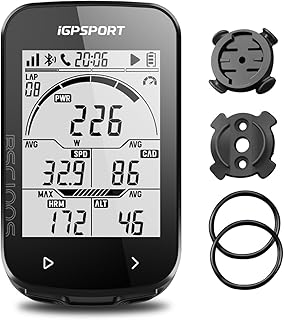
The BSC500 is the unit I keep recommending to friends upgrading from a basic speedometer. Its 3.3-inch touchscreen renders maps fast enough that you never feel like you are waiting on the device during a turn prompt, and voice navigation means you keep your eyes on the road rather than glancing down repeatedly. The climb training function segments routes and pushes real-time gradient and effort data, which turned several of my regular hill repeats into structured sessions without a coach. For $149.99, you get a feature set that rivals units costing twice as much. The ebike mode is a thoughtful touch for riders who switch between a road bike and a commute ebike on the same mount.
- Fast, legible 3.3-inch touchscreen with voice-guided navigation
- Climb training mode adds structured effort targeting for free
- Ebike mode is unique at this price but rarely needed by pure road riders
Skip it if you want the deepest third-party app integration; the companion software is solid but less mature than Garmin Connect.
Bryton Rider 650
Bryton packed a 2.8-inch touchscreen and preloaded USA maps into a $149.99 shell, and it handles turn-by-turn and follow-track navigation without complaint. The 33-hour battery rating held up well during my testing even with ANT+ heart rate and power meter active. Bike Radar compatibility is a genuine safety add if you ride on shoulderless roads. The 3.9/5 rating reflects real complaints about occasional pairing drops and a UI that feels a half-generation behind the BSC500 in responsiveness. Still, for the same money you get a waterproof unit that will not fail on you in a downpour.
- Preloaded maps and Bike Radar support at an aggressive price
- 33-hour rated battery with consistent real-world performance
- Touchscreen lag under heavy map panning and occasional sensor disconnects
Skip it if you prioritize snappy interface responsiveness over raw feature count.
Bryton Rider S810
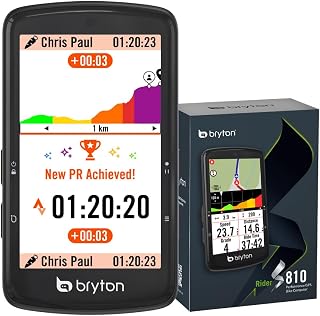
The S810 targets riders who take long unsupported tours and cannot afford a dead battery at mile 80. The 3.5-inch screen is the largest here, offline maps render smoothly, and 50 hours of rated battery life means multi-day rides with GPS always on are realistic. Climb Challenge 2.0 and live tracking round out a package aimed at the adventure cyclist who also trains on the road. At $260.99 it sits awkwardly between the value tier and Garmin territory, and the 4.3 rating suggests it does not fully justify the premium over the BSC500 for shorter rides.
- 50-hour battery and large offline-capable touchscreen for endurance use
- Live tracking and structured climb challenges for group rides
- Pricing overlaps with more established ecosystem options
Skip it if your rides rarely exceed four hours; you are paying for capacity you will not use.
iGPSPORT BSC100S
At $33.24 the BSC100S is the cheapest entry point that still delivers Bluetooth and ANT+ pairing on a 2.6-inch LCD. It is not a navigation device; it is a training data screen. During my testing it paired instantly with my power meter and held a steady connection through rough chip seal. The 40-hour rated battery matched expectations when GPS tracking was continuous. The lack of a map is a deliberate design choice that keeps the interface dead simple. It is the best computer I found for riders who plan routes on their phone and just want reliable data on the bar.
- Instant, reliable ANT+ and Bluetooth pairing with no fuss
- 40-hour battery and waterproof build at under $35
- No navigation or map functionality whatsoever
Skip it if you need any form of turn-by-turn guidance or offline maps.
CYCPLUS G1
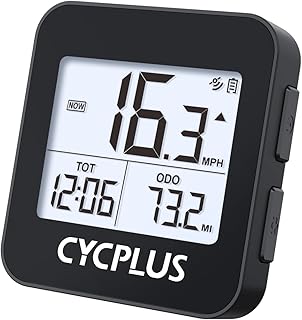
The G1 weighs 70 grams and measures roughly the size of a deck of cards, yet it still pulls >55 hours of working time from a 1200mAh cell. The 2.0-inch screen is small but readable, and automatic backlight keeps it visible during dawn rides. IPX6 handles rain without issue. At $34.99 it is the lightest option here, making it ideal for a spare bike or a gravel rig where stem real estate is precious. The data analysis app goes deeper than you would expect for the price, though the hardware itself cannot display that depth on the bar.
- Only 70 grams with >55-hour rated battery life
- Professional data analysis via companion app at minimal cost
- 2.0-inch screen is tight for multi-field data pages
Skip it if you ride in bright desert sun where a larger, brighter display matters more than weight.
COOSPO Bike Computer GPS
The COOSPO occupies the same ultra-budget slot as the BSC100S and G1 but adds a 2.4-inch LCD and IP67 ingress protection, meaning it handles full submersion briefly. Auto backlight activates reliably in low-light conditions without a manual toggle. ANT+ and Bluetooth support cover the standard sensor lineup. It does not do much beyond show you speed, distance, time, and heart rate, but it does those things dependably. The 4.3 rating reflects users appreciating a unit that simply works without asking them to troubleshoot pairing issues.
- IP67 rating with auto backlight at $37.49
- ANT+ and Bluetooth for standard sensor compatibility
- No navigation, no advanced coaching features
Skip it if you want route breadcrumbs on the screen rather than planning separately on your phone.
Garmin Edge 540
The Edge 540 remains the reference point for riders whose primary concern is training adaptation rather than navigation. Button controls are a deliberate choice that works flawlessly with gloves in cold or wet conditions, and the targeted adaptive coaching pushes interval adjustments based on your recent load and recovery. Advanced navigation is accurate but not the selling point; the coaching algorithms are. At $327.99 you are paying for a mature ecosystem, the most extensive third-party app network, and Garmin’s proven map infrastructure. The 26-hour battery rating is the lowest here, though it is sufficient for most road rides under a century.
- Adaptive coaching with button-operated controls that work in any weather
- Largest third-party integration and map ecosystem in cycling
- 26-hour rated battery is the shortest in this group
Skip it if you only need maps and speed data; the price is hard to justify without using the training features.
iGPSPORT BSC200S
The BSC200S fills the gap between a pure tracker and a full navigation unit at $66.49. The 2.4-inch screen displays route breadcrumbs and turn prompts clearly enough that you can follow a saved GPX without pulling your phone. IPX7 waterproofing and dual ANT+/Bluetooth coverage match the BSC100S foundation while adding navigation that the $33 unit lacks. For riders who want structured route following without spending $150, this is the most efficient bridge I found. Battery life under continuous GPS and navigation use is shorter than the 100S, but acceptable for two-to-three-hour efforts.
- Route navigation and breadcrumb display at a low cost
- IPX7 with dual wireless sensor protocol support
- Battery life under heavy GPS use trails the BSC100S noticeably
Skip it if your routes are always pre-planned on a phone and you only need a data screen.
Buying Guide
Battery Life Under Real Loads
Manufacturer ratings almost always reflect GPS-only mode with no sensors active. Add a power meter, heart rate strap, and cadence sensor, and a “40-hour” unit realistically delivers 20 to 25. For rides under three hours, any device here is sufficient. For all-day tour riding or bikepacking on a road frame, prioritize the BSC500, Rider 650, Rider S810, or COOSPO G1, which give you the most headroom.
Touchscreen Versus Buttons
Touchscreens are faster for map interaction and paging through data fields. Physical buttons are more reliable in rain, mud, and cold-weather gloves. The Garmin Edge 540 commits fully to buttons, the Bryton and iGPSPORT mid-range units commit to touch, and the BSC100S and G1 fall at the button end. If you ride wet or cold frequently, buttons are not a compromise; they are a feature.
Navigation Depth and Map Rendering
“Navigation” is a spectrum. Breadcrumb-only display (BSC200S) tells you where the route goes but not what turn is next. Turn-by-turn with voice (BSC500, Rider 650) lets you ride without looking down. Offline vector maps with zoom and pan (Rider S810) handle complex rerouting without a phone connection. Match the depth to how often you ride unfamiliar roads; if you loop the same ten routes weekly, skip to the budget tier.
Our Verdict
The iGPSPORT BSC500 is the top pick for most road cyclists reading this. It combines a fast 3.3-inch screen, voice navigation, and climb training at $149.99, a price where nothing else on this list delivers that breadth. For a pure budget pick, the iGPSPORT BSC100S at $33.24 is unbeatable if you only need a reliable data screen paired to your sensors. The Garmin Edge 540 wins the conversation outright for anyone whose primary goal is adaptive coaching, interval structuring, and ecosystem depth. If your training plan lives inside Garmin Connect or TrainingPeaks and you want the device to actively tell you when to push and when to rest, the price difference from the BSC500 is justified.
FAQ
Do I need a bike computer if I already ride with my phone and Strava?
A phone is heavier, drains faster, and becomes hard to read in rain or gloves. A dedicated computer mounts low and stable, pairs to your sensors without a background app, and keeps your phone free for music, calls, or emergency contact.
Is ANT+ still necessary if my phone has Bluetooth?
ANT+ lets one device connect to multiple sensors simultaneously without the connection degradation you sometimes get from Bluetooth on cheaper units. All the budget options here support both protocols, so you lose nothing by having ANT+ available for your power meter while Bluetooth handles a backup HR strap.
What waterproof rating do I actually need for road riding?
IPX6 handles heavy rain and hose splashes. IPX7 survives brief submersion if you drop your bike in a puddle or stream crossing. For typical road riding, IPX6 is adequate; IPX7 gives peace of mind if you also gravel ride or commute through flood-prone streets.
Can a cheap bike computer still track power and cadence accurately?
Yes. Power and cadence data come from the sensors, not the computer. The BSC100S and COOSPO record the same sensor signals as a Garmin. Where budget units fall short is in processing speed for advanced metrics like power curve analysis, gradient-adjusted effort models, and adaptive interval algorithms.


Write Your Review
No reviews yet. Be the first to share your experience!