
Key takeaways
What's inside
Best home gym cardio machine comparisons usually rank on calorie burn, which is the least useful measure for a home. Footprint, ceiling height, impact noise through the floor and whether the thing needs a mains socket decide far more often whether a machine gets used every week or quietly resented in the corner of a room.
As an Amazon Associate we earn from qualifying purchases at no extra cost to you. Product prices and availability are accurate as of the date shown and are subject to change.


As an Amazon Associate we earn from qualifying purchases at no extra cost to you. Product prices and availability are accurate as of the date shown and are subject to change.
By Chris Parker
🛒 Best Price Today on Amazon
Prime members get fast, free shipping on everything above, plus member-only deals. New members get a 30-day free trial — cancel anytime.
How to Choose the Best Home Gym Cardio Machine
The best home gym cardio machine for a garage and the one for a second-floor flat are rarely the same product. Four filters do the eliminating in order: joint impact, working and stored footprint, noise reaching other people, and power requirements. Calorie figures come a long way after all of those.
Impact, Joint Load and Which Machines Are Low Impact
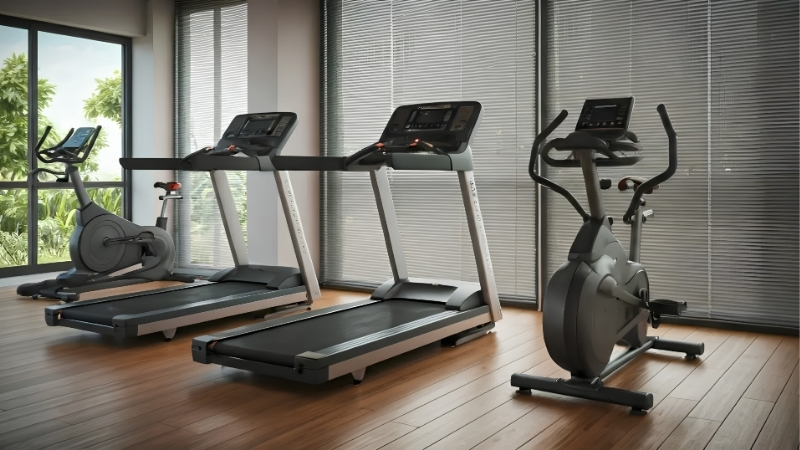
Treadmills are the only genuinely high-impact option here, because every foot strike sends load through the ankle, knee and hip and vibration into the floor. That is not a reason to avoid them, since running is a skill worth keeping, but it is the single biggest difference between the categories.
Bikes, rowers, ellipticals and air bikes are all low impact, with the foot either fixed to a pedal or supported throughout. They load the joints through range rather than through collision. If a specific joint problem is steering the decision, that is a conversation for a doctor or physiotherapist rather than a product page.
Footprint, Ceiling Height and Stored Size
Footprint on the best home gym cardio machine varies more than any other specification. A bike claims roughly 40-48 in by 20-24 in (102-122 x 51-61 cm). A rower needs around 8 ft by 2 ft (244 x 61 cm) in use, though it separates or stands on end. Treadmills fold; ellipticals mostly do not.
Ceiling height is the one that catches people out, and it is worst on ellipticals. The pedals sit 8-14 in (20-36 cm) off the floor, so you need your standing height plus that again plus clearance. Treadmill decks add 5-8 in (13-20 cm). Measure floor area, ceiling height and the doorway before ordering.
Noise, Neighbours and Power Requirements
Three different noises matter when picking the best home gym cardio machine. Mechanical noise is loudest on air bikes, where the fan is the resistance and there is no quiet setting. Impact noise is the treadmill problem, since footfall passes into a suspended floor whatever the deck cushioning claims. Magnetic bikes and rowers are quietest by some distance.
Power is the forgotten constraint. Treadmills need a mains socket and draw real current, and most ellipticals need at least a supply for the console. Bikes, rowers and air bikes generally run on battery-powered consoles or none at all, which means they can live anywhere rather than near an outlet.
How Much Cardio You Actually Need
The World Health Organization recommends adults accumulate 150 to 300 minutes of moderate-intensity aerobic activity a week, guidance published by WHO in 2020 and mirrored by the US Physical Activity Guidelines for Americans, second edition, 2018, alongside muscle-strengthening work on two or more days.
Spread evenly, the lower figure is roughly 22 minutes a day. That is a length of session almost any machine here covers, which shifts the decision away from performance ceilings and towards whether the machine is convenient enough that you will actually get on it on a busy weekday evening.
That is a scheduling argument rather than a health claim, and no machine prevents or treats anything. If you are returning after injury, managing a medical condition, or unsure whether a movement pattern suits you, speak to a doctor or a qualified trainer before starting a regular programme.
Top Picks: 6 Cardio Machines Compared for Home Use
The six below cover every mainstream category so the comparison is between machine types rather than between brands. The best home gym cardio machine depends almost entirely on your room, so the table leads with footprint, noise and whether the thing needs an electrical supply.
| Machine | Impact | Working Footprint | Noise | Mains Power |
|---|---|---|---|---|
| Schwinn IC4 indoor cycle | Low | Approx. 4 x 2 ft (122 x 61 cm) | Very low | No |
| Concept2 RowErg | Low | Approx. 8 x 2 ft (244 x 61 cm) | Moderate, flywheel | No |
| Sunny Health SF-RW5515 rower | Low | Long, folds upright | Low, magnetic | No |
| XTERRA Fitness TR150 treadmill | High | Large, folds | High, footfall | Yes |
| Sunny Health SF-E905 elliptical | Low | Compact but tall | Low | Console only |
| Schwinn Airdyne AD6 air bike | Low | Approx. 4 x 2 ft (122 x 61 cm) | Very high, fan | No |
Schwinn IC4 Indoor Cycle
The quietest and most flat-friendly machine here. Magnetic resistance across a hundred micro-adjustment steps with a 40 lb (18 kg) flywheel and a 330 lb (150 kg) capacity, running on a battery console with no mains requirement, so it can sit in any corner rather than near a socket.
It only trains the legs and it claims its floor space permanently, since the mass that makes it stable also makes it hard to move. The console shows metrics rather than running sessions, so a tablet is part of the setup. On a suspended upstairs floor, a rubber mat is still worth having.
Concept2 RowErg
The most complete machine on this list, working legs, back and arms in one movement at low joint impact. It separates into two pieces or stands on end for storage, the flywheel damper adjusts feel rather than resistance, and the capacity of 500 lb (227 kg) is far beyond anything else here.
It needs roughly 8 x 2 ft (244 x 61 cm) in use, which is a real commitment of length, and standing it on end requires ceiling height of around 7 ft (213 cm). The air flywheel is noticeably louder than a magnetic machine. Rowing technique also takes real learning before the machine repays the effort.
Sunny Health and Fitness SF-RW5515 Magnetic Rower
The affordable route into rowing, using eight levels of magnetic resistance rather than an air flywheel, which makes it dramatically quieter and better suited to a flat with neighbours below. It folds upright for storage and the 250 lb (113 kg) capacity covers most users comfortably.
Magnetic resistance does not respond to effort the way air does, so hard efforts feel flat compared with a Concept2 and the intensity ceiling is lower. The slide rail is shorter, which taller rowers notice. It is a good machine for steady work and a limited one for genuinely hard intervals.
XTERRA Fitness TR150 Folding Treadmill
The budget answer if running specifically is what you want, with a 2.25 HP motor, speeds up to 10 mph (16 km/h), a 250 lb (113 kg) capacity and a deck that folds upright to reclaim the floor between sessions. Nothing else on this list maintains running-specific fitness the way a treadmill does.
It is the loudest option for neighbours, because footfall impact travels into a suspended floor no matter what the deck cushioning claims. It needs a mains socket and draws real current, the belt is narrower than a gym treadmill, and the motor is not built for daily long-distance running.
Sunny Health and Fitness SF-E905 Elliptical
A compact elliptical with eight magnetic resistance levels and a 220 lb (100 kg) capacity, quiet enough for a flat and low impact throughout. The small floor footprint makes it look like an easy fit for a spare room, which is exactly where most elliptical buying decisions go wrong. The ceiling is the constraint.
Stride length is short by elliptical standards, so taller users find the motion cramped rather than flowing, and the pedals sitting 8-14 in (20-36 cm) off the floor mean you need considerable ceiling height. Measure from floor to ceiling and add your own height plus the pedal height before ordering.
Schwinn Airdyne AD6 Air Bike
Resistance comes from a fan, so it scales infinitely with effort and there is nothing to set. Moving arms and legs together makes it the highest intensity machine here for its footprint, it needs no mains power, and there is very little in it that can wear out or need servicing.
The fan is also the problem. Air bikes are genuinely loud at effort, loud enough to be antisocial in a flat and to make watching anything difficult. The upper body movement demands clearance around the handles, and the intensity that makes it effective also makes it easy to avoid using.
Frequently Asked Questions
Choosing the best home gym cardio machine raises the same practical questions every time: how much space is genuinely needed, what the neighbours will hear, which machine works the most muscle and whether folding designs actually help. These four answers cover each of them in turn, with the numbers attached.
Which cardio machine needs the least space?
An indoor cycle, at roughly 40-48 in by 20-24 in (102-122 x 51-61 cm), or a folding upright bike if it needs to disappear between sessions. Rowers need length, treadmills need both length and a mains socket, and ellipticals need surprising ceiling height despite modest floor dimensions.
Which machine is quietest for a flat?
A magnetic belt-driven bike, followed by a magnetic rower. Treadmills are the worst because footfall impact passes straight into a suspended floor, and air bikes are loud enough to be heard through walls. A dense rubber mat under any machine reduces structural transmission considerably and costs very little.
Which machine works the most muscle?
A rower, which drives through the legs, back and arms in a single coordinated movement, followed by an air bike where the arms work against the same fan as the legs. Bikes and treadmills are lower body dominant. Technique matters most on the rower, so expect a learning period.
Do folding machines actually save space?
Folding treadmills and rowers genuinely do, halving or better the stored footprint. Folding upright bikes do too, at the cost of a lighter flywheel and no standing efforts. Indoor cycles, ellipticals and air bikes essentially do not fold, so the floor they occupy on day one is gone for good.
See More:
- Best home pull-up bar
- Best at home pull up bar
- Best in house pull up bar
- Best rated ab roller
- Ankle weights best
Final Thoughts
The best home gym cardio machine is decided by your room, not by calorie charts. In a flat with neighbours below, a magnetic bike or rower is the sensible answer and a treadmill is the one to think hardest about. If space allows length, a rower trains the most muscle of anything here. Measure ceiling height first.

Write Your Review
No reviews yet. Be the first to share your experience!