
Key takeaways
What's inside
Best slip resistant yoga mat reviews almost always describe a mat on day one. What matters more is what the surface does after two hundred sessions, because grip is not a fixed property: it arrives with break-in, decays with body oils and abrasion, and can sometimes be brought back with the right cleaning routine.
As an Amazon Associate we earn from qualifying purchases at no extra cost to you. Product prices and availability are accurate as of the date shown and are subject to change.


As an Amazon Associate we earn from qualifying purchases at no extra cost to you. Product prices and availability are accurate as of the date shown and are subject to change.
By Chris Parker
🛒 Best Price Today on Amazon
Prime members get fast, free shipping on everything above, plus member-only deals. New members get a 30-day free trial — cancel anytime.
How to Choose the Best Slip Resistant Yoga Mat
The best slip resistant yoga mat relies on one of three separate mechanisms, and knowing which one a mat relies on tells you how it will age. Mechanical texture wears flat, material tack degrades with oils, and absorbent surfaces clog. Each fails differently, so the right choice depends on how long you expect the mat to last.
Moulded Texture Versus Embossed and Printed
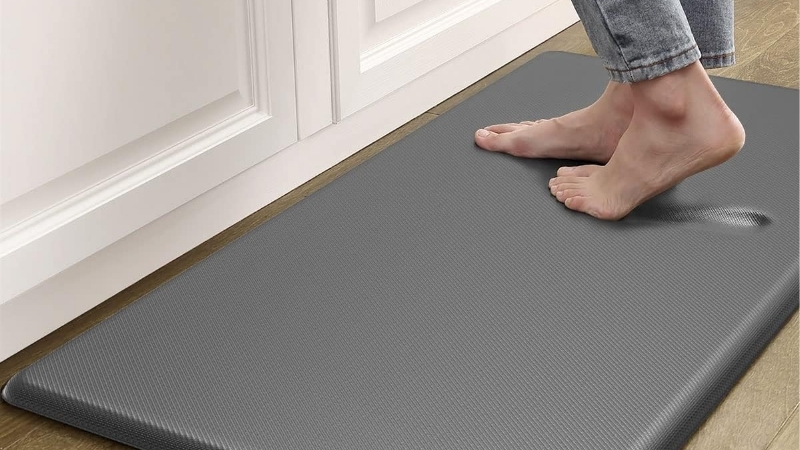
Mechanical grip depends entirely on how the pattern was made. Deep moulded texture is formed through the thickness of the material, so it survives wear and keeps working as the surface abrades. Embossed texture is pressed into a finished sheet and flattens over a year or two of regular contact.
Printed patterns give no grip at all, whatever they look like in a photograph, and are purely decorative. The tell is depth: run a fingernail across the surface and a moulded pattern has clear relief you can feel, while an embossed one is subtle and a printed one is completely smooth to the touch.
Texture Depth, Thickness and Rolled Footprint
Any best slip resistant yoga mat with deep texture is usually thicker or denser, which changes the footprint. Grip-focused mats sit at 4-6 mm and weigh 5-7.5 lb (2.3-3.4 kg), rolling to roughly 4-6 in (10-15 cm) across, so they store neatly in a cupboard but are less enjoyable to carry to a studio each week.
Unrolled they need 71-85 in by 24-27 in (180-216 x 61-68 cm), which is 12-16 sq ft (1.1-1.5 sq m) depending on the length option, plus clearance beyond the edges for wide stances. Measure your actual clear floor area and the storage spot before ordering, particularly if you are considering a long version.
Why Polyurethane Tops Went Mainstream
A decade ago a best slip resistant yoga mat that gripped when wet meant a studio-only purchase from one or two specialist makers. Polyurethane-topped mats have since spread across the market, and the technology that used to define the top of the range is now available from several brands rather than one.
What has not changed is what that surface asks of you in return. Polyurethane absorbs oils as readily as sweat, so hand cream, sun lotion and oil-based cleaners permanently dull the areas they touch, and the layer wears through at high-traffic spots long before the rubber underneath gives up.
That makes the choice a maintenance decision rather than a pure performance one. If you will clean the mat with water and mild soap and nothing else, the grip is worth having. If a mat needs to survive being wiped with whatever spray is nearest, closed-cell PVC with deep moulded texture is the more honest buy.
Top Picks: 6 Slip Resistant Mats and How They Age
The six below are chosen for how their grip behaves over time rather than on the first day. The best slip resistant yoga mat for you depends on whether you want grip immediately or grip that lasts, so the table lists the break-in requirement for each one alongside the way its surface eventually gives up.
| Mat | Grip Mechanism | Break-In Needed | How Grip Fades | Cleaning Rule |
|---|---|---|---|---|
| Manduka PRO | Closed-cell PVC texture | Weeks of use or salt scrub | Very slowly | Water and mild soap |
| Liforme Yoga Mat | Polyurethane absorption | None | Oils dull the surface | No oils, ever |
| Jade Harmony | Open-cell rubber tack | None | Surface wears and sheds | Periodic deep clean |
| Manduka X | Closed-cell moulded texture | Minimal | Texture flattens slowly | Easy wipe |
| Heathyoga Eco Friendly | Moulded TPE texture | None | Pattern wears flat | Easy wipe |
| Gaiam Performance Dry-Grip | Textured PVC | Minimal | Texture flattens | Easy wipe |
Manduka PRO
The longest-lived surface here by a clear margin. Closed-cell PVC at 6 mm, offered in 71 in (180 cm) and 85 in (216 cm) lengths with a lifetime guarantee, it resists abrasion in a way that no rubber or polyurethane mat manages, and the density under the knees is excellent at that thickness.
It arrives slippery and stays that way until the surface is opened up, which takes several weeks of use or an overnight coarse salt scrub. Wet grip remains poor afterwards, because the surface is sealed. At roughly 7.5 lb (3.4 kg) it is heavy, and it is an expensive mat to buy on faith.
Liforme Yoga Mat
Grip from the first minute with no break-in, and the most consistent surface across dry and damp conditions. The polyurethane top over natural rubber measures 72.8 x 26.8 in (185 x 68 cm) at 4.2 mm, and the etched alignment system stays useful long after the novelty of it wears off.
The maintenance rules are strict and non-negotiable. Any oil-based cleaner, essential oil or hand cream will permanently seal the patches it touches, and there is no way to reverse it. The polyurethane layer also wears through at hand and foot positions before the rest of the mat shows any age.
Jade Harmony Yoga Mat
Open-cell natural rubber gives immediate tack with no break-in period at all, and it remains the benchmark for how a mat should feel under dry hands. Lengths of 68, 71 and 74 in (173, 180 and 188 cm) at 4.8 mm cover most heights, and the material grips the floor as well as it grips you.
It ages fastest of anything here. The surface abrades and sheds fine rubber particles, it absorbs body oils and needs periodic deep cleaning rather than a wipe, it is a latex product, and direct sunlight degrades it quickly. Plan on replacing it sooner than a PVC mat, and budget accordingly.
Manduka X
Built for cross-training rather than yoga specifically, which makes it the most abrasion-tolerant mat here after the PRO. Closed-cell construction at 5 mm with a deep moulded texture on 71 x 24 in (180 x 61 cm), it handles shoes, floor work and dragging across a hard floor without visible damage.
The texture is designed for grip under trainers as much as bare hands, so it feels coarser than a dedicated yoga surface and is not as pleasant in seated or supine positions. Being sealed, wet grip is poor. Treat it as the right answer for mixed home training rather than a pure yoga purchase.
Heathyoga Eco Friendly Non Slip Yoga Mat
The budget option with genuinely moulded rather than embossed texture, which is why it holds grip longer than most mats at its price. TPE at 6 mm over 72 x 26 in (183 x 66 cm), with a patterned underside and printed alignment lines that are genuinely useful for as long as they last on the surface.
The alignment printing fades within a year or two of cleaning and wear, and the surface pattern does eventually flatten at the hand and foot positions. TPE is closed-cell, so wet grip is poor from day one and does not improve. Heat and direct sunlight degrade it faster than use does.
Gaiam Performance Dry-Grip Yoga Mat
A mid-priced textured PVC surface aimed at people whose hands get slightly damp rather than genuinely wet. It needs little or no break-in, it wipes clean with anything reasonable, and it holds its texture through several years of moderate use without the maintenance constraints a polyurethane top imposes.
Grip is entirely mechanical, so it fades gradually as the raised pattern wears down, and it will be defeated by a genuinely heated class. It is the sensible middle choice for a cool or mildly warm room where you want reliable grip and do not want to think about cleaning products.
Frequently Asked Questions
The useful questions about the best slip resistant yoga mat are all about time: how to make a new mat grip, why an old one stops, what ruins a surface permanently and when to give up on it entirely. These four answers cover the full life cycle of a mat rather than only the first session on it.
How do I break in a new mat?
Closed-cell PVC mats need it and nothing else does. Either practise on it for several weeks and let use open the surface, or spread coarse sea salt across it, leave it overnight, then brush it off and wipe the mat down. Rubber, polyurethane and TPE grip from the first session with no preparation.
Why does grip fade over time?
Three causes, depending on the material. Mechanical texture wears flat at the hand and foot positions. Open-cell surfaces clog with body oils so the pores stop absorbing. Polyurethane tops abrade through in high-traffic spots. Identifying which one applies tells you whether cleaning will help or whether the mat is finished.
What cleaners should I avoid?
Anything oil-based, including essential oils, and anything with a high alcohol content. Oils seal open-cell surfaces permanently and dull polyurethane; alcohol dries rubber out and accelerates cracking. Water with a small amount of mild soap is safe on every mat here, and on polyurethane tops it is the only sensible option.
When should I replace a mat?
When cleaning no longer restores grip and the surface is visibly worn at the hand and foot positions. Open-cell rubber typically reaches that point in two to four years of frequent use, polyurethane tops in three to five, and closed-cell PVC can run considerably longer. Persistent odour is a second signal.
See More:
- Best home pull-up bar
- Best at home pull up bar
- Best in house pull up bar
- Best rated ab roller
- Best yoga travel mat
Final Thoughts
The best slip resistant yoga mat depends on whether you want grip now or grip in three years. Rubber and polyurethane perform immediately but demand careful cleaning. Closed-cell PVC needs breaking in and never grips wet, yet it outlasts everything else here. Avoid oil-based cleaners entirely, and measure your storage spot before ordering.
Write Your Review
No reviews yet. Be the first to share your experience!