
Key takeaways
What's inside
Best rowers for home gym shortlists usually collapse once someone measures the room, because almost every rower is around 8 ft long. Resistance type and storage orientation matter more than stroke count or screen size. This guide covers both, then five machines across air, water, magnetic and hydraulic designs.
As an Amazon Associate we earn from qualifying purchases at no extra cost to you. Product prices and availability are accurate as of the date shown and are subject to change.


As an Amazon Associate we earn from qualifying purchases at no extra cost to you. Product prices and availability are accurate as of the date shown and are subject to change.
By Chris Parker
🛒 Best Price Today on Amazon
Prime members get fast, free shipping on everything above, plus member-only deals. New members get a 30-day free trial — cancel anytime.
How to Choose the Best Rowers for Home Gym Use
Four things decide this purchase: how resistance is created, how much floor the machine needs including your stroke, whether the rail fits your leg length, and whether the monitor works without a paid app. Screen size and stroke-count marketing come a long way behind all four of those four questions.
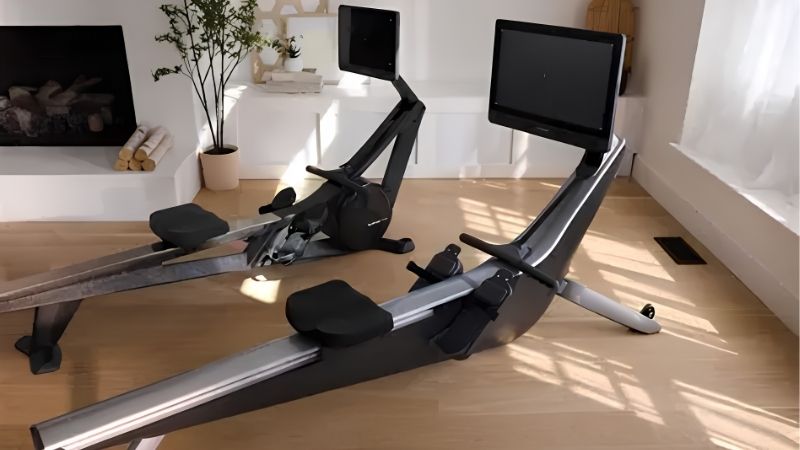
Resistance Type Sets the Noise and the Feel
Air resistance uses a fan flywheel, so effort scales with how hard you pull and the machine gets louder as you work – a genuine consideration in a flat or a room next to a bedroom. It is the mechanism used in competition, and the damper setting changes drag rather than making the work itself harder.
Magnetic resistance uses a brake near the flywheel with no contact, which makes it the quietest option and gives fixed levels independent of stroke speed. Water rowers produce a swooshing sound rather than a whine, with resistance rising with effort like air, and hydraulic pistons are the smallest and least natural feeling.
Noise is worth deciding early because it cannot be fixed later. Magnetic machines are the ones people actually use at 6am in a shared flat. Air rowers reward hard efforts with a rising roar that carries through walls, which is either motivating or precisely the reason the machine quietly ends up unused.
Footprint, Stroke Envelope and Storage
Most full-size rowers occupy roughly 8 x 2 ft (244 x 61 cm) on the floor, but the usable envelope is bigger: allow around 9-10 ft (2.7-3 m) of length so the handle and your body have room at the catch and the finish, plus clear space to get on and off the seat from either side. It is a small detail that quietly adds up.
Storage orientation splits the category. Some machines separate into two pieces, others fold at the rail, and water rowers commonly stand upright – which needs a ceiling above roughly 7 ft (2.1 m). Measure your actual floor length and ceiling height before ordering, because a rower that fits in use may not fit in storage.
Rail Length, Inseam and Weight Capacity
Rail length determines whether tall users reach full leg extension. Machines vary widely, and a rail that is too short cuts the drive stroke and turns rowing into a shortened arm exercise. Manufacturers state a maximum user height or inseam; check yours rather than assuming standard sizing covers it.
User weight capacity ranges from around 250 lb (113 kg) on budget machines to 500 lb (227 kg) on the sturdiest. Seat height matters too: 14 in (35 cm) is comfortable for most people to sit down onto, while very low seats make standing up afterwards harder for anyone with existing knee or hip restrictions.
Monitors and Subscription Costs
This is where ongoing cost hides. Some rowers include a self-contained monitor that records distance, split time, stroke rate and watts with no account or fee. Others put the metrics behind a subscription app, and without an active plan the screen may show little more than a basic running timer and nothing else.
Connected training has spread down into the mid tier, which is genuinely useful – but the question to ask before buying is what the machine does when you stop paying. If the answer is very little, factor several years of subscription into the true total cost rather than comparing purchase prices alone.
Top Picks: Best Rowers for Home Gym Spaces That Fit
These five cover every resistance mechanism and every storage strategy, from a competition-standard air rower to a hydraulic machine that folds into a cupboard. Each entry notes the storage format and the honest limitation, since no rower manages to be quiet, compact and heavy-duty all at the same time.
| Rower | Resistance | Storage | Subscription needed | Best for |
|---|---|---|---|---|
| Concept2 RowERG | Air | Splits in two | No | Serious training, data |
| WaterRower Natural | Water | Stands upright | No | Quiet-ish, living rooms |
| Sunny SF-RW5515 | Magnetic, 8 levels | Folds | No | Budget, apartments |
| NordicTrack RW600 | Magnetic | Folds upright | For full features | Guided workouts |
| Stamina BodyTrac 1050 | Hydraulic | Folds flat | No | Smallest spaces |
Concept2 RowERG
The reference machine for the category: air resistance with a damper from 1 to 10, a monitor that records watts, split and stroke rate without any account, a footprint near 8 x 2 ft (244 x 61 cm) and a user capacity listed at 500 lb (227 kg). It also separates into two pieces for storage against a wall.
It is loud under hard efforts, which rules it out for some shared buildings, and it is priced well above budget machines with no screen or guided content included. The chain needs occasional oiling. What you get is a machine that holds its resale value well and very rarely needs replacing at all. Most buyers only notice this some weeks later.
WaterRower Natural
A wooden-framed water rower measuring roughly 84 x 22 in (213 x 56 cm) that stands upright on its end for storage, taking a floor area smaller than most bookshelves when parked. Water resistance scales with effort and produces a rushing water sound rather than a hard mechanical whine under load. That gap tends to show up within a month.
Upright storage needs ceiling height above about 7 ft (2.1 m), and the filled tank makes the machine heavy to move once set up. Water needs periodic treatment tablets to stay clear. The monitor covers the basics but it is nowhere near as detailed as the data-focused alternatives listed here. It rarely appears anywhere on the spec sheet.
Sunny Health & Fitness SF-RW5515
Magnetic resistance across eight fixed levels, a folding frame and a user capacity around 250 lb (113 kg). It is the quiet option at the budget end – genuinely usable early in the morning in a flat – and the folding frame keeps it out of the way between sessions in a shared living room or bedroom. The difference is obvious the moment it is used.
Fixed magnetic levels mean effort does not scale with how hard you pull, so the stroke feels less like real rowing than air or water. The rail suits average heights better than tall users, and the frame flexes more under a powerful drive. It is a cardio machine rather than a training tool for rowers.
NordicTrack RW600
Magnetic resistance with digital level control and an integrated touchscreen for guided sessions, with a frame that folds upright to reduce stored footprint. Automatic resistance changes during instructor-led sessions are the main appeal among the best rowers for home gym use for people who need structure.
Full functionality is tied to a subscription, so budget for the recurring cost rather than the purchase alone, and confirm what the machine displays without it. It is also heavier and more complex than a mechanical rower, with a screen and electronics that add potential failure points over the years.
Stamina BodyTrac Glider 1050
A hydraulic-piston rower with independent arms that folds down to a fraction of the size of a rail machine, with a user capacity around 250 lb (113 kg). For a small flat where nothing can stay set up permanently, this is the one machine among the best rowers for home gym use that actually fits. None of that is visible in the product photographs.
Hydraulic pistons heat up during long sessions and resistance drifts as they warm, and the independent-arm motion is noticeably different from a proper rowing stroke. It suits general conditioning in a tight space rather than building rowing-specific fitness, so set your expectations accordingly before ordering.
Frequently Asked Questions
Buyers ask about space, noise and whether rowing is enough training on its own. These four cover the most common questions about the best rowers for home gym setups, including how much room to leave around the machine and what rowing genuinely contributes to general weekly health targets. That is worth checking before anything else is ordered.
How much space do the best rowers for home gym setups actually need?
Allow roughly 9-10 ft (2.7-3 m) of length and 4 ft (1.2 m) of width for the machine plus your stroke and side access. Upright storage adds a ceiling requirement above roughly 7 ft (2.1 m), so measure the real floor area, including the ceiling height above it, before ordering anything at all. It is the sort of thing a spec sheet never captures.
Is rowing enough exercise on its own?
It covers aerobic work well. The World Health Organization’s 2020 guidelines recommend 150 minutes of moderate activity weekly plus two muscle-strengthening sessions, so most people pair rowing with some form of resistance training. Consult a doctor before beginning any new exercise programme of your own.
Which resistance type is quietest?
Magnetic, by a clear margin, followed by water. Air rowers get progressively louder as effort rises because the fan is doing the work. In shared buildings or on upper floors, magnetic resistance is usually the only option that survives contact with real neighbours living directly below. Plan around it rather than hoping it will not matter.
Do I need a subscription to use a rower?
Not on mechanical machines with self-contained monitors, which display distance, pace and stroke rate independently. Connected rowers vary: some retain basic metrics without a plan, others show very little. Confirm what the monitor does offline before buying if you do not want a recurring monthly cost.
See More:
Final Thoughts
The best rowers for home gym use are the ones that match your noise constraints and your actual floor length, not the ones with the largest screen. Decide the resistance mechanism first, measure 9-10 ft of clear space, check the rail against your leg length, and confirm what the monitor does without a subscription.

Write Your Review
No reviews yet. Be the first to share your experience!