
An upright exercise bike can be a convenient way to build a consistent home cardio routine, but models vary widely in fit, resistance, comfort, and electronics. This upright exercise bike buying guide explains how to compare frame geometry, saddle adjustment, flywheels, consoles, stability, maintenance, and long-term purchasing value.
Quick Verdict: What Makes an Upright Exercise Bike Worth Buying?
The best upright exercise bike should fit your body comfortably, provide a suitable resistance range, remain stable while pedaling, and offer practical workout information.
For most home users, an adjustable magnetic upright bike with a comfortable saddle, secure pedals, and straightforward controls is a sensible starting point.
However, someone who enjoys guided workouts may prefer electronic resistance and programmable sessions. A frequent cyclist may prioritize precise fit adjustment, consistent resistance behavior, and useful cadence information.
A budget-conscious beginner may be better served by a simple machine with fewer electronic features.
The most important purchasing rule is to evaluate fit and exercise comfort before paying extra for a touchscreen, app subscription, or unusually high number of resistance settings.
Understanding Upright Exercise Bikes
What Is an Upright Exercise Bike?
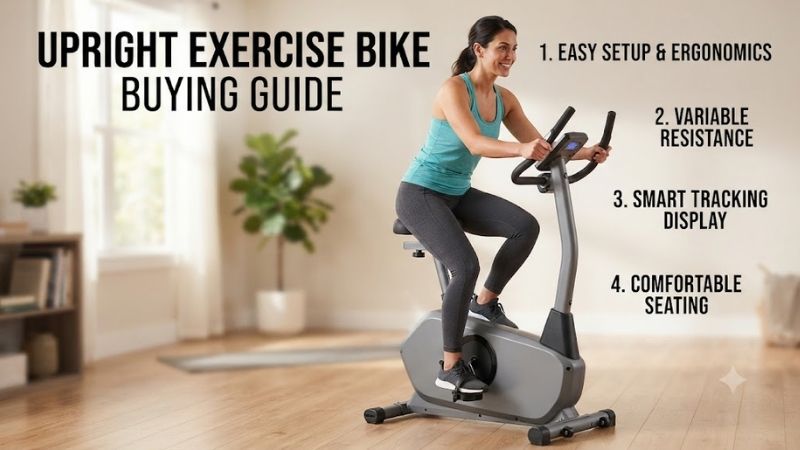
An upright exercise bike is a stationary cycling machine that positions the user in a relatively vertical seated posture.
The rider sits on a saddle and turns pedals connected to an internal resistance mechanism.
Most conventional upright models include stationary handlebars, a console, and adjustable resistance.
This arrangement differs from the reclining position of a recumbent exercise bike.
How Upright Bikes Differ From Outdoor Bicycles
An upright stationary bike reproduces some basic cycling movements but does not completely duplicate outdoor riding.
There is no steering balance requirement, road vibration, or changing terrain unless the machine simulates resistance variations.
The flywheel and resistance mechanism determine much of the exercise sensation.
As a result, the displayed speed and distance may not correspond directly to outdoor cycling performance.
Upright Exercise Bikes Versus Indoor Cycles
Indoor cycling bikes often emphasize studio-style exercise.
They may feature a road-style saddle, heavier flywheel arrangement, and handlebars suited to forward-leaning positions.
Conventional upright bikes commonly provide a more relaxed seated posture and console-based workout programs.
Both can support effective cardio exercise.
Choose according to riding preference rather than assuming one category is universally better.
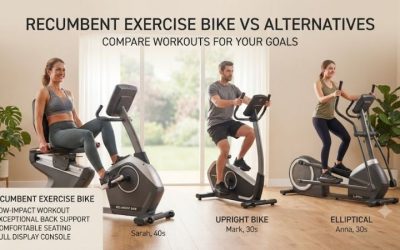
Upright Bikes Versus Recumbent Bikes
Recumbent bikes provide a larger seat with back support and place the pedals farther forward.
They generally occupy more floor length.
Upright bikes can be more space-efficient but provide less external back support.
Comfort and accessibility should guide the decision.
Main Upright Exercise Bike Categories
| Category | Main Characteristics | Best For | Trade-Off |
|---|---|---|---|
| Basic manual magnetic | Resistance dial, simple display | Beginners and budget users | Limited programs |
| Electronic magnetic | Button-controlled resistance | Structured training | Power and electronics |
| Connected upright | App support and guided workouts | Digital fitness users | Higher cost and subscriptions |
| Folding upright | Compact stored shape | Small apartments | Different fit geometry |
| Premium residential | Advanced console and adjustments | Frequent home exercise | Higher purchase price |
| Commercial-oriented | Built for intensive shared use | Facilities and heavy usage | Size and cost |
How Magnetic Resistance Works
The Basics of Magnetic Braking
Many upright exercise bikes use magnetic resistance.
A flywheel rotates as the user pedals, and magnetic braking creates resistance to that rotation.
The exact system varies.
Some machines use permanent magnets that move closer to or farther from the flywheel.
Others use electronically controlled components.
The advantage is that resistance can be adjusted without relying on continuous friction-pad contact.
Why Magnetic Resistance Is Popular
Magnetic resistance generally produces relatively little sound at the braking mechanism.
It also supports repeatable adjustment positions within the same machine.
This makes it practical for home workouts where the user wants to change effort without complicated mechanical adjustments.
However, the complete bike still contains pedals, bearings, drivetrain components, and other moving parts.
No bike should be assumed completely silent.
Manual Magnetic Resistance
Manual systems usually use a knob.
Turning the knob changes the resistance setting.
This approach is common on entry-level bikes because it is straightforward and often does not require external electrical power for braking.
A basic monitor may still need batteries.
Manual resistance is sufficient for many recreational users who prefer steady cycling.
Electronically Controlled Resistance
Electronic systems allow the user to change resistance through console buttons.
They can also support preset workouts.
For example, a program may alternate between easier and more demanding settings over a planned period.
This is attractive for people who enjoy structured intervals.
However, the machine may require a wall outlet and additional electronic maintenance.
Resistance Levels Are Not Standardized
An upright bike may advertise eight, sixteen, twenty-five, or more resistance levels.
These numbers represent selectable positions.
They do not establish a universal workload.
Level eight on one bike may feel different from level eight on another.
Buyers should not choose solely by comparing the number of settings.
Does More Resistance Mean Better Exercise?
Not automatically.
An effective cardio workout depends on effort, duration, cadence, and the individual’s conditioning.
Excessively high resistance can cause the rider to pedal slowly with poor technique.
A machine that provides manageable progression is often more useful than one designed mainly to advertise maximum resistance.
Flywheel Design and Pedaling Smoothness
What Does the Flywheel Do?
A flywheel stores rotational energy.
Its inertia helps maintain movement between pedal strokes.
The flywheel’s mass, mass distribution, gearing, bearings, and braking system all influence the experience.
Is a Heavier Flywheel Better?
A heavier flywheel may contribute greater rotational inertia, but it does not automatically guarantee smoother pedaling.
A well-designed lighter system can provide a controlled experience.
Conversely, a heavy flywheel with poor bearings or inconsistent resistance may feel unpleasant.
Perimeter-Weighted Flywheels
Some flywheels concentrate more mass toward the outer edge.
This can increase rotational inertia relative to another flywheel with the same total mass but a different mass distribution.
However, overall ride quality still depends on the complete drivetrain.
Belt Drives
Many modern upright exercise bikes use belt-driven systems.
These can be relatively quiet and require limited routine lubrication.
However, belts may eventually wear or require replacement.
Chain Drives
Chains are less common on many conventional residential upright bikes but appear in some cycling equipment.
They require appropriate maintenance.
Neither chain nor belt construction automatically guarantees a better workout.
Consistency Matters More Than Marketing
The most important practical quality is smooth, predictable pedaling.
The bike should not jerk, scrape, or create unusual resistance changes during normal use.
Saddle Height and Correct Bike Fit
Why Saddle Height Is Important
Saddle height strongly influences pedaling comfort.
When the saddle is too low, the knee remains excessively bent at the bottom of the stroke.
When it is too high, the rider may reach excessively for the pedal and rock the hips.
The goal is controlled pedaling with a comfortable amount of knee flexion.
How to Begin Adjusting Saddle Height
Start with the manufacturer’s fit recommendations.
Position the seat so that your leg approaches comfortable extension at the lowest pedal point without the knee locking.
Pedal slowly to assess whether your hips remain stable.
Make small changes until the movement feels controlled.
If you experience persistent discomfort, consider professional bike-fitting or clinical guidance as appropriate.
Inseam Compatibility
Inseam measurements can help determine whether the machine’s adjustment range will accommodate your legs.
A bike marketed for a broad height range may still be unsuitable for unusual body proportions.
Check published seat-height limits and any manufacturer-supported inseam guidance.
Fore-Aft Seat Adjustment
Some upright bikes allow the saddle to move forward and backward.
This changes the relationship between the hips, knees, and pedals.
It also influences reach to the handlebars.
A two-way adjustable saddle offers more fit flexibility than a seat that only moves vertically.
Saddle Tilt
Some bikes allow limited saddle-angle adjustment.
The appropriate angle depends on the saddle design and rider position.
Avoid extreme tilts that cause sliding or excessive pressure.
Why Seat Comfort Is Personal
A saddle that feels comfortable to one person may not suit another.
Pelvic anatomy, posture, padding, saddle width, and workout duration all influence pressure distribution.
The widest or softest saddle is not always the best.
Gel Saddles and Seat Covers
Aftermarket cushions can change the feel of a saddle.
However, adding thick padding may alter support or affect stability.
Before purchasing a cover, determine whether the existing saddle fits correctly.
Can You Replace the Saddle?
Some bikes use standard bicycle-style saddle attachments.
Others use proprietary mounting components.
Verify compatibility before buying replacement equipment.
Handlebar Design and Riding Posture
Upright Positioning
Conventional upright bikes are intended to provide a relatively supported seated cycling posture.
However, torso angle varies by model.
A comfortable position should not require excessive rounding or extension of the back.
Handlebar Reach
The user should reach the handlebars without locking the elbows or overextending the shoulders.
If the handlebars are too far away, the rider may lean forward uncomfortably.
Adjustable Handlebars
Some models allow vertical or angular handlebar adjustment.
This can improve comfort, especially when the bike is shared by users of different heights.
Grip Positions
Multiple grip positions can allow minor changes in hand placement.
However, they do not necessarily create a different exercise mode.
Contact Heart-Rate Sensors
Many upright bikes include metal pulse sensors in the handlebars.
These can provide convenient heart-rate estimates.
However, contact quality and movement may affect accuracy.
A compatible chest strap may provide more consistent workout heart-rate information for users who need it.
Avoid Excessive Hand Pressure
The handlebars are primarily for posture and control.
Users should avoid supporting excessive body weight through the wrists unless specifically required by an approved exercise method.
Pedal Design and Foot Security
Standard Flat Pedals
Most conventional upright bikes include flat pedals suitable for athletic shoes.
These are convenient for recreational home exercise.
Adjustable Foot Straps
Foot straps can help keep the feet positioned during pedaling.
Adjust them securely without creating uncomfortable pressure.
Pedal Width and Foot Position
The feet should remain comfortably supported.
The correct position depends on the pedal design, footwear, and rider anatomy.
Crank Length
Crank length affects the circular path traveled by the pedals.
Different designs may feel more or less comfortable depending on body proportions.
Most basic residential bikes do not offer adjustable crank length.
Pedal Bearings
The pedals should rotate smoothly.
Unusual clicking, resistance, or sideways movement may indicate wear or incorrect installation.
Replacement Pedals
Some bikes accept standard replacement pedals.
Others use specific thread sizes or proprietary parts.
Always confirm the manufacturer’s compatibility guidance.
Understanding Frame Stability
Why Stability Matters
An upright bike should remain secure during seated pedaling.
Excessive rocking can interfere with comfort and increase wear.
Stabilizers
Front and rear stabilizers help distribute the rider’s weight and pedaling forces.
Their width and construction influence stability.
Floor Leveling
Uneven floors can cause movement.
Some bikes include adjustable leveling feet.
Use these according to the manufacturer’s instructions.
Weight Capacity
The maximum user-weight rating is an essential purchasing specification.
Choose equipment that accommodates the intended rider.
Do not exceed the manufacturer’s limit.
Frame Material
Steel is common, although other materials may be used.
Structural quality depends on more than the material name.
Welding and Joints
Connections should be secure.
Visible damage, loose components, or unusual frame movement deserve attention before exercise.
Folding Bike Stability
Folding bikes can be stable when properly designed and locked.
However, the folding joint is another component that requires inspection.
Upright Exercise Bike Dimensions
Measure the Actual Footprint
Manufacturers publish assembled length and width.
These dimensions are useful but do not always include recommended clearance.
The rider also needs room to mount and dismount.
Bike Height
Equipment height can influence where the bike fits.
Console stands and handlebars may extend above the saddle.
Storage Requirements
A conventional upright bike may remain permanently assembled.
A folding model changes its shape for storage.
Measure the stored dimensions separately.
Transport Wheels
Transport wheels make repositioning easier.
However, they do not eliminate the need to tilt or lift the machine.
Machine Weight
A heavier frame may be less convenient to move.
A lighter machine may be easier to store.
Evaluate weight alongside stability and intended use.
Comparing Upright Exercise Bike Comfort Features
| Feature | Why It Matters | What to Check |
|---|---|---|
| Seat height | Knee extension and comfort | Adjustment range |
| Seat fore-aft | Relationship to pedals | Horizontal adjustment |
| Saddle width | Pressure distribution | Actual seat dimensions |
| Handlebar reach | Upper-body posture | Adjustment and grip positions |
| Pedal straps | Foot security | Fit and adjustability |
| Step-through access | Mounting convenience | Frame opening |
| Frame stability | Secure pedaling | Stabilizers and capacity |
| Seat height from floor | Mounting accessibility | Published measurement |
Workout Consoles and Digital Features
Basic LCD Displays
An entry-level console may show time, speed, distance, and estimated calories.
These functions can help users follow simple exercise goals.
RPM and Cadence
RPM describes pedal rotations per minute.
Cadence is useful for controlling rhythm and comparing workouts.
A higher cadence does not automatically mean greater workload because resistance also matters.
Resistance-Level Display
Electronically controlled machines often show the selected resistance setting.
This makes it easier to repeat a familiar workout.
Preset Programs
Programs may change resistance according to a schedule.
Some focus on steady workouts, while others alternate between harder and easier intervals.
Heart-Rate Programs
Certain bikes can change resistance according to heart-rate information.
The effectiveness of this function depends on sensor reliability and the control system.
Bluetooth Connectivity
Bluetooth may allow connection to fitness applications or sensors.
However, Bluetooth support does not guarantee all connected functions.
Check whether the bike can transmit cadence, receive heart rate, or control resistance through the intended application.
Integrated Touchscreens
Large displays can support guided workouts and entertainment.
They may also increase cost, equipment weight, and power consumption.
Subscription-Free Use
Before purchasing a connected upright bike, confirm which functions operate without an active membership.
Basic pedaling should not be assumed to unlock every console function.
Workout Metrics: What Is Actually Useful?
Elapsed Time
Time is a straightforward way to organize exercise.
It can be used for warmups, steady sessions, and intervals.
Distance Estimates
Stationary bike distance is generally estimated from machine operation.
Different manufacturers may use different calculations.
Speed
Displayed speed is often a modeled value.
It should not be assumed equivalent to outdoor cycling speed.
Calorie Estimates
Calorie figures are estimates.
They may be influenced by assumptions about resistance, power, and user characteristics.
Avoid treating them as exact measurements.
Heart Rate
Heart rate can help monitor exercise response.
However, wrist, contact, and chest-based systems may differ in accuracy and consistency.
Power
Some premium bikes provide watt estimates.
These can be useful when the equipment has a consistent measurement approach.
Do not assume watt readings are directly interchangeable across unrelated machines.
Upright Bike Noise and Apartment Use
Magnetic Resistance Noise
Magnetic braking is generally relatively quiet.
This makes it attractive for shared living spaces.
Drivetrain Noise
Pedals, belts, bearings, and cranks can still produce sound.
A quiet resistance system does not eliminate mechanical noise.
Floor Vibration
Even seated cycling can transmit vibration through the frame.
A stable exercise mat may help manage some floor transmission.
Equipment Placement
Avoid unstable flooring.
Position the bike away from furniture that could be contacted during movement.
When Noise Indicates a Problem
Grinding, unusual clicking, or scraping should be investigated.
These sounds may indicate loose components, incorrect assembly, or wear.
Maintenance and Long-Term Reliability
Cleaning After Workouts
Sweat can accumulate on handlebars, pedals, and the frame.
Clean approved surfaces according to the manufacturer’s instructions.
Inspecting Pedals
Check that pedals remain secure.
Loose pedals can damage crank threads.
Belt and Drive Maintenance
Follow the maintenance schedule for the specific drivetrain.
Do not attempt adjustments that the manufacturer reserves for service technicians.
Seat Adjustments
Keep adjustment components clean and check that locking mechanisms remain secure.
Console Maintenance
Electronic consoles may require batteries, firmware updates, or power-supply care.
Replacement Parts
Before buying, consider whether the manufacturer provides compatible saddles, pedals, straps, resistance components, and consoles.
Warranty Support
Read the warranty carefully.
Frame, mechanical, and electronic coverage may have different durations.
Budget, Midrange, and Premium Upright Bikes
Entry-Level Upright Bikes
Budget models often provide manual magnetic resistance and basic displays.
These can be sufficient for casual workouts.
However, fit adjustment and stability should remain priorities.
Midrange Upright Bikes
Midrange products may offer more resistance levels, better consoles, and more substantial seating or frame components.
These improvements can be worthwhile for frequent users.
Premium Connected Upright Bikes
Premium machines may feature integrated displays, workout programs, connected training, and advanced resistance control.
Their value depends on how often the user takes advantage of these features.
Commercial-Oriented Equipment
Commercial machines may be designed for frequent shared use.
However, higher price and weight do not automatically make them the best choice for a home.
Total Ownership Cost
Consider shipping, assembly, maintenance, electricity, replacement parts, and subscriptions.
A low advertised price may not reflect the full cost of ownership.
Matching an Upright Bike to Your Goals
Beginners
Choose comfortable fit, straightforward controls, and manageable resistance.
Begin with short sessions and progress gradually.
General Cardio
A stable bike with predictable resistance is sufficient for many recreational routines.
Interval Training
Electronic resistance adjustment and clear cadence tracking may be helpful.
Home Weight Management
Cycling can contribute to physical activity and energy expenditure.
However, body-weight changes depend on multiple lifestyle factors, not equipment selection alone.
Older Adults
Some older users may value convenient mounting, stable handlebars, and straightforward controls.
Individual balance, mobility, and medical needs should determine suitability.
Tall Riders
Seat adjustment range is particularly important.
Check manufacturer guidance rather than relying on broad height claims.
Shared Households
Choose equipment that accommodates different users through adjustable seating and suitable weight capacity.
Common Buying Mistakes
Buying Based Only on Resistance Levels
More settings do not automatically mean better exercise quality.
Ignoring Saddle Fit
An uncomfortable saddle can discourage consistent use.
Assuming All Upright Bikes Have the Same Geometry
Different models position the rider differently.
Choosing the Heaviest Flywheel Automatically
Flywheel weight alone does not determine smoothness.
Paying for Unused Connected Features
A premium subscription system may be unnecessary for independent exercise.
Overlooking Assembly Quality
Incorrectly assembled pedals or frame components can create mechanical problems.
Ignoring Replacement Parts
An inexpensive machine becomes less attractive if common components cannot be serviced.
Forgetting About Entry and Exit
A bike that fits the floor area may still be difficult to mount in a cramped room.
Assuming Displayed Calories Are Exact
Fitness-equipment calorie estimates should be treated cautiously.
Exceeding the Weight Rating
Never use a bike beyond the manufacturer’s published capacity.
Practical Buying Checklist
Before purchasing an upright bike, confirm these points:
-
The bike accommodates your height and inseam.
-
The saddle offers enough adjustment.
-
The handlebars support a comfortable posture.
-
The pedals are appropriate for your footwear.
-
The resistance system suits your training goals.
-
The machine fits the available exercise area.
-
The maximum user-weight rating is appropriate.
-
The frame is stable on your intended floor.
-
The console provides metrics you will use.
-
Connected features work with your preferred devices.
-
Replacement parts and warranty service are accessible.
-
The total cost fits your budget.
Frequently Asked Questions
Is an Upright Exercise Bike Good for Beginners?
Yes. Upright bikes provide controlled seated exercise and adjustable resistance. Beginners should prioritize comfortable fit and manageable intensity.
What Resistance Type Is Best for an Upright Exercise Bike?
Magnetic resistance is a common choice because it provides straightforward adjustment and relatively quiet operation.
Are Upright Exercise Bikes Better Than Recumbent Bikes?
Neither is universally better. Upright bikes are often more compact, while recumbent bikes provide back-supported seating.
How Many Resistance Levels Do I Need?
The appropriate number depends on the resistance system and your goals. Eight or sixteen levels can be sufficient for many recreational users.
Does Flywheel Weight Matter?
It influences rotational inertia, but bearings, drivetrain design, and resistance characteristics also affect pedaling feel.
Can an Upright Bike Help Improve Cardio Fitness?
Regular cycling can support cardiovascular conditioning when performed at an appropriate intensity and frequency.
Do Upright Bikes Require Electricity?
Manual magnetic models may operate without an outlet for resistance. Electronic models often require electrical power.
How Do I Know Whether the Saddle Is Too High?
Excessive reaching for the pedals or rocking of the hips may indicate an unsuitable height. Follow manufacturer fitting guidance.
Are Upright Exercise Bikes Quiet Enough for Apartments?
Magnetic models are often relatively quiet, although mechanical sound and floor vibration remain possible.
Can Two People Share the Same Upright Bike?
Yes, if the seat adjustment and weight rating accommodate both users.
Is a Connected Exercise Bike Worth Buying?
It can be valuable for users who enjoy guided workouts and activity tracking. Basic cycling does not require connected software.
How Long Should an Upright Exercise Bike Last?
Lifespan varies according to construction, usage, maintenance, and repair support. A fixed lifespan should not be assumed.
Conclusion
This upright exercise bike buying guide prioritizes comfortable fit, dependable resistance, stable construction, and practical workout features. Compare saddle adjustment, pedaling smoothness, maintenance, and total ownership cost before purchasing. The right bike should support enjoyable, consistent home exercise without unnecessary complexity.
Write Your Review
No reviews yet. Be the first to share your experience!