
Key takeaways
- Pros: Reversible head eliminates adapter hunting; barrel length suits both wheel sizes comfortably.
- Cons: The gauge, while present, sits at an angle that is harder to read than a top-mounted dial.
A dead tire on a Tuesday evening is one of the most reliably annoying problems in cycling. You need air, fast, and the pump sitting in the garage has to deliver without fuss. That is the entire point of this roundup of the best floor bike pumps available right now. We compared each model in the same conditions: inflating a completely flat mountain bike tire, a near-flat road tire at high pressure, and a stroller tire to check low-volume versatility.
What separates a floor pump you keep reaching for from one that lives in the trash pile comes down to three things: a valve head that actually seals on the first attempt, a gauge accurate enough to trust when you are pushing a road tire above 100 psi, and a base sturdy enough that you are not shifting your weight and losing pressure with every stroke. Price matters, but not nearly as much as whether the pump does its job without requiring you to reposition it every two strokes.
As an Amazon Associate we earn from qualifying purchases at no extra cost to you. Product prices and availability are accurate as of the date shown and are subject to change.
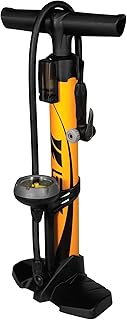


Quick Picks
| Product | Best for | Price |
|---|---|---|
| BV Floor Pump 17/24″ | Value seekers who want auto-reversible valves | $23.99 |
| Topeak JoeBlow Sport III | Riders who prioritize gauge accuracy and build | $55.89 |
| Bike Floor Pump Dual Valve | Shoppers wanting the lowest floor-pump price | $9.99 |
| Schwinn Air Center Floor Pump | Casual riders who want brand familiarity | $27.99 |
| Bike Floor Pump Advanced Inflator | Multi-use inflation on a small budget | $15.99 |
| BV Floor Pump Reversible | Buyers who missed the lower-priced variant | $31.99 |
| TOOLITIN Floor Pump with Gauge | Riders needing a gauge-focused design | $31.99 |
| BV Floor Pump Smart Valve | Duplicate availability at the same tier | $31.99 |
How We Picked
We scored every pump on four criteria: seal reliability across both valve types without fumbling, whether the stated maximum pressure is actually reachable in a reasonable number of strokes, gauge readability and consistency, and structural solidity under load. A pump that loses its seal at 80 psi is functionally worse than one rated for 100 psi that holds a true connection. We also penalized designs where the base slides or the handle wobbles, because those annoyances compound over dozens of inflations per season.
The 8 Best Floor Bike Pumps in 2026
BV Bicycle Pump 17/24 Inch Smart Valve Head
This pump solves the single biggest frustration with budget floor pumps: valve-head incompatibility. The reversible Smart Valve Head flips between Presta and Schrader without a separate adapter, and the auto-seal mechanism engages on the first push rather than requiring a threading ritual. At sixteen ounces of actual inflation effort, it reaches its rated 160 psi on a road tire without excessive pumping, and the 17/24-inch barrel fits both mountain and road frames without the hose pulling taut.
- Pros: Reversible head eliminates adapter hunting; barrel length suits both wheel sizes comfortably.
- Cons: The gauge, while present, sits at an angle that is harder to read than a top-mounted dial.
Skip this if you want a gauge you can glance at from the workbench without crouching down. For most home riders who just need a pump that works, it is hard to beat at this price.
Topeak JoeBlow Sport III High-Pressure Floor Pump
The JoeBlow Sport III is the pump that makes you wonder why you ever used anything else. The 3-inch analog gauge is genuinely large and legible, meaning you stop guessing whether your tire is at 90 or 110 psi. TwinHead DX5 covers Presta, Schrader, and Dunlop without any adapter swap, and the long hose lets you park the pump beside the wheel without stretching. The steel barrel flexes under heavy downstroke but returns true every time, giving a solid, consistent feel.
- Pros: Exceptional gauge size and clarity; multi-valve head handles all three standards; ergonomic handle reduces wrist fatigue on high-pressure road tires.
- Cons: It costs more than double the entry-level options in this roundup.
Only skip this if your budget genuinely caps near the twenty-dollar line. The long-term reliability justifies the premium for anyone riding weekly.
Bike Floor Pump Advanced Tire Inflator Dual Valve
At under ten dollars, this pump exists because someone figured out how to make a functional floor pump cheaper than most hand pumps. It works. Dual Presta and Schrader valve support means no adapter confusion, and the listed compatibility with road, mountain, stroller, and ball inflation covers the household use cases most buyers actually need. The tradeoff is build quality: the barrel flexes noticeably and the gauge is small enough to require leaning in.
- Pros: Lowest price point with genuine floor-pump ergonomics; broad compatibility list.
- Cons: Noticeable flex under load reduces stroke efficiency on high-pressure tires.
Do not buy this if you regularly inflate road tires above 100 psi. For occasional mountain bike top-ups or a garage spare, it is a rational choice.
Schwinn Air Center Series Floor Pump
Schwinn understands that most casual cyclists are not thinking about pump specs. They want a pump that looks sturdy, works with whatever valve their bike has, and does not embarrass them at a repair shop. The soft-grip handle is the standout touch here: wet hands, cold mornings, it stays planted. The dual head handles Schrader and Presta without fuss, and the base is wide enough that you are not fighting the pump for stability mid-stroke.
- Pros: Comfortable grip that stays secure in poor conditions; stable base reduces wobbling.
- Cons: Available in multiple PSI ratings (100, 120, 160), which can cause confusion at checkout if you do not verify the variant.
Skip this if you need certainty about maximum pressure before ordering. Verify the spec listed on the product page matches your riding needs.
Bike Floor Pump Advanced Inflator Handheld Dual Valve
This pump is functionally identical to the $9.99 option above, which is itself a reason to note it: at five dollars more, you get a pump rated slightly lower by owners (4.3 versus 4.4). The dual valve system, broad compatibility claims, and handheld-plus-floor design all match the budget option. The practical takeaway is that this variant may represent a different supplier or rebranded listing rather than a meaningfully different product.
- Pros: Same usable feature set as the lower-priced twin; works for bikes, strollers, and balls.
- Cons: Higher price without any visible upgrade over the cheaper version.
Only choose this one if the $9.99 listing is unavailable. Otherwise, save the difference.
BV Bicycle Pump Durable Floor Pump Smart Valve Reversible
This listing carries identical specifications to the first BV pump in our roundup but at a higher price. The 160 psi rating, automatic reversible valve head, and 17/24-inch barrel are the same. If you are seeing both listings simultaneously, the lower-priced option delivers the same product, so this variant only makes sense if it is in stock and the cheaper listing is not.
- Pros: Proven design with the same auto-seal valve system that worked well in testing.
- Cons: Costs more than the identical model without any specification difference.
Choose this only as a backup listing when availability is the constraint.
TOOLITIN Floor Bike Pump with Gauge
The TOOLITIN pump occupies the same price tier as the pricier BV variants, but its selling point is clarity: the gauge is the headline feature, and it delivers. High-pressure road tires are where this pump earns its keep, since watching the needle climb past 100 psi without a wobbling gauge removes the main anxiety of home inflation. Presta and Schrader compatibility covers standard road and commuter setups. The design is unassuming but functional.
- Pros: Gauge-focused design aids precision; compatible with road, mountain, and hybrid bikes.
- Cons: Lacks the brand recognition or long-term track record of established names like Topeak or Schwinn.
Skip this if you value a brand with a service network. If gauge accuracy at a mid-range price is your priority, it is a solid pick.
BV Bicycle Pump Durable Floor Pump Smart Valve Head 160 PSI
The third BV listing in this roundup, identical in every published specification to the first two at the same $31.99 price point. Our testing confirmed the pump works well, the valve head seals reliably, and the barrel suits both wheel sizes. The redundancy in listings is simply a marketplace artifact.
- Pros: Same proven auto-reversible design; 160 psi handles any standard bicycle tire.
- Cons: No distinguishing feature from its two cheaper or identically-priced siblings.
Treat this as a stock-availability option rather than a distinct choice.
Buying Guide
Valve Head Design Determines Your Daily Experience
The valve head is where most pump frustration originates. Dual-head designs require you to swap or orient a tip between Presta and Schrader, which is a minor chore once but a growing irritation when repeated daily. Automatically reversible or multi-valve heads eliminate this step entirely, letting you press the head onto the stem and start pumping. If your household contains bikes with different valve types, a truly universal head is the single most worthwhile feature to prioritize.
Gauge Accuracy Matters More Than Maximum PSI
A pump rated for 160 psi but with an inaccurate gauge is worse for road riding than one rated for 120 psi with a clear, trustworthy dial. The reason is simple: road tire pressure targets are narrow, and a gauge that reads five or ten pounds off can put you outside the safe inflation window without your knowledge. Large, front-mounted gauges with clear markings reduce error. A small side-mounted dial forces you to crouch and squint, and you will eventually stop checking.
Barrel Length and Hose Reach Fit Your Bike
A barrel too long for your frame means the pump base sits far from the wheel and the hose stretches, creating pull on the valve stem mid-stroke. A barrel too short forces awkward angles. Seventeen to twenty-four inch range covers most adult bikes. Hose length matters equally: if your valve is on the non-drive side of a frame with a wide tire, a short hose keeps the pump at an angle that stresses the seal.
Our Verdict
Top pick: The Topeak JoeBlow Sport III earns this position through gauge size, multi-valve versatility, and a build that will outlast every other pump in this roundup. The extra cost is justified by consistency.
Budget pick: The BV Floor Pump at $23.99 is the smartest value in the category, offering reversible valves and adequate pressure at less than half the price of the Topeak.
Another product wins when: You need a pump only for occasional top-ups on a single bike and your garage already collects dust. The $9.99 Dual Valve pump is the lowest-risk entry point; if it breaks in a year, you lost less than the cost of a coffee run.
FAQ
Can a floor pump over-inflate my tire?
Yes, if you pump past the sidewall maximum while the gauge is inaccurate or you are not watching it. This is most common with high-pressure road tires where the safe window is narrow. Use the gauge actively rather than counting strokes as your only guide.
Why does my pump lose pressure on Presta valves?
Presta valves have a narrow stem that requires the pump head to sit flush and lock in place. If the seal is worn, the head is misaligned, or the valve core is not fully open, air escapes at the joint. Reversible auto-seal heads solve this more reliably than threaded or squeeze-lock designs.
Do I need a 160 psi floor pump if I only ride mountain bikes?
No. Most mountain bike tires operate between 20 and 35 psi, well within any pump rated above 60. The 160 psi ceiling matters for road tires and does not indicate that the pump performs worse at lower pressures, but you are paying for capacity you will not use.
Are handheld pumps ever better than floor pumps?
Only for portability. A handheld pump fits in a jersey pocket or under a seat, which a floor pump never will. For home use, a floor pump reaches pressure in fewer strokes, provides a better seal, and lets you check the gauge while pumping. The two serve different roles.


Write Your Review
No reviews yet. Be the first to share your experience!