
Key takeaways
What's inside
Best ab roller exercises form a ladder that starts at a wall and ends standing, and almost everyone who gets hurt has skipped a rung. Each stage adds range rather than load, and the progression gate is whether the lower back stays flat.
As an Amazon Associate we earn from qualifying purchases at no extra cost to you. Product prices and availability are accurate as of the date shown and are subject to change.
As an Amazon Associate we earn from qualifying purchases at no extra cost to you. Product prices and availability are accurate as of the date shown and are subject to change.




By Chris Parker
🛒 Best Price Today on Amazon
Prime members get fast, free shipping on everything above, plus member-only deals. New members get a 30-day free trial — cancel anytime.
Start 30-Day Prime Free Trial →See Today’s Amazon DealsThe Progression Ladder of the Best Ab Roller Exercises
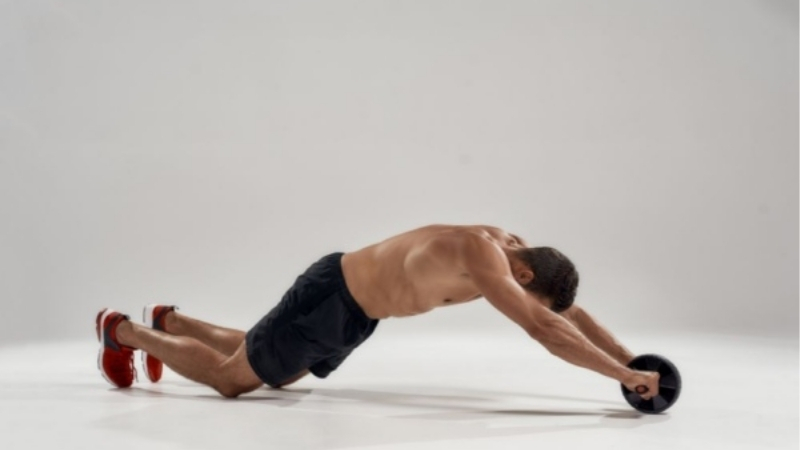
The best ab roller exercises are one movement performed at increasing ranges. That is why the best ab roller exercises are better understood as stages than as a list: wall rollouts, kneeling partial, kneeling full, then eccentric-only standing and finally standing rollouts.
Stage One: Wall Rollouts
Kneel a couple of feet from a wall and roll out until the wheel touches it. The wall caps the range, which lets you learn the bracing pattern without ever reaching a position you cannot return from.
Move the knees back an inch at a time as the position becomes easy. This is the single most useful stage and the one most people skip entirely, which is why partial-range kneeling rollouts feel impossible to them.
Stage Two: Kneeling Partial and Full Rollouts
Once the wall is a foot or more away, the movement becomes a genuine kneeling rollout. The gate here is the lower back: if it arches as you extend, you have gone past your current range regardless of whether you can get back.
Full kneeling rollouts, with the body almost horizontal, are the point at which most people stop progressing and start adding reps instead. Ten strict reps at full range is the correct gate before considering anything standing.
Stage Three: Band-Assisted and Eccentric Standing
A band anchored above and behind you, looped around the waist, removes part of the load at the extended position, which is exactly where standing rollouts fail. Dropping band width is the progression variable from here.
Eccentric-only standing rollouts are the other route: roll out slowly from standing, then drop to the knees to return. That trains the hardest portion without needing the strength to complete the concentric phase yet.
Space, Floor and Setup
Allow roughly 8 x 4 ft (2.4 x 1.2 m) of clear floor, since a standing rollout extends the body almost fully along the ground. Ceiling height is irrelevant here, which makes this one of the few exercises that suits a low room.
Floor surface decides whether the wheel behaves. Hard plastic slips on tile and laminate, rubber grips properly, and thick carpet makes the roll stiff. Interlocking mats give the most consistent surface and protect the knees.
Sets, Reps and How Often to Train
Three sets of five to ten strict reps is the working range, performed two or three times a week. Rollouts fatigue the bracing pattern faster than most core exercises, so quality falls off well before a high rep count is reached.
Progress by moving the knees back rather than by adding reps. Among the best ab roller exercises, range is the load variable, and pushing rep counts at a range you already own produces endurance rather than strength.
Market Context for Rollers and Aids
The mid tier resolves nearly everything in this category, because sealed bearings and wide rubber wheels are now standard at modest prices. Genuine premium models add convenience rather than a different training effect.
Below that tier the compromises are consistent: plain bushings that develop play, hard plastic wheels that slip, and handles that flex under load. The handle-to-axle joint is what fails first on the cheapest units.
The gap worth knowing about is padding. Almost no roller ships with a knee pad thick enough for the kneeling stages, so a proper mat is a required part of the purchase rather than an optional extra.
Gear for the Best Ab Roller Exercises
These seven cover the wheel itself plus one aid for each rung of the ladder. Each entry states which stage it serves and where it falls short.
| Product | Type | Serves Stage | Spec | Note |
|---|---|---|---|---|
| Vinsguir Ab Roller | Wide wheel | All stages | Rubber, sealed bearing | Best all-round |
| Perfect Fitness Ab Carver Pro | Assisted wheel | Stages one and two | Spring return | Reduces peak load |
| BalanceFrom Puzzle Mat | Flooring | Kneeling stages | 1/2 in (12.7 mm) | Effectively required |
| Serious Steel Flat Bands | Bands | Stage three | Graded widths | Needs an anchor |
| Anchor Gym H1 Wall Mount | Wall anchor | Stage three | Lag bolts to stud | Drilling required |
| Core Sliders | Sliding discs | Regression | Two-sided | Match disc to floor |
| Dual Narrow Wheel Roller | Narrow wheels | Advanced variation | Two wheels | Adds lateral demand |
Vinsguir Ab Roller
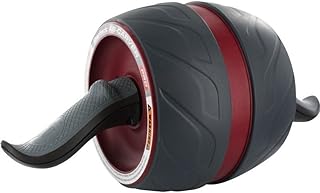
A wide rubber wheel with sealed bearings covers every stage of the ladder, from wall rollouts to standing, without any change of equipment. It grips tile and laminate properly, which is what makes the extended positions safe.
The included knee pad is thin enough that most people replace it immediately. The fixed handles also make it slightly bulkier to store than models that dismantle, though that is a minor cost.
Perfect Fitness Ab Carver Pro
Spring assistance helps most exactly where beginners fail, which is the return from the extended position. The contoured wide wheel also allows angled rollouts, adding an oblique variation the ladder otherwise lacks.
The assistance reduces load at the hardest point, which works against you once you are past the early stages. Wall rollouts with a plain wheel achieve the same regression for far less money.
BalanceFrom Puzzle Exercise Mat
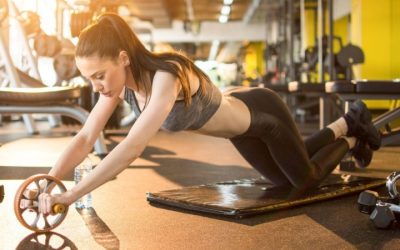
Every stage below standing is done from the knees, and half-inch interlocking tiles are what make that tolerable for more than a few sets. They also give the wheel a consistent grip surface and cut the noise.
Foam dents permanently under anything heavy left in place, so it suits bodyweight work rather than loaded equipment. Very soft mats also make the wheel feel sluggish and slow the rollout.
Serious Steel Flat Bands
Anchored above and behind you and looped around the waist, a flat band removes load exactly at the extended position where standing rollouts fail. Dropping band width is the clearest progression signal at stage three.
They need a solid anchor point, which is the practical barrier. Bands also fray where they cross an anchor and degrade in heat or sunlight, so storage in a drawer matters.
Anchor Gym H1 Wall Mount
A single ball anchor bolted into a stud gives the high anchor point that band-assisted rollouts require. It is small enough to be visually unobtrusive and serves every other band exercise as well.
Installation requires accurate stud location and lag bolts, which rules it out for many rented homes. It also provides only one height, so it is a single-purpose fixing unless you plan other band work.
Core Sliders
Hands on sliding discs, moving forward from the knees, replicates the rollout with far more control over the range. For anyone who cannot yet manage a wall rollout, this is the honest starting point.
The discs must match your floor, fabric for hard surfaces and plastic for carpet. They also lack the wheel’s momentum, so the transition to a roller still requires practice rather than being automatic.
Dual Narrow Wheel Roller
Two narrow wheels wobble laterally, which forces the obliques to resist rotation throughout the rollout. Once full kneeling rollouts are strict, this is a legitimate way to add difficulty without changing the range.
It is a poor first roller, because the instability makes the basic pattern harder to learn. The narrower contact patch also increases the slipping risk on smooth floors.
Frequently Asked Questions
These questions come up whenever someone tries a full kneeling rollout on day one and feels it entirely in the lower back.
Why do I feel rollouts in my lower back?
Because the range has exceeded your current bracing capacity and the spine is extending rather than staying rigid. Shorten the range with a wall until the back stays flat throughout, which is the gate every stage of the best ab roller exercises depends on.
How many reps should I do?
Five to ten strict reps per set, three sets, two or three times a week. Beyond that the quality drops before any extra benefit appears, and rollouts fatigue the bracing pattern quickly compared with most core exercises, so the last two reps of a long set are usually the ones where the back starts to arch.
How long until standing rollouts?
Several months for most people, and many never need them at all. Full kneeling rollouts at ten strict reps already load the trunk heavily, and standing versions carry a much higher risk if the range is misjudged, because there is no way to abandon the rep safely once you are past your limit.
Is the ab roller safe if I have back problems?
Existing back conditions are a matter for a doctor or a certified physiotherapist rather than a training article, and rollouts load the spine in extension under a long lever. Get an assessment before starting rather than testing your tolerance with the exercise.
See More:
- Ankle weights best
- Best rated ankle weights
- Best home workout equipment budget
- Best resistance bands for men
Final Thoughts
The best ab roller exercises are one movement at five ranges: wall rollouts, kneeling partial, kneeling full, band-assisted or eccentric standing, then standing. The gate at every stage is a flat lower back, not a rep count. Start at the wall with a mat under your knees and move it back an inch at a time.

Write Your Review
No reviews yet. Be the first to share your experience!