
Key takeaways
- Table of Contents 7 sections 9 min read 1 Quick Verdict 2 Side by Side 3 Where Power Rack Wins 4 Where Squat Stand Wins 5 Cost Over 5 Years 6 Which One for Your Home 6.1 Small apartment 6.2…
What's inside
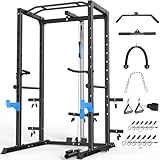
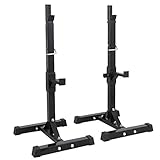
Choosing between a power rack and a squat stand is less about which one is “better” and more about how much safety, versatility, and floor space you want to buy. Both support a barbell for squats and presses, but they create very different home-gym experiences. A power rack surrounds the lifter with four uprights and adjustable safety bars. A squat stand uses two separate uprights, usually with a smaller footprint and fewer built-in features.
The real decision is whether you want one substantial piece of equipment that can anchor years of training, or a simpler, more portable setup that leaves room—and money—for other priorities. Your ceiling height, training alone, household traffic, and tolerance for setup and storage matter just as much as the listed weight capacity.
As an Amazon Associate we earn from qualifying purchases at no extra cost to you. Product prices and availability are accurate as of the date shown and are subject to change.


Quick Verdict
Choose a power rack if you lift alone, regularly train with a barbell, want built-in safety catches, or expect to add a bench, pull-up bar, dip handles, cable work, and other attachments. It is the more secure and expandable choice, but it normally costs more and occupies a permanent footprint.
Choose a squat stand if you have limited space, need to move equipment after workouts, mainly perform squats and presses, or want the lowest-cost path to barbell training. A stand can be entirely adequate for many lifters, provided it is stable, properly adjusted, and used with sensible loading.
Side by Side
| Consideration | Power rack | Squat stand |
|---|---|---|
| Comfort and confidence | Greater security from full-length safety bars or straps; easier to train alone | Open, quick to approach, but less forgiving if a rep fails |
| Durability | Typically 11-gauge to 14-gauge steel; heavier frames resist movement | Often lighter steel construction; stability depends heavily on the base and anchoring |
| Typical price range | About $250 to $1,500 before plates and a bench | About $60 to $500, with premium stands costing more |
| Maintenance | Inspect bolts, J-hooks, safeties, and pull-up or cable attachments | Fewer parts to check; inspect adjustment pins, feet, welds, and hardware |
| Space needed | Commonly about 48–54 inches wide, 48–54 inches deep, and 80–90 inches tall | Often about 40–50 inches wide and 20–30 inches deep; height is commonly 45–72 inches |
| Look | Permanent, dedicated-gym appearance | Minimal and less visually imposing |
| Resale | Strong demand for well-known, complete racks in good condition | Easy to sell when priced fairly, though entry-level stands have many competitors |
| Best for | Solo lifters, progressive strength training, and multi-exercise home gyms | Beginners, apartment users, limited budgets, and portable setups |
| Expandability | Usually supports pull-up bars, dip handles, cable systems, and storage | Limited; some models accept spotter arms or attachments, but compatibility varies |
Where Power Rack Wins
Safety is the biggest advantage. A properly positioned safety bar or strap can catch the bar if you cannot complete a squat or bench-press repetition. That does not make a rack fail-proof: safeties must be installed at the correct height, the rack must be assembled correctly, and bench pressing should use a compatible setup. Still, the surrounding frame gives solo lifters substantially more protection than lifting inside an open stand.
A rack also handles more training styles. In addition to squats and bench presses, you can perform rack pulls, overhead presses, barbell rows, pull-ups, and—in compatible models—lat pulldowns, cable exercises, dips, and landmine movements. A rack with 2-by-2-inch or 3-by-3-inch uprights and standard 1-inch or 5/8-inch holes offers a broad ecosystem of accessories, although holes and attachment sizes are not universally interchangeable.
It is also the better long-term platform for progressive training. A heavier rack may weigh roughly 200 to 500 pounds once assembled, while lighter models can weigh less. More mass generally reduces movement, and bolt-down holes provide another option when the manufacturer allows anchoring. If your goal is to build a dedicated strength room rather than a temporary workout corner, that stability can justify the larger footprint.
Home racks span a wide price range. For context, a rack with a listed price of $299.98, such as the ULTRA FUEGO Power Cage, sits in the entry-level range, while the $319.99 SPORTSROYALS Squat Rack is another example of a home cage with a comparatively broad feature set, including a lat-pulldown configuration. Treat listed capacities as manufacturer claims, not as a substitute for checking the frame, hardware, attachment ratings, and warranty.
Where Squat Stand Wins
A squat stand wins on simplicity. Two uprights are easier to place, adjust, and move than a full cage. Many stands fold, separate, or have transport wheels, making them useful in a garage that must still house a car or in a room that serves multiple purposes. You can often slide the components into a closet or against a wall after removing the bar.
The open design also provides easier access for walkouts, cleans, and other movements where you do not want to step through a cage. It is less visually dominant and can make a small room feel less crowded. However, the open sides mean you must have a reliable plan for missed reps. Spotter arms, safety pins, bumper plates, or a qualified training partner can help, but a basic stand without safeties is not equivalent to a power rack.
Price is the other clear advantage. The F2C Max Load 550Lbs adjustable squat rack is listed at $66.98, while the FitinOne adjustable rack is listed at $65.99. Those prices illustrate why stands are attractive for a first setup, though the total budget still needs to include a barbell, plates, flooring, and possibly a bench. At this price level, inspect the base width, adjustment mechanism, weld quality, feet, and whether the stated capacity applies to each upright or the complete pair.
Cost Over 5 Years
Compare total ownership cost rather than the rack’s sticker price. A basic squat stand priced around $65 to $150 could cost about $13 to $30 per year over five years, before accessories. A more substantial stand in the $200 to $500 range works out to roughly $40 to $100 per year. A home power rack priced around $300 to $800 costs approximately $60 to $160 per year, while premium systems priced near $1,000 to $1,500 cost $200 to $300 per year.
Those calculations assume the equipment remains usable for five years and exclude shipping, tax, plates, a bar, bench, flooring, and optional attachments. A rack can reduce future replacement costs if it accommodates your changing workouts, but you may spend more initially on a cable system, dip station, weight storage, or upgraded safeties. A stand may be the better value if you never use those features. Conversely, replacing a too-small stand after a year or two can erase its initial savings.
Which One for Your Home
Small apartment
Start with a squat stand unless you have a dedicated room and can confirm the dimensions. Measure the usable floor area, not just the empty corner: you need room to load the bar, walk around it, and place a bench. Check ceiling height too. A 72-inch stand may fit where an 84-inch rack will not, but overhead presses still require clearance for the bar. A foldable or separate-upright design is usually the least disruptive choice.
Family with kids or pets
A power rack is generally the safer choice because the bar and lifting area are more contained. Position it away from walkways, secure it according to the manufacturer’s instructions, and keep plates and collars stored so they cannot become trip hazards. No rack should be treated as childproof; lock or restrict access to the room, especially when a loaded bar is mounted.
Rental
A squat stand avoids permanent anchoring and is easier to take with you. Use protective flooring, respect building noise rules, and avoid dropping weights from a height. If you prefer a rack, choose a freestanding model with a stable base and verify that its depth and height work without drilling into the floor. A compact rack can be renter-friendly, but its weight and footprint still matter when moving day arrives.
Long-term home
Buy the power rack if you expect to train consistently for several years. Select a frame with compatible hole spacing, robust safeties, and enough interior depth for comfortable benching. Leave at least 24 inches of practical clearance around the rack where possible, and plan for plate storage so the room stays organized. The right rack can serve as the foundation for a complete home gym rather than a temporary bar holder.
FAQ
Is a power rack safer than a squat stand?
Usually, yes, because a power rack surrounds the lifter and provides adjustable safety bars or straps. Safety depends on correct setup, solid assembly, appropriate loading, and using the catches at the right height. Some squat stands include spotter arms, but a basic stand without them offers less protection during a failed repetition.
Can a squat stand handle heavy squats?
It can, if its construction, base, adjustment points, and rated capacity are appropriate for the load. A stand’s listed maximum is not the only consideration: racking the bar can create movement, and an unstable floor can reduce effective capacity. As weights increase, a wide, heavy, well-braced stand or a bolted rack becomes more appealing.
Do I need to bolt down a power rack?
Not always. Many freestanding racks are designed to be used without anchors, particularly when they have a substantial base and sufficient rear depth. Anchoring is recommended or required by some manufacturers, especially for pull-ups, kipping, or heavy attachments. Follow the manual and do not drill into a rental floor without permission.
Can I bench press safely in either option?
Yes, but the setup matters. A power rack should have safeties adjusted just below the bar path when your shoulders are on the bench. With a squat stand, use spotter arms or a competent spotter, and avoid collars if your training method requires dumping the plates in an emergency. The bench must also fit inside the stand or rack without interfering with its uprights.


Write Your Review
No reviews yet. Be the first to share your experience!