
Key takeaways
- One frame supports many exercises. A rack can handle squats, bench presses, overhead presses, barbell rows, rack pulls, pull-ups, and numerous band or cable movements.
- It improves training safety. Properly positioned safety bars or straps give you a place to fail a squat or bench press without relying entirely on a spotter.
- It can replace several machines. Add a bench, barbell, plates, and a pulley or landmine attachment, and one rack can cover much of a traditional gym routine.
- It supports progressive overload. Barbells and weight plates make it straightforward to increase resistance in small increments, which is useful for building strength.
- It is useful for multiple lifters. Adjustable J-hooks and safety positions allow people of different heights to train on the same rack.
- It can be economical over time. A rack costing $300 to $700 may pay for itself if it replaces a recurring gym membership and you use it consistently.
- Attachments extend its lifespan. Pull-up bars, dip stations, cable systems, landmines, and storage pegs can make the rack useful even as your program changes.
What's inside
The Short Answer
Yes—if you plan to train with a barbell at least two or three times per week and have enough room to use it safely. A power rack is one of the most versatile pieces of home-gym equipment because it supports squats, bench presses, overhead presses, rack pulls, pull-ups, and dozens of accessory exercises. If you mainly use dumbbells, resistance bands, or machines, however, a rack can become an expensive clothes hanger.
The best answer to “is a power rack worth it” depends on your training goals, available space, and willingness to anchor or stabilize the equipment. A basic rack may cost about $250 to $500, while a heavier, more complete setup with a bench, barbell, plates, and attachments can easily reach $1,000 to $2,000.
As an Amazon Associate we earn from qualifying purchases at no extra cost to you. Product prices and availability are accurate as of the date shown and are subject to change.

What You Actually Get
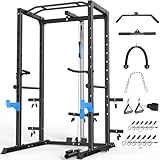
A power rack, also called a power cage, is a steel frame with four upright posts, adjustable bar supports, and horizontal safety bars or straps. You place the barbell inside the frame, set the supports at the appropriate height, and perform lifts within the cage. If you miss a rep, the safeties are designed to catch the bar before it reaches your body.
Most home racks measure roughly 45 to 55 inches wide, 45 to 65 inches deep, and 80 to 90 inches tall. Check your ceiling before buying. A rack listed at 83 inches may technically fit in a basement with an 84-inch ceiling, but pull-ups and overhead pressing can still be impractical. You need additional clearance above the frame and enough room to move around it.
Weight varies substantially. Compact racks may weigh around 100 to 180 pounds, while sturdier models can weigh 250 to 500 pounds before plates or attachments are added. Steel thickness, upright dimensions, hole spacing, hardware quality, and the way the rack connects to its base all affect stability. A claimed weight capacity of 800 or 1,200 pounds does not automatically mean the rack feels equally solid during every exercise.
Some racks are simple four-post frames. Others include a pull-up bar, dip handles, a landmine attachment, plate storage, or a cable pulley and lat-pulldown station. For example, the roughly $319.99 SPORTSROYALS Squat Rack combines a power cage with a lat-pulldown setup, while the approximately $299.98 ULTRA FUEGO Power Cage offers J-hooks, dip handles, a landmine attachment, and an optional cable system. These features can add value, but they also mean more assembly, more moving parts, and more space requirements.
Pros
- One frame supports many exercises. A rack can handle squats, bench presses, overhead presses, barbell rows, rack pulls, pull-ups, and numerous band or cable movements.
- It improves training safety. Properly positioned safety bars or straps give you a place to fail a squat or bench press without relying entirely on a spotter.
- It can replace several machines. Add a bench, barbell, plates, and a pulley or landmine attachment, and one rack can cover much of a traditional gym routine.
- It supports progressive overload. Barbells and weight plates make it straightforward to increase resistance in small increments, which is useful for building strength.
- It is useful for multiple lifters. Adjustable J-hooks and safety positions allow people of different heights to train on the same rack.
- It can be economical over time. A rack costing $300 to $700 may pay for itself if it replaces a recurring gym membership and you use it consistently.
- Attachments extend its lifespan. Pull-up bars, dip stations, cable systems, landmines, and storage pegs can make the rack useful even as your program changes.
Cons
- The total cost is higher than the rack price. A usable setup usually also needs a barbell costing about $100 to $350, plates costing roughly $1 to $3 per pound, and a bench costing about $100 to $400.
- It takes up permanent floor space. A rack may occupy around 15 to 25 square feet, but you also need clearance in front, behind, and to the sides for loading plates and moving safely.
- Assembly can be time-consuming. Expect a basic rack to take one to three hours to assemble, and longer if it includes cables, pulleys, or multiple attachments.
- Budget models may move during use. Lightweight racks can wobble during pull-ups, re-racking, or heavy squats unless they are bolted down or weighed down with plates.
- Stated capacity can be misleading. A high load rating may refer to static weight rather than dynamic lifting. The rack’s footprint, fasteners, safeties, and floor connection matter just as much.
- It can be noisy. Dropping plates, setting a bar on steel hooks, and using a cable attachment may disturb people in nearby rooms or apartments.
- It requires more technique and planning. A rack does not automatically make poor form safe. You still need to set the J-hooks and safeties correctly and learn how to bail out of a failed lift.
Who Should Buy It
A power rack is a strong choice for someone who wants to build a home strength-training setup around barbell exercises. It is particularly worthwhile if you squat, bench press, or press regularly; want to train without waiting for equipment; and have a dedicated area with a ceiling of about 90 inches or more.
It is also a good fit for households with multiple lifters. A rack with adjustable supports can serve beginners and experienced users, and a model with a pulley system or landmine can provide more exercise variety without buying separate machines.
Before purchasing, measure the exact installation area. Leave at least 24 inches of practical clearance on the sides for loading plates, about 36 inches in front for bar movement, and enough overhead space for pull-ups. If you plan to bench inside the rack, confirm that your bench fits between the uprights and that the safety bars adjust low enough to catch the bar near your chest.
Who Should Skip It
Skip a power rack if you do not intend to use a barbell consistently. For general fitness, walking, cycling, adjustable dumbbells, kettlebells, or resistance bands may provide more useful training per square foot.
Apartment dwellers should be cautious, especially on upper floors. A rack, plates, and lifting platform can create substantial noise and concentrated floor loads. You may also want to skip a full cage if your ceiling is low, your training room is temporary, or you cannot safely anchor a lightweight frame.
A rack is also a poor buy for someone who expects a single purchase to deliver a complete gym. Even a $300 rack does not include the bar, plates, bench, floor protection, or storage. Budget for the complete system rather than judging value from the frame alone.
Cheaper Alternatives
| Option | Cost | Trade-off |
|---|---|---|
| Adjustable dumbbells | $150–$500 | Excellent for pressing, rows, lunges, and general strength, but less convenient for very heavy squats and barbell work. |
| Resistance-band set with door anchor | $30–$150 | Very compact and quiet, but resistance is less consistent and the setup cannot replicate heavy barbell squats. |
| Pair of squat stands | $150–$350 | Uses less space and often costs less, but usually offers less side-to-side stability and fewer pull-up or attachment options than a cage. |
| Wall-mounted folding rack | $250–$700 | Frees floor space when folded, but requires a suitable wall, careful installation, and enough room to unfold safely. |
| Used power rack | $150–$500 | Can provide excellent value, but inspect welds, holes, safeties, bolts, rust, and missing hardware before buying. |
FAQ
Is a power rack safer than squat stands?
Generally, yes, because a cage provides adjustable safety bars or straps and limits the bar’s path during a failed lift. It is not risk-free, though. Set the safeties just below the lowest point of your movement, keep the rack on a level surface, and anchor it when the manufacturer recommends doing so.
How much should I spend on a home power rack?
Plan on about $250 to $500 for a basic rack, $500 to $1,000 for a heavier rack with better hardware or attachments, and more than $1,000 for a complete system with a bench, barbell, plates, and cable equipment. The best value is usually the rack that matches your actual lifts and space rather than the one with the largest advertised capacity.
Do I need to bolt a power rack to the floor?
Not always, but bolting is the most dependable way to prevent movement. Compact or lightweight racks may be acceptable when used with moderate weights and plate storage, but pull-ups and dynamic exercises can shift them. Follow the manufacturer’s instructions and use suitable hardware for your floor type.
Is a power rack worth it for beginners?
It can be, provided you are committed to learning barbell technique and training regularly. Beginners should start with manageable weights, practice setting the J-hooks and safeties, and consider a few sessions with a qualified coach. If you are still deciding whether strength training is a long-term habit, adjustable dumbbells or a basic bench may be a lower-risk first purchase.


Write Your Review
No reviews yet. Be the first to share your experience!