
Key takeaways
What's inside
Best kettlebell shoulder exercises work because the bell hangs behind the wrist rather than sitting on top of it, which loads the shoulder differently from a dumbbell. The press, the halo and the bottoms-up carry cover the whole joint, and this guide covers what each one needs.
As an Amazon Associate we earn from qualifying purchases at no extra cost to you. Product prices and availability are accurate as of the date shown and are subject to change.
As an Amazon Associate we earn from qualifying purchases at no extra cost to you. Product prices and availability are accurate as of the date shown and are subject to change.


By Chris Parker
🛒 Best Price Today on Amazon
Prime members get fast, free shipping on everything above, plus member-only deals. New members get a 30-day free trial — cancel anytime.
Start 30-Day Prime Free Trial →See Today’s Amazon DealsHow to Set Up the Best Kettlebell Shoulder Exercises
The best kettlebell shoulder exercises are limited by the smallest link in any kettlebell programme, so the press dictates your bell size while the swing could handle far more. Ceiling height, handle finish and the size jump between bells are the three things that decide whether these movements work at home.
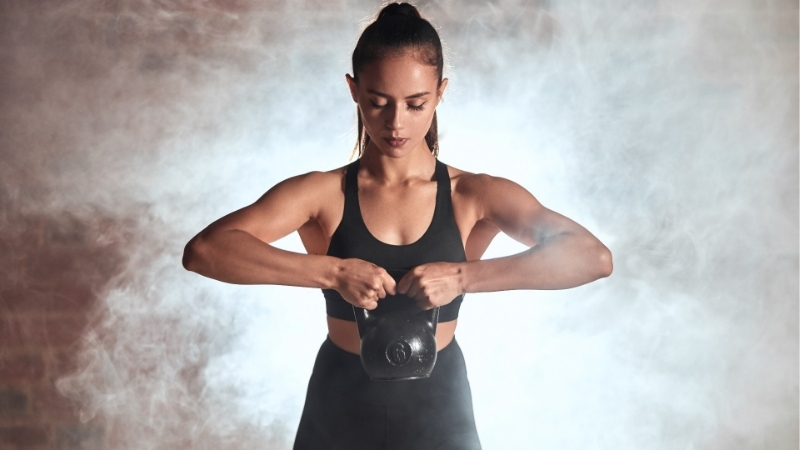
Ceiling Height and Overhead Footprint
Overhead work is measured with the arm extended and the bell above it, not to the top of your head. Standing presses need roughly 8-8.5 ft (2.4-2.6 m) of clear height for most adults, and low basement ceilings or sloped attic rooms rule out standing overhead work entirely.
Halos and bottoms-up carries need width rather than height, around 6 x 6 ft (1.8 x 1.8 m) with nothing breakable at arm’s length. Kneeling variations of the press solve most ceiling problems and add core work at the same time. Measure the height before planning anything overhead.
The Rack Position and Handle Finish
In the rack the bell rests against the forearm, and how comfortable that is depends on the handle finish and the bell’s shape. Powder coat behaves predictably; thick vinyl coating rolls awkwardly; painted steel gets slippery once you sweat and needs chalk.
Competition-style bells hold the same external dimensions across weights, so the contact point on your forearm stays identical as you get stronger. That consistency is worth more for pressing than for any other movement in kettlebell training.
Sizing the Bell for Pressing, Not Swinging
The press is always the weakest movement in a kettlebell session. Most untrained men press comfortably at 12-16 kg (26-35 lb) while swinging 20 kg or more, and most untrained women press at 6-8 kg (13-18 lb) while swinging 12 kg.
The 4 kg (about 9 lb) jump between sizes is harsh at the light end, where it can represent a 50 percent increase. Either buy consecutive sizes or use an adjustable bell, and progress through reps and tempo between the steps.
Warming Up the Shoulder Before Pressing
Cold shoulders press badly, and the halo doubles as the warm-up for everything that follows. Ten slow circles in each direction with a light bell moves the joint through its full range and settles the rack position before any loaded pressing begins.
A light bell for this purpose is worth owning separately. Warming up with your working weight defeats the point, and the best kettlebell shoulder exercises all start from a rack position that needs to feel settled rather than rushed.
Where the Equipment Market Sits
The mid tier holds the widest choice, and the differences below it show up specifically in the rack position: rougher casting seams inside the handle window, thicker coatings that roll on the forearm, and less consistent shaping between sizes. These matter more for pressing than for swinging.
Adjustable bells have filled the storage gap and they suit shoulder work well, because pressing benefits from smaller increments more than any other movement. The trade-off is a boxier profile against the forearm and a mechanism that must be checked before each set.
The steadier trend worth knowing is that home training is now treated as permanent rather than temporary, and mid-tier manufacturing has improved to match. A powder-coated bell bought today should outlast every band and mat in the same room, which changes how you weigh the price against the years of use.
Gear for the Best Kettlebell Shoulder Exercises
The list is short because the best kettlebell shoulder exercises need one bell and clear space. What the gear below solves is the rack comfort, the increment problem and the seated pressing option for rooms with low ceilings.
| Product | Type | Spec | Role | Note |
|---|---|---|---|---|
| Kettlebell Kings Powder Coat | Cast iron bell | Wide size range | Rack comfort | Seamless window |
| Titan Competition Style | Steel bell | 35 mm handle | Consistent contact | Same size each weight |
| Yes4All Powder Coated | Cast iron bell | 10-70 lb (4.5-32 kg) | Budget working bell | Best value |
| Bowflex SelectTech 840 | Adjustable | 8-40 lb (3.6-18 kg) | Small press increments | Do not drop |
| Kettlebell Wrist Guards | Protection | Neoprene sleeve | Cleaning to the rack | Learning phase |
| FLYBIRD Adjustable Bench | Bench | Multiple angles | Seated pressing | Folds flat |
| Liquid Chalk | Grip | Small bottle | Painted steel bells | Low mess indoors |
Kettlebell Kings Powder Coated
For pressing, handle quality stops being a luxury. A seamless window with a generous span means the bell settles into the rack position without a casting ridge digging into the hand, which is what ends longer pressing sets prematurely.
It costs meaningfully more per pound than budget cast iron, and the advantage is comfort rather than capability. If you own one good bell and several cheap ones, this should be the size you press with most often.
Titan Fitness Competition Style Kettlebell
Uniform external dimensions across weights mean the bell contacts your forearm in the same place at 12 kg as at 20 kg. For the best kettlebell shoulder exercises that consistency matters, because a shifting contact point changes the press groove as you progress.
The 35 mm handle is standardised rather than matched to your hand, and painted steel needs chalk once you sweat. It also costs more per pound than plain cast iron, so it suits committed users rather than first purchases.
Yes4All Powder Coated Kettlebell
The value option, and entirely adequate for pressing at the sizes most people start with. The powder coat holds chalk well and the price makes buying two consecutive sizes realistic, which is the practical answer to the 4 kg jump.
Casting varies unit to unit, and a seam in the handle window is felt most in the rack position rather than during swings. Check it by hand on arrival and smooth it with fine sandpaper before the first pressing session.
Bowflex SelectTech 840 Adjustable Kettlebell
Pressing benefits from smaller increments more than any other kettlebell movement, and an adjustable bell covering roughly 8-40 lb (3.6-18 kg) supplies exactly that. It also removes the storage argument against owning several sizes.
The boxier profile is most noticeable in the rack position, which is precisely where shoulder work lives, so it is a real trade-off rather than a cosmetic one. The selector must be confirmed seated before every set, and it must never be dropped.
Kettlebell Wrist Guards
Every press starts with a clean, and a mistimed clean lands the bell on the forearm hard. Neoprene sleeves absorb that during the weeks when the timing is still being learned, and they cost very little compared with a fortnight of bruising.
They mask feedback that is genuinely useful, so train without them periodically once the clean settles. They also add a little bulk in the rack, which slightly changes where the bell sits.
FLYBIRD Adjustable Weight Bench
A back support at 60-75 degrees allows seated pressing, which is the answer for rooms where standing overhead work does not fit under the ceiling. It also opens up chest-supported rear-delt work, which balances a pressing-heavy programme.
The pad is narrower than commercial equipment and there is a small gap where seat meets back. Check the assembly bolts after the first few sessions, since they can settle, and add padding if you also use it for hip work.
Liquid Chalk
Competition-style steel bells get slippery once your hands warm up, and a bell that rotates in the hand during a press is both unpleasant and unsafe. Liquid chalk fixes it cheaply and leaves no dust on carpet, which block chalk cannot claim.
It dries the skin with frequent use, and it needs a minute to dry before the first rep. On painted bells it can leave a light residue that is worth wiping down at the end of the session.
Frequently Asked Questions
These questions come up whenever someone adds pressing to a programme that previously consisted mostly of swings.
Why press a kettlebell instead of a dumbbell?
The mass hangs behind and below the hand rather than sitting in line with it, which creates a rotational demand the shoulder has to resist throughout the rep. That is what makes the best kettlebell shoulder exercises feel harder at the same weight.
What is the bottoms-up press actually for?
Holding the bell inverted forces the grip and the rotator cuff to stabilise constantly, and it exposes any wobble instantly. It is trained light, usually at half your normal press weight or less, and it works better as a warm-up than as a strength lift.
My shoulder pinches at the top of the press. What should I do?
Persistent pinching or pain is a matter for a doctor or a certified physiotherapist rather than something to work around. Stop the painful range in the meantime, and get it assessed rather than adding volume in the hope it settles.
Can I train shoulders with a low ceiling?
Yes. Half-kneeling and tall-kneeling presses drop your height by roughly 12-18 in (30-46 cm), and seated pressing on a bench drops it further. Halos and bottoms-up carries need no overhead space at all.
See More:
- Ankle weights best
- Best rated ankle weights
- Best home workout equipment budget
- Best resistance bands for men
Final Thoughts
The best kettlebell shoulder exercises are the press, the halo and the bottoms-up carry, and all three are limited by the same two things: ceiling height and the size jump between bells. Size the bell for your press rather than your swing, and measure the clear height with your arm extended before you plan any standing overhead work.



Write Your Review
No reviews yet. Be the first to share your experience!