
Key takeaways
What's inside
Best shoes for kettlebell training is really a question about soles: flat, firm and wide, because a swing is a hip hinge that needs the floor pushed away evenly. Running shoes do the opposite. Here is what to look for and six options worth considering.
As an Amazon Associate we earn from qualifying purchases at no extra cost to you. Product prices and availability are accurate as of the date shown and are subject to change.
As an Amazon Associate we earn from qualifying purchases at no extra cost to you. Product prices and availability are accurate as of the date shown and are subject to change.



By Chris Parker
🛒 Best Price Today on Amazon
Prime members get fast, free shipping on everything above, plus member-only deals. New members get a 30-day free trial — cancel anytime.
Start 30-Day Prime Free Trial →See Today’s Amazon DealsHow to Choose the Best Shoes for Kettlebell Training
Three numbers decide the best shoes for kettlebell training: stack height, heel-to-toe drop and outsole firmness. A cushioned running shoe compresses under load and tips you forward, which is exactly wrong for a hinge. Everything below follows from that single mechanical point.
Stack Height, Drop and Floor Feel
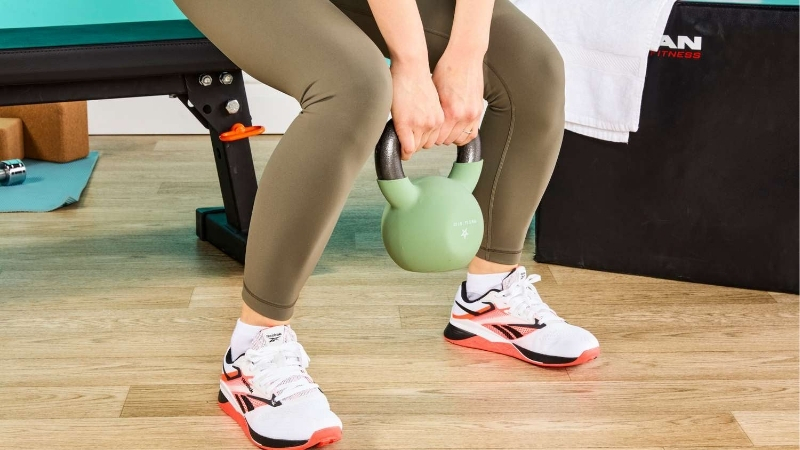
Drop is the height difference between heel and forefoot. Barefoot-style shoes sit at zero, most cross-trainers between about 4 mm and 7 mm, and running shoes far higher. For hinging, lower is better, because a raised heel shifts load toward the quadriceps and away from the hamstrings.
Stack height matters just as much. A thin, firm sole around 3-6 mm lets you feel where your weight sits over the midfoot, which is the feedback that keeps a swing balanced. Thick foam removes that information and makes heavy sets feel unstable.
Footprint, Storage and Floor Compatibility
The footprint that matters here is the shoe on your floor rather than the equipment in your room. Gum and plain rubber outsoles grip hardwood and foam matting without marking, while aggressive lugged outsoles designed for trails catch on foam tiles and tear them.
If you train on interlocking foam, check the outsole pattern before buying. Deep lugs also collect grit from outdoors, which then gets ground into the mat. A dedicated indoor pair kept by the training square solves this and takes almost no storage space.
Toe Box Width and Lateral Support
Toes spread under load, and a narrow toe box stops that happening. Wide, foot-shaped toe boxes let the foot form a stable base during heavy swings and goblet squats, which is the main practical advantage barefoot-style shoes hold over conventional trainers.
Lateral support cuts the other way. Complexes with lunges and lateral movement benefit from a firmer upper that holds the foot, which is where cross-training designs beat minimal shoes. Choose based on whether your sessions are mostly straight-line hinging or mixed movement.
Sizing, Break-In and Sock Choice
Fit decides more than the specification sheet. Barefoot-style shoes are shaped wider at the toes rather than simply made longer, so your usual length is generally correct, and sizing up creates slop that undermines the stability you bought the shoe for in the first place.
Break-in varies sharply across the best shoes for kettlebell training. Canvas and knitted uppers are comfortable immediately, while one-piece synthetic uppers stay stiff for a couple of weeks. Thin socks suit minimal shoes; thick cushioned socks fill space and defeat the purpose.
What the Training Footwear Market Offers Now
The flat, firm end of the market has widened considerably, and barefoot-style options are no longer a specialist purchase at a specialist price. Mid-tier models now cover zero drop and wide toe boxes, which was not true a few years ago.
Below the mid tier the compromises are predictable: thinner uppers that stretch out of shape within months, glued rather than stitched sole joins that separate at the toe, and outsole rubber that wears smooth quickly on abrasive matting. The sole join is the one to inspect first.
Late summer into autumn is when home training picks up as evenings draw in, and it is also when last season’s colourways clear at a discount. Since fit rather than colour is what matters for the best shoes for kettlebell training, an older colourway in the right size is usually the better buy.
Top Picks: Best Shoes for Kettlebell Training
These six cover the barefoot end, the cross-training end and the cheap classic that has served lifters for decades. Each entry notes what it is genuinely good at and where it falls short.
| Shoe | Style | Drop | Toe Box | Best For |
|---|---|---|---|---|
| Converse Chuck 70 | Canvas classic | Flat firm sole | Narrow to medium | Budget option |
| Xero Shoes Prio | Barefoot | Zero drop | Wide | Floor feel |
| Vivobarefoot Primus Lite | Barefoot | Zero drop | Wide | Thin, flexible sole |
| Inov-8 Bare-XF 210 | Barefoot trainer | Zero drop | Wide | Rope and lateral work |
| Reebok Nano | Cross-trainer | About 7 mm | Medium to wide | Mixed sessions |
| NOBULL Trainer | Cross-trainer | About 4 mm | Medium | Durability |
| Merrell Vapor Glove | Barefoot | Zero drop | Medium to wide | Thinnest sole here |
Converse Chuck 70
The canvas classic has been a lifting shoe for decades for one reason: the outsole is flat, firm and does not compress under load. For swings, deadlifts and goblet squats that is most of what the job requires, and the price is a fraction of a purpose-built trainer.
The toe box is narrow by modern standards and the canvas upper offers almost no lateral support, so lunging complexes feel loose. There is also no arch support at all, which some people find uncomfortable during longer standing sessions.
Xero Shoes Prio
A thin FeelTrue outsole around 5.5 mm with zero drop and a wide toe box makes this one of the best shoes for kettlebell training for anyone who wants floor feedback. The removable insole lets you go thinner still once your feet adapt.
The transition is real: coming from cushioned trainers, calves and arches complain for the first few weeks. The thin sole also offers little protection if a bell clips your foot, which is an argument for careful technique rather than for the shoe.
Vivobarefoot Primus Lite
A puncture-resistant sole around 4 mm thick with a foot-shaped last gives excellent ground feel while staying flexible enough for floor work and stretching. It looks unremarkable enough to wear outside the training square, which some people value.
It sits at the premium end of this list, and the thin upper is not built for outdoor abrasion. Like all barefoot designs it needs a gradual adaptation period, and it offers no cushioning if you also run.
Inov-8 Bare-XF 210
Zero drop with a sole around 3 mm, reinforced rope-guard sides and a wider fit make this the barefoot option that handles mixed sessions best. It grips foam matting well without the deep lugs that tear tiles.
The sole is firm to the point of feeling harsh on concrete, and the narrow heel does not suit every foot shape. It is also a specialist product, which means sizing advice varies and trying a pair on locally is rarely possible.
Reebok Nano
At around 7 mm of drop the Nano is the most conventional shoe here, and that is the point: enough cushioning for jumping and running intervals, enough firmness in the heel for hinging. For sessions that mix kettlebells with conditioning it is the sensible compromise.
That 7 mm heel is higher than ideal for pure hinge work, and the shoe is heavier than any barefoot option. Fit runs narrow through the midfoot in most versions, which is worth checking against your foot shape.
NOBULL Trainer
A firm outsole at roughly 4 mm of drop and a one-piece upper make this the durability pick. It resists abrasion better than knitted trainers, and the flat platform is stable under heavy swings and front squats without feeling harsh.
The upper is stiff out of the box and takes time to break in, and there is minimal cushioning if your session includes any running. Sizing is medium rather than wide, so it suits average rather than broad feet.
Merrell Vapor Glove
This is the thinnest sole on the list, with zero drop and a Vibram outsole that grips foam matting and hardwood without marking. For pure ground feel during heavy swings and goblet squats it gives more feedback than anything else here.
That thinness is also the drawback: there is no protection at all if a bell clips your foot, and the shoe offers nothing for running or jumping. Adaptation from cushioned trainers takes several weeks and should be gradual rather than immediate.
Frequently Asked Questions
These are the questions that come up whenever someone realises their running shoes are working against them during swings, and starts looking for the best shoes for kettlebell training instead.
Can I just train barefoot?
Yes, and many people do. Bare feet give the best floor feel and cost nothing, but they offer no protection if a bell brushes a toe and no grip on a slick floor. Shoes are a convenience and safety choice rather than a performance requirement.
Are weightlifting shoes with a raised heel a good option?
Not for kettlebell work. The raised heel is designed for deep squatting and it actively works against a hip hinge by shifting load forward. Keep them for barbell squatting if you own a pair, and use flat shoes for swings.
How long do training shoes last?
For indoor kettlebell use, considerably longer than running shoes, because there is no repeated impact. The usual failure points are the sole join at the toe and the upper stretching out of shape, both of which show up before the outsole wears through.
Do I need to size up for a wide toe box?
Usually not. Barefoot-style shoes are shaped wider at the toes rather than simply made larger, so your normal length with the wider last is generally correct. Measure your foot length against the brand chart rather than assuming your usual size.
See More:
- Ankle weights best
- Best rated ankle weights
- Best home workout equipment budget
- Best resistance bands for men
Final Thoughts
The best shoes for kettlebell training are flat, firm and wide enough to let your toes spread, which rules out almost every running shoe. Barefoot models give the most floor feedback, cross-trainers suit mixed sessions, and a canvas classic covers the basics cheaply. Check the outsole pattern against your flooring before ordering.



Write Your Review
No reviews yet. Be the first to share your experience!