
Key takeaways
What's inside
Best barbell pad for hip thrusts fails in one of two ways: too thin and the bar bruises the hip bones, or too slippery and it rolls up your abdomen mid-set. Thickness and grip are the two specifications, and most listings mention neither properly.
As an Amazon Associate we earn from qualifying purchases at no extra cost to you. Product prices and availability are accurate as of the date shown and are subject to change.
As an Amazon Associate we earn from qualifying purchases at no extra cost to you. Product prices and availability are accurate as of the date shown and are subject to change.




By Chris Parker
🛒 Best Price Today on Amazon
Prime members get fast, free shipping on everything above, plus member-only deals. New members get a 30-day free trial — cancel anytime.
Start 30-Day Prime Free Trial →See Today’s Amazon DealsHow to Choose the Best Barbell Pad for Hip Thrusts
Squat pads and hip thrust pads are not the same product, which is the first thing to establish. A squat pad sits on soft tissue across the traps, while the best barbell pad for hip thrusts sits directly on the pelvis, which is bone, and that changes what thickness is adequate.
Thickness and Foam Density
Thin general-purpose pads around 0.5 in (13 mm) of foam are inadequate once the load climbs, because the foam bottoms out and the bar contacts the pelvis through it. Dedicated hip thrust pads use considerably more material.
Density matters as much as thickness. A soft 1.5 in (38 mm) pad that compresses fully is worse than a firmer 1 in (25 mm) pad that holds its shape, so press the foam hard with a thumb rather than reading the stated thickness alone.
Grip and Whether It Rolls
Rolling is the complaint that ends most pads. A pad with a smooth nylon outer slides along the bar and up the body as the hips extend, which interrupts the set and puts the bar somewhere it should not be.
Look for a textured or rubberised inner surface and a Velcro closure that wraps fully rather than butting together. A pad that grips the bar rather than floating on it stays where you put it through a full set.
Inner Diameter and Bar Fit
Pads are sized for a shaft around 28-29 mm, and most fit any Olympic bar. What varies is whether the pad closes tightly enough on a thinner 25 mm bar, where a loose wrap allows rotation.
Length is usually around 17-18 in (43-46 cm), which covers the hips for most people. Broader hips benefit from the longer pads, and a pad that is too short leaves the bar contacting bone at the edges.
Storage Footprint and Alternatives
A rolled pad occupies roughly the volume of a shoebox and lives on a shelf or a rack peg, so storage is rarely the issue. It is one of the few pieces of gym equipment that adds no footprint at all.
Free alternatives exist and work. A folded exercise mat or a thick towel wrapped around the bar cushions adequately at moderate loads, though neither grips the bar, so both slide more than a purpose-made pad.
Bar Position and Where the Pressure Sits
Even a good pad fails if the bar sits in the wrong place. The bar belongs in the crease of the hips rather than across the lower abdomen, and a few inches too high concentrates pressure on soft tissue instead of the pelvis.
Setting up with the bar rolled into position while seated, then lifting into the start, keeps it there. The best barbell pad for hip thrusts makes a correct position comfortable rather than making a wrong position survivable.
Market Context for Pads
Most pads on the market are squat pads that mention hip thrusts as an afterthought, which is why so many are too thin for the job. Genuinely hip-thrust-specific pads are a narrow slice of the shelf.
Below the mid tier the compromises are predictable: open-cell foam that takes a permanent dent within months, Velcro that stops holding after a season of chalk exposure, and outer fabric that splits at the seam. The seam is what to inspect.
The useful development is that thicker high-density pads have moved down into ordinary pricing, which means the choice is no longer between a thin general pad and improvising with a folded mat.
Top Picks: Best Barbell Pad for Hip Thrusts
These seven candidates for the best barbell pad for hip thrusts span dedicated thick pads, general-purpose squat pads and the free alternatives worth knowing about. Each entry states the thickness where published and the honest weakness.
| Product | Type | Thickness | Grip | Best For |
|---|---|---|---|---|
| Iron Bull Strength Advanced Squat Pad | Thick pad | Extra thick foam | Textured inner | Heavier loading |
| Hampton Fitness Thick Bar Pad | Thick pad | High density | Firm wrap | Holds shape |
| Rogue Hip Thrust Pad | Dedicated pad | Purpose built | Grippy outer | Stays in place |
| ProsourceFit Barbell Squat Pad | General pad | Standard foam | Nylon outer | Light loads |
| Yes4All Barbell Pad | General pad | Standard foam | Nylon outer | Budget entry |
| Folded Exercise Mat | Improvised | Adjustable by folds | None | Free alternative |
| Hip Thrust Bench Pad | Bench padding | Thick upholstery | Not applicable | Back comfort |
Iron Bull Strength Advanced Squat Pad
Noticeably thicker than a standard squat pad, which is exactly what hip thrusts need once the bar is loaded past bodyweight. The textured inner surface grips the shaft, so it stays where you set it through a full set of reps.
The extra bulk makes it slightly awkward on a narrow bar and it is more expensive than general-purpose pads. Some users also find the added diameter changes the bar position across the hips slightly.
Hampton Fitness Thick Bar Pad
Higher-density foam that holds its shape rather than bottoming out is the argument here. Under heavier loading that matters more than raw thickness, because a pad that compresses fully offers no protection at all.
It is firmer than most people expect on first use, which feels less cushioned even though it protects better. It also sits at the upper end of the price range for what is a simple product.
Rogue Hip Thrust Pad
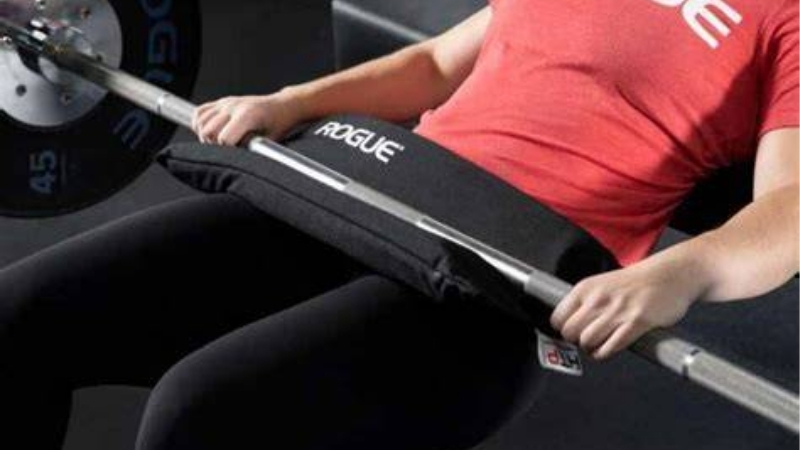
Purpose-built for the movement rather than adapted from a squat pad, with a grippier outer and dimensions suited to sitting across the pelvis rather than the traps. It solves the rolling problem more completely than general pads.
It is a single-purpose item, so it makes less sense if you also want a pad for squats or lunges. Availability outside North America can also be inconsistent.
ProsourceFit Barbell Squat Pad
A standard general-purpose pad that covers squats, lunges and light hip thrusts perfectly well. For someone whose hip thrust load is still moderate, it is entirely adequate and considerably cheaper.
Once the bar is loaded heavily, the foam bottoms out and the hip bones feel it. The smooth nylon outer also slides on the bar, which is the source of most rolling complaints in this price bracket.
Yes4All Barbell Pad
The budget entry and a reasonable first purchase to find out whether the movement suits you. It cushions adequately at light loads and costs little enough that outgrowing it is not a wasted purchase.
The foam compresses permanently within months of regular use, and the Velcro loses grip once it has been exposed to chalk. Expect it to be a consumable rather than a long-term item.
Folded Exercise Mat
Folding a 1/2 in (12.7 mm) mat into three gives roughly 1.5 in (38 mm) of foam for nothing, and you can add folds as the load increases. It is the cheapest workable answer and many lifters never move past it.
It does not grip the bar at all, so it slides and needs repositioning between sets. Getting it evenly placed under a loaded bar solo is also fiddly compared with a wrapped pad.
Hip Thrust Bench Pad
The other contact point people forget is the upper back against the bench edge. A padded bench cover spreads that pressure, which for many lifters is the more painful part of the movement than the bar across the hips.
It solves a different problem, so it is an addition rather than an alternative to a bar pad. It also needs to fit your specific bench width to stay in place during the set.
Frequently Asked Questions
These questions come up as soon as someone tries hip thrusts with the standard squat pad already in their gym bag.
Can I use a squat pad for hip thrusts?
At light loads, yes. Once the bar is loaded past bodyweight, standard pads bottom out against the pelvis and the best barbell pad for hip thrusts becomes a genuinely different product with more foam and a grippier surface.
Why does my pad keep rolling up my body?
Because the outer surface is smooth and the pad is floating on the bar rather than gripping it. A textured inner and a full Velcro wrap fixes it, and tightening the wrap before each set helps with any pad.
How thick should the pad be?
Enough that firm thumb pressure does not reach the bar through it. That usually means more than 1 in (25 mm) of dense foam for moderate loads, and more again as the weight climbs.
Does a folded towel work?
At light loads it cushions adequately, though it compresses quickly and slides constantly. A folded exercise mat is a better free option because the foam holds its shape far better than fabric does.
See More:
- Ankle weights best
- Best rated ankle weights
- Best home workout equipment budget
- Best resistance bands for men
Final Thoughts
The best barbell pad for hip thrusts is thicker and denser than a squat pad and grips the bar rather than sliding on it. Test the foam with firm thumb pressure rather than trusting the stated thickness, and remember that a folded exercise mat covers the job for nothing while you decide.


Write Your Review
No reviews yet. Be the first to share your experience!