
Key takeaways
- Chrome: Common on entry-level bars and easy to wipe clean. A chrome bar, such as a 35-pound, 7-foot CAP Olympic bar, can be a practical indoor option. Quality varies: lower-cost chrome can chip or wear where plates contact the sleeves.
- Zinc: Usually found on budget and mid-priced bars. It offers basic corrosion protection, though it can dull over time.
- Black oxide: Gives a dark appearance and a more natural steel feel in the hands, but needs regular brushing and oiling in damp spaces.
- Cerakote: A durable colored coating often found on higher-priced bars. It resists corrosion well, though the coating can slightly soften the feel of the knurl.
- Stainless steel: Offers excellent corrosion resistance and a natural grip feel, but usually costs more than $300.
What's inside
Buying your first barbell is easy to overthink—and just as easy to get wrong. Many beginners buy the cheapest bar they can find, only to discover that it does not fit their plates, is too short for their rack, has uncomfortable knurling, or flexes noticeably during basic lifts. Others spend heavily on a specialty powerlifting or Olympic weightlifting bar before they know how they will actually train.
The right first barbell is usually a simple, full-length Olympic bar with standard 2-inch sleeves, enough load capacity for long-term progress, and a finish that suits the humidity of your training space. For most home gyms in 2026, the goal is not to buy the most expensive bar; it is to buy one that safely fits your room, rack, plates, and workout plan.
As an Amazon Associate we earn from qualifying purchases at no extra cost to you. Product prices and availability are accurate as of the date shown and are subject to change.


Decide These 3 Things First
- What lifts will you do? For general strength training, squats, deadlifts, presses, rows, and bench presses, a multipurpose Olympic bar is the practical default. If you only need light curls, presses, and beginner workouts, a shorter standard or threaded barbell set may be enough.
- What equipment do you already own? Olympic barbells use plates with 2-inch center holes and sleeves about 1.96 inches in diameter. Standard bars usually use 1-inch plates. These systems are not interchangeable without adapters, which can be awkward and reduce usable sleeve space.
- How much space do you have? A conventional Olympic bar is about 7 feet long. Measure the room, rack, and clearance around it before ordering. A 6-foot bar can work in compact spaces, but may not sit correctly in every power rack.
Barbell Size and Fit
For most adult beginners, a 7-foot Olympic barbell is the safest all-around choice. A typical men’s-style Olympic bar weighs 45 pounds, measures approximately 86 to 87 inches long, and has a 28 to 29 mm shaft diameter. It generally has about 16 inches between the inner collars, allowing it to fit standard squat stands, bench press stations, and power racks.
A 6-foot Olympic training bar is a sensible alternative for smaller rooms, apartment gyms, or users who do not need a full rack setup. Many weigh 15 to 33 pounds, depending on construction. Before choosing one, measure the distance between your rack’s J-cups. If the rack requires at least 46 to 48 inches between uprights, a compact bar with a shorter shaft may not rack safely.
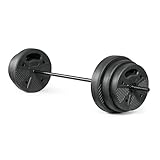
Threaded standard barbells, such as 47-inch bars included in some 100-pound cement-plate sets, are much more compact. They can be useful for curls, floor presses, rows, and basic strength work. However, they are generally too short for conventional rack work, and their threaded sleeves make plate changes slower. A starter set can be a good value when budget and space are tight, but it is not the same as building around a full Olympic system.
Material, Finish, and Rust Resistance
Most affordable barbells use steel shafts with a protective finish. The finish matters because bare steel can rust, especially in garages, basements, sheds, and humid climates.
- Chrome: Common on entry-level bars and easy to wipe clean. A chrome bar, such as a 35-pound, 7-foot CAP Olympic bar, can be a practical indoor option. Quality varies: lower-cost chrome can chip or wear where plates contact the sleeves.
- Zinc: Usually found on budget and mid-priced bars. It offers basic corrosion protection, though it can dull over time.
- Black oxide: Gives a dark appearance and a more natural steel feel in the hands, but needs regular brushing and oiling in damp spaces.
- Cerakote: A durable colored coating often found on higher-priced bars. It resists corrosion well, though the coating can slightly soften the feel of the knurl.
- Stainless steel: Offers excellent corrosion resistance and a natural grip feel, but usually costs more than $300.
For a climate-controlled indoor room, chrome or zinc is usually sufficient. For an unconditioned garage, prioritize stainless steel, Cerakote, or a well-maintained black oxide bar. Regardless of finish, wipe chalk, sweat, and dust from the shaft after training. Do not leave plates loaded on the sleeves for weeks at a time.
Construction, Load Rating, and Sleeves
A beginner should look beyond the headline weight capacity. A bar rated for 300 pounds may be entirely adequate for light-to-moderate home training, especially if you expect to stay under roughly 200 to 250 pounds on the bar. For a bar intended to support years of squats, deadlifts, and bench presses, a stated rating of 700 pounds or more provides more useful margin.
Remember that a barbell’s total load includes the bar itself. A 45-pound bar loaded with two 45-pound plates per side weighs 225 pounds total. With four 45-pound plates per side, it weighs 405 pounds total. Buy based on the heaviest total weight you realistically expect to use over the next several years—not only your current working weight.
Sleeve construction affects how the bar feels. Basic bars may use bushings, while more expensive bars may use needle bearings.
- Bushings: Durable, lower-maintenance, and ideal for general strength work, powerlifting-style training, and beginners.
- Bearings: Spin more freely and are useful for Olympic-style lifts such as cleans and snatches. They are not necessary for basic squats, presses, and deadlifts.
Look for Olympic sleeves around 16 inches long if you plan to add substantial weight. Shorter sleeves limit how many plates fit. A bar with snap-ring or end-cap sleeve retention is generally preferable to a visibly bolted sleeve on a heavily used bar, though a basic bolted bar can still serve lighter home workouts well when regularly inspected.
Comfort and Performance Features
The shaft diameter and knurl pattern determine much of a bar’s day-to-day comfort. Most multipurpose bars use a 28.5 mm or 29 mm shaft. A 28 mm shaft is common for Olympic lifting bars and may feel easier to grip for smaller hands, while a 29 mm shaft feels stiffer and is common on power bars.
For a first bar, choose moderate knurling: enough texture to keep the bar secure during deadlifts, but not so aggressive that it tears up your hands during high-repetition rows or cleans. Deep, sharp knurling is useful for some heavy powerlifting specialists, not most new lifters.
Center knurl is another practical detail. It helps the bar stay in place during back squats, but can feel abrasive against the neck during front squats or high-bar squats. A multipurpose bar may have no center knurl or a lighter center section. If back squats will be a major part of your program, a light center knurl can be worthwhile.
Also consider bar whip, or flex. A stiff bar feels predictable for squats, presses, and deadlifts. A more flexible bar can be useful for Olympic lifting, but it is not a feature beginners need to chase. Technique, secure collars, and a stable rack matter more.
Price Tiers and What You Get
Budget: $70 to $130. This category includes basic Olympic bars and compact threaded sets. A $79.99 7-foot chrome Olympic bar can make sense for a beginner with Olympic plates and modest strength goals. Expect simpler finishes, bushings, and lower stated load ratings. Inspect the sleeves and collars periodically, and do not assume every low-cost bar is suitable for repeated heavy drops.
Starter package: $150 to $300. This is often the best route for someone starting from nothing. For example, an Olympic starter weight set priced around $183 can provide a bar, plates, and collars in one purchase. Check exactly how much weight is included, whether the plates are cement-filled or cast iron, and whether the bar is 5, 6, or 7 feet long.
Mid-range: $180 to $350 for the bar alone. Expect better steel, more consistent knurling, smoother sleeves, and stated load ratings commonly above 700 pounds. This is the sweet spot for a home gym owner who wants one bar for years of general training.
Premium: $350 to $700 or more. Premium bars may offer stainless steel, Cerakote, tighter manufacturing tolerances, higher-quality bearings, or sport-specific designs. They are worthwhile for dedicated lifters, but are not required to learn the basic barbell lifts safely.
Warranty and Long-Term Support
Read the warranty before treating a bar as a long-term investment. Budget bars may offer 30 days to 1 year of coverage, while established fitness brands may offer 5 years, a limited lifetime warranty, or separate coverage for the shaft and sleeves.
Check what the warranty excludes. Common exclusions include cosmetic finish wear, rust caused by poor storage, damage from dropping an unloaded bar, commercial use, and misuse with concrete floors. A “lifetime” warranty may apply only to manufacturing defects, not normal wear.
Keep your receipt, order confirmation, and photos of the bar upon delivery. If a bar arrives bent, has loose sleeves, damaged threads, or uneven knurling, report it before loading it. A bar that rolls unevenly on a flat floor may be bent, although minor visual movement can also come from sleeve construction.
Delivery, Assembly, and Safe Setup
Barbells are long, heavy packages. A 45-pound bar shipped in an 87-inch carton may be difficult to bring through narrow hallways or upstairs alone. Confirm delivery access, especially in apartment buildings. Plates are often shipped separately in multiple boxes; a 200-pound set may arrive as four or more cartons.
Most Olympic barbells need no assembly beyond removing protective packaging. You will need collars, plates, and ideally a storage solution. Spring collars are inexpensive and quick, but lockjaw-style collars are more secure and typically cost $20 to $50 per pair.
Do not train with a barbell over an unprotected hard floor. At minimum, use 3/8-inch rubber flooring for general lifting. For deadlifts or Olympic-style lifting, 3/4-inch rubber mats or a dedicated platform provides better floor protection and noise control. If you use a rack, ensure it is level, anchored or stabilized as instructed, and rated for the loads you intend to use.
Spec Checklist
| Spec | Budget | Mid | Premium |
|---|---|---|---|
| Typical price, bar only | $70–$130 | $180–$350 | $350–$700+ |
| Length | 6–7 ft | 7 ft / 86–87 in. | Sport-specific or 7 ft |
| Bar weight | 15–45 lb | 35–45 lb | 35–55 lb |
| Shaft diameter | 25–30 mm | 28–29 mm | 25–29 mm by specialty |
| Load rating | 300–700 lb stated | 700–1,500 lb stated | 1,000 lb+ stated or specialty-rated |
| Sleeves | Olympic or threaded standard | 2-in. Olympic, about 16 in. | 2-in. Olympic, precision sleeves |
| Best for | Light training and starter setups | Long-term home gym use | Dedicated lifting styles |
Red Flags
- No stated bar length, shaft diameter, sleeve diameter, or load rating.
- A “standard” 1-inch bar advertised as compatible with Olympic 2-inch plates.
- A short bar marketed for use in any full-size power rack without dimensions.
- Loose, rattling, cracked, or visibly bent sleeves on arrival.
- Threaded collars that do not fully tighten or slip during use.
- Claims that a lightweight starter bar is suitable for repeated loaded drops.
- No warranty information or no clear return process for shipping damage.
- Cement-filled plates sold as though they perform like cast iron or bumper plates.
FAQ
Should a beginner buy a 45-pound Olympic barbell?
Usually, yes. A 45-pound, 7-foot Olympic bar is the most versatile choice if you have room and plan to use a rack, bench, and 2-inch Olympic plates. Choose a 15- to 35-pound training bar if the empty 45-pound bar is currently too heavy or if space is limited.
What is the difference between Olympic and standard barbells?
Olympic bars use rotating sleeves designed for plates with 2-inch center holes. Standard bars typically use 1-inch plates and may have threaded sleeves with spin-lock collars. Olympic equipment costs more initially but is easier to expand with racks, bumper plates, and higher-capacity bars.
How much weight capacity does a beginner need?
A stated 300-pound capacity can cover light training, but a 700-pound-or-higher rating is a better long-term target for a full-size home-gym bar. This provides useful headroom as your squat, deadlift, and bench press improve.
Do I need bumper plates with my first barbell?
No. Cast-iron plates are fine for controlled lifts performed in a rack or from the floor without dropping. Choose bumper plates if you expect to practice cleans, snatches, or deadlifts that may need to be lowered quickly. Use appropriate flooring either way.


Write Your Review
No reviews yet. Be the first to share your experience!