
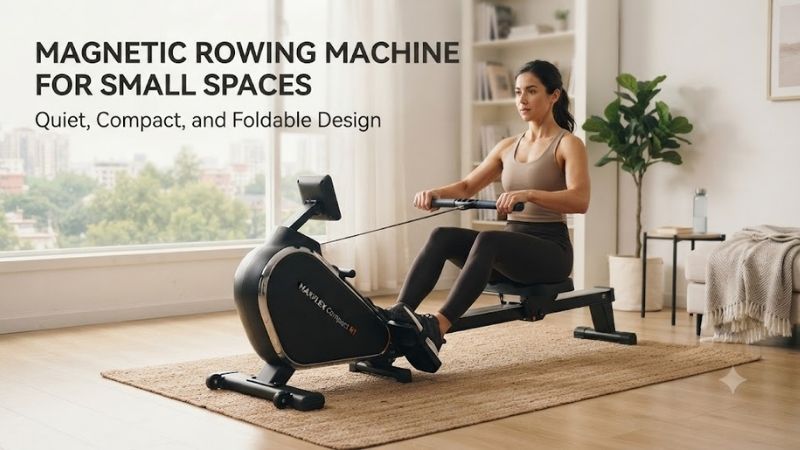
A magnetic rowing machine for small spaces can provide full-body cardio without requiring a dedicated home gym. However, compact dimensions alone do not guarantee comfortable rowing or convenient storage. The best choice should balance usable rail length, quiet resistance, frame stability, and enough clearance for a complete stroke while fitting your available room.
Quick Verdict: What Should You Look For?
For most apartment residents and small-home owners, a compact magnetic rowing machine with a folding rail, adjustable resistance, and a comfortable seat-travel range provides the most practical balance.
Prioritize the following characteristics:
-
Footprint: The machine should fit your exercise area with clearance for mounting, rowing, and dismounting.
-
Storage: Folding or manufacturer-approved upright storage can help free up floor space.
-
Resistance: Magnetic resistance is generally quieter than fan-based air resistance.
-
Rail length: The machine must accommodate your leg extension without restricting the stroke.
-
User capacity: The manufacturer’s rated weight limit must accommodate the intended user.
-
Portability: Transport wheels and manageable equipment weight make storage easier.
-
Workout tracking: A basic monitor is sufficient for many recreational users.
The biggest mistake is choosing the shortest machine without confirming whether its seat travel and footplate arrangement fit your body.
Understanding Compact Magnetic Rowing Machines
How Magnetic Resistance Works
Magnetic rowing machines use magnetic braking to create resistance against a moving component, generally associated with a flywheel.
In many designs, a belt or strap connects the handle to the resistance mechanism. Pulling the handle accelerates the flywheel while the magnetic system creates opposing torque.
Some rowers adjust resistance mechanically through a dial that changes magnet positioning. Others use electronically controlled resistance.
Magnetic systems avoid the substantial airflow noise associated with fan-driven rowing machines. This makes them particularly attractive for apartments and shared living spaces.
However, magnetic rowers are not completely silent. Seat rollers, belts, pulleys, foot movements, and frame vibration can still produce audible noise.
Why Compact Does Not Always Mean Foldable
A compact rowing machine has relatively small operating dimensions.
A folding rowing machine uses a hinged or otherwise manufacturer-designed mechanism to reduce its storage footprint.
These features are related but not interchangeable.
A short, nonfolding rower may occupy less floor space during exercise but remain difficult to store. A longer folding rower may accommodate taller users comfortably while reducing its stored length after workouts.
Some rowers can also be stored upright without folding.
Each storage approach has different clearance and safety requirements.
The Trade-Off Between Length and Comfort
Rowing involves a coordinated sequence of leg drive, trunk movement, and arm movement.
The sliding seat must travel far enough to allow comfortable positioning at both the catch and finish.
A compact machine with insufficient seat travel can force taller users into shortened strokes.
This limitation matters more than the difference between two similarly priced resistance systems.
Whenever possible, compare usable rail travel and manufacturer-supported inseam measurements rather than relying exclusively on total equipment length.
Quick Comparison: Compact Rowing Machine Designs
| Design | Main Advantage | Main Limitation | Best For |
|---|---|---|---|
| Short nonfolding magnetic rower | Small operating footprint | May have limited seat travel | Shorter users with permanent exercise space |
| Folding magnetic rower | Reduced stored footprint | Requires folding and locking | Multipurpose rooms |
| Upright-storage magnetic rower | Frees floor space between workouts | Needs vertical clearance and secure storage | Apartments with suitable storage corners |
| Long-rail magnetic rower | Greater potential legroom | Larger operating footprint | Taller users |
| Connected magnetic rower | Guided workouts and tracking | Screen, power, and membership considerations | Users who prefer structured sessions |
| Basic manual magnetic rower | Simple controls and fewer electronics | Limited automated programs | Budget-conscious home users |
How Much Space Does a Magnetic Rowing Machine Need?
Measure the Full Operating Footprint
Begin by measuring the longest and widest available floor area.
A traditional home rowing machine commonly occupies roughly six to seven feet or more in length, although actual dimensions vary substantially.
Some compact models are shorter, but this may come at the expense of seat travel.
Measure the exact model rather than treating those general dimensions as purchasing specifications.
The available area should accommodate the frame and enough surrounding space to use the equipment safely.
Allow Room for Mounting and Dismounting
Many rowing machines have relatively low seats.
Users must be able to enter and exit without colliding with nearby furniture.
A machine fitted tightly between a desk and a wall may technically fit but remain inconvenient or unsafe to use.
Follow manufacturer clearance instructions where provided.
Account for Handle and Body Movement
During a normal rowing stroke, the handle travels toward the torso while the user moves along the rail.
The machine needs enough front and rear clearance for that movement.
Do not assume the equipment’s published dimensions include every recommended operating clearance.
Nearby shelves, cabinets, and furniture should not interfere with the exercise path.
Measure the Storage Position Separately
A folding rower may become shorter but taller when folded.
An upright-storage machine can occupy a relatively small floor area while requiring substantial ceiling height.
Measure the proposed storage space in all three dimensions.
Also consider whether the machine can be safely moved into that space without lifting it over furniture.
Choosing the Right Rail Length
Why Seat Travel Matters
The rail guides the seat through the rowing stroke.
At the catch, the knees bend while the arms extend forward. During the drive, the legs extend and the seat travels backward.
If the rail is too short, the user may reach its mechanical limit before completing a comfortable leg extension.
This can interfere with rowing technique and reduce the machine’s practical suitability.
Overall Length Versus Usable Rail Length
A machine may be long because of its flywheel housing, front stabilizer, or console arrangement.
That does not necessarily mean it provides extensive seat travel.
Conversely, a thoughtfully designed compact rower may offer more usable movement than its exterior dimensions suggest.
Compare the manufacturer’s stated slide-rail length, inseam guidance, or seat-travel information.
Do not assume those measurements are interchangeable; manufacturers may define them differently.
Consider Your Height and Inseam
Height can provide a rough starting point when evaluating a rowing machine, but inseam and body proportions offer more relevant information.
Two people of the same height may have different leg lengths.
A taller person with relatively long legs may require a longer rail than another person with similar total height.
Check the manufacturer’s supported user dimensions whenever available.
Magnetic Resistance: How Many Levels Do You Need?
Eight Versus Sixteen Resistance Levels
Entry-level magnetic rowers frequently offer manually selectable resistance levels.
Some have eight settings, while others provide sixteen or more.
A higher count means there are more selectable adjustment positions, not necessarily that the highest setting is harder.
An eight-level machine can have a different resistance range from a sixteen-level model.
For recreational rowing, comfortable movement and useful resistance progression matter more than the numerical count alone.
Manual Magnetic Resistance
Manual resistance systems generally use a knob or lever.
They are straightforward to operate and may not require electrical power for the resistance mechanism.
This can be useful in small rooms where electrical outlets are inconveniently positioned.
Manual adjustment is particularly attractive for steady-state cardio and straightforward training sessions.
Electronic Magnetic Resistance
Electronic systems change resistance through powered controls.
They may also support programmed intervals, automatic adjustments, and connected workouts.
These features can be valuable for structured training, but they introduce additional electronics and potentially external power requirements.
For a small apartment gym, the added functionality should justify the equipment’s complexity.
Why Maximum Resistance Is Difficult to Compare
There is no universal relationship between advertised magnetic resistance levels and standardized rowing force.
Different machines use different flywheel designs, braking arrangements, and mechanical transmission systems.
Without comparable measurement data, one manufacturer’s level sixteen should not be treated as equivalent to another manufacturer’s level sixteen.
Choose based on verified equipment capabilities and your intended exercise intensity.
Folding Versus Upright Storage
Folding Rowing Machines
Folding models use a manufacturer-designed mechanism to change frame geometry.
This can substantially reduce storage length.
However, folding machines introduce hinges, locking pins, and other components that must remain secure.
Before exercising, confirm the machine is correctly unfolded and locked according to the manual.
Upright Storage Rowers
Some machines can be stored vertically.
This may be particularly useful in narrow rooms where floor space is limited but ceiling height is adequate.
Never store a rower upright unless the manufacturer explicitly approves that position.
Also consider stability, access by children or pets, and whether additional securing equipment is required.
Machines With Transport Wheels
Transport wheels make it easier to reposition a rower.
However, machine weight still matters when tilting or lifting the frame.
A 60-lb machine may be more manageable for some users than a substantially heavier connected rower.
Compare equipment weight and the recommended handling method rather than relying only on the presence of wheels.
Comfort and Ergonomics in Small Rowing Machines
Seat Height and Cushioning
A rowing seat should allow stable movement along the rail.
Very low seats can make entry and exit inconvenient for some users.
Seat padding also affects comfort, but thick cushioning is not always better. Excessively soft seats can alter positioning and pressure distribution.
Choose a machine with a seat appropriate for your comfort and mobility.
Footplate Position and Adjustment
The footplates should securely accommodate your footwear.
Adjustable straps help prevent unnecessary foot movement while rowing.
Check that the heel can move as intended and that the straps do not create excessive pressure.
Handle Grip and Reach
The handle should allow a comfortable grip without forcing excessive wrist bending.
A user should be able to extend the arms naturally at the catch without overreaching.
Handle reach depends on the overall machine geometry, not just rail length.
Frame Stability
Compact machines still experience repeated forces during rowing.
The frame should remain stable on a level surface.
Check the stabilizers, adjustment feet, and manufacturer-rated capacity.
A lighter machine is not automatically unstable, but its construction must be appropriate for the user’s training intensity.
Noise Considerations for Apartments
Magnetic Resistance Noise
Magnetic resistance generally generates relatively little sound at the braking mechanism.
However, the drivetrain and seat assembly can remain audible.
A belt-driven model may avoid chain-related sound, but actual noise depends on construction and maintenance.
Floor Vibration
Repeated rowing movements can transmit vibration through the floor.
This is particularly relevant in apartment buildings.
A suitable equipment mat may reduce some vibration and protect flooring.
However, it cannot guarantee that neighbors will hear nothing.
Equipment Placement
Place the rower on a level, stable surface.
Avoid positioning it against furniture or walls where movement may cause contact noise.
Also keep sufficient clearance for airflow around powered components when required.
Workout Features Worth Paying For
Basic LCD Monitoring
For many home users, a basic display is sufficient.
Useful metrics include elapsed time, stroke count, and strokes per minute.
Distance and calorie estimates can help compare workouts on the same machine, but calculations differ among manufacturers.
Bluetooth Connectivity
Bluetooth can connect compatible machines to training applications.
This may help users record workouts or follow guided sessions.
Check whether the exact rowing machine supports the functions you want rather than assuming every Bluetooth rower offers automatic resistance control.
Large Touchscreens
Premium connected rowers may include large displays and extensive training content.
However, screens increase cost, equipment weight, and power requirements.
A basic magnetic rower paired with an existing tablet may be more economical for some users.
Common Buying Mistakes
Choosing Only by Folded Dimensions
A machine that stores compactly may still require substantial room during exercise.
Always evaluate both configurations.
Ignoring Rail Length
An inexpensive short-frame rower may be unusable for a person with long legs.
Body fit should come before resistance settings or connected features.
Assuming Magnetic Means Completely Silent
Seat movement, belts, and floor vibration still create sound.
Noise-sensitive buyers should evaluate the complete machine, not just its resistance mechanism.
Overvaluing Resistance-Level Counts
More levels do not guarantee a more demanding workout.
Mechanical design and usable adjustment range matter more.
Ignoring Assembly and Storage Safety
Folding mechanisms and upright storage require correct setup.
Never improvise storage methods that the manufacturer has not approved.
Frequently Asked Questions
What Is the Best Magnetic Rowing Machine for a Small Apartment?
A folding or manufacturer-approved upright-storage model with appropriate seat travel and relatively quiet resistance is generally a practical choice. The exact model should be selected according to body fit and room dimensions.
Can a Magnetic Rowing Machine Fit in a Bedroom?
Yes, provided there is enough operating clearance, a stable floor, and a safe storage location.
Are Folding Magnetic Rowers Good for Tall People?
Some are. The key factor is usable seat travel, not whether the frame folds.
Do Magnetic Rowers Need Electricity?
Manual systems may operate without a wall outlet, although their monitors may use batteries. Electronic resistance and connected displays can require external power.
Can You Store a Magnetic Rowing Machine Upright?
Only when the manufacturer explicitly approves vertical storage for the exact model.
Is a Compact Magnetic Rower Good for Beginners?
Yes. Adjustable resistance and relatively quiet operation can make compact magnetic rowers practical for beginners, provided the machine fits correctly.
Conclusion
The best magnetic rowing machine for small spaces is one that accommodates your full rowing stroke, fits safely within your room, and can be stored conveniently after exercise. Prioritize rail length, folding or approved upright storage, magnetic resistance, and frame stability before paying extra for connected workout features.



Write Your Review
No reviews yet. Be the first to share your experience!