
Key takeaways
-
Comfortable seat travel and footplate positioning.
-
Resistance that suits your current fitness level and training goals.
-
Stable construction with an appropriate user-weight rating.
-
A reliable drive mechanism and smooth seat movement.
-
Enough operating and storage space.
-
Useful workout monitoring without unnecessary electronics.
-
Manufacturer support, replacement parts, and reasonable warranty terms.
Choosing a magnetic rowing machine requires more than comparing resistance levels or advertised prices. The right rower should accommodate your body, provide a comfortable stroke, operate reliably, and match your workout goals. This magnetic rowing machine buying guide explains the important mechanical features, performance differences, safety considerations, and purchasing trade-offs.
Quick Verdict: What Matters Most?
For most recreational home users, a magnetic rowing machine with a comfortable rail length, stable frame, adjustable resistance, and straightforward workout monitoring is a practical choice.
The most important purchasing priorities are:
-
Comfortable seat travel and footplate positioning.
-
Resistance that suits your current fitness level and training goals.
-
Stable construction with an appropriate user-weight rating.
-
A reliable drive mechanism and smooth seat movement.
-
Enough operating and storage space.
-
Useful workout monitoring without unnecessary electronics.
-
Manufacturer support, replacement parts, and reasonable warranty terms.
Avoid choosing a machine simply because it advertises the most resistance levels or the heaviest flywheel.
How Magnetic Rowing Machines Work
The Flywheel and Resistance Mechanism
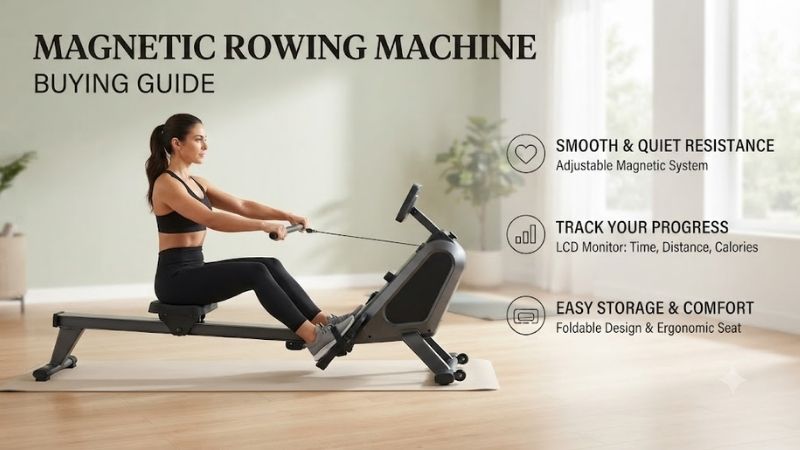
A magnetic rowing machine generally uses a rotating flywheel or conductive component influenced by a magnetic braking system.
When the user pulls the handle, the drive mechanism accelerates the flywheel. The magnetic system creates resistance to that rotation.
The exact behavior depends on the machine’s braking design, mechanical transmission, and control system.
This is why two magnetic rowers with the same number of advertised levels can feel different.
Permanent-Magnet Versus Electronically Controlled Systems
Many affordable machines use manually positioned magnets.
Turning a resistance dial changes the magnetic interaction and alters the braking force.
More sophisticated equipment may use electronic controls to adjust resistance.
Electronic systems can support automated changes and programmed sessions, but they usually require additional power and control components.
Neither system is automatically superior for every buyer.
Magnetic Resistance Versus Air Resistance
Air rowers generate resistance through a fan.
As the user accelerates the fan more aggressively, aerodynamic resistance rises.
Magnetic rowers instead use a braking system that can provide selected resistance settings.
The practical difference is that air machines are commonly preferred for responsive performance-focused rowing, while magnetic machines appeal to users who want controlled adjustment and relatively low resistance-system noise.
However, magnetic resistance is not necessarily constant throughout every stroke. Its behavior depends on flywheel speed and braking design.
Magnetic Resistance Versus Water Resistance
Water rowers use an impeller moving through a water tank.
The resistance responds to the user’s stroke effort and tank characteristics.
Magnetic rowers avoid water maintenance and generally provide convenient adjustment through a dial or electronic controls.
Water machines offer a different sound and rowing sensation.
Choose based on preferred training characteristics rather than assuming one is universally more realistic.
Comparison of Magnetic Rowing Machine Features
| Feature | Basic Magnetic Rower | Midrange Magnetic Rower | Premium Connected Rower |
|---|---|---|---|
| Resistance control | Usually manual | Manual or electronic | Commonly electronic |
| Workout monitor | Basic LCD | Expanded metrics and Bluetooth | Integrated connected display |
| Rail design | Model-dependent | Often more substantial | Model-dependent, sometimes longer |
| Workout programming | Limited | Basic programs or app support | Extensive guided sessions |
| Maintenance | Basic mechanical inspections | Mechanical and electronic care | Hardware and software considerations |
| Main advantage | Simplicity and cost | Balanced functionality | Integrated training experience |
| Main trade-off | Limited features | Moderate equipment cost | Higher price and possible subscriptions |
These categories describe common equipment patterns, not guaranteed specifications for every machine.
Resistance Levels: How Many Are Enough?
Understanding the Numbers
Manufacturers commonly advertise eight, sixteen, twenty-six, or another number of resistance settings.
These numbers identify selectable positions within the machine’s system.
They do not represent standardized pounds, watts, or rowing force.
A machine with sixteen settings does not automatically provide twice the resistance of a machine with eight.
Beginners and Recreational Users
Beginners generally benefit from an adjustment range that allows controlled movement without requiring excessive force.
An eight- or sixteen-setting system can be sufficient, depending on its actual resistance characteristics.
Good technique and comfortable movement should take priority over maximizing the resistance setting.
Experienced Home Exercisers
Experienced users may appreciate finer resistance adjustment, especially when following structured intervals.
However, the resistance mechanism must also accommodate the desired stroke rate and effort.
A large number of settings is less useful if the machine feels inconsistent or the rowing geometry is uncomfortable.
Why Resistance Settings Do Not Equal Power
Power is the rate of mechanical work.
A numbered magnetic resistance setting does not independently establish how much power a user produces.
Actual power depends on handle force, stroke speed, mechanical efficiency, and the machine’s measuring or estimation system.
Without compatible measurement methods, power figures from different rowing machines should not be treated as directly interchangeable.
Flywheel Weight and Rowing Feel
What Flywheel Mass Does
A flywheel stores rotational energy.
Its mass distribution influences rotational inertia, which affects how the machine responds as the user accelerates and decelerates the mechanism.
A larger or more substantial flywheel may preserve more momentum, but mass alone does not determine smoothness.
Why Heavier Is Not Always Better
The quality of the bearings, drive system, magnetic braking arrangement, and flywheel geometry all influence the rowing experience.
A lighter, well-designed machine may feel smoother than a heavier machine with inconsistent resistance or poor mechanical alignment.
Do not use advertised flywheel weight as a standalone measure of quality.
Resistance Consistency
A useful rowing machine should provide predictable resistance behavior throughout ordinary operation.
Unexpected sticking, scraping, or jerky handle movement can indicate mechanical problems.
These symptoms should not be confused with normal changes in resistance associated with flywheel speed.
Rail Length and Rowing Geometry
Why Seat Travel Is Important
The seat must move far enough for the user’s legs to extend comfortably.
At the catch, the knees bend and the arms reach forward. During the drive, the legs extend before the upper body completes the movement.
Insufficient rail travel may force a shortened stroke.
Check Inseam Compatibility
Manufacturers may publish supported inseam measurements or rail lengths.
Use these measurements to assess whether the machine can accommodate your proportions.
Do not assume overall machine length equals usable seat travel.
Seat Height and Accessibility
Low seats are common on residential rowing machines.
A low seating position may be inconvenient for users who struggle with lowering themselves or standing up.
Higher seats can improve accessibility for some buyers, but the entire mounting process and body fit must still be considered.
Footplate and Handle Position
Footplates should secure the feet without excessive pressure.
Handle positioning should permit natural arm extension and controlled pulling.
If the machine forces an uncomfortable wrist, shoulder, or knee position, its resistance features may offer little practical value.
Frame Stability and Weight Capacity
Manufacturer-Rated Capacity
Every rowing machine has a maximum user-weight limit.
Choose equipment that accommodates the intended user within that rating.
A higher published limit does not automatically establish superior construction in every respect.
Frame Rigidity
The frame should remain stable during normal rowing.
Excessive rocking, twisting, or unusual movement may indicate an uneven floor, loose assembly, or an equipment problem.
Follow the manufacturer’s installation instructions before attempting adjustments.
Single-Rail Versus Dual-Rail Designs
Single-rail rowers use a central seat track.
Dual-rail models support the seat on two parallel tracks.
Either arrangement can work well when designed and manufactured appropriately.
The number of rails alone does not determine smoothness, stability, or durability.
Folding Mechanisms
Folding frames are useful for storage but introduce additional joints and locking components.
Check that all folding mechanisms are correctly secured before exercise.
Avoid using a machine with damaged or loose frame hardware.
Belt Drive Versus Chain Drive
Belt-Driven Rowers
Many residential magnetic rowers use a belt or strap mechanism.
This can reduce some mechanical noise and maintenance demands compared with chain-based arrangements.
However, belts can still wear, stretch, or become damaged.
Chain-Driven Rowers
Chain drives are common in some performance-focused rowing machines.
They require appropriate lubrication and inspection according to manufacturer guidance.
A chain does not automatically make a machine more durable or suitable for heavier users.
Handle Return Mechanism
After each drive, the handle must return smoothly.
This usually involves a spring, elastic element, or other retraction mechanism.
The return should be controlled without excessive slack or unusual resistance.
A faulty handle return system should be inspected before further use.
Console and Workout Monitoring
Essential Metrics
For basic home rowing, useful metrics include elapsed time, stroke count, and strokes per minute.
Distance and calorie estimates can provide additional tracking information.
However, these estimates may use different calculations between manufacturers.
Understanding Stroke Rate
Stroke rate describes how many complete rowing strokes are performed per minute.
It helps users control workout cadence.
A higher stroke rate does not necessarily mean the user generates more power, especially if technique deteriorates.
Distance and Pace Estimates
Some rowers estimate distance or a 500-meter pace.
These figures may be based on flywheel speed and manufacturer-specific algorithms.
Use consistent equipment when comparing personal progress.
Heart-Rate Connectivity
Some machines receive data from compatible Bluetooth or ANT+ chest straps.
This can be useful for users organizing workouts around heart-rate information.
Check the exact wireless protocol and profile compatibility before purchasing accessories.
App Connectivity
Bluetooth may allow workout logging, guided training, or other digital functions.
However, Bluetooth compatibility does not necessarily mean the app can change the machine’s resistance.
Verify supported functions individually.
Magnetic Rowing Machine Noise
Resistance-System Noise
Magnetic braking usually avoids the loud fan noise associated with air rowers.
This makes magnetic machines attractive for apartment use.
However, the overall rower still produces mechanical sound.
Seat Rollers and Rail Noise
Seat rollers may produce noise as they travel.
Debris, misalignment, or worn components can increase sound.
Clean and maintain the rail according to manufacturer guidance.
Frame Vibration
Rowing generates repeated forces that may transfer through the floor.
Use a stable, level surface and consider an appropriate equipment mat.
Do not assume a mat will eliminate all vibration transmission.
Storage and Space Requirements
Operating Footprint
Measure the machine’s full assembled length and width.
Include room for mounting, dismounting, and completing the stroke.
Folding Storage
Check both operating and folded dimensions.
Some machines become considerably taller when folded.
Upright Storage
Only use vertical storage when expressly approved by the manufacturer.
Ensure the machine is stable and cannot be accidentally tipped over.
Equipment Weight
A lighter rower may be easier to move, but a heavier frame can still be appropriate when permanent installation is intended.
Consider how frequently the machine will be repositioned.
Maintenance and Long-Term Ownership
Regular Inspection
Inspect the frame, foot straps, handle, drive mechanism, seat rollers, and rail.
Follow the manufacturer’s inspection schedule.
Cleaning
Remove sweat and debris from approved exterior surfaces.
Avoid applying cleaning agents or lubricants to components unless permitted by the manual.
Replacement Parts
Check whether the manufacturer supplies replacement straps, pedals, rollers, monitors, or belts.
A machine with accessible parts may offer better long-term value.
Warranty Coverage
Read the warranty provisions for the frame, mechanical components, and electronics.
Warranty duration and coverage exclusions may differ substantially.
Matching a Magnetic Rower to Your Needs
| Buyer Type | Priority Features | Features That May Be Optional |
|---|---|---|
| First-time user | Comfortable fit, stable frame, simple resistance | Premium touchscreen |
| Apartment resident | Low operating noise, compact storage | Maximum flywheel mass |
| Tall user | Long usable rail, appropriate inseam accommodation | Smallest stored footprint |
| Frequent exerciser | Smooth drive, durable components, consistent monitoring | Entertainment features |
| Shared household | Broad adjustment range, appropriate capacity | Specialized competition metrics |
| Connected-workout enthusiast | Compatible training apps and programs | Completely manual controls |
Common Buying Mistakes
Buying by Resistance Count Alone
Sixteen levels do not automatically mean superior resistance compared with eight.
Evaluate the actual design and intended use.
Ignoring Body Fit
A poorly fitting rowing machine may be uncomfortable regardless of its price.
Rail travel and footplate geometry should be purchasing priorities.
Assuming More Technology Means Better Exercise
Large screens and subscriptions can be useful but are not necessary for effective basic rowing.
Only pay for connected features you expect to use.
Overlooking Parts and Warranty Support
An inexpensive machine can become a poor value if essential replacement components are difficult to obtain.
Confusing Advertised Capacity With Commercial Durability
A high user-weight rating does not establish that the machine is approved for continuous commercial use.
Respect the manufacturer’s intended usage category.
Frequently Asked Questions
Is a Magnetic Rowing Machine Good for Beginners?
Yes. Magnetic rowers offer adjustable resistance and are commonly designed for recreational home exercise.
Are Magnetic Rowers Better Than Water Rowers?
Magnetic rowers generally provide easier resistance adjustment and avoid water maintenance. Water rowers offer different effort-responsive characteristics and sound.
Do Magnetic Rowers Build Muscle?
They involve the legs, back, arms, and trunk and can support muscular endurance. They are not a complete replacement for progressive strength training.
Is Sixteen-Level Magnetic Resistance Enough?
It can be sufficient for many recreational users. Actual suitability depends on the machine’s resistance range and the user’s goals.
How Often Should a Magnetic Rower Be Serviced?
Follow the manufacturer’s maintenance schedule and inspect visible components regularly.
Do Expensive Magnetic Rowers Provide Better Workouts?
Not necessarily. Premium machines may offer better construction, more adjustments, and connected features, but effective exercise depends on fit, technique, workload, and consistency.
Conclusion
A good magnetic rowing machine should provide comfortable rowing geometry, reliable resistance adjustment, stable construction, and practical workout monitoring. Prioritize rail length, drive quality, user-weight capacity, maintenance support, and space requirements before spending more on advanced displays or connected training.



Write Your Review
No reviews yet. Be the first to share your experience!