
Key takeaways
What's inside
Best in house pull up bar choices are shaped by the room, not the marketing. Indoors you are dealing with painted trim, plasterboard walls, timber floors and people in the next room, which rules out several designs immediately. Here are six options judged on footprint, noise, mounting damage and honest load limits.
As an Amazon Associate we earn from qualifying purchases at no extra cost to you. Product prices and availability are accurate as of the date shown and are subject to change.


As an Amazon Associate we earn from qualifying purchases at no extra cost to you. Product prices and availability are accurate as of the date shown and are subject to change.
By Chris Parker
🛒 Best Price Today on Amazon
Prime members get fast, free shipping on everything above, plus member-only deals. New members get a 30-day free trial — cancel anytime.
How to Choose the Best In House Pull Up Bar
The best in house pull up bar has to work around constraints a garage never imposes. Ceiling height is lower, walls are often non-structural, floors transmit sound, and nobody wants a permanent steel frame in the living room. The four filters below deal with those problems in the order they usually kill a purchase.
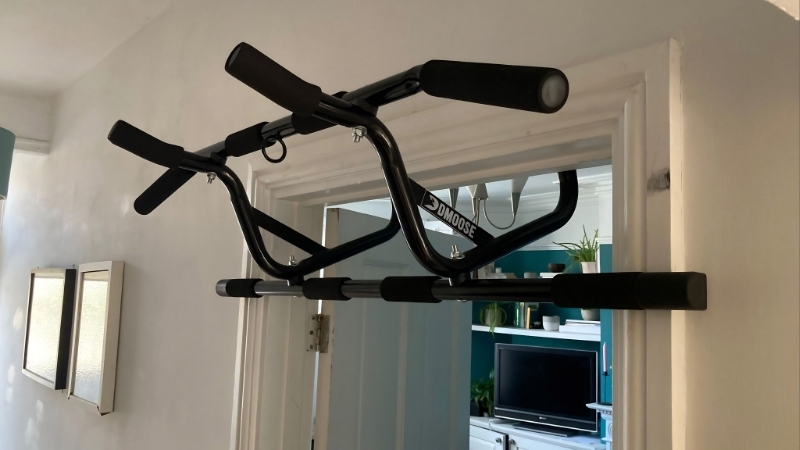
Footprint, Doorway Width and Ceiling Clearance
Footprint for the best in house pull up bar means three separate measurements: the doorway opening, the depth the bar projects into the room, and the floor area lost if you choose a tower. Doorway bars fit openings of roughly 24-36 in (61-91 cm) and project 8-14 in (20-36 cm) into the corridor when mounted.
Ceiling clearance is the one that catches people out. A standard interior door tops out near 80 in (203 cm), putting your hands at 78-84 in (198-213 cm), and an 8 ft (244 cm) ceiling leaves little room above a wall mount. Measure the real height and width of your chosen spot before ordering.
Noise, Flooring and Shared Walls
The pull-up itself makes almost no sound. What travels is the bar creaking against the frame, the click of a tower joint, and feet landing on a hard floor. On a suspended timber floor above a neighbour, that impact noise carries further than most people expect, especially early in the morning.
Fixes are cheap. Put a 6-8 mm rubber or foam mat under the landing zone, step down instead of dropping, and skip kipping entirely indoors. Felt pads under leverage brackets stop trim squeak and protect paint. On timber floors, a tower without proper feet will scuff, so check what the base uses.
How Often You Actually Need to Train
The World Health Organization recommends adults get 150 to 300 minutes of moderate-intensity aerobic activity per week plus muscle-strengthening work on two or more days, guidance published by WHO in 2020 and mirrored by the US Physical Activity Guidelines for Americans, second edition, 2018.
Two resistance sessions a week is a modest target, and it is the travel time to a gym rather than the session length that most often breaks the habit. A bar mounted in a hallway removes the commute entirely, which is the practical argument for keeping equipment where you already walk past it.
None of that is a promise about outcomes, and it is not medical advice. Pull-ups load the shoulders, elbows and spine, so if you have existing joint pain, a previous injury or any medical condition, talk to a doctor or a certified trainer before starting a new exercise programme.
Top Picks: 6 In House Pull Up Bars That Suit Real Rooms
Each option below is picked for a specific indoor constraint: no fixings, no trim, low ceilings, shared walls or a strict landlord. The best in house pull up bar for a rented flat is rarely the same as the one for a spare room you own, so read the drawback line before the spec line.
| Model | Mount | Indoor Constraint It Solves | Listed Limit | Noise Risk |
|---|---|---|---|---|
| Iron Gym Total Upper Body | Leverage doorway | No fixings, converts to floor use | 300 lb (136 kg) | Trim squeak |
| Perfect Fitness Multi-Gym | Leverage doorway | Protects painted trim | 300 lb (136 kg) | Low |
| Garren Fitness Maximiza | Telescoping in-frame | Doorways with no moulding | 300 lb (136 kg) | Low |
| Ultimate Body Press Doorway | Leverage, raised | Full hang for taller users | 300 lb (136 kg) | Low |
| Titan Fitness Wall Mounted | Stud-bolted | Weighted work, fixed position | 500 lb (227 kg) | Very low |
| Sportsroyals Power Tower | Freestanding | Zero holes in the wall | 330 lb (150 kg) | Floor impact |
Iron Gym Total Upper Body Workout Bar
Indoors, the appeal is that it does not stay up. Thirty seconds to hook over the trim, thirty seconds to lift off and slide behind a wardrobe, and on the floor it works as a push-up and dip stand. For a one-bedroom flat where nothing can be permanent, that flexibility is the whole argument.
It needs door moulding roughly 3.5 in (9 cm) wide, so flush modern frames are out. The bracket marks paint unless you pad it, foam grips compress within months, and the 300 lb (136 kg) rating assumes controlled hangs. No kipping, no swinging, no dropping off the bar onto a timber floor.
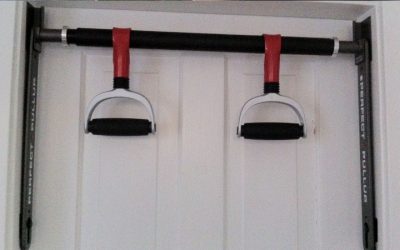
Perfect Fitness Multi-Gym Doorway Pull Up Bar
The version to choose when the trim is decorative and the landlord is attentive. Wider door-side pads spread the clamping force across more surface, which is the single biggest factor in whether a leverage bar leaves marks, and the contoured foam grips are noticeably kinder over longer sets.
Specs are conventional: 300 lb (136 kg) and 24-32 in (61-81 cm) openings. Grip width is fixed and narrower than some prefer for wide pull-ups, and there is no getting around the fact that any leverage design blocks the doorway while mounted and is not rated for dynamic movement. Take it down between sessions.
Garren Fitness Maximiza Pull Up Bar
Modern interior doors frequently have shallow or flush casings, which defeats every leverage bar on the market. This telescoping design sidesteps that by mounting on two brackets fixed inside the frame, then extending to fill openings of roughly 26-36 in (66-91 cm) and lifting out when not in use.
The cost is four small pilot holes, which may or may not be acceptable in a rental. It sits high in the opening so taller users lose hang clearance, and it needs a storage home between sessions since it does not fold. Capacity is listed around the standard 300 lb (136 kg), and two brackets stay on the frame.
Ultimate Body Press Doorway Pull Up Bar
Low interior ceilings and short doorways force a compromise for anyone tall, and this bar attacks it directly by hanging roughly 12 in (30 cm) below the frame top. That extra drop is what lets a 6 ft (183 cm) user reach a dead hang with straight legs rather than tucked knees. Shorter users lose nothing by it.
Naturally it consumes more headroom, so under a low ceiling or in a short doorway it becomes awkward rather than helpful. Assembly is longer than a single-piece hook, and the long straight bar limits hand positions compared with a multi-grip frame at similar money. Rated 300 lb (136 kg).
Titan Fitness Wall Mounted Pull Up Bar
If you own the house and have a wall with locatable studs, this is the quiet, permanent option. Listed at 500 lb (227 kg) and projecting about 21.5 in (55 cm), it gives room for chest-to-bar work and a weighted vest without your knees finding the plasterboard on every rep. Locate the studs before you drill.
It is permanent, and a bad install is a real hazard, so a stud finder and correct lag bolts are non-negotiable. Non-structural partition walls are not always suitable. Grip variety is limited compared with a doorway frame, and mounting height is locked in the moment the first hole is drilled.
Sportsroyals Power Tower Dip Station
The zero-holes solution for a spare room, box room or converted garage. Height adjusts through several settings to roughly 91 in (231 cm), and the frame adds dip handles plus a knee-raise back pad, with total capacity generally listed near 330 lb (150 kg) across the assembly. Expect an hour of build time.
It permanently claims about 42 x 27 in (107 x 69 cm) of floor, which in a small room is significant. On a suspended upstairs floor it transmits more impact than a doorway bar, so a mat underneath is worth the money. Lighter frames rock during fast reps, so keep tempo controlled and put a mat under the base.
Frequently Asked Questions
Indoor buyers ask a consistent set of questions about the best in house pull up bar, and almost all of them concern damage, doorframe shape, noise and whether the thing can simply stay up. These four answers cover what usually determines the decision once the shortlist is down to two options.
Will an in house pull up bar work on a flush door frame?
Not if it is a leverage design. Those bars hook over the moulding and need roughly 3.5 in (9 cm) of trim depth to bear against, which flush and minimal modern casings do not provide. Use a telescoping in-frame bar that mounts on brackets inside the opening, or move to a wall-mounted or freestanding option.
How do I stop the bar from marking my paintwork?
Pad the contact points. A strip of felt, a folded tea towel or adhesive furniture pads under the door-side brackets spreads the clamping load over a wider area and prevents the sharp indentations that show on soft pine trim. Lift the bar off after each session rather than leaving it clamped for weeks.
Is a power tower too loud for an upstairs room?
It can be, because the noise is impact through the floor rather than airborne sound. Put a 6-8 mm rubber mat under the base, step down from the bar instead of dropping, and avoid explosive reps. On a suspended timber floor at 6 am, a doorway bar over a carpeted landing is the more neighbourly choice.
Can I leave a doorway bar up permanently?
You can, but it blocks the doorway and puts constant pressure on the trim, which is how dents form. Leverage bars are designed for repeated removal, so most people take them down between sessions. If you want something permanent, the best in house pull up bar option is a bolted wall mount: safer, tidier and rated for far more load.
See More:
Final Thoughts
The best in house pull up bar is whichever one your room can accommodate without leaving damage or annoying the people below you. In a rented flat that means a leverage or telescoping doorway bar taken down after each session; in an owned house with locatable studs, a bolted wall mount is quieter and stronger.






Write Your Review
No reviews yet. Be the first to share your experience!