
Key takeaways
What's inside
Best home smith machine gym units are bought for one reason: training heavy without a spotter. What buyers underestimate is the room they need, the assembly time and the cable maintenance. This roundup compares six machines on footprint, bar capacity, rail design and what each one actually gives up.
As an Amazon Associate we earn from qualifying purchases at no extra cost to you. Product prices and availability are accurate as of the date shown and are subject to change.

#1 Pick

#2 Pick

#3 Pick
#4 Pick

#5 Pick

#6 Pick

#7 Pick

As an Amazon Associate we earn from qualifying purchases at no extra cost to you. Product prices and availability are accurate as of the date shown and are subject to change.
By Chris Parker
🛒 Best Price Today on Amazon
Prime members get fast, free shipping on everything above, plus member-only deals. New members get a 30-day free trial — cancel anytime.
How to Judge a Home Smith Machine
A best home smith machine gym unit solves the spotter problem by running the bar on fixed rails that lock at any point in the range. That safety brings trade-offs, and four things decide whether one works in your house: the space claimed, the bar and rail design, the attachments bundled, and the maintenance needed.
Footprint, Ceiling Height and Assembly
A best home smith machine gym unit is the largest single piece of equipment most people put in a house. A full cage system can measure around 70 in (178 cm) deep, 84 in (213 cm) wide and 86 in (218 cm) tall, and reviewers typically recommend about 6 x 7 ft (183 x 213 cm) of clear floor once you have added the access room around it.
Ceiling height is the constraint that catches the most people out here. A full-function unit with a pull-up bar wants close to 9 ft (274 cm) of clearance, which rules out a great many basements and standard garages. Measure the actual area before ordering, including the doorway width and any turn at the top of a staircase.
Assembly is a project rather than an afternoon job. The larger machines ship as several long, heavy boxes and take two people something like five to six hours from unboxing to the first rep. Some units weigh over 500 lb (227 kg) once assembled, so they really need to go in the right place the first time.
Bar Weight, Rail Angle and Rated Capacity
On a best home smith machine gym unit the empty bar weighs between roughly 15 and 45 lb (7 and 20 kg), depending on whether the carriage is counterbalanced. Counterbalanced machines feel lighter at the start position, which suits beginners, while a heavier uncounterbalanced bar gives a truer sense of the load that is actually being moved.
Rail angle changes the movement. Vertical rails keep the bar in a straight line, which suits pressing but forces a slightly artificial squat path. Angled rails follow the bar path of a real squat much more closely, and premium machines use them for exactly that reason rather than as a marketing feature.
Rated capacity varies far more than the marketing suggests. Budget all-in-one cage systems commonly list around 300 lb (136 kg) on the Smith bar, with a higher figure quoted on the bench, while the heavier commercial-leaning frames are rated closer to 800 or 1,000 lb (363 or 454 kg) on 11-gauge steel.
Attachments, Cables and Long-Term Maintenance
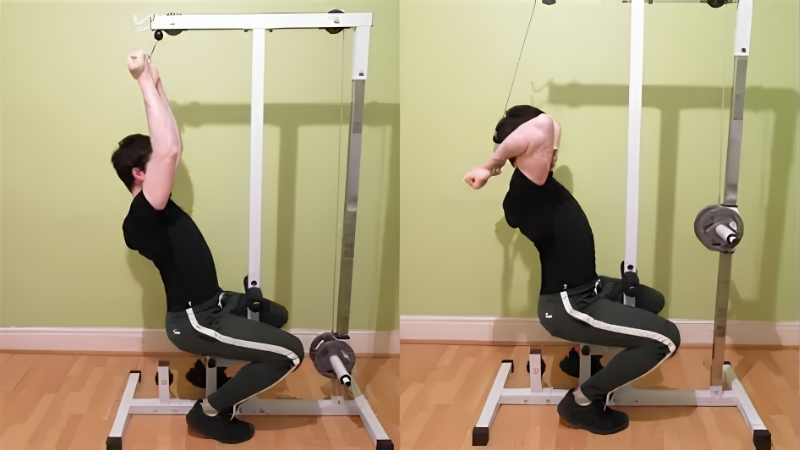
The all-in-one units bundle a lat pulldown, low row, pec deck, leg developer and sometimes an adjustable bench, which is where the value sits. Plate-loaded pulleys are common at this price, so budget for Olympic plates and accept that the cables will feel less smooth than a commercial machine running on sealed bearings.
Cables are the wear item. A light silicone spray at the pulley interface every three to six months keeps things moving, and with regular use a cable change every two to three years is normal rather than a fault. Check that replacement cables and pulleys are actually sold for the model before buying it.
Where the Smith Machine Market Sits Now
The best home smith machine gym category has split into two clear halves. At the budget end sit all-in-one cage systems that bundle a dozen stations into one frame, aimed at replacing an entire gym. At the top sit heavier machines that combine a counterbalanced Smith carriage with a functional trainer and a real power rack.
What separates the two tiers is steel and smoothness rather than the exercise count. Budget frames use thinner tube and plate-loaded pulleys with noticeable friction at the start of each rep, while the heavier machines use 11-gauge steel, sealed bearings and longer warranties, which is largely what the extra money buys.
Freight economics apply here more than anywhere else in home fitness. These units weigh several hundred pounds, so shipping is expensive, returns are impractical and genuine discounts cluster into one or two periods a year. Measuring correctly before ordering matters more than usual, because sending one back is rarely realistic.
Top Picks: 6 Smith Machines Compared
These six span the practical range for a best home smith machine gym, from a budget all-in-one to a commercial-leaning trainer. Figures below are manufacturer specifications. All of these need the safety hooks set correctly before loading, and none of them replace free-weight work for stabiliser development entirely.
| Machine | Type | Smith bar capacity | Best for |
|---|---|---|---|
| Marcy SM-4033 | All-in-one cage | ~300 lb / 136 kg | Replacing a whole gym |
| Marcy Smith Cage MWM-988 | All-in-one, compact | Moderate | Beginners on a budget |
| Major Lutie PLM03 | Smith plus cage | ~1,000 lb / 454 kg frame | Value all-in-one |
| Titan Fitness Smith Machine | Dedicated Smith | High | Smith work only |
| Body-Solid Powerline Smith | Dedicated Smith | Mid | Smallest budget |
| Force USA Monster G3 | Smith, cage and trainer | ~800 lb / 363 kg frame | One machine, everything |
Marcy SM-4033 Smith Machine Cage System
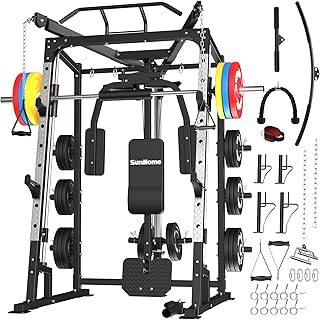
This is the machine most people picture when they think of a home Smith setup. The cage measures roughly 70 x 84 x 86 in (178 x 213 x 218 cm), the frame is built from 3 x 3 in (7.6 x 7.6 cm) 14-gauge tube, and the bundle includes dual adjustable pulleys, a pec deck, a leg developer and an adjustable bench.
The Smith bar is rated around 300 lb (136 kg) and the bench around 600 lb (272 kg), which is a real ceiling for stronger lifters. Assembly runs to about five and a half hours with two people, the assembled unit weighs over 500 lb (227 kg), and the plate-loaded cables feel sticky at the start of a rep.
Marcy Smith Cage MWM-988
This is comfortably the easiest entry point in the whole category. It bundles a vertical Smith bar together with a pull-up bar, a pec deck, low pulley cables, a leg developer and an adjustable bench, so a beginner can train every major muscle group without buying anything else at all during the first year.
The build is lighter duty than it is on the bigger frames, the steel is thinner, and the bar capacity is modest, so anyone training seriously will outgrow it quickly. Cable friction is noticeable and the bench is no substitute for a dedicated one. As a first machine at moderate loads, it still does the job.
Major Lutie PLM03
The PLM03 is clearly the value pick among the all-in-one Smith and cage combinations. The frame is rated near 1,000 lb (454 kg), the Smith carriage and the cage share a single footprint, and the bundle includes cable stations, so it covers most of what a home gym needs without three separate purchases.
Assembly is long, and the instructions are the usual weak point of marketplace equipment. Cable smoothness sits below the commercial machines, the accessory range is limited to the manufacturer’s own parts, and the combined frame means squatting inside it feels tighter than it does in a dedicated cage of the same width.
Titan Fitness Smith Machine
If you want the Smith function without any of those bundled stations, a dedicated machine is the cleaner answer overall. The frame is simpler, the footprint is smaller than on a full cage system, and there are no cables at all to maintain or replace, which removes the main long-term running cost of the all-in-one units.
The trade-off here is obvious enough: there is no lat pulldown, no pec deck and no leg developer, so a bench and dumbbells are both still needed alongside it. It is also a poor choice as a first and only purchase, because a Smith bar on its own leaves some large gaps in any general strength programme.
Body-Solid Powerline Smith Machine
This represents about the smallest sensible budget for a dedicated Smith machine. Body-Solid has a long track record and a reputation for its frame warranties, the design is straightforward, and the compact footprint suits a garage corner where a full cage system would swallow up the entire usable floor area.
Rated capacity sits below that of the heavier machines here, and the bar path is vertical rather than angled, which makes squats feel less natural than they do on a premium carriage. There are no bundled stations either, so treat it as one component of a setup rather than as a complete gym in itself.
Force USA Monster G3
This is the machine that stops most of the usual compromises. A counterbalanced Smith carriage on an angled rail, a functional trainer cable station and a genuine power rack all share one footprint, on an 11-gauge frame rated at around 800 lb (363 kg), with a long in-home warranty standing behind it.
Price is several times that of the budget all-in-ones, assembly is a serious multi-hour project, and the footprint and ceiling demands sit right at the top of the category. It is the right answer only if it genuinely replaces a rack, a cable machine and a Smith machine rather than simply sitting alongside them.
Frequently Asked Questions
These come up most often once someone has decided that a Smith machine is the answer, and then starts working out whether one of them will physically fit at all. The answers below assume a normal garage or a basement rather than a purpose-built room with commercial ceiling height and a wide access door.
How much space does a best home smith machine gym unit need?
Around 6 x 7 ft (183 x 213 cm) of clear floor for a full cage system once the access room is added, and close to 9 ft (274 cm) of ceiling height for the full pull-up function. Measure the actual area first, including the doorway width, because returns on machines this heavy are very rarely practical.
Is a Smith machine a replacement for free weights?
Not entirely, no. The fixed bar path removes the balance demand that free-weight squats and presses place on the stabilising muscles, which is exactly what makes it safe to train alone. Most home setups end up using the Smith for the heavier work, and then dumbbells or a barbell for everything else.
How heavy is the bar itself?
Between roughly 15 and 45 lb (7 and 20 kg) depending on the machine in question. Counterbalanced carriages feel lighter at the start position, which helps beginners, while the uncounterbalanced bars give a truer reading of the total load. Check that figure before comparing any of your Smith numbers to free-weight lifts.
What maintenance do the cables need?
A light silicone spray at the pulley interface every three to six months, and then a full cable replacement every two to three years with regular use. Confirm that spares are sold for the model you buy, because a machine with unobtainable cables will eventually just become a very large clothes rail.
See More:
- Best gym bench for home
- Best weight benches home gym
- Best at home full body workout equipment
- Best resistance bands workout
- Best resistance bands leggings
Final Thoughts
Choosing the best home smith machine gym unit is mostly about being honest on space and load. Measure the floor and the ceiling first, then compare bar weight, rail angle and rated capacity, and check that cables and spares are actually available. Consult a doctor before starting any new training programme.


Write Your Review
No reviews yet. Be the first to share your experience!