
Key takeaways
What's inside
Best resistance bands workout results depend far more on band type and anchoring than on brand name. Tube stacks, fabric loops, flat therapy sheets and long power bands all behave differently under load. This roundup compares six band systems on tension range, anchor safety, wear pattern and storage needs.
As an Amazon Associate we earn from qualifying purchases at no extra cost to you. Product prices and availability are accurate as of the date shown and are subject to change.

#1 Pick

#2 Pick

#3 Pick

#4 Pick

#5 Pick

#6 Pick

#7 Pick

As an Amazon Associate we earn from qualifying purchases at no extra cost to you. Product prices and availability are accurate as of the date shown and are subject to change.
By Chris Parker
🛒 Best Price Today on Amazon
Prime members get fast, free shipping on everything above, plus member-only deals. New members get a 30-day free trial — cancel anytime.
How to Choose Gear for the Best Resistance Bands Workout
Bands are cheap enough that most people buy the wrong type twice before landing a best resistance bands workout that actually progresses. Three variables decide it: the resistance curve, how the band attaches to you and the room, and how the material ages over months of use. Everything else is packaging.
Storage Space and the Anchor Point Problem
Band sets are the most space-efficient training tools available anywhere. A full stackable tube set with handles, ankle straps and a door anchor fits in a bag around 12 x 8 x 4 in (30 x 20 x 10 cm) and lives in a drawer. Fabric loops fold down smaller than a pair of rolled socks. Nothing else trains this much from a drawer.
The floor space you need is for the movement, not the kit. Standing pressing and rowing needs roughly 6 x 6 ft (183 x 183 cm) of clear area, and floor work needs mat length near 68 to 72 in (173-183 cm). Measure the actual area before building a routine around long bands. Ceiling height matters for overhead work too.
The anchor is the real constraint. A door anchor requires a door that opens away from you, a solid frame and a closed latch, because a hollow interior door is not safe under a heavy tube stack. Wall or ceiling anchors need a stud or joist and a drill, which rules out most rented flats. Test the anchor before loading it fully.
Tension Range, Stacking and Material Ageing
Band tension is not constant, and that shapes every best resistance bands workout you can build. Resistance rises as the band stretches, so a band that feels light at the start of a press is heaviest at lockout. That curve suits pressing and triceps work, and suits the bottom of a squat or a deadlift poorly.
Stackable tube sets quote combined figures ranging from around 96 lb (44 kg) up to over 400 lb (181 kg) at full stretch, so read all of those as peak values only. Latex degrades predictably too: surface crazing, edge nicks or a shiny stretched section all mean retire the band rather than push it further.
Where the Band Market Currently Sits
Bands sit almost entirely in the budget band of the market, which changes what price actually signals. Rather than separating usable from unusable, price here mostly separates sets with internal safety cords, metal clips and real door anchors from sets shipping with thin plastic handles and a token anchor strap.
The gap in the category is honest labelling. Tension figures are quoted inconsistently, with some brands listing peak tension at full stretch and others listing a nominal figure with no reference length attached. Comparing two sets on stated numbers alone is unreliable, which quietly pushes buyers toward established names.
Top Picks: 6 Band Systems Worth Buying
These six cover the formats that matter for a best resistance bands workout: stackable tubes for full body loading, fabric or latex loops for lower body work, flat sheets for controlled reps, and long loops for pull-up assistance. None of them replace a loaded barbell for heavy squatting or deadlifting.
| Band system | Type | Best use | Anchor needed |
|---|---|---|---|
| Bodylastics Stackable Bands | Tube with handles | Full body pressing and pulling | Door or wall |
| WHATAFIT Resistance Bands Set | Tube with handles | Budget full body starter | Door |
| Fit Simplify Loop Bands | Latex mini loop | Hips, glutes, warm-ups | None |
| TheraBand Professional Bands | Flat sheet | Controlled, low-load work | None or door |
| Serious Steel Assisted Pull-Up Bands | Flat loop | Pull-up assistance, mobility | Bar |
| TRX Strength Bands | Flat loop | Travel training, mobility | Bar or door |
Bodylastics Stackable Resistance Bands
Bodylastics is the pick for anyone who wants bands as their main strength tool rather than an accessory. The tubes carry an internal safety cord, the clips are metal rather than plastic, and stacking multiple tubes on one handle gives a fine-grained progression that single bands simply cannot match at any price.
The handles are firmer than some people like, and a full set involves a lot of small components to keep track of. Stacking also changes the resistance curve, so a stacked pair does not feel like one band of the same nominal tension. Read the quoted stack figures as peak values only. Track the components or you will lose them.
WHATAFIT Resistance Bands Set
This is the sensible budget entry into tube bands and a fine way to trial a best resistance bands workout before spending more. Five tubes, handles, ankle straps, a door anchor and a carry bag cover a full body routine at very low cost. For travel and hotel rooms, it does what most people actually need.
Clip quality and handle comfort sit below the Bodylastics standard, and the tubes have no internal safety cord, which matters at higher stacked tensions. Inspect the tube-to-fitting junction before each session, and replace any band showing surface crazing rather than pushing it through another few weeks of hard use.
Fit Simplify Resistance Loop Bands
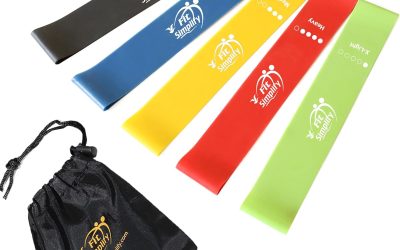
Five latex mini loops covering light through extra heavy, sold for less than a takeaway meal, and genuinely useful for hip work, warm-up sets and lateral movement. No anchor is needed, no assembly is required, and the whole set weighs almost nothing in a bag or a suitcase side pocket. Nothing else costs this little to try.
Latex loops roll and pinch on bare skin during heavier lateral work, which is the main complaint from buyers. They also lose elasticity over time and the lightest bands wear fastest. Fabric loops solve the rolling problem at a higher price, but these remain the best value entry point into loop training.
TheraBand Professional Resistance Bands
Flat sheet bands give the smoothest, most controlled resistance curve of any format, which is why clinics have used them for decades. For shoulder work, controlled pulling and any movement where a sudden tension change would be unhelpful, the flat format behaves better than tubes with rigid handles attached.
They have no handles, so grip is on the band itself and heavier levels are hard to hold onto. They tear from small nicks more readily than tubes and are unsuited to heavy loading. Any rehabilitation use should follow guidance from a doctor or a certified physical therapist rather than a product listing.
Serious Steel Assisted Pull-Up Bands
Long flat loop bands are the correct tool for pull-up assistance, and they double for mobility work and for adding accommodating resistance to barbell lifts. Width determines tension, so a 1 in (25 mm) band and a 2.5 in (64 mm) band deliver very different levels of help at the bottom position. Width, not colour, is the spec to read.
Heavy loop bands store a large amount of energy and can cause injury if they slip off a bar or a foot. Set them up carefully and never stretch one toward your face. They also wear where they contact a knurled bar, so check for nicks after every single session that you use them. Never anchor one at eye level.
TRX Strength Bands
These are the travel option. Flat loops in graded tensions, no handles to pack, and enough versatility to run a full session from a door frame or a park bar. Build quality sits a step above generic loop bands, and tension grading is far more consistent across the set than cheaper alternatives manage.
They cost noticeably more than unbranded equivalents for what is, materially, a latex loop. Without handles, the heavier bands are hard to grip for pressing work. Treat them as a portability purchase rather than a complete home strength solution and the price starts to make a lot more sense. You are paying for consistency, not tension.
Frequently Asked Questions
The practical questions below come up repeatedly from people building a best resistance bands workout as their main routine rather than using bands as a warm-up accessory before lifting. They cover substitution, safe anchoring, replacement intervals and the floor space a band session actually needs.
Can bands replace dumbbells entirely?
For pressing, pulling and accessory work, largely yes. For loaded hinging and squatting, not really, because the resistance curve is lightest exactly where those lifts are hardest. A stacked tube set plus bodyweight work covers most general programming, but heavy lower body work eventually needs real load on a bar.
How do I anchor bands safely without drilling?
Use the supplied door anchor on a solid door that opens away from you, with the latch closed. Hollow interior doors and doors that open toward you are not safe anchors under load. If neither is available, anchor low around a heavy fixed object rather than improvising something at head height. Inspect the door frame carefully before every session.
How often should bands be replaced?
Inspect before every session and replace on sight of surface crazing, edge nicks or a shiny stretched section. With regular use and no sunlight exposure, latex tubes typically last a year or more, while fabric loops tend to lose their elasticity gradually rather than failing all at once under a load.
How much space does band training need?
Roughly 6 x 6 ft (183 x 183 cm) of clear floor for standing work, plus mat length near 68 to 72 in (173-183 cm) for floor movements. Check height clearance too if you plan overhead work. Measure the actual area before building a routine around long bands and lateral travel. Anchor height changes the arc as well.
See More:
- Best gym bench for home
- Best weight benches home gym
- Best at home full body workout equipment
- Best resistance bands leggings
Final Thoughts
A best resistance bands workout setup comes down to matching format to purpose: stackable tubes for full body loading, loops for hips, flat sheets for controlled work, and long loops for pull-up assistance. Buy sets with safety cords and metal clips, inspect them before every session, and check your space before you start.


Write Your Review
No reviews yet. Be the first to share your experience!