
Key takeaways
What's inside
Best resistance training bands are bought as a system rather than as a single band, because elastic cannot be loaded in small even steps the way a dumbbell can. Progression comes from stacking, swapping width or changing anchor distance. These six build a graded set that keeps working as you get stronger.
As an Amazon Associate we earn from qualifying purchases at no extra cost to you. Product prices and availability are accurate as of the date shown and are subject to change.

#1 Pick

#2 Pick

#3 Pick

#4 Pick

#5 Pick

#6 Pick

#7 Pick

As an Amazon Associate we earn from qualifying purchases at no extra cost to you. Product prices and availability are accurate as of the date shown and are subject to change.
By Chris Parker
🛒 Best Price Today on Amazon
Prime members get fast, free shipping on everything above, plus member-only deals. New members get a 30-day free trial — cancel anytime.
How to Build a Set of the Best Resistance Training Bands
A single band is a novelty; the best resistance training bands work as a graded set. The four criteria below explain why elastic progression works differently from weight, then cover the ladder, the anchor points and the replacement cycle that nobody plans for.
Progression With Elastic Is Not Progression With Weight
A band marked 30 to 60 lb (14 to 27 kg) produces roughly the lower figure early in the stretch and the upper figure near the end of its usable range. There is no single number to log, which makes week-to-week comparison harder than with dumbbells.
Because resistance climbs as the band stretches, the load is lightest at the start of a movement, where most lifts are hardest, and heaviest at the finish, where you are usually strongest. That curve is the opposite of how free weights behave.
Progression therefore comes from three levers rather than one: adding a band, moving further from the anchor to increase pre-stretch, or slowing the tempo. None of these is as repeatable as adding 2.5 lb, which is the honest limitation of the format.
Build a Ladder, Not a Band
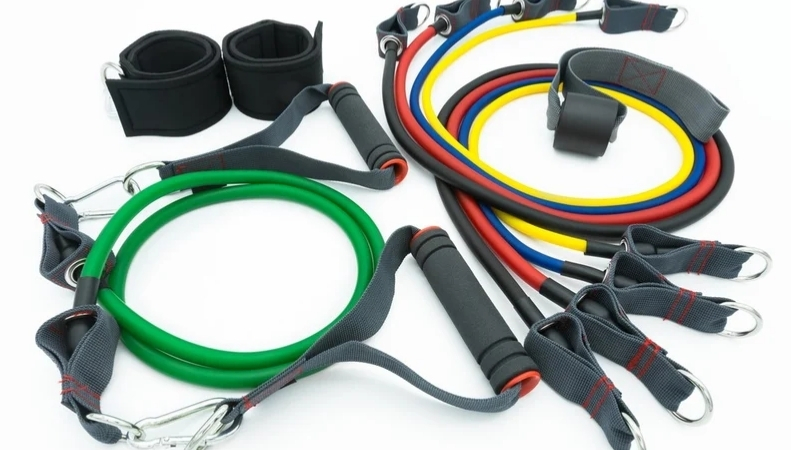
The best resistance training bands progress by clipping additional tubes to the same handles, which is the closest elastic gets to adding a plate. Each tube adds a known increment, so the ladder is built into the product rather than improvised.
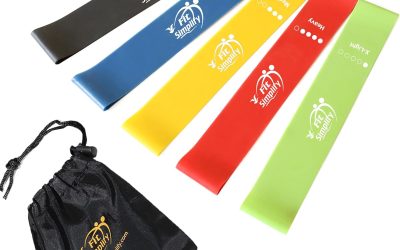
Flat loop bands progress by width instead. A set spanning roughly 0.5 in (13 mm) to 2.5 in (64 mm) covers everything from light pull-aparts to serious pull-up assistance, and each width acts as a rung on the ladder rather than as a replacement.
Mini loops need their own graded set, because the resistances that suit hip work bear no relation to those used for pressing. Buying one band in each category and hoping to progress later is the most common mistake in this market.
Anchor Points, Pull Distance and Floor Space
Bands have almost no storage footprint, but they need room in the direction of pull. A seated row against a door anchor uses roughly 8 ft (244 cm) of floor length once you account for the band itself, your body and the stretch involved.
Door anchors require a solid door that opens away from you rather than toward you. Wall and ceiling anchors need a timber stud or a masonry fixing rather than plasterboard, and rack-mounted pegs need a frame rated for the added lateral force involved.
Measure the actual dimensions of the space you plan to use before choosing an anchor position, including the pull distance for the longest movement you intend to do. The band itself takes up no room at all; the movement takes up a great deal.
Rotation, Inspection and Replacement Cycle
Most of the best resistance training bands use latex, which degrades with ultraviolet light, heat and ozone whether or not it is used, so age matters as much as mileage. Storing a set in a drawer away from a window and away from a radiator genuinely extends its life.
Inspect for surface cracking, a chalky bloom or nicks along the edge every few months, and retire anything showing them rather than waiting for a failure under tension. Handles and clips fail before tubes do, so check those at the same time.
Home training stopped being a temporary arrangement years ago, and band systems have improved accordingly, with layered construction and separately available components now normal at the mid tier. Plenty of cheap sets still seal the handle to the tube, which turns one worn part into a whole new purchase.
Top Picks: 6 of the Best Resistance Training Bands and Anchors
The best resistance training bands split into two progression systems, two anchoring solutions and two specialist additions, chosen so the set has somewhere to go rather than a single resistance. The table pairs each item with the rung it occupies in the ladder.
| Item | Progresses by | Anchors to | Role |
|---|---|---|---|
| Bodylastics stackable tubes | Adding tubes | Door anchor | Core of the system |
| Serious Steel graded loops | Band width | Bar or feet | Pull-up assistance ladder |
| Heavy-duty wall anchor | Anchor height | Stud or masonry | Fixed pull point |
| Handle and ankle strap kit | Attachment choice | Existing tubes | Movement variety |
| Graded fabric mini loops | Fixed steps | Legs | Hip and squat work |
| Gorilla Bow Original | Swapping loops | Own frame | Barbell-style grip |
1. Bodylastics Stackable Tube System
The core of any serious band setup. Clipping tubes together builds resistance in known increments rather than forcing a whole-band swap, and with a door anchor it covers rows, presses, pushdowns and pull-aparts from a single drawer.
Handles and clips are the failure points rather than the tubes, so confirm they are sold separately. The door anchor needs a solid door opening away from you, and a clip letting go under tension is the one genuine hazard in this category.
2. Serious Steel Graded Flat Loops
A width ladder rather than a single band. Continuous 41 in (104 cm) loops from roughly 0.5 in (13 mm) upward give a proper progression for assisted pull-ups, where every narrower band means you are taking more of your own body weight.
Assistance is greatest at the very bottom of the pull and then fades away toward the bar, which is the reverse of where many people actually fail. Wide bands are also genuinely difficult to control if they slip off a bar while loaded.
3. A Heavy-Duty Wall Anchor
Fixing an anchor into a stud or masonry gives a pull point at a chosen height, which unlocks angles a door anchor cannot reach and removes the dependency on a door that opens the right way. It costs very little and takes up no floor.
Installation is a drilling job that is difficult to reverse and unsuitable for plasterboard at any published rating. Locate the studs before buying, and treat any stated load figure as an absolute ceiling rather than a working target.
4. A Handle, Ankle Strap and Door Anchor Kit
Attachments widen what an existing tube set can train more cheaply than buying more bands. Ankle straps unlock hip and hamstring work, and a second pair of handles means you are not unclipping attachments between movements in a circuit.
Compatibility here is not universal, so check the clip type against your existing tubes before ordering. Cheap ankle straps use thin padding that rolls under load, which is uncomfortable enough to stop the movement being used at all.
5. Graded Fabric Mini Loops
Wider fabric bands around 3 in (76 mm) stay flat on the thigh through a full squat instead of rolling, which makes them usable during compound movements rather than only in isolation drills. Graded sets give a ladder rather than one resistance.
Fabric bands come in fixed steps rather than a smooth range, so progression through them is coarse, and they cost several times what latex loops do. The stitching is the wear point here, and it cannot be repaired once it starts to go.
6. Gorilla Bow Original
A rigid bow-shaped bar tensioned by loops, giving a barbell-style grip for presses, rows and squats with total resistance around 110 lb (50 kg) depending on the bands fitted. Progression comes from swapping loops rather than adding plates.
Resistance still remains variable and lightest exactly where lifts are hardest, so it does not replace a loadable bar. The fixed bar length also limits single-arm and rotational work that a tube set with proper handles covers easily.
Frequently Asked Questions
Most questions about the best resistance training bands concern how to progress with them and when to replace them. Each answer below works from how the elastic actually behaves rather than from the figures printed on the packaging.
How Do I Progress if the Load Cannot Be Measured?
Use the three levers available: add a tube or a wider band, increase pre-stretch by standing further from the anchor, or slow the tempo. Record which combination you used rather than a weight, since that is the only repeatable reference.
Should I Buy Tubes or Flat Loops?
Choose tubes with handles for anything resembling cable work, flat loops for pull-up assistance and anything anchored over a bar. They are not interchangeable, and most complete home setups end up owning a graded set of each type.
When Should Bands Be Replaced?
At the first sign of surface cracking, a chalky bloom or a nick along the edge, regardless of how much use they have had. Latex ages in storage, so a set bought three years ago deserves inspection even if it has barely been touched.
Can Bands Alone Build Strength?
They build work capacity and are excellent for assistance and accessory volume, but progressive strength loading needs a measurable, repeatable increment. Most setups pair a band system with dumbbells rather than choosing between them.
See More:
- Best changeable dumbbells
- Best rated yoga mat
- Best mat yoga
- Best home gym equipmen
- Best fitness equipment for home gym
Final Thoughts
The best resistance training bands are a graded system with somewhere to progress to, anchored to something that will take the force. Buy the ladder rather than one band, check that handles and clips are replaceable, and inspect the latex every few months.


Write Your Review
No reviews yet. Be the first to share your experience!