
Key takeaways
-
Usable belt dimensions: Enough room for natural walking strides and lateral foot placement.
-
Compact overall footprint: Fits the intended operating area with required safety clearance.
-
Low-profile design: Compatible with the standing desk and intended storage location.
-
Appropriate speed range: Supports comfortable, controlled walking rather than unnecessary running speeds.
-
Accessible stopping controls: Allows users to stop the belt promptly.
-
Stable construction: Appropriate for the user’s weight and intended operating conditions.
-
Practical storage: Transport wheels and manageable equipment weight where frequent movement is required.
-
Documented support: Clear operating instructions, warranty coverage, and replacement-part availability.
Choosing an under desk treadmill for small spaces requires more than finding the smallest machine. A good walking pad must fit your floor area, accommodate your stride, work with your desk, and provide safe, convenient operation. This guide explains which specifications matter, how to measure your space, and what to prioritize before buying.
Quick Answer: What Makes a Good Under Desk Treadmill?
The best under-desk treadmill for a small room is one that provides a usable walking surface, manageable storage dimensions, compatible desk height, and reliable stopping controls without taking up more space than necessary.
A compact walking pad is generally more appropriate for slow walking while working than a conventional running treadmill.
However, choosing the smallest available unit can create compromises in walking comfort and safety. An extremely short or narrow belt may make natural foot placement difficult, particularly for taller users.
For most small-space buyers, the priorities should be:
-
Usable belt dimensions: Enough room for natural walking strides and lateral foot placement.
-
Compact overall footprint: Fits the intended operating area with required safety clearance.
-
Low-profile design: Compatible with the standing desk and intended storage location.
-
Appropriate speed range: Supports comfortable, controlled walking rather than unnecessary running speeds.
-
Accessible stopping controls: Allows users to stop the belt promptly.
-
Stable construction: Appropriate for the user’s weight and intended operating conditions.
-
Practical storage: Transport wheels and manageable equipment weight where frequent movement is required.
-
Documented support: Clear operating instructions, warranty coverage, and replacement-part availability.
A walking pad should be selected primarily as walking equipment. A manufacturer’s high advertised maximum speed does not automatically establish suitability for running.
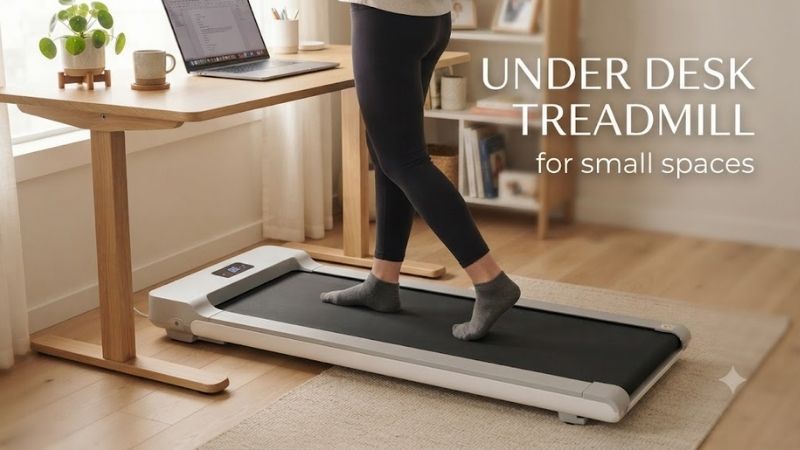
Understanding Under-Desk Treadmills for Small Rooms
What Is an Under-Desk Treadmill?
An under-desk treadmill is a motorized walking platform designed to operate beneath or near a compatible standing desk.
Many models are also described as walking pads.
Unlike conventional treadmills, under-desk models typically have compact frames, lower deck profiles, smaller displays, and reduced console structures.
Some models omit handrails entirely, while others include folding or removable support structures.
The equipment is generally intended for lower-speed walking rather than demanding running workouts.
How Is It Different From a Folding Treadmill?
A folding treadmill usually prioritizes conventional exercise capability with the option of reducing its storage footprint.
An under-desk treadmill prioritizes compact operation, often with a low-profile platform that fits beneath an adjustable workstation.
| Feature | Under-Desk Treadmill | Conventional Folding Treadmill |
|---|---|---|
| Main activity | Low-speed walking | Walking, jogging, or running |
| Frame | Often low-profile | Often upright with console |
| Walking belt | Commonly shorter | Often longer |
| Handrails | Optional or absent | Commonly included |
| Storage | Often horizontal | Often vertical |
| Desk compatibility | Frequently intended | Model-dependent |
| Maximum speed | Usually lower | Often higher |
Neither design is automatically superior. The correct choice depends on whether the equipment will primarily support desk-based walking or dedicated exercise sessions.
Who Benefits Most From a Compact Walking Pad?
An under-desk treadmill may be a practical purchase for remote workers, apartment residents, students, and home-office users who want an indoor walking option.
It can also suit households where the same room serves as a bedroom, office, or living space.
However, individuals who need substantial balance support should not assume that a rail-free walking pad is appropriate simply because it operates slowly.
The available support structure and the user’s ability to stop safely matter more than compactness.
How Much Space Does an Under-Desk Treadmill Need?
Measure the Operating Footprint First
The most important measurement is the full space required while the treadmill is operating.
A product may fit neatly beneath a desk when switched off but leave insufficient space for someone to walk safely.
Measure the available floor area from the front of the desk to the nearest obstruction behind the treadmill.
Then measure the width between desk legs and any nearby furniture.
The selected treadmill must fit without interfering with the desk structure, cables, furniture, or safe access around the equipment.
Important: Follow the manufacturer’s required safety-clearance dimensions. Do not substitute a small gap behind the treadmill simply because the machine is marketed as compact.
Understand the Difference Between Belt Size and Machine Size
Manufacturers may advertise the overall equipment dimensions and the usable walking-belt dimensions separately.
Both matter.
The overall dimensions determine whether the machine fits your room.
The usable belt dimensions influence walking comfort and available foot-placement space.
For example, consider a hypothetical walking pad measuring 48 inches long and 21 inches wide with a usable belt measuring 39 × 15 inches.
The larger dimensions determine where the machine can be positioned. The smaller dimensions determine the actual area available for walking.
A buyer should not assume the full external platform is available for foot placement.
Compare Walking Belt Lengths
The appropriate belt length depends on walking speed, natural stride, and individual proportions.
| Usable Belt Length | General Suitability |
|---|---|
| Under 36 inches | Very compact designs; careful stride assessment required |
| 36–39 inches | Short-stride, low-speed walking |
| 40–43 inches | More room for ordinary low-speed walking |
| 44–48 inches | Additional walking-stride flexibility |
| Over 48 inches | More generous walking space but usually a larger machine |
These are shopping guidelines, not manufacturer-approved operating limits.
Some users may find a shorter belt comfortable at very low speeds, while others require more room.
If possible, evaluate the belt dimensions against your normal walking stride before buying.
Consider Belt Width
A narrow walking surface can be one of the biggest compromises of an ultra-compact treadmill.
A belt approximately 14–15 inches wide may fit a small machine, but it leaves less room for lateral foot placement.
A belt around 16–18 inches wide can provide additional space, although the exact benefit depends on the user’s gait and comfort.
Prioritize sufficient belt width over a marginal reduction in the machine’s overall footprint.
Measure Vertical Clearance
The treadmill deck raises your standing height above the floor.
That affects both ceiling clearance and desk ergonomics.
If a treadmill platform raises your feet by 5 inches, your working position rises by approximately the same amount.
A standing desk that was previously adjusted correctly may need to extend higher to maintain comfortable keyboard and monitor positions.
Always verify that the desk can reach the required working height.
Choosing the Right Under-Desk Treadmill Features
1. Speed Range for Comfortable Desk Walking
Speed range is more important than maximum speed alone.
An under-desk treadmill should offer a low enough starting speed for comfortable entry and controlled movement.
Many walking pads operate at speeds beginning around 0.5–0.6 mph, although individual models differ.
For desk-based activity, a comfortable walking speed may be substantially slower than someone’s normal outdoor walking pace.
Typing, reading, and video meetings place different demands on coordination.
A useful treadmill should allow small, predictable speed adjustments without forcing large changes in pace.
Buyers should also check whether the machine starts gradually and whether its speed controls remain accessible during use.
2. Motor Ratings and Operating Duration
Motor specifications can be confusing, especially among compact walking pads.
Manufacturers may advertise peak horsepower, continuous-duty horsepower, or other power figures.
These ratings are not interchangeable.
A walking pad advertising a high peak horsepower figure is not necessarily more durable or better suited to extended operation than another model with a lower continuous rating.
For long work sessions, evaluate the manufacturer’s intended use and any operating-duration limits.
Some compact equipment may require rest periods or have operating restrictions that make it unsuitable for continuous desk walking.
Prioritize documented duty requirements over promotional motor claims.
3. Equipment Weight and Portability
A compact footprint does not guarantee convenient portability.
Consider the actual machine weight and how the treadmill is intended to be moved.
Transport wheels may simplify repositioning, but their usefulness depends on wheel placement, handle accessibility, and flooring.
If the treadmill must be stored after every session, choose a model you can manage safely without awkward lifting.
A heavier machine may be inconvenient to move daily, while an extremely lightweight design should still be evaluated for stability.
4. Storage Design
Small-space walking pads generally use several storage approaches.
Flat, non-folding designs: Low-profile units that may fit beneath furniture when sufficient clearance exists.
Folding-deck designs: Machines with hinged walking platforms that reduce their stored length.
Folding-handrail designs: Models that lower an attached rail or console while retaining the same basic deck length.
Each approach has trade-offs.
A folding deck introduces hinges and joints that must be correctly secured during operation.
A non-folding unit may be mechanically simpler but require a longer storage area.
Always check whether vertical storage is explicitly permitted by the manufacturer.
5. Noise and Vibration
Noise is especially important in bedrooms, apartments, and shared home offices.
Under-desk treadmills can produce sound from the motor, moving belt, footsteps, and vibration transmitted into the floor.
Advertised noise ratings may not represent actual apartment conditions, particularly when measurements are taken at different speeds or distances.
A machine marketed as quiet should not automatically be considered suitable for use above a neighbor’s bedroom.
Check independently documented operating-noise information when available.
An appropriate equipment mat may help protect flooring and reduce some vibration, but it cannot eliminate all sound transmission.
6. Emergency Stopping and Safety Controls
Safety deserves particular attention because many under-desk treadmills lack the full handrails found on conventional machines.
Look for documented stopping controls that can be reached promptly.
Where appropriate, compare models with safety keys, accessible stop buttons, automatic stopping systems, or other manufacturer-supported controls.
A wireless remote can make normal speed adjustments convenient, but it should not be assumed to replace an effective emergency stopping arrangement.
Consumer Reports has identified safety concerns among several under-desk treadmills, reinforcing the importance of examining safety features and published evaluations rather than relying only on compact dimensions.
Keep children, pets, loose objects, and cables away from the moving belt and its rear opening.
7. User Weight Capacity
The manufacturer’s maximum user weight must accommodate the intended user.
However, a high published capacity does not establish equivalent stability, mechanical durability, or comfortable walking space.
Compare the rated capacity with deck dimensions, frame construction, and the machine’s documented intended use.
A treadmill with a short belt and high advertised weight limit is still a short-belt treadmill.
8. Display and Control Options
Basic under-desk treadmill displays commonly provide speed, elapsed time, distance, and an estimated calorie figure.
Additional features may include remote controls, app connectivity, workout history, and preset programs.
For compact desk use, a simple, accessible control arrangement often matters more than a large feature list.
Calorie estimates should be treated as approximations rather than precise measurements of energy expenditure.
Under-Desk Treadmill Types for Small Spaces
Flat Walking Pads
A flat walking pad has a low-profile deck without a conventional upright treadmill console.
This design can work well with compatible height-adjustable desks.
The main advantages are compact construction and potentially convenient horizontal storage.
The main limitations are the absence of substantial handrail support on many models and the shorter walking surfaces found on some compact units.
Best for: Users comfortable with unsupported low-speed walking who need a simple workstation setup.
Folding Walking Pads
Folding walking pads reduce their stored dimensions through a folding mechanism.
They can be attractive when storage length is a major limitation.
However, buyers should inspect the folded height, machine weight, hinge arrangement, and permitted operating configuration.
The ability to fold a treadmill does not automatically mean it is easy to move or suitable for every storage orientation.
Best for: Households that need to reclaim floor space after each session.
Under-Desk Treadmills With Handrails
Some compact treadmills include folding or fixed handrails.
These can provide an additional contact point where the design and manufacturer instructions support it.
However, handrails may interfere with desk placement or increase the equipment’s storage height.
The added structure also does not guarantee that the machine meets an individual user’s balance needs.
Best for: Buyers who prefer a compact machine with an additional support structure and have room for it.
Two-in-One Walking and Running Treadmills
Two-in-one designs typically offer different operating modes depending on whether a handrail or console is raised.
Some advertise higher speeds in the raised-rail configuration.
These machines may suit households that want occasional faster workouts without purchasing a separate treadmill.
Nevertheless, short belt dimensions can remain a limitation.
Best for: Buyers needing both compact walking capability and additional speed flexibility within the manufacturer’s stated limits.
How to Set Up an Under-Desk Treadmill in a Small Home Office
Step 1: Measure Your Desk and Floor Area
Measure the clear width between desk legs and the available front-to-back space.
Record any obstructions, including chair bases, cabinets, outlets, and cable trays.
Compare these measurements with the treadmill’s actual operating dimensions and required safety clearances.
Do not place the rear of the treadmill close to a wall or furniture if that violates the manufacturer’s clearance instructions.
Step 2: Check Standing Desk Height
Position the desk at your normal standing-work height without the treadmill.
Then account for the treadmill’s deck elevation.
The desk must extend high enough to accommodate the raised standing position while allowing comfortable arm and monitor placement.
A desk that cannot reach the necessary height may require a different equipment arrangement.
Step 3: Prepare the Floor
Choose a level, stable surface suitable for the equipment.
Follow the manufacturer’s instructions regarding allowable flooring and mats.
Avoid thick, unstable surfaces that can interfere with treadmill positioning or ventilation.
If a protective mat is used, confirm that it does not obstruct ventilation openings or create a tripping hazard.
Step 4: Manage Cables
Keep power cords and other cables away from the moving belt, rear roller, and walking area.
Avoid routing cables where they can become caught beneath the treadmill or pulled by the user.
Use the manufacturer’s electrical instructions, including outlet and extension-cord restrictions.
Do not operate the machine with a damaged power cord or plug.
Step 5: Check Belt Operation Before Walking
With the walking area clear, follow the manufacturer’s startup procedure.
Confirm that the belt runs correctly and that the normal stopping controls function.
Inspect for visible belt misalignment, unusual movement, or other conditions requiring troubleshooting.
Do not attempt to adjust a moving belt by hand.
Step 6: Begin at a Low Speed
Start with a slow, comfortable walking pace.
Avoid immediately combining walking with detailed typing or demanding computer work.
Become familiar with the treadmill’s movement and control system before adding work-related tasks.
If you become distracted, feel unstable, or need precise hand control, stop walking and resume the task while stationary.
Step 7: Store the Equipment Correctly
After use, stop the treadmill completely and follow the manufacturer’s shutdown procedure.
Allow any required cooling period before storage.
Disconnect or secure the machine as instructed, especially in households with children or pets.
Use only manufacturer-approved storage positions.
Common Mistakes When Buying a Small Under-Desk Treadmill
Choosing the Smallest Machine Available
An extremely compact treadmill may save floor space but provide an uncomfortable walking surface.
The better objective is to find the smallest machine that still accommodates your natural walking movement and required safety clearance.
Ignoring Desk Height
A walking pad raises the user above the floor.
If the desk cannot extend high enough, the workstation may become uncomfortable even though the treadmill fits perfectly beneath it.
Desk height should be checked before purchasing.
Buying Based on Maximum Speed
A high advertised maximum speed does not necessarily make a compact walking pad suitable for running.
Short decks, narrow belts, and missing handrails can limit practical use.
Choose based on intended activity rather than the highest speed number.
Assuming Every Walking Pad Is Quiet
Compact equipment can still produce noticeable motor sound, footfall noise, and floor vibration.
Apartment residents should pay particular attention to published noise evaluations and building conditions.
Overlooking the Safety System
A treadmill without accessible stopping controls can create avoidable risks.
Compact dimensions and low walking speeds do not eliminate the possibility of falls, entanglement, or other accidents.
Ignoring Maintenance Requirements
Walking pads may require belt cleaning, lubrication, tracking adjustment, and inspection.
Failure to follow the manufacturer-recommended maintenance schedule can affect operation and service life.
Budget Considerations: What Should You Pay For?
Under-desk treadmills cover several levels of construction, features, and service support.
Rather than assuming a particular price guarantees quality, compare what each spending level is intended to provide.
| Buying Priority | Features Worth Paying For | Features You May Not Need |
|---|---|---|
| Basic desk walking | Comfortable belt, safe controls, suitable weight rating | High top speed |
| Small apartment | Compact storage, manageable weight, verified noise performance | Large console |
| Frequent walking | Appropriate operating-duty guidance, service support, durable construction | Decorative display |
| Shared workstation | Easy repositioning, straightforward controls | Extensive workout programs |
| Walking and occasional jogging | Suitable belt size, stable design, manufacturer-approved speed range | Unnecessary app subscriptions |
A lower initial price may not represent better value if the machine lacks dependable warranty coverage, replacement parts, or a safe operating configuration.
Look for sellers with clear return policies and manufacturers with accessible documentation.
Under-Desk Treadmill vs Other Compact Exercise Equipment
| Equipment | Best Use | Storage Advantage | Main Limitation |
|---|---|---|---|
| Under-desk treadmill | Standing desk walking | Low-profile options available | Requires safe walking clearance |
| Mini exercise bike | Seated pedaling | Small equipment footprint | Requires knee clearance |
| Folding upright bike | Seated cardio | Some compact storage options | Not usable as a walking workstation |
| Compact elliptical | Guided standing exercise | Varies by model | Different movement and space needs |
| Conventional folding treadmill | Walking and jogging | Upright deck storage | Usually larger |
An under-desk treadmill is most useful when walking while working is the actual goal.
For seated movement, a mini pedal exerciser may be more practical.
For dedicated running, a conventional folding treadmill with an appropriate running surface is generally a stronger candidate.
Frequently Asked Questions
What Size Under-Desk Treadmill Is Best for a Small Apartment?
Choose the smallest treadmill that provides enough usable belt space for your stride and fits the available operating area with the required safety clearance. A compact footprint is helpful, but the exact length and width should be evaluated alongside walking comfort, storage dimensions, and equipment weight.
Can an Under-Desk Treadmill Fit Beneath a Regular Desk?
It may physically fit beneath a regular desk for storage, but that does not mean it can be used comfortably while working. A fixed-height seated desk is generally not high enough for a standing walking workstation. A compatible adjustable standing desk is usually more appropriate.
Are Under-Desk Treadmills Quiet Enough for Apartments?
Some may produce relatively modest noise at low walking speeds, but sound transmission depends on the treadmill, floor construction, walking technique, and installation. Motor noise, belt movement, and footfalls can still be noticeable. No walking pad should be assumed silent without suitable evidence.
Can You Run on an Under-Desk Treadmill?
Only when the manufacturer explicitly supports running in the relevant configuration. Many under-desk treadmills are intended primarily for walking. A high advertised maximum speed does not override the limitations of a short belt, narrow deck, or unsupported operating setup.
Do Under-Desk Treadmills Work on Carpet?
That depends on the treadmill manufacturer’s flooring instructions. Thick or soft carpet can affect stability, ventilation, and belt operation. Some machines require a firm, level surface or an approved equipment mat. Follow the specific product manual rather than assuming all carpet types are acceptable.
Is a Folding Walking Pad Better Than a Non-Folding Model?
A folding walking pad can be more convenient when storage length is limited. A non-folding design may be simpler and avoid a deck hinge. Neither is universally better; compare usable belt dimensions, folded and operating measurements, hinge design, maintenance requirements, and intended storage position.
Conclusion
The best under desk treadmill for small spaces is not necessarily the smallest or cheapest model. Prioritize a comfortable walking surface, safe operating clearance, compatible desk height, dependable stopping controls, and realistic storage convenience. A compact walking pad can work well for home-office movement, while folding or handrail-equipped designs may better suit particular layouts. Before purchasing, confirm the exact manufacturer’s dimensions, safety instructions, weight capacity, operating limits, and warranty support.
Write Your Review
No reviews yet. Be the first to share your experience!