
Key takeaways
- Best Overall Value Curved Runner: Assault Fitness AssaultRunner Pro. Sets the benchmark for approachable slat-treadmill engineering, pairing a generous 17-by-62-inch TPU running surface with commercial-grade uprights and an unmotorized drivetrain backed by a 150,000-mile belt rating.
- Best with Multi-Level Magnetic Resistance: Bells of Steel Blitz Manual Treadmill. Combines a steep 17-degree curvature, 6 levels of magnetic drag, and multi-position handrails capable of transitioning from light jogging to heavy sled-push simulations.
- Best Under $1,500 with App Tracking: Sunny Health & Fitness SF-X7110. Delivers 8 adjustable magnetic resistance levels, a 59-by-17.7-inch running surface, and integrated Bluetooth telemetry on an accessible residential chassis.
- Best Mid-Tier Commercial Build: SB Fitness Equipment CT400. Features an ultra-sturdy 450-pound maximum user capacity, flexible shock-absorbing vulcanized slats, and 3 mechanical resistance settings for high-intensity intervals.
- Best for Dedicated Sled Conditioning: Tru Grit Grit Runner. Boasts a massive 400-pound frame, an 18.75-inch-wide slatted deck, and a 6-level magnetic brake tailored for heavy resistance pushing and sprint drills.
- Best Bidirectional Slat Deck: SOLE C80. Delivers a spacious 19-by-62-inch bidirectional slat-belt running track, 8 levels of magnetic resistance, and heavy-gauge steel uprights engineered for diverse athletic conditioning.
- Best Compact Footprint for Low Ceilings: IN10CT Health Runner. Features a low-profile deck clearance, corrosion-resistant steel chassis, and an efficient pulley-guided slat track designed for tight residential garage gyms.
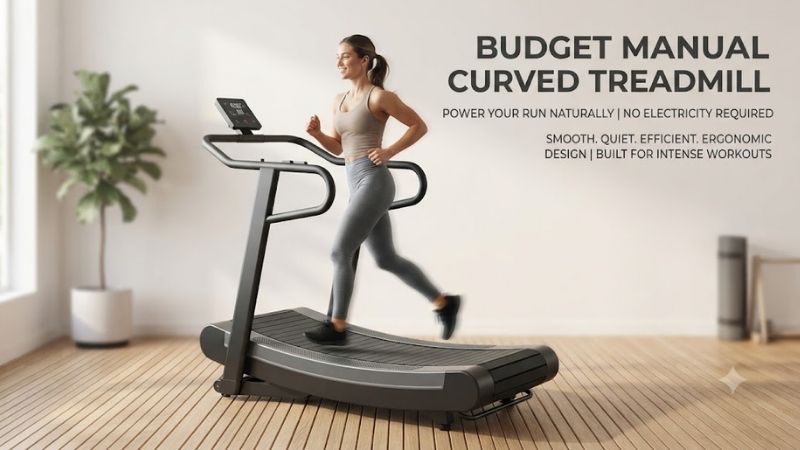
Curved manual treadmills have transformed cardiovascular conditioning by shifting propulsion entirely to the athlete. Unlike standard motorized platforms where an electric motor pulls the running belt beneath your feet, a curved manual treadmill relies strictly on gravity, downward foot pressure, and kinetic friction across precision ball-bearing tracks. This self-powered design increases metabolic demand and posterior-chain recruitment while completely eliminating electrical utility cords and motor failure risks. However, with commercial-tier slat runners frequently exceeding $3,000 to $6,000, finding a dependable budget or value-oriented curved treadmill requires rigorous analysis of frame gauges, bearing counts, slat durability, and mechanical resistance. This guide reviews the top budget manual curved treadmills available for residential home gyms, examining verified engineering specifications, operational footprints, and real-world trade-offs.
Quick Verdict
- Best Overall Value Curved Runner: Assault Fitness AssaultRunner Pro. Sets the benchmark for approachable slat-treadmill engineering, pairing a generous 17-by-62-inch TPU running surface with commercial-grade uprights and an unmotorized drivetrain backed by a 150,000-mile belt rating.
- Best with Multi-Level Magnetic Resistance: Bells of Steel Blitz Manual Treadmill. Combines a steep 17-degree curvature, 6 levels of magnetic drag, and multi-position handrails capable of transitioning from light jogging to heavy sled-push simulations.
- Best Under $1,500 with App Tracking: Sunny Health & Fitness SF-X7110. Delivers 8 adjustable magnetic resistance levels, a 59-by-17.7-inch running surface, and integrated Bluetooth telemetry on an accessible residential chassis.
- Best Mid-Tier Commercial Build: SB Fitness Equipment CT400. Features an ultra-sturdy 450-pound maximum user capacity, flexible shock-absorbing vulcanized slats, and 3 mechanical resistance settings for high-intensity intervals.
- Best for Dedicated Sled Conditioning: Tru Grit Grit Runner. Boasts a massive 400-pound frame, an 18.75-inch-wide slatted deck, and a 6-level magnetic brake tailored for heavy resistance pushing and sprint drills.
- Best Bidirectional Slat Deck: SOLE C80. Delivers a spacious 19-by-62-inch bidirectional slat-belt running track, 8 levels of magnetic resistance, and heavy-gauge steel uprights engineered for diverse athletic conditioning.
- Best Compact Footprint for Low Ceilings: IN10CT Health Runner. Features a low-profile deck clearance, corrosion-resistant steel chassis, and an efficient pulley-guided slat track designed for tight residential garage gyms.
Quick Comparison Table
| Product | Best For | Key Specifications | Main Advantage | Trade-Off |
| Assault Fitness AssaultRunner Pro | Best Overall Value | 17″ x 62″ TPU slat belt; 350 lb capacity; 280 lb machine weight | Proven ball-bearing drivetrain with 150,000-mile belt durability | Fixed curvature with zero secondary magnetic resistance adjustments |
| Bells of Steel Blitz | Best Magnetic Resistance | 17″ x 65″ slat belt; 6 magnetic levels; 17° curve; 400 lb capacity | Aggressive steep curve with multi-grip handles for sled pushing | Stiff initial belt resistance requires substantial effort to start |
| Sunny Health & Fitness SF-X7110 | Best Entry-Level Budget | 17.7″ x 59″ belt; 8 magnetic levels; 330 lb capacity; 157 lb weight | Highly accessible price with integrated Bluetooth app connectivity | Lighter frame exhibits slight vibration under aggressive full sprinting |
| SB Fitness Equipment CT400 | Best Mid-Tier Commercial | 18″ x 60″ belt; 3 magnetic levels; 450 lb capacity; 165 lb weight | Exceptional 450 lb user rating paired with flexible shock slats | Basic digital readout console lacks advanced interval programming |
| Tru Grit Grit Runner | Best Sled Conditioning | 18.75″ belt width; 6 magnetic levels; 330 lb capacity; 400 lb weight | Ultra-heavy 400 lb base ensures rock-solid floor stability | Extreme total unit weight makes indoor room relocation very difficult |
| SOLE C80 | Best Bidirectional Deck | 19″ x 62″ bidirectional belt; 8 magnetic levels; 330 lb capacity | Wide running surface with reverse-movement exercise capabilities | Substantial 72-inch overall length requires dedicated floor space |
| IN10CT Health Runner | Best for Low Ceilings | 17.16″ x 61″ belt; manual drive; 400 lb capacity; steel frame | Low-profile step-up height accommodates lower basement ceilings | Completely free-spinning design without magnetic braking options |
How We Selected
Our evaluation process focuses strictly on verified engineering specifications, mechanical drive designs, and functional durability within the non-motorized cardio category. True curved manual treadmills utilize individual interlocked slats mounted on sealed radial bearings rather than a continuous flat belt stretched over a wooden slider board. To distinguish reliable training tools from poorly balanced alternatives, we evaluated products across five foundational criteria:
- Drivetrain Friction and Bearing Assemblies: We examined the quality and distribution of precision sealed cartridge ball bearings along the guidance track. A high-quality curved deck must spin freely under forward weight transfer without binding, jerky deceleration, or lateral belt wandering.
- Deck Curvature and Ergonomic Geometry: We analyzed the deck’s arc radius and entry angle (typically ranging between 8 and 17 degrees). Flatter curves mimic outdoor road cadences, whereas steeper curves provide distinct acceleration zones and aggressive posterior-chain loading.
- Resistance Mechanism and Braking Integration: We assessed whether the unit relies solely on pure gravity and body positioning or incorporates secondary eddy-current magnetic resistance. Machines with magnetic brakes provide expanded versatility for sled pushes, power hiking, and cadence control.
- Slat Construction and Running Surface Dimensions: Belt width and usable length were cross-referenced against sprinting mechanics. High-velocity sprinting requires at least 60 inches of length to accommodate aggressive forward leans and rear leg extensions without foot clipping.
- Frame Rigidity and Base Stability: We evaluated overall machine weights, structural steel gauges, and base leveling capabilities. Non-motorized sprinting introduces violent horizontal shear forces; an unstable frame will slide across rubber gym flooring during all-out acceleration phases.
How We Selected
Detailed Product Recommendations
Assault Fitness AssaultRunner Pro
Best For: Runners, functional fitness athletes, and home gym builders seeking a battle-tested curved manual treadmill backed by commercial pedigree.
Why We Picked It: The Assault Fitness AssaultRunner Pro remains the benchmark standard for home curved runners. Rather than compromising drivetrain integrity, Assault Fitness incorporates the exact same heavy-duty drive layout found in commercial facilities. It utilizes thick, shock-absorbing thermoplastic polyurethane (TPU) slats guided by precision steel bearings, offering a low-friction cadence response that accelerates effortlessly under full sprinting strides.
Key Specifications:
- Drive Type: Non-motorized self-propelled
- Running Surface: 17″ W x 62″ L
- Resistance: Pure kinetic (user-position-controlled)
- Max User Weight: 350 lb
- Assembled Weight: 280 lb
- Dimensions: 69.7″ L x 33.1″ W x 64″ H
Features & Benefits: The hallmark of the AssaultRunner Pro is its durable slat-belt construction, designed to withstand up to 150,000 miles of operation without belt stretching or tracking misalignment. The heavy-duty steel frame provides a grounded feel that completely eliminates chassis rocking during explosive intervals. The high-contrast LCD console tracks watts, speed, RPM, distance, time, calories, and interval splits, featuring pre-programmed Tabata and custom interval routines.
Performance & Practical Use: Running on the Pro requires natural hip drive and mid-foot striking. Moving toward the front curve instantly accelerates the track, while settling into the center pocket maintains steady-state aerobic cruising. At 280 pounds, the frame stays planted on stall mats during maximum 20-second sprint intervals, though built-in transport wheels and an integrated rear grab bar allow one person to pivot and steer the unit across flat flooring.
What Makes It Different: Unlike budget competitors that use lightweight nylon plastic components, the AssaultRunner Pro utilizes dense polyurethane slats over industrial-grade cartridge bearings, ensuring minimal kinetic resistance and an exceptionally smooth glide.
Pros:
- Industry-leading durability backed by a 150,000-mile belt rating.
- Substantial 62-inch deck length easily accommodates full sprinting strides.
- High-contrast console features dedicated athletic interval profiles.
Cons:
- Lacks adjustable magnetic resistance for sled-push simulation.
- Assembled weight (280 lb) makes initial delivery and doorway navigation difficult.
Buy If: You want a proven, low-maintenance curved runner for daily conditioning and high-speed interval sprints.
Skip If: You require built-in magnetic resistance for heavy walking or resisted sled work.
Bells of Steel Blitz Manual Treadmill
Best For: Trainees who want the dual functionality of a curved sprint treadmill and a heavy sled-push conditioning station in one footprint.
Why We Picked It: Most curved treadmills rely purely on gravity and body positioning to dictate speed. The Bells of Steel Blitz incorporates an aggressive 17-degree curvature paired with a 6-level magnetic resistance system. This mechanical architecture allows trainees to transition seamlessly from low-friction endurance running to high-drag sled pushes without needing a separate turf strip or weighted prowler.
Key Specifications:
- Drive Type: Non-motorized self-propelled
- Running Surface: 17″ W x 65″ L
- Resistance: 6-level magnetic drag system
- Max User Weight: 400 lb
- Assembled Weight: 325 lb
- Dimensions: 78.7″ L x 35″ W x 61″ H
Features & Benefits: The Blitz features a heavy-gauge 9-gauge steel frame with an industrial powder-coat finish. Its slatted belt runs across 200 precision ball bearings, providing exceptional mechanical fluidness under speed. The frame incorporates an expansive handlebar array, including elevated uprights, lower sled-grip handles, and lateral sidebars. A heavy-duty mechanical lever controls the magnetic brake, which also functions as an emergency stop mechanism.
Performance & Practical Use: On resistance levels 1 through 2, the belt glides freely for cadence runs and rapid sprint intervals. Clicking into levels 3 and 4 creates significant drag, forcing intense posterior-chain activation for uphill power walking. At levels 5 and 6, the magnetic resistance locks down the belt, transforming the machine into a stationary sled push where you brace against the multi-grip bars to drive the rubber-coated aluminum slats backward.
What Makes It Different: The combination of an aggressive 17-degree slope with heavy magnetic braking makes this unit significantly more challenging than standard shallow-curve runners, placing extreme training demand on the glutes and hamstrings.
Pros:
- Six distinct magnetic resistance levels support both free running and sled pushes.
- Heavy-duty 9-gauge steel chassis supports users up to 400 pounds.
- Generous 65-inch deck length provides ample room for aggressive body angles.
Cons:
- Steep 17-degree curvature takes longer for beginners to adapt to.
- Substantial 325-pound assembled frame requires a dedicated permanent training space.
Buy If: You prioritize brutal metabolic conditioning, sled pushes, and power hiking alongside high-speed sprint intervals.
Skip If: You want a shallow, easy-gliding curve strictly for long-distance marathon base training.
Sunny Health & Fitness SF-X7110
Best For: Budget-conscious buyers seeking an entry-level curved manual treadmill with magnetic resistance under $1,500.
Why We Picked It: Curved slat treadmills have historically been priced out of reach for casual home gyms. The Sunny Health & Fitness SF-X7110 bridges this gap by delivering true curved slatted-belt mechanics, 8 levels of magnetic resistance, and modern Bluetooth telemetry at a fraction of the cost of commercial alternatives.
Key Specifications:
- Drive Type: Non-motorized self-propelled
- Running Surface: 17.7″ W x 59″ L
- Resistance: 8-level magnetic system
- Max User Weight: 330 lb
- Assembled Weight: 157 lb
- Dimensions: 67.7″ L x 29.9″ W x 59.05″ H
Features & Benefits: The SF-X7110 utilizes an array of 14 high-strength magnets positioned near the internal flywheel assembly, controlled via a multi-position resistance lever. Its slatted running track features rubber-coated treads designed to dampen foot-strike vibration through residential subfloors. The onboard console tracks speed, distance, time, calories, and pace, broadcasting real-time workout telemetry via Bluetooth to mobile devices and fitness apps.
Performance & Practical Use: Weighing in at 157 pounds, the SF-X7110 is significantly easier to maneuver around a spare room or residential garage than 300-pound commercial units. Belt movement is smooth and controlled, making it exceptionally well-suited for brisk walking, tempo jogging, and low-impact steady-state cardio. The 8 resistance settings allow users to progressively increase tension for steep uphill simulations without needing motorized elevation motors.
What Makes It Different: It offers one of the most accessible entry points into slatted curved treadmill ownership while retaining full magnetic drag control and digital app connectivity.
Pros:
- Approachable pricing for a slatted curved cardio platform.
- Eight levels of magnetic resistance provide versatile training loads.
- Lightweight chassis (157 lb) with transport wheels simplifies home storage.
Cons:
- Shorter 59-inch belt length can feel tight for over-striding sprinters over 6 feet tall.
- Frame exhibits minor lateral flex during maximum-effort sprint accelerations.
Buy If: You want an affordable, self-powered curved treadmill with magnetic resistance for walking, jogging, and moderate intervals.
Skip If: You weigh over 300 pounds or plan on executing competitive collegiate sprint workouts.
SB Fitness Equipment CT400
Best For: Athletes looking for an ultra-durable, commercial-rated curved treadmill capable of supporting high user weights without paying luxury prices.
Why We Picked It: The SB Fitness CT400 delivers commercial-grade structural integrity at an approachable price point. Rated for an impressive 450-pound maximum user weight, it utilizes flexible, high-density vulcanized rubber slats mounted on sealed high-speed bearings, providing a balanced blend of joint-friendly shock absorption and immediate kinetic responsiveness.
Key Specifications:
- Drive Type: Non-motorized self-propelled
- Running Surface: 18″ W x 60″ L
- Resistance: 3 magnetic resistance levels
- Max User Weight: 450 lb
- Assembled Weight: 165 lb
- Dimensions: 73″ L x 30.5″ W x 61.6″ H
Features & Benefits: The CT400 utilizes a shallow, natural arc designed to replicate outdoor ground contact forces without forcing excessive knee flexion. The vulcanized rubber slats provide substantial shock absorption, significantly reducing impact forces on the ankles, knees, and hips compared to traditional motorized flat decks. A multi-position resistance lever allows trainees to engage light magnetic resistance for targeted strength conditioning.
Performance & Practical Use: The 18-inch belt width provides extra lateral clearance, giving runners greater peace of mind during fatigued sprint intervals. The track glides with minimal rolling resistance on setting zero, allowing immediate transitions from slow recovery walking to full sprints. While the 165-pound frame remains maneuverable via its front handle and rear wheels, its reinforced steel framework provides rigid support for athletes of all sizes.
What Makes It Different: It offers an industry-leading 450-pound weight rating on a sub-200-pound frame, combining exceptional load-bearing strength with flexible rubber shock slats.
Pros:
- Massive 450-pound maximum user capacity backed by heavy-duty steel bracing.
- Vulcanized rubber slats absorb substantial foot-strike impact shock.
- Wide 18-by-60-inch running surface provides excellent lateral margin for error.
Cons:
- Three resistance levels offer fewer micro-adjustments than 8-level systems.
- Basic digital display lacks wireless chest-strap heart rate pairing.
Buy If: You require a high-capacity, durable curved manual treadmill with commercial-grade slat cushioning for varied family or garage gym use.
Skip If: You need granular resistance adjustments across 8 or 10 distinct difficulty tiers.
Tru Grit Grit Runner
Best For: Powerlifters, strongman athletes, and serious cross-trainers seeking an indestructible, heavy-anchored curved treadmill for sled pushes.
Why We Picked It: Weighing an incredible 400 pounds, the Tru Grit Grit Runner is built like an industrial power rack. Instead of relying on lightweight alloys, Tru Grit constructed this machine using heavy structural steel and thick aluminum components. It features an 18.75-inch-wide slatted deck and an integrated 6-level magnetic brake designed specifically to hold up under the most violent acceleration and heavy push forces.
Key Specifications:
- Drive Type: Non-motorized self-propelled
- Running Surface: 18.75″ W x 62″ L
- Resistance: 6-level magnetic resistance
- Max User Weight: 330 lb
- Assembled Weight: 400 lb
- Dimensions: 78″ L x 34″ W x 60″ H
Features & Benefits: The defining characteristic of the Grit Runner is its absolute frame rigidity. Because the chassis weighs 400 pounds, it creates zero frame lift, shudder, or vibration, even when an athlete drives full bodyweight into the forward uprights. The slatted belt features textured, heavy-duty rubber treads that provide unmatched grip for athletic shoes. A side-mounted lever adjusts the magnetic resistance across distinct zones for sprinting, walking, and sled pushes.
Performance & Practical Use: On lower resistance settings, the heavy track requires assertive forward drive to get rolling, but once in motion, its substantial rotational inertia carries a smooth, consistent rhythm. On resistance settings 5 and 6, the magnetic brakes clamp down with heavy drag, allowing athletes to simulate weighted sled pushes in a stationary 6.5-foot footprint. The battery-powered console displays time, distance, pace, speed, watts, and calories.
What Makes It Different: It is by far the heaviest and most structurally solid unit in its category, engineered specifically for high-impact commercial gyms and rugged garage setups where equipment movement cannot be tolerated.
Pros:
- 400-pound overall weight provides absolute, unyielding frame stability.
- Wide 18.75-inch running belt accommodates broad athletic gaits.
- Six-level magnetic resistance supports full-power sled training.
Cons:
- Enormous assembled weight makes upstairs delivery virtually impossible.
- Wheel shrouds sit low to the ground, requiring a steep lift angle when rolling the unit.
Buy If: You train in a ground-floor garage gym and want an ultra-rugged machine built to handle heavy sled drives and intense sprints.
Skip If: You live in an apartment, need to move equipment frequently, or have restricted floor load allowances.
SOLE C80
Best For: Athletes seeking premium brand support, an expansive running surface, and reverse-movement training capabilities.
Why We Picked It: The SOLE C80 represents the venerable cardio brand’s expansion into non-motorized training. Backed by SOLE’s established residential engineering, the C80 delivers a massive 19-by-62-inch slatted running deck paired with an 8-level magnetic resistance system. Uniquely, the slat-belt assembly is bidirectional, allowing trainees to perform reverse walking and backward uphill climbs for knee rehabilitation and quadriceps isolation.
Key Specifications:
- Drive Type: Non-motorized self-propelled (bidirectional)
- Running Surface: 19″ W x 62″ L
- Resistance: 8-level magnetic system
- Max User Weight: 330 lb
- Assembled Weight: 261 lb
- Dimensions: 72″ L x 32″ W x 61″ H
Features & Benefits: The C80 features heavy-duty steel construction with ergonomic multi-grip performance handles designed to accommodate both standard upright running postures and forward-leaning drive stances. Its 19-inch deck width is among the widest in the category, giving athletes complete freedom of movement. The onboard LCD screen provides immediate readouts of speed, distance, elapsed time, and caloric burn.
Performance & Practical Use: The bearing array provides seamless track acceleration with zero dead spots. Engaging the magnetic resistance via the console-mounted selector adds progressive drag, making it easy to shift between aerobic threshold running and high-intensity hill power-walking. The bidirectional track allows users to face forward or backward, engaging the tibialis anterior and vastus medialis muscles during controlled reverse walking drills.
What Makes It Different: Its bidirectional belt capability and broad 19-inch running deck provide functional training options that single-direction curved treadmills cannot replicate.
Pros:
- Spacious 19-by-62-inch deck accommodates wide, unrestricted running mechanics.
- Bidirectional track supports forward running and reverse-walking conditioning.
- Smooth 8-level magnetic resistance transitions.
Cons:
- Substantial 72-inch overall length requires generous clearance space.
- Display console utilizes a basic LCD format without backlit smart features.
Buy If: You want a wide, comfortable curved deck with bidirectional capabilities and multi-level magnetic drag from an established brand.
Skip If: You have a narrow workout room where a 32-inch wide, 72-inch long frame would obstruct walkways.
IN10CT Health Runner
Best For: Home gym owners dealing with lower basement ceilings or tighter footprints who still want a commercial-grade, motorless cardio tool.
Why We Picked It: Ceiling clearance is often the primary obstacle when placing a curved treadmill in a basement or garage gym. The IN10CT Health Runner features an engineered low-profile deck design that keeps the runner’s foot height closer to the floor than bulkier high-incline units, while still providing an extensive 17.16-by-61-inch running surface and a 400-pound weight rating.
Key Specifications:
- Drive Type: Non-motorized self-propelled
- Running Surface: 17.16″ W x 61″ L
- Resistance: Pure kinetic (user-position-controlled)
- Max User Weight: 400 lb
- Assembled Weight: 242 lb
- Dimensions: 69″ L x 32″ W x 61.5″ H
Features & Benefits: The IN10CT Health Runner utilizes a corrosion-resistant steel frame paired with durable rubber-over-polyurethane slats. A specialized pulley track alignment system ensures the slat belt remains centered across thousands of interval cycles without drifting or rubbing against the side shrouds. The high-contrast console tracks speed, distance, time, calories, watts, pace, and heart rate telemetry.
Performance & Practical Use: Operating without magnetic brakes, the Health Runner delivers a completely natural, low-drag kinetic experience. The belt responds instantly to cadence shifts: stepping up onto the front curve produces rapid acceleration, while maintaining foot placement directly in the center contour holds steady marathon pace. Rear transport wheels and a built-in crossbar handle make moving the 242-pound machine surprisingly manageable on firm surfaces.
What Makes It Different: Its low step-up height and compact 69-inch frame length provide commercial-level durability without demanding the extreme ceiling clearance of steeper competing units.
Pros:
- Low-profile frame architecture accommodates residential basements with lower ceilings.
- Heavy-duty 400-pound maximum user capacity.
- Pulley-guided track system prevents belt drift during hard lateral movement.
Cons:
- Purely self-propelled design lacks magnetic drag resistance for sled training.
- Handrail layout is tailored primarily for running rather than specialized sled-push grips.
Buy If: You need a high-capacity, low-maintenance curved runner that fits safely under lower ceilings.
Skip If: You want variable magnetic resistance to simulate steep hills or weighted sled work.
Buying Guide: How to Choose a Budget Curved Manual Treadmill
Investing in a curved manual treadmill requires understanding the unique mechanical principles and spatial demands of non-motorized cardio equipment. Evaluating the following criteria will ensure you choose a machine that fits your biomechanical needs, training goals, and available home gym space.
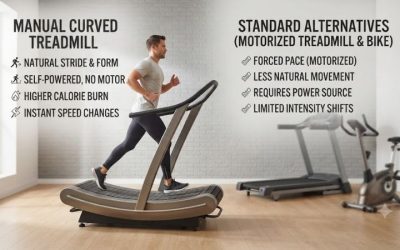
Curved Slat-Belt Mechanics vs. Flat Motorized Decks
What It Is: Curved manual treadmills utilize an interlocking series of rigid, rubber-coated aluminum or polyurethane slats mounted on sealed radial ball bearings across a curved steel framework. Flat treadmills utilize a thin, continuous multi-ply belt driven over a wooden slider deck by an electric continuous-duty motor.
Why It Matters: On an electric treadmill, the motor sets the speed, pulling your leg into extension and encouraging a passive foot strike. On a curved manual treadmill, your muscular output initiates and maintains belt movement. You must pull the belt beneath your center of mass using the glutes, hamstrings, and calves. This self-powered dynamic demands greater kinetic effort, burns more energy per minute, and eliminates the risk of motor controller failure, electrical short circuits, and replacement capacitor costs.
Who Benefits: Trainees seeking functional posterior-chain development, lower-impact joint loading, athletic sprint training, and equipment that operates independently of electrical outlets.
Trade-Off: Curved slatted treadmills are mechanically heavier (typically 160 to 400 pounds), do not fold for storage, and have a higher baseline purchase price than entry-level flat motorized treadmills.
Arc Curvature and Biomechanical Gait Adaptation
What It Is: The degree of curvature across the running deck, typically measured from an 8-degree shallow arc up to a steep 17-degree radius.
Why It Matters: The curvature dictates how rapidly the belt accelerates under forward foot placement and how intensely it loads the lower extremities. A shallow curve (8 to 10 degrees, like the AssaultRunner or IN10CT) closely simulates outdoor road running, promoting a natural mid-foot landing with predictable acceleration. A steep curve (15 to 17 degrees, like the Bells of Steel Blitz) acts like a continuous uphill climb, placing high rotational torque on the track and heavily taxing the calves and hamstrings.
Who Benefits: Distance runners and aerobic trainees generally prefer shallow-to-moderate arcs for smooth cadence control. Sprinters, HIIT athletes, and power trainees benefit from steeper curves that accelerate immediately during aggressive forward-leaning starts.
Trade-Off: Steeper curves require an adaptation period to master cadence balance and can make sustained steady-state aerobic jogging feel exhausting for beginners.
Resistance Systems: Pure Kinetic vs. Adjustable Magnetic Drag
What It Is: A pure kinetic treadmill relies entirely on gravity and user position to control speed. A magnetic-resistance curved treadmill integrates a row of rare-earth magnets positioned beside a conductive internal flywheel, controlled via an exterior manual lever to create adjustable eddy-current drag.
Why It Matters: Pure kinetic machines provide an unlimited top speed and an effortless, free-spinning glide that excels for tempo runs and all-out sprints. However, they cannot increase mechanical resistance at slow speeds. Units with adjustable magnetic brakes allow you to create heavy resistance at slow walking paces, simulating weighted sled pushes, uphill ruck marching, and resisted power walks within a static footprint.
Who Benefits: Trainees who want an all-in-one conditioning tool to replace outdoor sprint tracks and weighted prowler sleds benefit from magnetic drag. Pure runners who only care about sprinting and aerobic mileage do not need magnetic brakes.
Trade-Off: Magnetic resistance systems add mechanical complexity, additional control linkages, and slight initial drag even on their lowest setting.
Running Deck Dimensions and Sprint Clearance
What It Is: The usable surface area of the slatted belt, measured in width and length between the stationary side footboards.
Why It Matters: When sprinting on a curved manual treadmill, your stride opens up, your body leans forward at an acute angle, and your foot-strike moves higher up the front arc. A running deck that is too short (under 55 inches) creates a constant hazard of kicking the front frame or slipping off the rear roller during maximum-effort sprint finishes. A belt width of at least 17 to 19 inches is critical to prevent your shoes from clipping the stationary side rails during high-fatigue workouts.
Who Benefits: Athletes taller than 6 feet and high-velocity sprinters require a deck length of 60 to 65 inches. Walkers and tempo joggers can comfortably utilize 50 to 59-inch decks.
Trade-Off: Longer running surfaces expand the overall machine footprint, requiring 6 to 7 feet of dedicated horizontal floor space.
Ceiling Height and Overhead Clearance Calculations
What It Is: The vertical distance required between the home gym floor and the ceiling to safely accommodate the runner at the highest point of the curved deck.
Why It Matters: Unlike flat treadmills where the running deck sits 6 to 8 inches off the ground, a curved manual treadmill has an elevated front and rear curve. At the highest point of the arc, the slats can sit 12 to 16 inches above floor level. In addition, athletic sprinting introduces considerable vertical oscillation.
To ensure safe overhead clearance, calculate:
$$\text{Minimum Ceiling Height} = \text{User Height} + \text{Deck Arc Apex Height (approx. 14 in)} + \text{Vertical Sprint Bounce (6 to 8 in)}$$
For example, a 6-foot-2 athlete ($74\text{ inches}$) running on a curved deck with a 14-inch step-up height requires a ceiling of at least 96 inches ($8\text{ feet}$) to prevent head-strike hazards.
Who Benefits: Anyone installing equipment in a finished basement, low garage, or attic gym.
Trade-Off: Trainees with 7-foot basement ceilings must prioritize low-profile designs like the IN10CT Health Runner or place the machine between ceiling joists.
Frequently Asked Questions
Why are curved manual treadmills more expensive than motorized treadmills?
Curved manual treadmills carry a higher upfront cost because of their heavy-duty structural materials and precision mechanical manufacturing. Rather than using an inexpensive electric motor, a thin PVC belt, and a piece of lubricated particle board, a curved manual treadmill requires dozens of individually molded, shock-absorbing vulcanized rubber or polyurethane slats. Each slat is mounted onto precision-machined steel guide tracks with 100 to 200 sealed radial ball bearings. The heavy steel chassis must withstand violent forward acceleration without shifting, resulting in a machine built to commercial structural standards with an operational lifespan that far exceeds entry-level motorized units.
Can beginners safely use a curved manual treadmill?
Yes, beginners can safely train on a curved manual treadmill, but they must respect the initial learning curve. Because there is no motor driving the belt, the track responds instantly to foot placement and body weight. Stepping onto the front curve causes the belt to accelerate rapidly, which can feel destabilizing if you are accustomed to a motorized machine. Beginners should start by holding the stationary side handrails, stepping into the lowest center pocket of the curve, and establishing a slow, controlled walking cadence before attempting jogging or hands-free running.
Does a curved manual treadmill require regular lubrication?
No, curved slatted treadmills generally do not require the frequent silicone deck lubrication that flat motorized treadmills demand. Flat treadmills generate continuous high friction as a thin belt drags directly across a flat wooden slider board. Curved treadmills eliminate slider-board friction by suspending the slats on sealed, lubricated radial ball bearings that roll along guide channels. Maintenance is primarily limited to vacuuming airborne dust and lint from beneath the slat track, wiping down the sweat guards, and checking frame assembly hardware periodically for tightness.
Can you walk or jog on a curved manual treadmill, or are they only for sprinting?
You can easily walk, jog, and run steady-state miles on a curved manual treadmill. While they are renowned in athletic training facilities for high-intensity interval training (HIIT) and maximum-velocity sprinting, finding a steady pace simply requires finding the neutral balance point of the curve. Walking or jogging in the center pocket of the deck maintains a steady, continuous speed. Many athletes find that walking on a curved treadmill actively engages the posterior chain and promotes better upright posture than walking on a motorized flat deck.
How much physical space is needed around a curved treadmill?
In addition to the physical footprint of the machine (which typically measures approximately 68 to 78 inches long by 30 to 35 inches wide), you should maintain a minimum operating clearance zone for safety. Ensure there is at least 6.5 feet (2 meters) of clear, unobstructed floor space behind the rear roller and at least 1.5 to 2 feet of clearance on either side of the handrails. This ensures you can safely dismount or exit the deck during high-intensity sprint intervals without colliding with walls, power racks, or weight plates.
Are curved treadmills loud compared to motorized treadmills?
Curved treadmills produce a different sound profile than motorized machines. They eliminate electric motor whine, high-pitch cooling fan buzz, and internal transformer hum. However, the mechanical movement of dozens of heavy rubberized slats rolling over steel bearings creates a rhythmic, low-frequency rolling sound. During all-out sprints, foot strikes on the slatted surface will produce audible mechanical thumping. Placing the machine on dense, 3/4-inch vulcanized rubber stall mats will significantly isolate vibrations from travelling through residential subfloors.
Conclusion
Investing in a budget curved manual treadmill brings commercial-grade athletic conditioning into your home gym without the electrical constraints, high utility bills, or motor breakdowns common to motorized cardio gear. If you want the most reliable, battle-tested curved runner with an expansive 62-inch deck and an unmotorized drivetrain built to last thousands of miles, the Assault Fitness AssaultRunner Pro remains the benchmark value selection. If your training demands hybrid conditioning where high-speed sprints alternate with brutal sled pushes, the Bells of Steel Blitz Manual Treadmill and its 6-level magnetic resistance system deliver unmatched training versatility. For shoppers seeking the lowest entry price into slatted curved training with app connectivity, the Sunny Health & Fitness SF-X7110 provides excellent residential value. For spaces with strict height limits, the IN10CT Health Runner keeps deck elevation low without sacrificing frame durability. Select the unit that matches your ceiling clearance, training style, and floor layout to build an enduring, self-powered cardio station at home.
Write Your Review
No reviews yet. Be the first to share your experience!