
Key takeaways
- Best Overall Manual Curved Treadmill: Assault Fitness AssaultRunner Elite (Heavy-duty commercial steel frame, high-inertia bearing track, 400 lb capacity, and lifetime belt warranty).
- Best for Running Form & Gait Retraining: TrueForm Trainer (Subtle 2.5-inch shallow curve radius engineered specifically to cue upright posture and midfoot strike mechanics).
- Best Value Curved Treadmill for Home Gyms: Assault Fitness AssaultRunner Pro (Identical running geometry to commercial variants with an efficient, stripped-down console mast).
- Best Premium Slat-Belt Treadmill: Woodway Curve LTG (Patented low-friction thermoplastic polyurethane slat system delivering exceptionally smooth running dynamics).
- Best with Integrated Magnetic Resistance: Xebex AirPlus Runner Smart Connect (Eight levels of magnetic and air resistance to combine sprint conditioning with heavy sled push simulations).
- Best Compact & Maneuverable Curved Treadmill: SB Fitness Equipment CT400 (Lightweight 165 lb chassis with transport handles and flexible shock-absorbing composite slats).
- Best Multi-Resistance Curved Deck: Sole C80 (Eight-level magnetic resistance adjustment with a wide 19″ x 62″ track suited for walking, jogging, and resistance drills).
Compare the best manual curved treadmills for home gyms. We evaluate slat-belt friction, curve radius, bearing assemblies, and magnetic resistance systems.
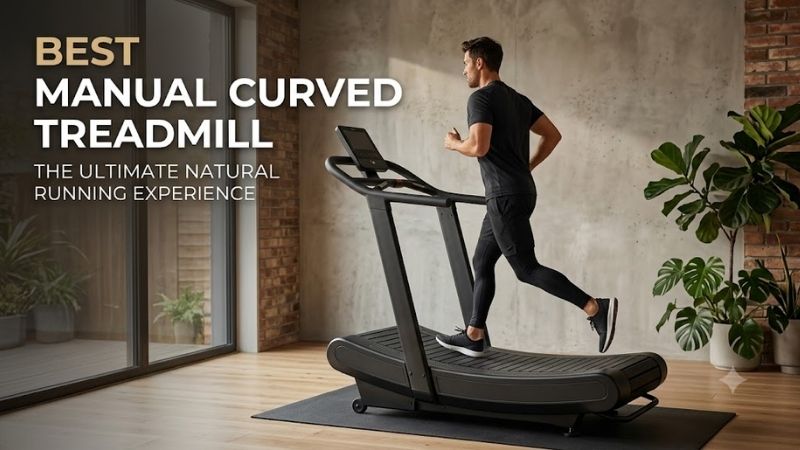
Manual curved treadmills replace electric drive motors with human propulsion, using gravity, body weight, and bearing-mounted slat tracks to govern speed dynamically. By eliminating electronic speed caps and flat running boards, non-motorized curved decks engage the posterior chain, encourage midfoot landing kinematics, and support instant anaerobic sprint intervals without electrical outlets. However, variations in curve curvature, bearing friction, deck weight, and magnetic resistance dramatically impact user mechanics and room suitability. This guide evaluates the top non-motorized curved treadmills across key performance categories, detailing their verified mechanical specifications, operational clearances, and practical trade-offs to help you select the right model for your home gym.
Quick Verdict
- Best Overall Manual Curved Treadmill: Assault Fitness AssaultRunner Elite (Heavy-duty commercial steel frame, high-inertia bearing track, 400 lb capacity, and lifetime belt warranty).
- Best for Running Form & Gait Retraining: TrueForm Trainer (Subtle 2.5-inch shallow curve radius engineered specifically to cue upright posture and midfoot strike mechanics).
- Best Value Curved Treadmill for Home Gyms: Assault Fitness AssaultRunner Pro (Identical running geometry to commercial variants with an efficient, stripped-down console mast).
- Best Premium Slat-Belt Treadmill: Woodway Curve LTG (Patented low-friction thermoplastic polyurethane slat system delivering exceptionally smooth running dynamics).
- Best with Integrated Magnetic Resistance: Xebex AirPlus Runner Smart Connect (Eight levels of magnetic and air resistance to combine sprint conditioning with heavy sled push simulations).
- Best Compact & Maneuverable Curved Treadmill: SB Fitness Equipment CT400 (Lightweight 165 lb chassis with transport handles and flexible shock-absorbing composite slats).
- Best Multi-Resistance Curved Deck: Sole C80 (Eight-level magnetic resistance adjustment with a wide 19″ x 62″ track suited for walking, jogging, and resistance drills).
Quick Comparison Table
| Product | Best For | Key Specifications | Main Advantage | Trade-Off |
| Assault Fitness AssaultRunner Elite | High-Intensity Sprints & Heavy Training | 17″ x 62″ track; 400 lb max user capacity; 289 lb unit weight; 69.9″ L x 31.7″ W x 64.4″ H | Dual commercial side handrails, overbuilt steel frame, and lifetime belt warranty | Heavy chassis requires dedicated floor space and two people to position |
| TrueForm Trainer | Natural Gait & Cadence Training | 17″ x 54″ track; 400 lb max user capacity; 270 lb unit weight; 64″ L x 31″ W x 63″ H | Shallow 2.5-inch curve forces proper upright posture without runaway belt spin | Shorter 54-inch track limits extreme overstride sprinting for tall runners |
| Assault Fitness AssaultRunner Pro | Budget-Conscious Athletic Conditioning | 17″ x 62″ track; 350 lb max user capacity; 280 lb unit weight; 69.9″ L x 31.7″ W x 64.4″ H | Delivers core Assault running mechanics and bearing responsiveness at lower cost | More utilitarian console frame with single upright mast construction |
| Woodway Curve LTG | Long-Distance Ergonomics & Durability | 17″ x 62″ track; 350 lb max user capacity; 299.6 lb unit weight; 67.8″ L x 33.6″ W x 70.1″ H | Genuine Woodway TPU slat design minimizes joint shock and friction | High financial investment; strictly free-spinning without magnetic braking |
| Xebex AirPlus Runner Smart Connect | Sled Pushes & Dual Resistance Workouts | 17″ x 67″ track; 350 lb max user capacity; 352 lb unit weight; 71″ L x 35″ W x 65″ H | 8 magnetic resistance levels simulate hill sprints and forward sled drives | Largest footprint and heaviest frame in category, making relocation difficult |
| SB Fitness Equipment CT400 | Small Spaces & Mixed-Fitness Rooms | 18″ x 60″ track; 375 lb max user capacity; 165 lb unit weight; 73″ L x 30.5″ W x 61.6″ H | Lightweight frame with integrated transport handle moves easily | Lighter flywheel mass yields lower rotational inertia during high-speed runs |
| Sole C80 | Multi-Purpose Walking & Hybrid Training | 19″ x 62″ track; 330 lb max user capacity; 261 lb unit weight; 72″ L x 32″ W x 61″ H | Broad 19-inch running deck paired with 8 magnetic resistance settings | Console metrics are basic; footprint cannot fold or compress for storage |
How We Selected
Selecting a manual curved treadmill requires looking beyond standard motor horsepower ratings and analyzing physical dynamics: mechanical friction, bearing resistance, curved deck geometry, and chassis rigidity. Because human muscle power serves as the drive motor, small variations in slat weight and track pitch drastically alter running effort. In evaluating non-motorized treadmills for this guide, our editorial research prioritized seven technical criteria:
- Curve Arc Geometry and Chord Depth: The steepness of the curve dictates acceleration behavior. Deeper curves (around 9 degrees of arc) provide aggressive acceleration for HIIT sprints, while shallow arcs (such as TrueForm’s 2.5-inch total curve depth) require precise foot placement over the center of mass, penalizing overstriding and promoting natural posture.
- Slat-Belt Architecture and Bearing Construction: Slat decks rely on sealed cartridge bearings running along steel guide rails. We evaluated the composition of the slats (molded vulcanized rubber, thermoplastic polyurethane, or engineered composites), roller tolerances, and bearing counts. High-quality bearings reduce internal drag, preventing the belt from feeling sticky or jerky during foot transitions.
- Inertia and Flywheel Calibration: A manual belt requires enough rotational inertia to glide between strides without slipping backward or feeling like quicksand. We examined roller flywheel balancing to verify that the track maintains smooth cyclical momentum during both slow cadence walking and maximum velocity sprint intervals.
- Frame Weight and Ground Anchoring: When an athlete transitions from a dead stop into an explosive 20 mph sprint, massive horizontal shear forces are transferred into the frame. We prioritized heavy-gauge tubular steel chassis weighing between 250 and 350 lb to eliminate frame hop, chassis twist, and floor drift under maximal loads.
- Resistance Capabilities (Free-Spin vs. Magnetic Brake): While traditional curved treadmills operate purely on free-spinning mechanical inertia, hybrid models introduce magnetic or air braking. We analyzed whether resistance systems allow users to expand beyond cardio into heavy resistance pushes, sled simulations, and controlled low-speed power hiking.
- Console Utility and Telemetry Tracking: Non-motorized consoles run on internal battery power rather than wall outlets. We evaluated LCD legibility, update responsiveness (eliminating display lag during split-second interval transitions), and ANT+/Bluetooth FTMS connectivity for broadcasting cadence and heart rate telemetry to external devices.
- Serviceability and Component Longevity: Unlike motorized belts that require continuous silicone deck lubrication, slat belts require lower maintenance. We weighed warranty coverage on frames, belts, and bearings, verifying that slats are individually replaceable in the event of mechanical wear.
Detailed Product Recommendations
Assault Fitness AssaultRunner Elite
Best For: Athletes, functional fitness enthusiasts, and cross-training facilities demanding commercial-grade durability and high-speed interval stability.
Why We Picked It: The Assault Fitness AssaultRunner Elite represents the industry benchmark for commercial-grade manual curved treadmills. Designed to withstand high-volume commercial fitness facilities, the Elite combines an overbuilt steel chassis with a heavy-inertia slat track running on precision ball bearings. Unlike lighter consumer decks that skip under aggressive acceleration, the Elite absorbs instantaneous sprint transitions with zero belt slip. Assault backs the running surface with a lifetime belt warranty, confirming long-term confidence in its structural integrity.
Key Specifications:
- Drive System: Manual non-motorized, dual-bearing drive
- Running Surface: 17″ W x 62″ L
- Max Speed: Unlimited / User-defined
- User Weight Capacity: 400 lb
- Machine Dimensions: 69.9″ L x 31.7″ W x 64.4″ H (Weight: 289 lb)
- Console Display: High-contrast multi-window LCD with Bluetooth and ANT+
- Warranty: Lifetime belt, 10-year structural frame, 3-year non-wear parts, 1-year labor
Features & Benefits: The Elite features dual side handrails constructed from heavy-gauge tubular steel with an ergonomic forward loop, giving athletes multiple hand positioning options during maximum recovery intervals or slow walking warm-ups. The running surface utilizes thick, vulcanized rubber slats that provide natural shock absorption without the soft rebound bounce seen on standard motorized flex decks. An upgraded digital console includes high-visibility interval programs (such as 20/10 and 10/20 tabs), custom target time and distance modules, and seamless ANT+ connectivity to pair with wireless chest straps and external fitness trackers.
Performance & Practical Use: Transitioning from an easy 10-minute mile warm-up into a 22 mph sprint occurs naturally on the Elite. Because belt speed responds to how far forward you strike on the curve, moving your stride toward the front arc initiates immediate acceleration. The 289 lb assembled weight anchors the chassis firmly to the floor, preventing the rear frame from kicking upward during violent sprint starts. Integrated heavy-duty transport wheels and a welded rear steel grab bar allow a single user to lift and pivot the frame across gym mats, though horizontal storage space must accommodate its fixed 70-inch footprint.
What Makes It Different: Compared to standard entry-level manual treadmills, the Elite features a fully reinforced steel frame, higher 400 lb user rating, wider side shrouds for foot resting, and an unconditional lifetime belt replacement warranty.
Pros:
- Overbuilt steel architecture eliminates frame deflection during maximum velocity sprints.
- Responsive bearing assembly transitions smoothly between walking and all-out sprinting.
- Lifetime warranty coverage on the complete slat running belt.
Cons:
- Heavy 289 lb chassis requires significant floor space and effort to navigate through doorways.
- The running track lacks magnetic resistance adjustments for sled-push style training.
Buy If: You want a bombproof, commercial-standard curved treadmill built for rigorous high-intensity intervals, athletic conditioning, and heavy daily volume.
Skip If: You have a small room requiring folding storage, or you want adjustable magnetic resistance levels for simulated hill pushes.
TrueForm Trainer
Best For: Road runners, marathoners, and athletes focused on correcting biomechanical gait flaws, cadence pacing, and posture.
Why We Picked It: While most curved treadmills feature an aggressive curvature designed primarily for rapid sprint acceleration, the TrueForm Trainer uses a shallow curve profile. With only 2.5 inches of elevation change from its lowest point to the front and rear tips, the Trainer forces the user into an authentic, upright running posture. Striking the belt with an overextended heel brake causes immediate resistance; conversely, striking beneath your center of mass with a midfoot strike creates fluid, effortless belt turnover. It functions as an unyielding, mechanical running coach.
Key Specifications:
- Drive System: Non-motorized, low-contour bearing curved track
- Running Surface: 17″ W x 54″ L
- Max Speed: Unlimited / User-defined
- User Weight Capacity: 400 lb
- Machine Dimensions: 64″ L x 31″ W x 63″ H (Weight: 270 lb)
- Console Display: Battery-powered digital LCD tracking pace, speed, distance, and heart rate
- Warranty: 10-year frame, 7-year parts, 2-year console, 1-year labor
Features & Benefits: The TrueForm Trainer features molded thermoplastic elastomer slats supported by internal steel reinforcement ribs, delivering a running feel that mirrors outdoor asphalt roads rather than a springy treadmill track. Its battery-powered LCD monitor tracks instantaneous pace per mile, total distance, speed, and cadence without requiring a wall plug. Front transport wheels and a built-in rear lifting handle allow the machine to be repositioned inside a residential garage or basement gym. The shorter 64-inch overall length makes it more compact than competing full-length curved trainers.
Performance & Practical Use: Running on the TrueForm Trainer requires more focus and cardiovascular output than conventional motorized or aggressively curved treadmills. The shallow 2.5-inch curve creates realistic road resistance: you cannot cheat the belt by leaning forward and relying on gravitational falling momentum. This design encourages a high cadence (170 to 185 steps per minute) and vertical pelvis alignment. While the 54-inch usable belt length is shorter than the 62-inch standard, the shallow curve keeps foot strikes compact, making the length sufficient for natural running strides.
What Makes It Different: It possesses the shallowest curve contour on the market (2.5 inches), engineered specifically to retrain running mechanics and penalize overstriding rather than maximizing artificial sprint acceleration.
Pros:
- Subtle curve geometry teaches midfoot striking, optimal cadence, and vertical alignment.
- Solid road-feel deck surface accurately replicates outdoor pavement running.
- Compact 64-inch frame length fits smaller residential gym layouts.
Cons:
- The shallow curve requires higher user effort to maintain pace than deeper curved tracks.
- Shorter 54-inch track limits extreme overstriding during top-end sprint drills.
Buy If: You are a dedicated distance runner or endurance athlete wanting to correct running gait, eliminate heel-striking, and simulate real road resistance indoors.
Skip If: You prioritize effortless belt spin for high-speed CrossFit intervals or want built-in magnetic sled resistance.
Assault Fitness AssaultRunner Pro
Best For: Home gym owners seeking commercial-tier curved running mechanics at an accessible price point.
Why We Picked It: The Assault Fitness AssaultRunner Pro shares the same running geometry, bearing architecture, and curve radius as the flagship AssaultRunner Elite, but eliminates the heavier dual handrails and high-finish cosmetic shrouds to deliver a more cost-effective package. For residential strength and conditioning spaces where continuous commercial use is not required, the Pro delivers uncompromised sprint performance, heavy-duty build quality, and comprehensive metric tracking.
Key Specifications:
- Drive System: Non-motorized, dual-stage precision bearing track
- Running Surface: 17″ W x 62″ L
- Max Speed: Unlimited / User-defined
- User Weight Capacity: 350 lb
- Machine Dimensions: 69.9″ L x 31.7″ W x 64.4″ H (Weight: 280 lb)
- Console Display: High-contrast LCD with Bluetooth/ANT+ and preloaded interval programs
- Warranty: 150,000-mile belt warranty, 5-year frame, 3-year parts, 1-year labor
Features & Benefits: The AssaultRunner Pro utilizes heavy-duty polyurethane and rubber-composite slats designed to absorb footfall impacts across repetitive training sessions. Its upright console mast holds an intuitive, battery-operated display that pairs with Bluetooth and ANT+ heart rate straps, displaying split times, wattage output, calories, and speed. The frame includes side foot platforms allowing users to step safely off the moving belt during interval rests. Transport wheels mounted to the front crossmember enable directional rolling across flat concrete or rubber stall mats.
Performance & Practical Use: Under sprint conditions, the Pro accelerates smoothly without mechanical hesitation. The deep 9-degree curve profile allows rapid transitions: stepping forward toward the top of the front arc delivers instant acceleration for 100-meter dash repeats, while settling into the center pocket locks in an even tempo pace. The 350 lb user capacity and 280 lb machine weight provide solid grounding, exhibiting no lateral sway under heavy strides. While the side handrails are more minimalist than the Elite version, they provide sufficient support for steady-state walking and interval mounting.
What Makes It Different: It offers commercial-grade Assault running dynamics and a 150,000-mile belt rating at a substantially lower price tier than luxury commercial models.
Pros:
- Proven curved geometry identical to competition-grade Assault commercial trainers.
- Durable 150,000-mile rated belt reduces long-term maintenance overhead.
- Battery-powered operation eliminates power cords and outlet placement constraints.
Cons:
- Thinner, more utilitarian side handrails compared to the Elite variant.
- Lacks mechanical or magnetic resistance options for strength-push work.
Buy If: You want the industry-standard curved treadmill running feel for sprint intervals and cardio conditioning without paying for high-end commercial aesthetic trims.
Skip If: You require a lightweight frame under 200 lb or want integrated magnetic braking for resistance pushing.
Woodway Curve LTG
Best For: Serious endurance runners, competitive track athletes, and luxury home gyms prioritizing low-impact running comfort.
Why We Picked It: Woodway is the originator of the modern slat-belt treadmill, and the Curve LTG brings that engineering into a residential-accessible footprint. Unlike conventional treadmills that pull a flat woven belt across a stationary wooden deck, Woodway’s patented system utilizes independent thermoplastic polyurethane (TPU) slats riding on low-friction, precision ball bearings. This design eliminates friction between the belt and deck board, yielding a quiet, natural running stride that minimizes joint impact while operating entirely under human power.
Key Specifications:
- Drive System: Non-motorized, patented low-friction curved slat-belt system
- Running Surface: 17″ W x 62″ L
- Max Speed: Unlimited / User-defined
- User Weight Capacity: 350 lb running / 400 lb walking
- Machine Dimensions: 67.8″ L x 33.6″ W x 70.1″ H (Weight: 299.6 lb)
- Console Display: Battery-powered LCD with Bluetooth and ANT+ connectivity
- Warranty: 10-year frame, 5-year drive and belt, 3-year all components, 1-year labor
Features & Benefits: The hallmark of the Curve LTG is its T-shaped TPU slat design. Each slat flexes independently under load, absorbing shock forces at ground contact and returning energy during toe-off. The LTG features a gentler, progressive curve radius (approximately 3% to 4% grade feel) that provides a balance between natural distance running mechanics and sprint acceleration. Its console tracks speed, heart rate, distance, cadence, and calories, featuring Bluetooth FTMS connectivity to transmit telemetry data directly to fitness apps. Ergonomic curved handrails provide support without encroaching into your upper-body arm swing.
Performance & Practical Use: The mechanical glide of the Woodway Curve LTG is distinct from competing units. Internal bearing drag is exceptionally low, allowing the belt to turn over with minimal joint strain. Distance runners will appreciate that the belt does not drag or catch during cadence adjustments, making sustained 5-mile to 10-mile aerobic tempo runs comfortable. However, the machine’s ultra-smooth glide requires initial acclimation: new runners must practice controlled deceleration, as the low-friction track continues to spin if you stop stepping abruptly.
What Makes It Different: The patented Woodway TPU slat-belt architecture provides the lowest coefficient of friction and highest mechanical refinement of any curved treadmill on the market.
Pros:
- Patented TPU slats deliver quiet, smooth belt glide with low joint impact.
- Progressive curve allows comfortable transition between steady distance running and sprinting.
- High-grade commercial components backed by Woodway’s proven engineering pedigree.
Cons:
- Premium price point represents a significant investment for a home gym.
- The free-gliding belt requires careful foot control when decelerating from high speeds.
Buy If: You want the gold standard in low-friction slat-belt mechanics for joint-friendly distance running and sprint training.
Skip If: You are working within a strict budget or require variable magnetic resistance for sled pushing.
Xebex AirPlus Runner Smart Connect
Best For: Functional fitness athletes, hybrid trainees, and strength athletes who want to combine sprinting with heavy sled pushes.
Why We Picked It: Most curved treadmills are strictly cardio machines: they spin freely without adjustable resistance. The Xebex AirPlus Runner Smart Connect changes this dynamic by integrating both air and magnetic resistance into a single curved chassis. With 8 distinct resistance settings controlled via a side lever, the AirPlus shifts from a freely spinning speed track (Level 1) into a high-resistance sled trainer (Level 8). This allows trainees to perform sprint repeats, power hiking, and heavy forward sled pushes on a single machine without taking up floor space with a weighted sled and turf strip.
Key Specifications:
- Drive System: Non-motorized curved slat track with dual Air and 8-level Magnetic Resistance
- Running Surface: 17″ W x 67″ L
- Max Speed: Unlimited / User-defined
- User Weight Capacity: 350 lb
- Machine Dimensions: 71″ L x 35″ W x 65″ H (Weight: 352 lb)
- Console Display: Smart Connect LCD tracking resistance, watts, speed, pace, and heart rate
- Warranty: 5-year frame, 3-year parts, 2-year console
Features & Benefits: The Xebex AirPlus includes a multi-grip handlebar assembly with high, mid, and low grip points. In low-resistance modes, the open cockpit accommodates free-running arm swings. In high-resistance modes (Levels 5 through 8), the user grasps the low or mid handles, leans forward at a 45-degree angle, and drives their legs into the track to simulate a heavy outdoor prowler push. Its Smart Connect console tracks power output in watts, cadence, speed, and distance, broadcasting data via Bluetooth and ANT+ to mobile training apps. The spacious 67-inch running surface is one of the longest in the category.
Performance & Practical Use: At Level 1, the AirPlus behaves like a standard curved treadmill, responding smoothly to body position. As you adjust the lever upward, internal magnetic brakes clamp down against the flywheel. At Levels 7 and 8, the resistance is stout enough that running becomes impossible, forcing an aggressive, full-body sled-driving march that taxes the quadriceps, glutes, and calves. At 352 lb, the frame is extremely heavy and completely stable, eliminating any chassis lift during maximal sled efforts. However, moving this machine requires substantial effort, even with its transport wheels.
What Makes It Different: The combination of an extended 67-inch curved deck with 8 levels of magnetic resistance and multi-position push handles enables true dual-purpose cardio and sled training.
Pros:
- 8 adjustable magnetic resistance levels allow seamless shifting from sprinting to heavy sled pushes.
- Multi-grip forward handles support realistic forward body angles for push conditioning.
- Extra-long 67-inch deck accommodates tall users and long bounding strides.
Cons:
- Substantial 352 lb weight makes moving the unit difficult for one person.
- Broad 35-inch frame width occupies significant lateral space in home gyms.
Buy If: You want a versatile machine that doubles as an unlimited sprint trainer and an indoor sled push station.
Skip If: You only care about traditional distance running and prefer a lighter, simpler non-resistance deck.
SB Fitness Equipment CT400
Best For: Home gym owners, apartment dwellers, and cross-trainers with limited floor space who need an easy-to-move curved deck.
Why We Picked It: High-end commercial curved treadmills frequently weigh between 300 and 400 lb, making residential delivery and room-to-room relocation difficult. The SB Fitness Equipment CT400 solves this operational barrier by utilizing a high-strength aluminum and composite frame that brings total unit weight down to 165 lb. Despite its lighter footprint, it features a full 18″ x 60″ running surface, three levels of magnetic resistance, and an impressive 375 lb user weight rating, delivering true curved-deck conditioning in a manageable form factor.
Key Specifications:
- Drive System: Non-motorized curved track with 3-level magnetic resistance
- Running Surface: 18″ W x 60″ L
- Max Speed: Unlimited / User-defined
- User Weight Capacity: 375 lb
- Machine Dimensions: 73″ L x 30.5″ W x 61.6″ H (Weight: 165 lb)
- Console Display: Digital LCD tracking time, speed, distance, calories, and pulse
- Warranty: 10-year frame, 5-year parts, 2-year console, 1-year labor
Features & Benefits: The CT400 features a curved track built from high-density, flexible composite slats that absorb footstrike shock while reducing overall rotating mass. An easy-access manual tension lever controls 3 levels of magnetic resistance: Level 1 provides free-spinning low-resistance running, Level 2 adds moderate friction for hill simulation, and Level 3 increases resistance for steep walking and stride power drills. A built-in rear transport handle and wide front polyurethane wheels allow a single individual to tilt and roll the unit easily across carpet, hardwood, or gym rubber.
Performance & Practical Use: Operating the CT400 reveals a responsive, user-friendly deck. The lighter rotating mass makes it easier for beginners and lighter runners to initiate belt turnover compared to heavy 300+ lb commercial flywheels. The 18-inch belt width provides an extra inch of lateral clearance over standard 17-inch tracks, giving runners peace of mind during fatigue. While the frame is structurally sound, elite sprinters exerting violent horizontal drive will notice slight chassis vibration compared to 300 lb steel platforms, making this machine best suited for moderate sprint work, interval conditioning, and daily jogging.
What Makes It Different: At just 165 lb, it weighs roughly half as much as commercial curved trainers while still delivering an 18″ x 60″ running track and 3 levels of magnetic resistance.
Pros:
- Lightweight 165 lb design allows a single person to move and store the unit.
- Broad 18-inch belt width provides comfortable foot placement clearance.
- 3-position magnetic resistance expands training options beyond standard free-running.
Cons:
- Lower machine mass yields minor frame feedback during all-out maximal sprints.
- Console tracking interface offers baseline metrics without advanced app integration.
Buy If: You want the biomechanical benefits of a curved treadmill in a lightweight, maneuverable frame that can be relocated easily.
Skip If: You are a high-level competitive sprinter demanding an unyielding 300+ lb commercial steel chassis.
Sole C80
Best For: Walkers, hybrid fitness athletes, and endurance trainees who want wide-deck comfort and multi-level resistance control.
Why We Picked It: The Sole C80 bridges the gap between dedicated sprint trainers and versatile home cardio equipment. Many commercial curved treadmills feature narrow 17-inch belts and high-inertia flywheels that make casual walking or controlled resistance training awkward. The C80 addresses this with an expansive 19″ x 62″ bidirectional running surface and an integrated 8-level magnetic resistance system. This allows users to dial in exact resistance settings for power walking, tempo jogging, or high-load leg conditioning drills without sacrificing stride room.
Key Specifications:
- Drive System: Non-motorized curved slat deck with 8-level magnetic resistance
- Running Surface: 19″ W x 62″ L
- Max Speed: Unlimited / User-defined
- User Weight Capacity: 330 lb
- Machine Dimensions: 72″ L x 32″ W x 61″ H (Weight: 261 lb)
- Console Display: Battery-powered digital LCD monitor tracking speed, distance, calories, and time
- Warranty: Lifetime frame, 5-year parts, 2-year electronics, 1-year labor
Features & Benefits: The C80’s 19-inch-wide track is among the widest in the curved category, providing comfortable lateral clearance for wider stances and lateral agility drills. The deck uses durable rubberized slats designed to mute mechanical foot noise while providing firm, joint-friendly cushioning. The 8-level resistance lever is positioned conveniently on the side handrail, allowing quick adjustments mid-workout. An integrated device shelf enables users to mount an iPad or smartphone to watch media or follow external workout programming while training.
Performance & Practical Use: Running on the C80 feels stable and controlled. At resistance Level 1, the track turns over smoothly for interval sprints and steady-state jogs. Shifting through Levels 4 to 8 introduces smooth magnetic drag that challenges the hamstrings and calves, making it effective for steep power walking and low-impact cardiovascular conditioning. The 261 lb steel frame sits flat on the floor with no chassis rocking, supported by adjustable leveling feet. However, the console electronics are straightforward, focusing on raw metric readouts rather than interactive software platforms.
What Makes It Different: It combines one of the widest running tracks in the curved segment (19 inches) with 8 levels of magnetic resistance and Sole’s robust residential warranty.
Pros:
- Extra-wide 19-inch running deck provides generous foot strike margins.
- 8 distinct resistance levels support low-speed strength-walking and cardio intervals.
- Sturdy 261 lb frame backed by a lifetime structural warranty.
Cons:
- Basic LCD display lacks native backlighting and advanced Bluetooth telemetry export.
- Large 72-inch overall footprint cannot fold for compact storage.
Buy If: You want a wide, comfortable curved running track with variable magnetic resistance for versatile walking, running, and resistance drills.
Skip If: You want a lightweight, portable treadmill or require an advanced, interactive console ecosystem.
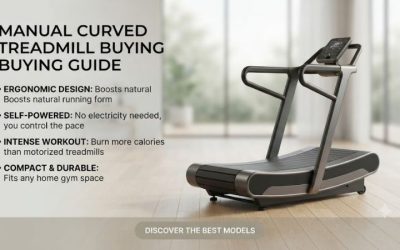
Manual Curved Treadmill Buying Guide
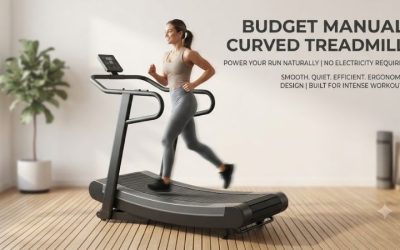
Non-motorized curved treadmills function on entirely different biomechanical and mechanical principles than standard motorized machines. Choosing the correct model requires evaluating slat friction, curve depth, frame stability, and training resistance. Review these mechanical and spatial factors before purchasing.
+--------------------------------------------------------------------------------------------------+
|                              CURVED TREADMILL BIOMECHANICAL ARCHITECTURE                         |
+--------------------------------------------------------------------------------------------------+
|                                                                                                  |
|                      =========================================  <-- Handrails / Console Mast      |
|                     /                                         \                                  |
|                    /     +---------------------------------+   \                                 |
|                   /      |  FRONT CURVE: ACCELERATION ZONE |    \                                |
|                  /       |  (Foot strikes forward of COM   |     \                               |
|                 /        |   drives belt acceleration)     |      \                              |
|                /         +---------------------------------+       \                             |
|               /                                                     \                            |
|              /           +---------------------------------+         \                           |
|             /            |  CENTER POCKET: EQUILIBRIUM ZONE|          \                          |
|            /             |  (Foot strikes under COM        |           \                         |
|           /              |   maintains steady-state speed) |            \                        |
|          /               +---------------------------------+             \                       |
|         /                                                                 \                      |
|        /                 +---------------------------------+               \                     |
|       /                  |  REAR CURVE: DECELERATION ZONE  |                \                    |
|      /                   |  (Foot moves rearward during    |                 \                   |
|     /                    |   toe-off and cadence reset)    |                  \                  |
|    /                     +---------------------------------+                   \                 |
|   /                                                                             \                |
|  +-------------------------------------------------------------------------------+               |
|  | SLAT TRACK: Sealed Bearings + Composite/TPU Slats + Magnetic Brake Mechanism  |               |
|  +-------------------------------------------------------------------------------+               |
|                                                                                                  |
+--------------------------------------------------------------------------------------------------+
Curve Geometry and Biomechanical Impact
What It Is: The contour, radius, and vertical chord depth of the running surface from the lowest center point to the elevated front and rear lips. Standard curves feature approximately 3 to 5 inches of rise (around 9 degrees of arc), while shallow designs (such as TrueForm) measure roughly 2.5 inches.
Why It Matters: The curvature dictates how gravitational falling torque translates into belt propulsion:
- Aggressive Curves (3.5″ to 5″ rise): As the foot lands forward on the upward slope, gravity and body weight pull the belt downward and backward, generating instant acceleration. This profile is optimal for high-velocity sprint training, HIIT intervals, and athletic acceleration drills.
- Shallow Curves (2.0″ to 2.5″ rise): A subtle curve minimizes gravitational assistance, requiring the user to drive the belt primarily through active hip extension and hamstring recruitment. Striking too far forward creates an awkward braking effect, naturally forcing the runner to maintain an upright torso, high cadence, and midfoot landing under their center of mass.
Who Benefits: Sprinters, CrossFit athletes, and HIIT trainees benefit from aggressive curves for rapid speed changes. Distance runners and athletes recovering from gait-related injuries benefit from shallow curves that reinforce proper mechanics.
Trade-Off: Deeper curves can cause runners with unrefined gait to overstride or feel unstable, while shallow curves require noticeably higher physical effort to maintain steady running speeds.
Slat-Belt Drive Mechanics vs. Motorized Flat Belts
What It Is: A running track constructed from individual rubber, TPU, or composite slats connected to heavy-duty guide chains riding along sealed precision ball bearings, operating entirely without an electric drive motor.
Why It Matters: Traditional motorized treadmills pull the runner’s foot backward via an electric motor, encouraging passive landing mechanics and heel striking. On a manual slat deck, the user must actively generate belt turnover through posterior chain recruitment—engaging the gluteus maximus, hamstrings, and calves. Studies indicate that running on a manual curved treadmill increases oxygen consumption ($\text{VO}_2$) and metabolic demand by roughly 30% compared to flat motorized running at identical speeds. Furthermore, slat belts eliminate stationary wooden slider decks, significantly lowering friction and eliminating the need for periodic silicone belt lubrication.
Who Benefits: Athletes looking to maximize caloric burn in less time, improve running economy, and train their posterior chain without electronic speed limitations.
Trade-Off: Slat decks require higher initial cardiovascular effort; there is no motor to sustain your pace if fatigue sets in, making passive walking or “mindless” recovery jogs more physically demanding.
Resistance Systems: Free-Spinning vs. Magnetic Braking
What It Is: The presence of an adjustable internal eddy-current magnetic brake or air damper that opposes the rotation of the flywheel assembly.
Why It Matters: Standard manual curved treadmills are purely free-spinning: belt resistance is dictated strictly by mechanical bearing friction and user body weight. Hybrid models introduce adjustable magnetic resistance (typically 3 to 8 levels).
- Level 0/1 (Free-Spinning): Provides minimal friction for sprint intervals, tempo running, and natural gait conditioning.
- Levels 4 to 8 (High Magnetic Resistance): Creates heavy drag against the belt. By gripping forward handles and driving into the track at a forward lean, users can execute simulated sled pushes, heavy resistance power walks, and uphill climbing drills without needing an outdoor turf lane.
Who Benefits: Cross-training athletes, football or rugby players, and home gym owners with limited space who want a single machine for both high-speed cardio and heavy lower-body push conditioning.
Trade-Off: Magnetic resistance assemblies add mechanical complexity, wider side chassis dimensions, and an additional 30 to 60 lb of overall machine weight.
Footprint, Frame Weight, and Ceiling Clearance
What It Is: The total physical dimensions, assembled weight, and working step-up height required to operate the treadmill safely inside a residential room.
Why It Matters: Curved treadmills do not fold. They feature fixed, heavy-gauge steel frames engineered to withstand explosive horizontal running forces. When considering room layout:
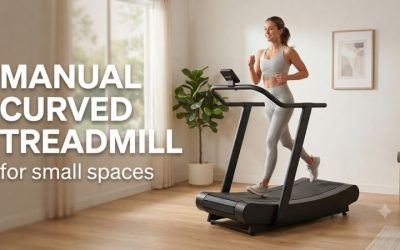
- Floor Space: Most units require a floor footprint of roughly 70 to 74 inches in length and 31 to 35 inches in width. You must also allow at least 6 feet of clear perimeter safety zone behind the rear roller.
- Ceiling Clearance: The step-up height of a curved deck is measured from the floor to the lowest center point of the curve (typically 12 to 14 inches) plus the user’s height. When sprinting, vertical head displacement rises. A safe minimum ceiling height is:
$$\text{Minimum Ceiling Height} = \text{User Height} + \text{Center Step-Up Height (14″)} + 12\text{ inches (Headroom)}$$
For a 6-foot runner (72 inches), an 8-foot (96-inch) ceiling is the bare minimum, while 9-foot ceilings are strongly recommended to allow upright sprinting without spatial claustrophobia.
- Floor Loading: With assembled machine weights ranging from 165 lb to over 350 lb—combined with an active 200+ lb athlete sprinting dynamically—these units exert substantial point loads. Place the machine on high-density rubber stall mats (3/8″ or 3/4″ thick) to protect underlying subfloors and dampen vibration.
Who Benefits: Homeowners evaluating garage, basement, or spare room placements to avoid overhead clearance and floor damage issues.
Trade-Off: Lighter machines (under 200 lb) are significantly easier to move around a home gym, but heavier frames (280 to 350 lb) provide the necessary inertia to prevent chassis hopping during all-out sprint starts.
Maintenance and Component Longevity
What It Is: The ongoing mechanical upkeep required to maintain smooth bearing glide and belt tracking over years of training.
Why It Matters: Motorized treadmills fail primarily due to thermal motor burnouts, fried motor controller boards, or deck friction caused by lack of lubrication. Manual curved treadmills eliminate electric motors, power cords, and circuit boards, drastically reducing failure points. Slat belts ride on sealed precision cartridge bearings that do not require silicone liquid lubrication. Maintenance is largely limited to keeping the track clear of dirt, vacuuming dust from underneath the slats, checking belt tension bolts, and replacing console AA/AAA batteries every 12 to 18 months.
Who Benefits: Garage gym owners and high-volume households that want durable, commercial-grade equipment without continuous mechanical maintenance.
Trade-Off: When a slat-belt bearing does eventually fail or suffer impact damage, replacing individual slats and sealed bearing tracks is more mechanically involved than swapping a standard flat belt.
Frequently Asked Questions
Why are manual curved treadmills more expensive than motorized treadmills?
Manual curved treadmills require intricate mechanical engineering rather than relying on an electric motor to pull a simple belt. A curved treadmill uses dozens of individually molded vulcanized rubber or composite slats, each mounted to precision-sealed cartridge bearings and reinforced guide chains. The frame must be constructed from heavy-gauge structural steel to prevent chassis flexing under explosive human-generated torque. This complex bearing assembly, heavy steel framework, and precision-balanced flywheel construction result in higher manufacturing and material costs than standard mass-market motorized decks.
Do manual curved treadmills burn more calories than flat treadmills?
Yes. Independent exercise science studies demonstrate that running on a non-motorized curved treadmill demands approximately 30% higher metabolic expenditure ($\text{VO}_2$) and elevated heart rate responses compared to running on a motorized flat treadmill at equivalent speeds. Because there is no motorized belt pulling your feet backward, your posterior chain muscles (glutes, hamstrings, and calves) must actively work to propel the heavy slat track beneath you. This self-powered drive requires constant muscular engagement, increasing cardiovascular output and caloric burn.
What ceiling height is needed for a curved manual treadmill?
To run safely on a manual curved treadmill, you should have a minimum ceiling height equal to your tallest user’s height plus 26 inches. The center step-up height of most curved decks sits between 12 and 15 inches off the floor, and runners experience natural vertical displacement of 3 to 6 inches during aggressive bounding strides. For an athlete who is 6 feet tall (72 inches), an 8-foot ceiling (96 inches) provides barely enough clearance for easy running, while a 9-foot ceiling (108 inches) is strongly recommended for sprint intervals and tall users.
Can beginners and walkers use a curved manual treadmill?
Yes, beginners can use curved treadmills, but they require a short acclimation period. Because the belt responds directly to foot placement, walking near the front upward slope accelerates the track, while walking in the center pocket maintains an even, steady pace. Beginners should initially hold the side handrails to learn how body positioning dictates speed. Models equipped with variable magnetic resistance (such as the Sole C80 or SB Fitness CT400) make walking especially approachable by introducing controlled drag that stabilizes belt rotation.
Do manual curved treadmills require electricity or a wall outlet?
No. Manual curved treadmills operate 100% without electrical power. The rotation of the belt is powered solely by your feet and body weight. The digital LCD consoles on these machines are powered by standard AA or AAA batteries, while some models utilize small internal generators driven by belt rotation to power the electronics. This completely motorless architecture allows you to place the treadmill anywhere in your home gym, garage, or patio without worrying about wall outlets, extension cords, or circuit breaker overloads.
How does a curved treadmill improve running form?
A curved deck naturally discourages overstriding and heavy heel-striking. If you overstride and land your foot too far forward on the upward curve, the belt creates an abrupt upward resistance that acts as a biomechanical brake, penalizing poor mechanics. To achieve a smooth, rhythmic glide, the runner is forced to land with a midfoot or forefoot strike directly underneath their center of mass, pull their hips into vertical alignment, and maintain an optimal cadence (around 170 to 185 strides per minute).
Conclusion
Choosing the right manual curved treadmill depends on your primary training style, available floor space, and desired resistance versatility. For athletes, cross-trainers, and high-intensity sprinters seeking an indestructible commercial standard, the Assault Fitness AssaultRunner Elite and AssaultRunner Pro deliver unmatched bearing responsiveness, rigid steel anchoring, and proven durability. Distance runners and athletes dedicated to perfecting upright cadence and midfoot mechanics will achieve superior form correction on the gentle 2.5-inch curve of the TrueForm Trainer, while those demanding joint-friendly, ultra-low-friction luxury will find the Woodway Curve LTG in a class of its own. Finally, if you want your treadmill to double as a heavy sled push conditioning station, hybrid magnetic platforms like the Xebex AirPlus Runner provide the ultimate all-in-one athletic training solution.

Write Your Review
No reviews yet. Be the first to share your experience!