
Key takeaways
- Best Overall: Horizon Fitness 7.0 AT. Combines a 3.0 CHP motor, quick-turn handrail dials, a generous 20-by-60-inch deck, and a robust 0–15% motorized incline range without locked software subscriptions.
- Best Value Motorized Incline: Horizon Fitness T101. Offers an ultra-reliable 2.5 CHP motor, 0–10% motorized incline, and hydraulic soft-drop folding at an approachable price point.
- Best for Interactive Streaming Workouts: NordicTrack T Series 6.5S. Features a responsive 2.6 CHP motor, 0–10% motorized incline, and automated trainer-led incline adjustments through optional iFIT integration.
- Best Balanced Walking & Jogging Deck: Schwinn 810. Delivers a 2.6 CHP motor, 0–10% power incline, and a comfortable 20-by-55-inch running deck with Softrak cushioning.
- Best Under $500 with Motorized Incline: Sunny Health & Fitness SF-T7515. Delivers rare 12-level motorized elevation and Bluetooth audio integration on an ultra-compact frame.
- Best Ultra-Budget Manual Incline Runner: XTERRA Fitness TR150. Delivers a 2.25 HP motor, 16-by-50-inch deck, and 3-level manual incline adjustment under a strict sub-$400 budget.
- Best Compact Manual Incline for Walkers: Sunny Health & Fitness SF-T4400. Features a 2.2 HP motor, 3-level manual pin incline up to 4.3%, and soft-drop folding for tighter residential rooms.
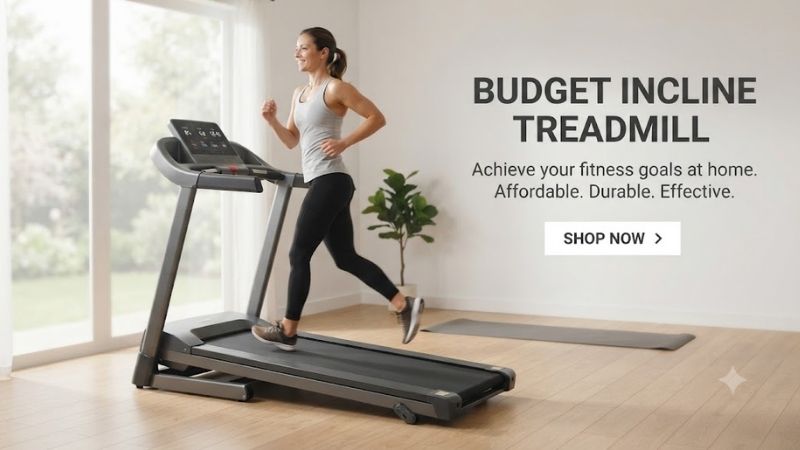
Best Budget Incline Treadmills for Home Gyms
Finding a dependable budget incline treadmill requires balancing mechanical stability, usable belt dimensions, and continuous motor output against strict pricing limits. Incline training significantly elevates cardiovascular demand and activates posterior-chain musculature without demanding high-impact running speeds. However, entry-level motorized decks often cut corners on motor insulation, frame gauge, and deck elevation systems. This guide reviews the top budget incline treadmills currently available, examining verified engineering specifications, elevation mechanics, deck clearances, and trade-offs to help you select the right machine for your home workout space.
Quick Verdict
- Best Overall: Horizon Fitness 7.0 AT. Combines a 3.0 CHP motor, quick-turn handrail dials, a generous 20-by-60-inch deck, and a robust 0–15% motorized incline range without locked software subscriptions.
- Best Value Motorized Incline: Horizon Fitness T101. Offers an ultra-reliable 2.5 CHP motor, 0–10% motorized incline, and hydraulic soft-drop folding at an approachable price point.
- Best for Interactive Streaming Workouts: NordicTrack T Series 6.5S. Features a responsive 2.6 CHP motor, 0–10% motorized incline, and automated trainer-led incline adjustments through optional iFIT integration.
- Best Balanced Walking & Jogging Deck: Schwinn 810. Delivers a 2.6 CHP motor, 0–10% power incline, and a comfortable 20-by-55-inch running deck with Softrak cushioning.
- Best Under $500 with Motorized Incline: Sunny Health & Fitness SF-T7515. Delivers rare 12-level motorized elevation and Bluetooth audio integration on an ultra-compact frame.
- Best Ultra-Budget Manual Incline Runner: XTERRA Fitness TR150. Delivers a 2.25 HP motor, 16-by-50-inch deck, and 3-level manual incline adjustment under a strict sub-$400 budget.
- Best Compact Manual Incline for Walkers: Sunny Health & Fitness SF-T4400. Features a 2.2 HP motor, 3-level manual pin incline up to 4.3%, and soft-drop folding for tighter residential rooms.
Best Budget Incline Treadmills for Home Gyms
Quick Comparison Table
| Product | Best For | Key Specifications | Main Advantage | Trade-Off |
| Horizon Fitness 7.0 AT | Best Overall | 3.0 CHP motor; 0–15% motorized incline; 20″ x 60″ deck; 325 lb capacity | Studio-ready quick-turn dials and zero mandatory subscriptions | Heavy 277 lb assembled frame requires dedicated floor space |
| Horizon Fitness T101 | Best Value Motorized | 2.5 CHP motor; 0–10% motorized incline; 20″ x 55″ deck; 300 lb capacity | Durable hydraulic folding frame and quiet, dependable elevation motor | Top speed capped at 10 mph; no advanced interactive telemetry |
| NordicTrack T Series 6.5S | Best for Streaming Workouts | 2.6 CHP motor; 0–10% motorized incline; 20″ x 55″ deck; 300 lb capacity | Seamless auto-adjusting incline during interactive trainer-led sessions | Heavy software push toward ongoing subscription ecosystem |
| Schwinn 810 | Best Balanced Jogger | 2.6 CHP motor; 0–10% motorized incline; 20″ x 55″ deck; 275 lb capacity | Softrak deck cushioning and smooth elevation transitions | 275 lb user limit is lower than competing frames in its tier |
| Sunny Health & Fitness SF-T7515 | Best Low-Cost Motorized Incline | 2.2 HP motor; 12-level motorized incline; 16.5″ x 49.5″ deck; 240 lb capacity | Push-button power incline at a sub-$500 entry price point | Narrow 16.5-inch belt width restricts higher-speed jogging strides |
| XTERRA Fitness TR150 | Best Ultra-Budget Option | 2.25 HP motor; 3-level manual incline; 16″ x 50″ deck; 250 lb capacity | Exceptional price-to-motor output ratio with 10 mph capability | Manual elevation requires dismounting the machine to set pin angles |
| Sunny Health & Fitness SF-T4400 | Best Compact Walking Incline | 2.2 HP motor; 3-level manual incline (up to 4.3%); 15.5″ x 49″ deck; 220 lb capacity | Compact footprint with reliable hydraulic soft-drop deck descent | Limited 220 lb user rating and shallow manual incline grade |
How We Selected
Our equipment evaluation process focuses strictly on verified engineering specifications, real-world mechanical integrity, and functional value within the budget cardio market. Budget incline treadmills span from sub-$400 entry units up to $1,000 workhorses. To separate dependable training tools from disposable machines, we assessed products across five foundational criteria:
- Motor Drive and Continuous Horsepower (CHP): We distinguished continuous-duty ratings (CHP) from deceptive peak-horsepower metrics. Machines intended for continuous incline walking or jogging require sufficient continuous motor torque to operate under sustained friction without overheating the motor control board.
- Incline System Mechanics: We evaluated motorized push-button linear actuators versus multi-position manual pin linkages. Motorized actuators allow on-the-fly angle changes during workouts, whereas manual pin systems demand stopping and stepping off the belt.
- Deck Area and Frame Geometry: Running belt width and length were scrutinized against intended training gait. Walkers require at least 45 to 50 inches of belt length, whereas joggers and taller runners require 55 to 60 inches to avoid clipping the front motor shroud or stepping off the rear roller.
- Structural Integrity and Capacity: We cross-referenced gross unit weights, frame steel thickness, deck shock-absorption configurations, and verified manufacturer maximum weight ratings. Heavier machines generally provide greater stability at steep incline angles.
- Software Freedom and Usability: We prioritized consoles that provide functional onboard workouts, clear LCD readouts, and open device shelves over machines that artificially limit core metric tracking behind mandatory, recurring software paywalls.
Detailed Product Recommendations
Horizon Fitness 7.0 AT
Best For: Walkers, joggers, and serious hill-climb trainees seeking a durable machine with commercial-grade incline range under $1,000.
Why We Picked It: The Horizon Fitness 7.0 AT sits at the absolute peak of budget-tier treadmills. It provides a true 3.0 CHP continuous-duty motor and an expansive 0–15% motorized incline range. Most budget treadmills cap elevation at 10% or 12%, making the 15% grade on the 7.0 AT an outstanding outlier for steep hiking simulations and high-intensity interval conditioning.
Key Specifications:
- Motor: 3.0 CHP
- Incline Range: 0–15% motorized
- Speed Range: 0.5–12 mph
- Running Area: 20″ W x 60″ L
- Weight Capacity: 325 lb
- Assembled Weight: 277 lb
- Folded Dimensions: 44″ L x 36″ W x 69″ H
Features & Benefits: The hallmark of the Horizon 7.0 AT is its ergonomic QuickDial control system mounted directly on the chest-level hand grips. Instead of repeatedly punching rubber console buttons mid-stride, you simply roll the right dial forward to increase speed and the left dial forward to steepen the incline grade. The deck features Horizon’s 3-Zone Variable Response Cushioning, which provides firmer impact absorption near the push-off zone and softer cushioning at the front foot-strike area.
Performance & Practical Use: The 3.0 CHP motor effortlessly manages sustained walking at steep grades, where motor load is substantially higher due to downward belt drag. The generous 20-by-60-inch belt provides complete freedom of motion for tall runners taking full strides. Because the unit weighs 277 pounds, it remains completely planted with zero frame wobble during aggressive incline climbs.
What Makes It Different: Unlike competitors that funnel users toward subscription streaming platforms, Horizon equips this console with open Bluetooth FTMS connectivity. It connects with apps like Zwift, Peloton, or Kinomap without locking basic console metrics if you decline a paid membership.
Pros:
- Broad 0–15% motorized incline range with rapid motor response.
- Generous 20-by-60-inch running belt accommodates all user heights.
- QuickDial thumb controls simplify mid-workout grade and speed adjustments.
Cons:
- Very heavy frame (277 lb) makes initial delivery and relocation difficult.
- Console footprint occupies significant floor space in smaller spare rooms.
Buy If: You want commercial-grade 15% motorized incline capabilities, open app connectivity, and heavy-duty frame stability without paying over $1,000.
Skip If: You have a small second-story apartment with strict weight or floor space limitations.
Horizon Fitness T101
Best For: Everyday home gym builders looking for the most dependable, easy-to-use motorized incline treadmill under $700.
Why We Picked It: The Horizon Fitness T101 has long served as the benchmark for entry-level reliability. Powered by an ultra-quiet 2.5 CHP motor, it features a smooth 0–10% motorized incline system that adjusts via one-touch console keys. It avoids complex electronics in favor of bulletproof baseline mechanics, making it exceptionally reliable over years of residential use.
Key Specifications:
- Motor: 2.5 CHP
- Incline Range: 0–10% motorized
- Speed Range: 0.5–10 mph
- Running Area: 20″ W x 55″ L
- Weight Capacity: 300 lb
- Assembled Weight: 180 lb
- Folded Dimensions: 46″ L x 34″ W x 61″ H
Features & Benefits: The T101 features Horizon’s FeatherLight hydraulic folding system, which slowly lowers the running deck to the floor hands-free once unlocked. The 20-by-55-inch deck is paired with 3-Zone Variable Response elastomers to protect knee and ankle joints from repetitive impact. The console includes integrated Bluetooth speakers, a cooling fan, an integrated device rack, and an onboard USB rapid-charging port.
Performance & Practical Use: Changing the incline from flat to a 10% grade is quiet and steady, with the internal linear actuator elevating the front frame smoothly under full user load. While the 10 mph top speed and 55-inch deck length are best suited for walkers and light joggers rather than competitive marathon sprinters, the 2.5 CHP motor handles daily power-walking at maximum incline without thermal throttling.
What Makes It Different: The T101 focuses on mechanical reliability and straightforward hardware rather than fragile digital touchscreens, resulting in one of the lowest out-of-box failure rates in the budget cardio sector.
Pros:
- Proven 2.5 CHP motor and dependable linear incline lift actuator.
- FeatherLight hydraulic folding system offers controlled, safe deck lowering.
- Built-in device shelf and USB charging port support phone or tablet streaming.
Cons:
- Maximum speed is limited to 10 mph.
- Incline grade tops out at 10%, which is lower than the 15% seen on the 7.0 AT.
Buy If: You want a low-maintenance, easy-to-fold motorized incline treadmill for daily cardio, brisk walking, and moderate jogging.
Skip If: You require steep grades above 10% or a full 60-inch deck for sprint training.
NordicTrack T Series 6.5S
Best For: Fitness enthusiasts who want interactive, instructor-led incline training and automatic trainer adjustments on a budget.
Why We Picked It: The NordicTrack T Series 6.5S brings smart cardio integration into the entry-level price bracket. With a continuous 2.6 CHP motor and a 0–10% motorized elevation system, its standout feature is the ability of external training apps (via your connected tablet or phone) to automatically adjust your speed and incline in real time based on terrain maps or studio classes.
Key Specifications:
- Motor: 2.6 CHP
- Incline Range: 0–10% motorized
- Speed Range: 0–10 mph
- Running Area: 20″ W x 55″ L
- Weight Capacity: 300 lb
- Assembled Weight: 203 lb
- Folded Dimensions: 38″ L x 36″ W x 67.5″ H
Features & Benefits: The T 6.5S features NordicTrack’s FlexSelect deck cushioning system, which allows users to toggle between a softer, shock-absorbent deck surface for joint protection and a firmer surface that mimics outdoor pavement. Its SpaceSaver design with EasyLift Assist utilizes a hydraulic strut to assist in raising and lowering the running deck with minimal physical strain.
Performance & Practical Use: The 2.6 CHP motor smoothly adjusts through grade changes without jerky speed drops. The 20-by-55-inch surface provides enough width for natural lateral arm swing and stride variation during incline climbs. When utilizing interactive workout routes, the automatic incline shifts smoothly to replicate rolling outdoor hills.
What Makes It Different: The integration with iFIT allows hands-free incline manipulation, meaning the treadmill adjusts its own grade to match video trainers or real-world topographic profiles while you focus entirely on your cadence.
Pros:
- Automated incline adjustments through connected smart training platforms.
- FlexSelect adjustable deck dampening accommodates varying surface preferences.
- Quick-touch speed and incline buttons on the console console faceplate.
Cons:
- Heavily pushes ongoing paid subscription services to access interactive features.
- Basic 5-inch backlit LCD display looks dated when used without an external tablet.
Buy If: You enjoy following guided studio classes or simulated outdoor trail walks where the machine automatically changes the incline for you.
Skip If: You refuse to navigate apps and prefer direct, offline, distraction-free push-button workouts.
Schwinn 810
Best For: Walkers and interval joggers seeking a comfortable cushioned deck and proven brand engineering under $800.
Why We Picked It: The Schwinn 810 combines Nautilus-engineered mechanical components with an accessible price point. Featuring a 2.6 CHP motor and a 10% motorized incline deck, it bridges the gap between ultra-compact walking pads and large premium running decks, providing a stable mid-size platform for residential cardio.
Key Specifications:
- Motor: 2.6 CHP
- Incline Range: 0–10% motorized
- Speed Range: 1.0–10 mph
- Running Area: 20″ W x 55″ L
- Weight Capacity: 275 lb
- Assembled Weight: 155 lb
- Folded Dimensions: 39.5″ L x 35.6″ W x 60.2″ H
Features & Benefits: Schwinn incorporates its Softrak deck cushioning system, which isolates impact across a multi-cell elastomer setup. The console features a high-contrast blue backlit LCD that tracks heart rate, speed, elevation, and distance across 16 built-in exercise profiles. A reinforced media shelf holds large tablets securely without blocking essential workout telemetry.
Performance & Practical Use: The Schwinn 810 provides quiet motorized elevation adjustments. Motor torque remains steady during progressive hill workouts, and the hydraulic SoftDrop release ensures the deck unfolds slowly without manual lifting strain. The 155-pound unit weight strikes an ideal balance, remaining stable during jogging while remaining maneuverable on built-in transport wheels.
What Makes It Different: The console includes Explore the World app compatibility alongside two customizable user profiles, allowing multiple household members to track individual workout metrics independently without mandatory recurring subscriptions.
Pros:
- Softrak cushioning significantly reduces joint impact during running strikes.
- SoftDrop hydraulic folding mechanism simplifies room cleanup.
- Clean console layout with dedicated one-touch incline control keys.
Cons:
- Maximum user weight capacity is capped at 275 lb.
- Assembly wiring routing through the console mast requires careful handling.
Buy If: You want a reliable 10% motorized incline treadmill with great deck cushioning from an established fitness brand.
Skip If: You weigh over 275 pounds or need a machine capable of speeds above 10 mph.
Sunny Health & Fitness SF-T7515
Best For: Budget-conscious shoppers living in apartments who need motorized, push-button incline adjustments in a tight footprint under $500.
Why We Picked It: Finding true motorized auto-incline on a treadmill priced under $500 is rare. While most machines in this entry-level tier require manual pins at the rear feet, the SF-T7515 features a dedicated internal lift motor providing 12 levels of motorized incline (ranging from approximately 2.6% to 12% grade) right from the dashboard controls.
Key Specifications:
- Motor: 2.2 HP Peak
- Incline Range: 12 levels motorized (up to ~12% grade)
- Speed Range: 1.0–8.0 mph
- Running Area: 16.5″ W x 49.5″ L
- Weight Capacity: 240 lb
- Assembled Weight: 123.5 lb
- Folded Dimensions: 40.25″ L x 28″ W x 54.75″ H
Features & Benefits: The SF-T7515 features digital console controls with rapid adjustment keys for speed and elevation, a soft-drop hydraulic folding arm, and an integrated Bluetooth stereo speaker system with an onboard microphone for hands-free audio. The display tracks pulse through metallic handlebar telemetry pads alongside time, speed, distance, and calories.
Performance & Practical Use: The motorized lift operates quietly and smoothly across all 12 elevation levels. Because the motor is rated at 2.2 HP and the top speed is 8.0 mph, this machine is specifically designed for power walking, uphill hiking simulations, and light recovery jogging. The compact 16.5-by-49.5-inch belt provides ample room for walking strides while occupying minimal floor space.
What Makes It Different: It delivers genuine push-button motorized incline adjustment at an ultra-budget price tier dominated almost entirely by awkward manual pin systems.
Pros:
- Rare 12-level motorized auto-incline under the $500 price point.
- Compact footprint folds down to just 40 inches in length.
- Integrated Bluetooth speakers and backlit LCD console.
Cons:
- Top speed is limited to 8.0 mph.
- Narrow 16.5-inch belt width is unsuitable for wide-stance running strides.
- 240 lb maximum weight capacity is lower than heavier frames.
Buy If: You want convenient motorized push-button incline training for walking or hiking without spending $700 or more.
Skip If: You are taller than six feet, weigh over 240 pounds, or intend to run at speeds exceeding 8 mph.
XTERRA Fitness TR150
Best For: Budget buyers seeking maximum motor reliability and frame durability under $400 who do not mind manual incline adjustments.
Why We Picked It: The XTERRA TR150 is one of the most widely sold entry-level home treadmills. Rather than compromising motor quality to install a cheap motorized lift system, XTERRA opted for a robust 2.25 HP motor paired with a 3-position manual incline bracket. This engineering decision keeps the retail price exceptionally low while providing a dependable 10 mph top speed.
Key Specifications:
- Motor: 2.25 HP
- Incline Range: 3 manual levels (approx. 0.5°, 1.5°, and 2.5° angles)
- Speed Range: 0.5–10 mph
- Running Area: 16″ W x 50″ L
- Weight Capacity: 250 lb
- Assembled Weight: 97 lb
- Folded Dimensions: 28.5″ L x 28.75″ W x 61″ H
Features & Benefits: The TR150 features XTRASoft deck cushioning across the running surface to reduce foot-strike vibration through home floors. The console includes a 5-inch high-contrast LCD with 12 preset workout programs and three direct-access speed keys (2, 3, and 4 mph). The frame easily folds vertically and locks with a manual pull-pin for fast storage.
Performance & Practical Use: The 2.25 HP motor runs smoothly across both walking and jogging cadences up to its 10 mph maximum. Setting the incline requires lifting the rear of the deck and repositioning steel detent pins on each side prior to starting a workout. While manual adjustment prevents mid-run elevation changes, the fixed angled deck adds notable cardiovascular resistance for steady-state walking and jogging.
What Makes It Different: It delivers a true 10 mph top speed and 50-inch deck length at a sub-$400 price point, outperforming almost all mini walking pads in durability and stability.
Pros:
- Outstanding price-to-performance ratio backed by a proven 2.25 HP motor.
- Full 10 mph top speed supports light-to-moderate running sessions.
- Lightweight 97-pound frame folds upright and rolls away easily.
Cons:
- Incline is completely manual; requires stopping workouts to alter angle pins.
- Shallow maximum incline angle compared to motorized alternatives.
- Deck does not have a hydraulic soft-drop cylinder.
Buy If: You have a strict sub-$400 budget, want to jog up to 10 mph, and do not mind setting your incline angle manually before each session.
Skip If: You need on-the-fly, mid-run motorized elevation changes or steep grades.
Sunny Health & Fitness SF-T4400
Best For: Entry-level walkers and small-apartment dwellers needing a lightweight, compact treadmill with modest manual incline.
Why We Picked It: The Sunny SF-T4400 remains a staple for home fitness beginners. Featuring a reliable 2.2 HP motor and a 3-level manual incline system reaching up to a 4.3% grade, it provides a safe, low-cost platform for daily indoor walking and light conditioning without crowding multi-purpose living spaces.
Key Specifications:
- Motor: 2.2 HP
- Incline Range: 3 manual levels (0%, 2%, 4.3% grade)
- Speed Range: 0.5–9.0 mph
- Running Area: 15.5″ W x 49″ L
- Weight Capacity: 220 lb
- Assembled Weight: 103 lb
- Folded Dimensions: 36″ L x 26″ W x 58″ H
Features & Benefits: The SF-T4400 includes a soft-drop hydraulic lowering system—a rare convenience feature on a sub-$400 treadmill. Handrail controls feature integrated start, stop, and speed adjustment buttons alongside heart-rate pulse sensors. The console provides 9 built-in workout profiles and a secure tablet shelf.
Performance & Practical Use: The 2.2 HP motor accelerates smoothly and maintains reliable belt tension at walking and light jogging cadences up to 9 mph. The manual incline brackets adjust across three notches at the rear of the deck. While a 4.3% grade is modest compared to 10% or 15% motorized units, it effectively increases hamstring and calf engagement during brisk walking routines.
What Makes It Different: Its ultra-compact folded footprint (36 by 26 inches) combined with hydraulic soft-drop unfolding makes it one of the easiest treadmills to store in tight corners or home offices.
Pros:
- Hydraulic soft-drop mechanism allows safe, controlled deck deployment.
- Intuitive handrail-mounted speed controls and heart rate contact sensors.
- Extremely compact footprint suitable for tight living quarters.
Cons:
- User weight capacity is strictly limited to 220 lb.
- Belt width of 15.5 inches provides minimal margin for foot drift.
- Incline adjustment is manual and tops out at a modest 4.3% grade.
Buy If: You are an entry-level walker seeking a compact, reliable folding treadmill under $400 for daily step counting.
Skip If: You weigh over 220 pounds or require wide running decks with motorized incline controls.
Buying Guide: How to Choose a Budget Incline Treadmill
Selecting an incline treadmill in the budget category requires understanding the physical, mechanical, and spatial compromises manufacturers make to hit lower price tiers. Evaluating the following criteria will ensure you invest in a machine that meets your training demands without compromising equipment safety or longevity.
Motorized Auto-Incline vs. Manual Pin Incline
What It Is: Motorized incline uses an internal electric linear actuator motor at the front of the frame to lift and lower the deck via push buttons on the console. Manual incline relies on mechanical pins or folding legs located at the rear of the running deck that must be manually adjusted by hand while the machine is stationary.
Why It Matters: Motorized incline allows you to alter elevation dynamically during a workout, enabling hill interval training, rolling terrain simulations, and heart-rate zone management. Manual incline locks you into a single angle for your entire workout session; changing the angle requires stopping the belt, stepping off, and crawling behind the deck to adjust steel pins.
Who Benefits: Trainees who perform interval training or follow guided online running classes benefit immensely from motorized incline. Manual incline suits steady-state walkers who set a fixed angle and maintain that grade throughout their workout.
Trade-Off: Motorized incline systems add between $150 and $300 to the machine’s base cost, increase overall gross weight by 30 to 60 pounds, and introduce another electrical component that may require servicing over time.
Motor Continuous Duty Ratings (HP vs. CHP)
What It Is: Continuous Horsepower (CHP) measures the sustained mechanical power a motor can deliver continuously under load without overheating. Peak Horsepower (HP) indicates the absolute maximum surge power a motor can produce for a fraction of a second before thermal overload occurs.
Why It Matters: Incline training places substantial strain on treadmill motors. When the deck is angled upward, user weight exerts backward gravitational drag against belt rotation. A weak motor (under 2.0 CHP) will suffer belt stutter, slip, or overheat under sustained incline walking. For dedicated incline walking and light jogging, 2.25 to 2.5 CHP is recommended. For regular running, look for 3.0 CHP.
Who Benefits: Users weighing over 200 pounds and trainees doing prolonged incline hikes need higher continuous horsepower ratings to prevent premature motor controller burnout.
Trade-Off: Treadmills with larger CHP motors feature heavier motor casings, larger copper windings, and bulkier flywheels, which increase total machine footprint and upfront purchase costs.
Running Deck Dimensions and Stride Mechanics
What It Is: The usable surface area of the belt, measured in width and length between the side foot rails and front-to-rear rollers.
Why It Matters: Stride length naturally changes based on gait and incline angle. When walking uphill, stride length shortens, but lateral foot placement requires adequate belt width (at least 16 to 20 inches) to prevent accidental foot contact with the stationary side rails. For running or jogging, belt length must be at least 55 inches (and ideally 60 inches for runners over six feet tall) to accommodate natural kickback without drifting off the rear roller.
Who Benefits: Taller users and runners need at least a 20-by-55-inch deck. Compact 16-by-50-inch decks are suitable for dedicated walking and moderate jogging at controlled paces.
Trade-Off: Longer and wider decks dramatically increase the folded and unfolded footprint of the machine, demanding significantly more floor space in your home gym.
Maximum Incline Percentage and Ceiling Clearance
What It Is: The steepness of the deck’s elevation, expressed as a percentage of grade (rise over run), typically ranging from 3% to 15% on budget motorized machines.
Why It Matters: Higher incline grades dramatically elevate cardiovascular intensity and metabolic demand without increasing joint impact from speed. However, elevating the deck raises your physical standing height closer to the ceiling.
To determine necessary ceiling height, calculate:
$$\text{Required Ceiling Clearance} = \text{User Height} + \text{Deck Step-Up Height} + \text{Maximum Incline Rise} + 6\text{ inches buffer}$$
For example, a 6-foot user on a deck with an 8-inch step-up height and a 15% incline rise (approx. 9 inches) needs a ceiling of at least 89 inches (approx. 7.5 feet) to avoid head strike hazards.
Who Benefits: Trainees seeking low-impact cardiovascular conditioning and maximum caloric expenditure benefit from steep 10% to 15% grades.
Trade-Off: Maximum incline grades place severe shearing forces on the front pivot pins and elevate the user significantly, requiring rooms with standard 8-foot or higher ceilings.
Weight Capacity and Frame Structural Stability
What It Is: The manufacturer-rated maximum user load, backed by the structural gauge of the steel frame, deck thickness, and roller diameter.
Why It Matters: Maximum user weight ratings should never be treated as everyday operational targets. To ensure long-term durability and eliminate deck flex during incline training, select a treadmill with an advertised capacity that exceeds your body weight by at least 30 to 50 pounds. A machine rated for 220 pounds will experience significant frame vibration and belt drag under a 200-pound user walking at an incline.
Who Benefits: Heavier users and interval runners require reinforced frames (rated at 300+ lb) with dual steel uprights to avoid side-to-side chassis flex.
Trade-Off: Sturdier frames utilize thicker tubular steel and larger flywheel assemblies, making the treadmill substantially harder to transport and fold.
Frequently Asked Questions
Is a manual incline treadmill worth buying?
A manual incline treadmill is worth buying if you are working with a strict budget under $400 and prioritize motor reliability over mid-workout elevation changes. Manual incline units use mechanical pins at the rear feet that must be set before starting your exercise session. If your training routine involves setting a fixed moderate incline and walking or jogging for continuous steady-state cardio, a manual system offers a durable, low-cost solution. However, if you perform interval training or follow classes that frequently change elevation, a motorized auto-incline treadmill is well worth the additional investment.
Can you jog or run on a budget incline treadmill?
Yes, you can jog or run on a budget incline treadmill, provided the machine features adequate motor horsepower and deck length. For jogging and running, look for a motor rated at 2.5 CHP or higher and a deck length of at least 55 inches (preferably 60 inches for runners over six feet tall). Compact budget units with 16-by-49-inch decks and 2.0 to 2.2 HP motors are engineered primarily for walking and light jogging up to 6 or 8 mph; running at high speeds on these smaller decks increases the risk of clipping the side rails or slipping off the rear edge.
How much ceiling height do I need for an incline treadmill?
To safely operate an incline treadmill, your ceiling height should equal the height of the tallest user in your household plus the treadmill deck’s base step-up height (typically 7 to 9 inches), plus the total vertical rise at maximum incline (usually 8 to 12 inches), plus an additional 6 inches of head clearance. In practice, a standard 8-foot (96-inch) ceiling is sufficient for most users up to 6-foot-2 using a 10% or 12% incline. If your home gym has low basement ceilings (7 feet or below), measure your clearance carefully before purchasing a machine that inclines to 15%.
What is the difference between peak horsepower (HP) and continuous horsepower (CHP)?
Continuous horsepower (CHP) measures the power output a treadmill motor can maintain continuously under a sustained training load without overheating. Peak horsepower (HP) represents the maximum instantaneous surge power the motor can achieve for a brief burst under ideal conditions. For home treadmills—especially incline models where gravity increases belt resistance—CHP is the only reliable metric for assessing performance. Always look for continuous duty ratings (CHP) of 2.25 to 3.0 when comparing machines for regular jogging or power walking.
Do budget incline treadmills require regular maintenance?
Yes, budget incline treadmills require routine maintenance to protect the drive motor and belt from premature failure. You must lubricate the underside of the running deck with 100% silicone treadmill lubricant every 3 to 6 months (or every 130 to 150 miles of use) to reduce friction between the belt and deck. In addition, you should inspect belt tension and alignment monthly using the rear roller adjustment bolts, vacuum dust from the motor compartment hood twice a year, and inspect the incline lift actuator pivot bolts for tightness.
Can you use budget incline treadmills without a paid monthly subscription?
Yes. Many budget treadmills, such as the Horizon 7.0 AT, Horizon T101, and Schwinn 810, feature standalone consoles with pre-programmed workout routines and standard manual modes that require zero subscriptions or internet connectivity. While brands like NordicTrack offer deep integration with paid interactive platforms like iFIT, the machines still operate in manual mode without an active membership. If you want to avoid recurring software fees, prioritize treadmills with open consoles and built-in tablet shelves.
Conclusion
Upgrading your home cardio setup with a budget incline treadmill does not require compromising on motor reliability or training safety. If you want the most versatile and durable performance with a 15% motorized grade, 3.0 CHP motor, and open app connectivity under $1,000, the Horizon Fitness 7.0 AT is the clear standout choice. For buyers seeking dependable push-button motorized incline under $700, the Horizon Fitness T101 delivers rock-solid engineering and a smooth hydraulic folding deck. If your budget is strictly under $500, the Sunny Health & Fitness SF-T7515 provides rare motorized auto-incline in a compact footprint, while the XTERRA Fitness TR150 offers the best sub-$400 mechanical speed and motor durability for users comfortable with manual angle adjustments. Match your choice to your available ceiling clearance, body weight, and training goals to build an effective incline workout routine right at home.
Write Your Review
No reviews yet. Be the first to share your experience!