
Key takeaways
- Best Overall Manual Curved Treadmill: Woodway Curve. Built with patented near-frictionless ball-bearing tracks and vulcanized rubber t-slats, setting the engineering benchmark for natural gait kinematics and commercial durability.
- Best for Sprinting and HIIT Conditioning: Assault Fitness AssaultRunner Elite. Features a heavy-gauge solid steel chassis, dual side-mounted transport handles, and an overbuilt bearing system optimized for all-out athletic acceleration.
- Best Adjustable Resistance Curved Treadmill: TrueForm Trainer. Engineered with a proprietary shallow curve radius that forces optimal vertical posture, biomechanically rewarding midfoot striking over heel impact.
- Best High-Resistance Sled Push Hybrid: Grit Runner by Grit Fitness. Combines a slatted curved deck with multi-stage magnetic resistance lever controls to switch between free-spinning sprints and high-load sled drives.
- Best Value Non-Motorized Runner: SB Fitness Equipment CT400. Provides commercial-grade sealed cartridge bearings and adjustable magnetic resistance at an accessible price point for residential garages.
- Best Compact Curved Treadmill: NOHrD Sprintbok. Features an artisan solid hardwood contour frame paired with flexible wooden slats that minimize motorless operating noise in shared residential living spaces.
Choosing a manual curved treadmill requires balancing slatted belt friction, bearing tolerances, chassis mass, and variable magnetic resistance capabilities. This manual curved treadmill buying guide analyzes mechanical drive systems, ergonomic arc geometries, and floor-space footprints to help you select a non-motorized machine tailored to your running mechanics, sprint intervals, and home gym layout.
Quick Verdict: Top Manual Curved Treadmill Selections
- Best Overall Manual Curved Treadmill: Woodway Curve. Built with patented near-frictionless ball-bearing tracks and vulcanized rubber t-slats, setting the engineering benchmark for natural gait kinematics and commercial durability.
- Best for Sprinting and HIIT Conditioning: Assault Fitness AssaultRunner Elite. Features a heavy-gauge solid steel chassis, dual side-mounted transport handles, and an overbuilt bearing system optimized for all-out athletic acceleration.
- Best Adjustable Resistance Curved Treadmill: TrueForm Trainer. Engineered with a proprietary shallow curve radius that forces optimal vertical posture, biomechanically rewarding midfoot striking over heel impact.
- Best High-Resistance Sled Push Hybrid: Grit Runner by Grit Fitness. Combines a slatted curved deck with multi-stage magnetic resistance lever controls to switch between free-spinning sprints and high-load sled drives.
- Best Value Non-Motorized Runner: SB Fitness Equipment CT400. Provides commercial-grade sealed cartridge bearings and adjustable magnetic resistance at an accessible price point for residential garages.
- Best Compact Curved Treadmill: NOHrD Sprintbok. Features an artisan solid hardwood contour frame paired with flexible wooden slats that minimize motorless operating noise in shared residential living spaces.
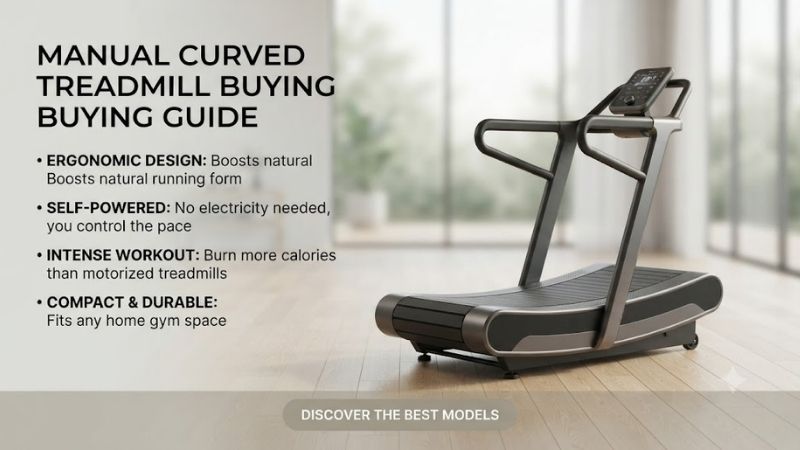
Quick Comparison Table
| Product | Best For | Key Specifications | Main Advantage | Trade-Off |
| Woodway Curve | Commercial athletic performance & longevity | Non-motorized; curved slat-belt; 116 ball bearings; usable surface: 17″ x 67″; 400 lb run / 800 lb walk limit | Lowest belt-glide friction; exceptionally durable vulcanized rubber slats | Extremely high investment cost; heavy commercial footprint |
| Assault Fitness AssaultRunner Elite | Maximum sprint intervals & commercial durability | Non-motorized; 100 precision ball bearings; usable surface: 17″ x 62″; 400 lb user limit | Reinforced solid steel uprights with zero frame deflection during sprints | High baseline resistance requires aggressive user drive to get moving |
| TrueForm Trainer | Biomechanical running gait correction | Non-motorized; shallow 2.5″ curve; usable surface: 17″ x 64″; 400 lb user limit | Shallow contour reinforces upright posture and proper midfoot strike | Demands strict running form; unforgiving to lazy heel-striking gaits |
| Grit Runner by Grit Fitness | Multi-modal power training & sled simulation | Non-motorized; curved slat-belt; multi-level magnetic brake; usable surface: 17″ x 63″; 400 lb user limit | Lever-actuated magnetic resistance enables high-load leg drive and sled work | Additional mechanical resistance levers introduce extra moving wear parts |
| SB Fitness Equipment CT400 | Budget-conscious garage gym runners | Non-motorized; curved slat-belt; 3-stage magnetic resistance; usable surface: 17.5″ x 60″; 375 lb user limit | Competitive price-to-performance ratio with built-in magnetic drag | Display console provides basic metric tracking with limited connectivity |
| NOHrD Sprintbok | Aesthetic residential living spaces | Non-motorized; flexible hardwood slats; ball-bearing mounted; usable surface: 17.7″ x 63″; 350 lb user limit | Beautiful solid wood aesthetic with lower acoustic profile than steel frames | Premium price point; natural wood frame requires climate-controlled rooms |
How We Selected These Machines
Our editorial evaluation is based on mechanical specifications, frame engineering, published manufacturer technical schematics, and structural stress tolerances rather than marketing claims. We evaluated the specific mechanical attributes that dictate the performance and longevity of non-motorized slatted machines:
- Bearing System and Slat Friction: Curved treadmills rely completely on momentum transfer. We examined the quantity, grade, and mounting tolerance of the internal ball bearings. A well-engineered bearing assembly allows smooth belt rotation without sticking or excessive free-spinning slip.
- Curve Geometry and Arc Depth: We analyzed the deck contour depth (ranging from shallow 2.5-inch drops to deeper parabolic curves). Arc depth directly influences where the user must land to accelerate, maintain pace, or decelerate.
- Resistance Mechanisms: We evaluated both free-spinning, momentum-only systems and dual-action machines equipped with eddy-current or permanent magnetic braking arrays for resistance training.
- Chassis Mass and Structural Stability: Non-motorized sprinting exerts violent horizontal and downward drive forces through the frame. We prioritized equipment built with heavy-gauge structural steel or reinforced framing that eliminates rocking and chassis flex during top-end sprint intervals.
Detailed Product Recommendations
Woodway Curve
Best For: Commercial training facilities, serious marathoners, and competitive athletes demanding the gold standard in low-friction bearing mechanics and vulcanized slat longevity.
Why We Picked It: The Woodway Curve is the foundational engineering standard for non-motorized curved treadmills. Its patented design utilizes 116 precision commercial ball bearings running along low-friction guide tracks, eliminating drive belts and deck friction plates entirely.
Key Specifications:
- Drive Type: 100% manual non-motorized
- Bearing Count: 116 high-precision ball bearings
- Usable Surface: 17 inches wide by 67 inches long
- Assembled Dimensions: 70″ L x 33″ W x 67″ H
- User Weight Capacity: 400 lb (running), 800 lb (walking)
- Unit Weight: 355 lb
Features & Benefits: The running surface consists of individual vulcanized rubber slats mounted over a high-tensile steel wire-reinforced belt system. This eliminates the conventional deck board and thin PVC belt found on motorized treadmills. By removing deck contact friction, the belt glides smoothly beneath the runner, allowing near-instantaneous pace shifts based entirely on where the foot strikes along the arc.
Performance & Practical Use: Acceleration on the Woodway Curve is immediate. Stepping forward toward the upward curve accelerates the belt; shifting back toward the center maintains cadence; drifting to the rear applies natural braking. The vulcanized rubber slats absorb downward impact force while returning energy directly to the runner’s stride, making it exceptionally joint-friendly during grueling interval workouts.
What Makes It Different: Unlike consumer-tier curved treadmills that use lightweight plastic slats, Woodway uses solid rubber molded around a continuous steel cable core. The system has no drive motor, meaning electrical failures and motor controller replacements are nonexistent.
Pros:
- Patented 116-bearing track system offers the lowest rotational friction in the industry.
- Heavy-duty vulcanized rubber slats last up to 150,000 miles without replacement.
- Exceptional walking user weight rating of up to 800 lb.
Cons:
- Substantial commercial financial investment compared to consumer alternatives.
- Heavy 355-lb steel structure requires two or more people to maneuver safely.
Buy If: You have a dedicated ground-floor training space, want the most durable manual treadmill built, and prioritize absolute mechanical reliability.
Skip If: You have a strict residential budget, or want built-in magnetic sled resistance options.
Assault Fitness AssaultRunner Elite
Best For: CrossFit athletes, strength and conditioning gyms, and high-intensity interval runners who require a rugged, high-rigidity steel chassis for all-out sprinting.
Why We Picked It: The AssaultRunner Elite is engineered specifically to withstand punishing athletic environments. Built around a solid steel frame with heavy-gauge uprights and dual side-mounted transport handles, it handles high-torque sprint starts without structural wobble.
Key Specifications:
- Drive Type: 100% manual non-motorized
- Bearing System: 100 precision sealed cartridge bearings with 12 roller guides
- Usable Surface: 17 inches wide by 62 inches long
- Assembled Dimensions: 69.9″ L x 31.7″ W x 64.4″ H
- User Weight Capacity: 400 lb
- Unit Weight: 289.2 lb
Features & Benefits: The Elite variant builds on the popular Pro model by adding reinforced commercial uprights, upgraded side handrails, and rust-resistant hardware. The console includes high-contrast interval programming (20/10, 10/20, or custom splits) paired with integrated Bluetooth and ANT+ connectivity to broadcast heart rate and cadence to fitness devices.
Performance & Practical Use: The internal bearing system provides slightly more natural mechanical drag than frictionless running tracks. This slight resistance prevents the belt from slipping out from underneath aggressive foot strikes during 100% sprint accelerations. The textured polyurethane slats provide dependable traction even under wet, sweat-heavy workouts.
What Makes It Different: The AssaultRunner Elite pairs a 400-lb capacity solid steel structure with commercial-grade sealed bearings backed by an extensive 10-year structural frame warranty.
Pros:
- Rigid steel uprights and solid handrails eliminate frame shudder during explosive sprint starts.
- Overbuilt sealed cartridge bearings withstand dirty garage and basement environments.
- Comprehensive console tracks speed, pace, distance, calories, and interval targets.
Cons:
- Heavier mechanical baseline resistance requires higher physical effort to sustain jogging speeds.
- Rigid industrial styling and exposed metal lack residential aesthetic warmth.
Buy If: You run hard HIIT intervals, use the machine for team conditioning, and need a rugged steel frame that tolerates aggressive use.
Skip If: You primarily want an effortless, free-spinning running feel for long, relaxed road marathons.
TrueForm Trainer
Best For: Runners focused on stride efficiency, gait retraining, cadence improvement, and reducing heel-strike impact forces.
Why We Picked It: The TrueForm Trainer features the shallowest curve contour in the non-motorized category, with a subtle 2.5-inch vertical rise from center to front. This geometry is biomechanically engineered to teach users to pull their feet under their center of mass rather than overstriding.
Key Specifications:
- Drive Type: 100% manual non-motorized
- Bearing System: Sealed steel bearings with dynamic belt-guide rollers
- Usable Surface: 17 inches wide by 64 inches long
- Assembled Dimensions: 64″ L x 31″ W x 63″ H
- User Weight Capacity: 400 lb
- Unit Weight: 280 lb
Features & Benefits: Traditional curved treadmills use deep parabolic arcs that make acceleration easy simply by leaning forward. The TrueForm’s shallow 2.5-inch curve requires genuine core engagement, upward hip extension, and a midfoot or forefoot strike to propel the track. It acts as an active biofeedback device, forcing runners into optimal upright posture.
Performance & Practical Use: The molded thermoplastic elastomer slats provide a firm running surface that replicates the mechanical feedback of outdoor asphalt. If you drop your hips or overstride with a heavy heel strike, the belt will immediately decelerate, training you to maintain a quick, light 180-steps-per-minute running cadence.
What Makes It Different: The shallow contour makes the TrueForm Trainer the least forgiving—and most biomechanically accurate—curved treadmill on the market. It trains functional running mechanics rather than simply offering a surface to run on.
Pros:
- Shallow 2.5-inch curve geometry forces midfoot landing and discourages overstriding.
- Firm slat composite provides a road-like foot strike without joint-jarring impact.
- Heavy-duty formed steel frame with a 400-lb user capacity.
Cons:
- Steeper learning curve for beginner runners accustomed to motorized decks.
- Minimal console tracks only essential metrics (pace, speed, distance, time).
Buy If: You want to correct your running form, eliminate overstriding, and train with biomechanically accurate gait feedback.
Skip If: You want deep parabolic curves for effortless sprint acceleration or built-in magnetic resistance for sled training.
Grit Runner by Grit Fitness
Best For: Trainees who want the dual utility of a free-wheeling curved running track and a high-resistance, stationary sled-push conditioning station.
Why We Picked It: The Grit Runner integrates an adjustable multi-level magnetic resistance system operated by a direct mechanical lever. This allows users to switch seamlessly between a low-resistance curved track for sprints and a locked, high-drag surface for heavy leg pushes.
Key Specifications:
- Drive Type: Manual non-motorized with variable magnetic braking
- Resistance System: Multi-stage lever-adjusted magnetic array
- Usable Surface: 17 inches wide by 63 inches long
- Assembled Dimensions: 78″ L x 34″ W x 61″ H
- User Weight Capacity: 400 lb
- Unit Weight: 330 lb
Features & Benefits: The multi-position resistance lever introduces permanent ceramic magnets near the internal aluminum flywheel. At level one, the deck spins freely for natural sprint intervals and steady-state jogging. At higher settings, the magnetic eddy-current brake applies heavy resistance, turning the machine into a simulated turf sled. The forward handrails are designed with multiple grip angles to accommodate forward-leaning sled pushes.
Performance & Practical Use: In sled mode, the machine offers continuous, joint-friendly resistance that builds posterior-chain power without the floor-space requirements of a 50-foot indoor turf strip. The heavy 330-lb frame stays firmly planted during aggressive forward drive steps, with zero lifting or tipping at the rear roller.
What Makes It Different: While most curved treadmills rely strictly on user body positioning for speed control, the Grit Runner’s mechanical brake provides structured variable load for strength-endurance workouts.
Pros:
- Dual-function design: free-spinning curved runner and heavy resistance sled trainer.
- Multi-position handgrips allow proper torso positioning during sled pushes.
- Eliminates the need for a dedicated outdoor or garage turf strip.
Cons:
- Substantial total length (78 inches) requires a larger footprint than standard curved units.
- Moving brake linkages require periodic inspection and cable tension checks.
Buy If: You want a hybrid cardio-strength machine capable of both all-out sprinting and heavy sled-push resistance.
Skip If: You only care about pure running mechanics and prefer the simplicity of a non-magnetic bearing deck.
SB Fitness Equipment CT400
Best For: Budget-conscious home gym owners seeking a commercial-grade slatted curved deck with magnetic resistance at an accessible price point.
Why We Picked It: The SB Fitness Equipment CT400 delivers sealed cartridge bearings, high-density molded slats, and a 3-stage magnetic resistance selector at a lower price point than premium commercial brands, without sacrificing structural integrity.
Key Specifications:
- Drive Type: Manual non-motorized with adjustable magnetic drag
- Resistance System: 3-stage magnetic adjustment lever
- Usable Surface: 17.5 inches wide by 60 inches long
- Assembled Dimensions: 73″ L x 31″ W x 63″ H
- User Weight Capacity: 375 lb
- Unit Weight: 295 lb
Features & Benefits: The CT400 uses high-speed sealed cartridge bearings paired with durable molded nylon-composite slats. The 3-stage magnetic brake allows you to dial in mechanical resistance: low for free running, medium for uphill tempo climbs, and high for power walking and forward sled driving. The built-in transport wheels and rear lifting bar make moving the 295-lb unit manageable for one person.
Performance & Practical Use: The deck curvature provides smooth acceleration when driving off the balls of the feet. The 17.5-inch belt width is half an inch wider than many competitors, giving runners slightly more lateral leeway during high-speed sprint intervals. The console displays speed, time, distance, and heart rate when connected to a compatible chest strap.
What Makes It Different: It provides magnetic resistance and high-tensile composite slats at a price point significantly lower than commercial alternatives, making it an attractive mid-range home gym pick.
Pros:
- Excellent price-to-performance value for a curved treadmill with magnetic braking.
- Slightly wider 17.5-inch belt surface provides added lateral margin.
- Smooth sealed cartridge bearings provide quiet, dependable rotation.
Cons:
- Maximum user weight is rated at 375 lb (slightly lower than the 400-lb commercial standard).
- Display console has basic LCD backlighting and lacks interactive platform syncing.
Buy If: You want a reliable, slatted manual runner with magnetic resistance for under typical commercial pricing.
Skip If: You require an ultra-premium aesthetic or an oversized running surface longer than 60 inches.
NOHrD Sprintbok
Best For: Upscale residential living spaces, urban apartments, and trainees who want high-performance non-motorized running wrapped in an elegant wooden frame.
Why We Picked It: The NOHrD Sprintbok re-engineers the manual curved treadmill using sustainable, solid hardwood contours. Beyond its striking visual appeal, the hardwood frame naturally absorbs structural vibration and acoustic noise, making it one of the quietest manual runners available.
Key Specifications:
- Drive Type: 100% manual non-motorized
- Bearing System: Ball-bearing mounted wooden flex-slats
- Usable Surface: 17.7 inches wide by 63 inches long
- Assembled Dimensions: 71″ L x 34″ W x 55″ H
- User Weight Capacity: 350 lb
- Unit Weight: 352 lb
Features & Benefits: Built with a curved frame crafted from solid hardwoods (such as walnut, oak, cherry, or ash), the Sprintbok uses 62 flexible wooden slats coated with linoleum for high grip and durability. The natural compliance of the wooden slats provides smooth shock absorption that deflects noise rather than echoing through hollow metal uprights.
Performance & Practical Use: Running on the Sprintbok is exceptionally smooth. Its shallow contour rewards light, rhythmic strides, and the low-friction ball bearings allow effortless pace transitions. The minimalist handlebar houses a sleek 17.3-inch touchscreen tablet interface that displays speed, distance, and interactive scenery runs.
What Makes It Different: The Sprintbok completely replaces the utilitarian, industrial aesthetic of commercial fitness machines with fine furniture craftsmanship, functioning as a design focal point in modern living rooms or open-concept home gyms.
Pros:
- Solid hardwood frame naturally dampens motorless operating vibrations and noise.
- Distinctive aesthetic fits upscale residential decors.
- Wide 17.7-inch running surface provides generous foot clearance.
Cons:
- Premium designer price tag.
- Natural wood frame requires climate-controlled residential rooms to prevent warping.
Buy If: Your treadmill will live in an open living space or bedroom and aesthetic appeal, low operational noise, and natural materials are top priorities.
Skip If: You train in an unconditioned, humid garage gym or want heavy-duty steel construction for sled pushing.
Manual Curved Treadmill Buying Guide: Factors to Consider
Selecting a manual curved treadmill requires evaluating friction dynamics, biomechanical deck geometries, frame construction, and operating sound levels. Understand these critical mechanical considerations before purchasing.
Drive Mechanics: Manual Slats vs. Motorized Decks
The fundamental difference between a motorized treadmill and a manual curved machine lies in how the belt moves:
- What It Is: Motorized treadmills use an electric motor to pull a flat belt across a fixed low-friction deck board. Manual curved treadmills have no motor; the running track consists of individual rigid slats linked together on guide chains, resting on high-precision ball bearings.
- Why It Matters: On an electric treadmill, the motor dictates the speed, and you simply lift your feet to keep pace. On a curved manual treadmill, your legs act as the motor. To move the belt, your feet must pull the track rearward against gravitational resistance. This forces higher recruitment of the posterior chain (glutes, hamstrings, and calves) and spikes metabolic expenditure without requiring excessive speeds.
- Who Benefits: Athletes looking for authentic running kinetics, sprint acceleration, and outdoor road preparation benefit substantially. Because there is no motor governor, you can accelerate from a jog to a full sprint instantly without waiting for an electric motor to spool up.
- Trade-Off: Non-motorized slatted machines do not allow you to set an automated pace to cruise passively; if you slow down, the belt slows down immediately.
Curve Geometry and Biomechanical Landing Profiles
The depth and radius of the deck curve dictate how the machine reacts to your stride:
- What It Is: The vertical displacement between the lowest point of the center running deck and the highest point of the front and rear curves.
- Shallow Curves (2.0 to 2.5 inches of rise): Found on machines like the TrueForm Trainer. These require precise midfoot foot placement directly under your center of mass to generate movement. If you overstride and land on your heel in front of your body, you push backward against the upward slope, halting the belt. This geometry aggressively corrects running form.
- Deep Parabolic Curves (3.0 to 4.0 inches of rise): Found on sprint-oriented machines like the AssaultRunner and Woodway Curve. The steeper front incline allows you to build momentum quickly by stepping higher up the curve, making high-speed acceleration and maximal sprinting easier to initiate.
- Trade-Off: Deep curves make fast running easier to initiate but are less sensitive for correcting subtle gait flaws. Shallow curves enforce clean posture but demand more physical effort to reach top sprint speeds.
Bearing Configurations and Operating Longevity
The bearing assembly is the mechanical heart of a non-motorized treadmill:
- What It Is: Sealed cartridge bearings mounted along the lateral rails of the frame that support the weight of the runner while allowing the slat track to circulate freely.
- Bearing Count and Quality: Entry-level curved machines use fewer bearings (typically 60 to 80), which can result in noticeable friction and a “sticky” rotation. Premium commercial units incorporate 100 to 116 high-precision, sealed ball bearings. A higher bearing count distributes the user’s downward impact force across more contact points, lowering rolling resistance and extending track longevity.
- Maintenance Needs: Because high-end manual runners use sealed cartridge bearings, they are virtually maintenance-free. Unlike motorized treadmills that require regular silicone lubrication between the belt and deck board, slatted manual tracks must never be lubricated with liquid oils, which attract dirt and degrade the bearings.
- Trade-Off: Higher bearing counts and precision steel housings substantially increase the baseline manufacturing cost and total unit weight.
Variable Magnetic Resistance vs. Free-Spinning Tracks
Manual treadmills offer two primary resistance philosophies:
- Pure Free-Spinning Systems: Machines like the Woodway Curve, TrueForm Trainer, and AssaultRunner Elite rely strictly on gravity, bearing tolerances, and user body weight. Speed is controlled entirely by cadence and position along the curve. This delivers the most authentic running feel.
- Adjustable Magnetic Systems: Machines like the Grit Runner and SB Fitness CT400 incorporate an aluminum disc and an adjustable permanent magnetic array (eddy-current brake). Moving a lever positions magnets closer to the disc, creating mechanical drag without physical contact.
- Who Benefits from Magnetic Drag: Users who want to combine cardiovascular running with high-load power training. Raising the magnetic drag allows you to lean forward into the handrails and perform intense sled pushes and uphill power hiking, recruiting the quadriceps and calves without buying a separate indoor turf sled.
- Trade-Off: Magnetic brake assemblies introduce extra adjustment cables, linkages, and levers that add complexity and require occasional tension adjustments.
Frame Rigidity, Weight Limits, and Machine Mass
The forces applied during non-motorized sprinting require exceptional frame engineering:
- Chassis Stability: In an all-out sprint on a manual machine, the runner drives their feet backward with substantial horizontal force. Lightweight frames under 200 lb will rock, lift, or slide along the floor under heavy efforts. Commercial manual runners weigh between 280 and 360 lb, anchoring them securely to your floor.
- Weight Capacities: Look for a verified user weight capacity of at least 350 to 400 lb. A high weight rating indicates heavy-gauge steel side rails and thick structural cross-members that eliminate frame flex during foot strikes.
- Maneuverability in Home Gyms: Due to their massive weight, ensure any manual curved treadmill you purchase includes integrated industrial transport wheels and a heavy-duty rear lifting bar or handle so you can pivot and reposition the unit as needed.
Noise Levels and Flooring Considerations
Manual treadmills generate sound differently than motorized treadmills:
- Acoustic Profile: Without an electric motor, curved treadmills produce zero motor hum. However, the movement of 60 or more individual composite or rubber slats cycling across 100 ball bearings creates a distinct mechanical whirring sound. During top-end sprints, the sound of shoes impacting rigid slats can be louder than running on a flexible motorized belt.
- Rubber vs. Plastic Slats: Heavy vulcanized rubber slats (Woodway) or wooden slats (NOHrD) absorb downward impact noise significantly better than hard polyurethane or composite plastic slats.
- Flooring Protection: Always place a manual curved treadmill on high-density rubber gym flooring (minimum 8mm to 9.5mm thickness). The concentrated point loads from the machine’s steel leveling feet and its heavy 300+ lb weight will dent hardwood floors or crack unsealed garage concrete over time.
Ceiling Height Clearances
Although curved treadmills do not elevate electronically like incline trainers, their base deck height is higher than standard motorized treadmills:
Total Minimum Ceiling Height = User Height + Deck Step-Up Height (14 to 17 inches) + 12 inches (Stride Clearance)
- Curved Step-Up Height: The center of a curved deck typically sits 10 to 12 inches off the ground, but the front and rear curved lips rise 14 to 18 inches above the floor.
- Safety Margin: Because manual running encourages a tall, upright posture with high knee drive, allow a generous 10 to 12-inch clearance margin above the user’s head.
- Example Calculation: If the tallest runner in your house is 6 feet 0 inches (72 inches), and the curved machine has a maximum front lip height of 16 inches: $$72\text{ inches} + 16\text{ inches} + 12\text{ inches} = 100\text{ inches (8.33 feet)}$$ In this scenario, a standard 8-foot (96-inch) ceiling is uncomfortably tight during sprint workouts. Ensure your garage or basement ceiling has adequate clearance before purchasing.
Frequently Asked Questions
Are manual curved treadmills harder to run on than motorized treadmills?
Manual curved treadmills require significantly more physical effort than motorized treadmills at identical paces. Because there is no electric motor pulling the belt beneath you, your legs must continuously generate horizontal and vertical propulsive force to rotate the slatted track. Independent exercise physiology studies consistently show that running on a non-motorized curved treadmill increases heart rate, oxygen uptake, and relative perceived exertion by roughly 20% to 30% compared to running at the same speed on a flat motorized treadmill deck.
Do manual curved treadmills require electricity to operate?
Manual curved treadmills operate 100% without electrical power. The movement of the running surface is entirely driven by your foot strikes and body weight interacting with the curved bearing assembly. The metric tracking consoles on most models are powered by standard AA or AAA batteries, while some models use an onboard generator that recharges via track rotation. This allows you to position a curved treadmill anywhere in your home gym or garage without worrying about wall outlets, extension cords, or dedicated electrical circuits.
How long do the slats on a manual curved treadmill last?
The running surface on a manual curved treadmill is dramatically more durable than the thin two-ply belts found on conventional motorized units. Individual vulcanized rubber or high-density composite slats are engineered for commercial longevity, typically lasting between 100,000 and 150,000 miles of training without structural failure. Because there is no deck board underneath generating friction and heat, you will never need to replace a worn deck or lubricate the track surface with silicone oil.
Can beginners and walkers use a curved manual treadmill?
Beginners and walkers can safely use a manual curved treadmill, but they must adapt to the self-regulating pace dynamics. Walking near the center or slightly behind the center of the arc allows for a slow, steady walking cadence. However, older trainees or beginners with balance limitations should choose a model with extended, full-length handrails (such as the AssaultRunner Elite or Woodway Curve) to steady themselves while adjusting to the sensitive, free-spinning momentum of the slatted belt.
How do you stop a manual curved treadmill safely?
To stop or slow down on a manual curved treadmill, simply decrease your cadence and allow your feet to drift toward the center or slightly rearward along the arc, where your body weight counteracts track momentum. To stop instantly during a high-speed sprint, grab the side handrails firmly and plant your feet onto the stationary side footplates to straddle the moving track, allowing the belt to spin to a gentle halt on its own bearings. Never attempt to stop the spinning belt abruptly with your toes.
Conclusion
The right manual curved treadmill delivers a lifetime of high-performance conditioning with virtually zero maintenance, electrical dependency, or motor burnout. If you demand the gold standard in low-friction bearing kinematics and commercial longevity, the Woodway Curve remains the industry benchmark. For athletes who want an indestructible solid steel chassis optimized for all-out sprint intervals, the Assault Fitness AssaultRunner Elite provides unmatched structural rigidity. If your goal is correcting running mechanics and eliminating overstriding, the shallow contour of the TrueForm Trainer provides the best biomechanical feedback. Finally, for those wanting the dual benefits of sprint conditioning and heavy sled-push strength work, the Grit Runner offers the most versatile magnetic braking platform. Measure your ceiling clearance, assess your training goals, and choose the non-motorized platform built for your athletic pursuits.


Write Your Review
No reviews yet. Be the first to share your experience!