
Key takeaways
-
Walking without reserving a separate exercise session
-
Convenient integration with some standing desks
-
Relatively compact designs compared with conventional treadmills
-
Adjustable walking speeds
-
Potentially convenient storage between sessions
Compare under desk treadmills vs alternatives, including walking pads, folding treadmills, desk bikes, and ellipticals, to find the right fit for your workspace.
Choosing between an under desk treadmill vs alternatives depends on your workspace, activity preferences, budget, and tolerance for noise. Under desk treadmills make walking during computer work possible, but walking pads, desk bikes, under desk ellipticals, and traditional treadmills offer different advantages. This guide compares their space requirements, usability, ergonomics, safety, and long-term value to help you choose the right equipment.
Under Desk Treadmill vs Alternatives: Quick Comparison
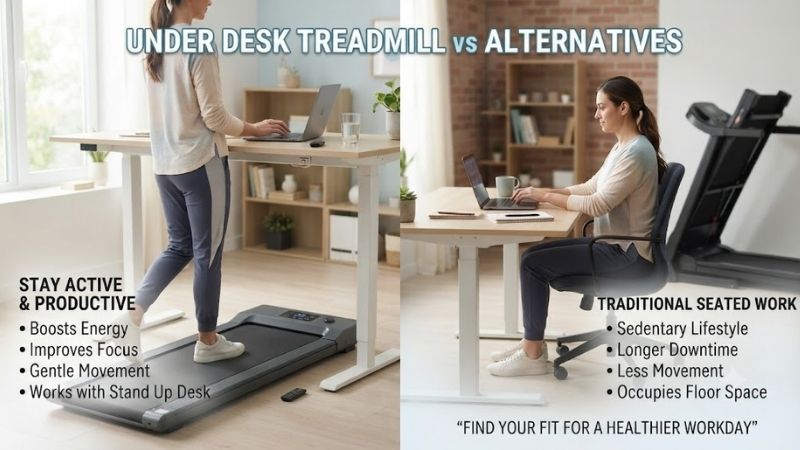
An under desk treadmill is most useful for people who want to walk while completing suitable standing-desk tasks. Other equipment may be more practical for seated work, compact storage, or dedicated cardio sessions.
No single equipment category is universally better. The correct choice depends on how you intend to move during your workday.
Quick Comparison Table
| Equipment | Best For | Space Requirements | Main Advantage | Main Limitation |
|---|---|---|---|---|
| Under desk treadmill | Walking while working | Moderate floor length | Enables continuous walking during suitable desk tasks | Requires a standing desk and balance |
| Walking pad | Casual walking and compact spaces | Usually compact | Low-profile design and storage convenience | Often limited walking surface and speed |
| Folding treadmill | Dedicated walking or running | Larger when unfolded | More workout versatility | May be impractical beneath a desk |
| Under desk bike | Seated pedaling | Space beneath desk | Can be used while seated | Requires knee and pedal clearance |
| Under desk elliptical | Seated low-impact movement | Relatively compact | Allows seated leg movement | Limited workout intensity on many models |
| Standing desk | Alternating sitting and standing | Desk footprint | Changes working posture without moving exercise equipment | Does not provide walking exercise |
| Compact exercise bike | Dedicated seated cardio | Separate floor area | Allows focused cycling workouts | Cannot usually be used at a standard desk |
An under desk treadmill is the strongest fit when the main objective is combining walking with computer work. A desk bike or elliptical may be preferable when the user wants to remain seated.
For people who prioritize jogging or running, a conventional treadmill designed for those activities is generally more appropriate.
What Is an Under Desk Treadmill?
An under desk treadmill is a motorized walking machine designed to fit beneath a compatible standing desk.
Unlike many conventional treadmills, it usually has a low-profile deck and lacks a permanently upright console.
Users control belt speed using a remote, onboard controls, or a compatible application, depending on the model.
The compact design allows walking during certain desk activities, such as listening to meetings, reading, or completing relatively simple computer tasks.
How Under Desk Treadmills Work
An electric motor drives a continuous walking belt across a deck.
The user selects a comfortable speed and walks while maintaining position near the workstation.
Under desk treadmills typically emphasize low-speed operation rather than high-speed running.
Important specifications include usable belt length, belt width, deck height, motor operating limits, user weight capacity, and stopping controls.
A machine’s suitability cannot be established from maximum speed or motor horsepower alone.
Main Advantages of Under Desk Treadmills
The primary advantage is the ability to combine walking with activities that would otherwise involve prolonged sitting or standing.
Additional benefits include:
-
Walking without reserving a separate exercise session
-
Convenient integration with some standing desks
-
Relatively compact designs compared with conventional treadmills
-
Adjustable walking speeds
-
Potentially convenient storage between sessions
These benefits depend on the equipment and workstation being appropriately configured.
An under desk treadmill does not eliminate the need for safe operation, breaks, or attention to ergonomics.
Main Disadvantages of Under Desk Treadmills
Under desk treadmills introduce practical limitations.
Walking may interfere with precise typing, mouse control, or tasks requiring concentrated visual attention.
The user must remain aware of the moving belt while working.
The machine also raises standing height, which may require additional desk adjustment.
Other considerations include equipment noise, floor vibration, electrical requirements, maintenance, and the absence of handrails on many models.
Some users may find seated exercise alternatives easier to incorporate into their existing workstation.
Under Desk Treadmill vs Walking Pad
Walking pads are among the closest alternatives to under desk treadmills.
In fact, the terms frequently overlap in product listings.
The difference is usually related to intended use and design rather than a universally defined equipment category.
Design and Dimensions
Many walking pads use a low-profile frame with a compact walking surface.
Some are designed primarily for use beneath standing desks, while others are marketed for general home walking.
An under desk treadmill should be evaluated for desk compatibility, including deck height and control accessibility.
A general walking pad may offer similar features but is not automatically suitable for every workstation.
| Feature | Under Desk Treadmill | General Walking Pad |
|---|---|---|
| Intended use | Desk walking | Casual walking or desk use |
| Console | Usually minimal | Usually minimal |
| Handrails | Commonly absent | Often absent or foldable |
| Storage | Often low-profile | Often low-profile |
| Speed range | Usually walking-focused | Varies by model |
| Desk compatibility | Central design consideration | Must be verified |
| Belt dimensions | Model-dependent | Model-dependent |
Walking Comfort
Both equipment types can provide comfortable low-speed walking when the belt dimensions suit the user.
A narrow or short belt may restrict natural stride length, particularly for taller users.
For desk walking, low deck height and precise speed control may matter more than maximum belt speed.
For general exercise, a longer walking belt may be preferable if the machine will be used at faster walking speeds.
Which Should You Choose?
Choose an under desk treadmill or walking pad explicitly approved for workstation use if your main goal is walking while working.
Choose a general walking pad if your primary objective is casual walking with convenient storage and desk compatibility is not essential.
Because these product categories overlap, compare exact specifications instead of relying on the marketing label.
Under Desk Treadmill vs Folding Treadmill
Folding treadmills generally provide a different balance between exercise versatility and storage convenience.
Some compact folding machines are walking-focused, while others support jogging or running.
Workout Capability
Under desk treadmills are typically designed for slower walking.
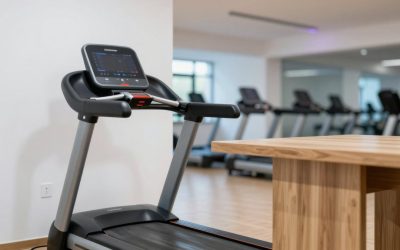
Folding treadmills may have larger belts, higher maximum speeds, incline mechanisms, and upright consoles.
These features can make folding treadmills more appropriate for dedicated workouts.
However, not every folding treadmill supports running. The manufacturer’s approved uses determine what activities are suitable.
Storage and Portability
An under desk treadmill may slide beneath furniture or remain relatively unobtrusive when stored flat.
A folding treadmill may reduce its floor footprint by lifting the deck vertically or collapsing the frame.
Vertical folding designs can require substantial storage height.
Flat-folding machines may be easier to store beneath furniture, but their belt dimensions and permitted speeds vary.
Under Desk Treadmill vs Folding Treadmill Comparison
| Criterion | Under Desk Treadmill | Folding Treadmill |
|---|---|---|
| Walking while working | Often suitable | Usually less practical |
| Dedicated walking workouts | Suitable within design limits | Suitable on many models |
| Jogging and running | Usually not intended | Supported by some models |
| Running deck size | Often compact | May be larger |
| Folding mechanism | Not always included | Defining feature |
| Standing desk use | Often practical | Depends on frame and console |
| Storage height | Often relatively low | Highly design-dependent |
Which Should You Choose?
Choose an under desk treadmill when integrating low-speed walking into desk work is the main priority.
Choose a folding treadmill when you want dedicated cardio sessions, especially if jogging or running is part of the plan.
Do not sacrifice adequate running-belt dimensions simply to obtain a smaller stored footprint.
Under Desk Treadmill vs Under Desk Bike
An under desk bike, sometimes called a desk pedal exerciser, allows users to pedal while seated.
This creates an important difference from treadmill walking because the user does not need to stand.
Seated vs. Standing Exercise
An under desk treadmill requires upright walking.
An under desk bike allows movement from a seated position.
For people who spend long periods completing detailed computer tasks, seated pedaling may be easier to coordinate with typing or mouse use.
However, pedaling can still interfere with concentration or posture, especially at higher resistance levels.
Desk Compatibility
Under desk bikes need sufficient space beneath the desk for the pedal mechanism, knees, and full pedaling motion.
A machine with a compact floor footprint may still be unsuitable if the user’s knees strike the underside of the desktop.
Chair stability and seat height also matter.
Under desk treadmills require a standing desk that can adjust to accommodate the user’s increased height while standing on the treadmill deck.
Resistance and Movement
Desk bikes commonly use adjustable resistance, although mechanisms vary.
Resistance may be magnetic, friction-based, or provided through other systems.
Under desk treadmills primarily adjust belt speed. They provide walking movement rather than cycling resistance.
Neither movement is inherently superior for everyone.
The more useful option is the one that fits the user’s preferred activity, workspace, and physical capabilities.
Which Should You Choose?
An under desk bike may be more practical if you prefer remaining seated, lack a standing desk, or find walking incompatible with your work.
An under desk treadmill is preferable if your priority is walking rather than pedaling and you have an appropriate workstation.
Under Desk Treadmill vs Under Desk Elliptical
Under desk ellipticals are compact machines that guide the user’s feet through a repeated pedal motion.
Most under desk models are designed for seated use, although specifications vary.
Differences in Movement
A treadmill supports a walking gait in which the user moves their feet along a motorized belt.
An under desk elliptical guides the legs through a fixed or adjustable elliptical movement.
The two activities have different movement patterns, positioning requirements, and resistance characteristics.
An elliptical should not be assumed to reproduce the biomechanics of normal walking.
Space and Storage
Under desk ellipticals often require less floor length than treadmills.
However, their height and pedal movement may create clearance issues beneath certain desks.
Some models have handles or controls that increase overall dimensions.
Check the entire pedal path rather than comparing external footprints alone.
Workout Intensity
Under desk ellipticals may offer resistance settings, allowing users to change how difficult the pedaling motion feels.
Walking treadmill intensity is influenced by belt speed, duration, and incline when available.
Neither category guarantees a particular energy expenditure or fitness outcome.
Actual exercise demand depends on the user, equipment settings, and activity.
Which Should You Choose?
An under desk elliptical may be better for seated users who want compact, controlled leg movement.
An under desk treadmill is generally more appropriate for users who prefer walking and have sufficient space for safe standing-desk operation.
Under Desk Treadmill vs Standing Desk
A standing desk is not exercise equipment, but it is an important alternative for users who want to change their work posture.
It allows users to alternate between sitting and standing without adding a moving belt to their workspace.
Movement vs. Posture Changes
A standing desk changes working position.
An under desk treadmill adds walking movement while the user remains upright.
These are different functions.
Standing does not produce the same movement pattern as walking, and walking introduces coordination and balance demands that ordinary standing does not.
Equipment and Workspace Requirements
A height-adjustable desk can be used independently of a treadmill.
Adding a treadmill increases the workstation’s complexity because the deck raises the user’s feet above the floor.
The desk must adjust high enough to maintain a comfortable keyboard and monitor position.
The user also needs sufficient floor clearance and an accessible stopping control.
Which Should You Choose?
Choose a standing desk if you mainly want the flexibility to alternate sitting and standing.
Choose a compatible under desk treadmill and standing desk combination if walking during work is a specific priority.
A standing desk can also serve as a useful foundation for people who may add a treadmill later.
Under Desk Treadmill vs Compact Exercise Bike
Compact exercise bikes provide another option for home cardio but generally require a separate exercise position.
Even small upright bikes and folding exercise bikes are designed differently from under desk pedal exercisers.
Dedicated Exercise vs. Working Movement
An under desk treadmill is designed around combining walking with suitable desk tasks.
A compact exercise bike is usually better suited to dedicated cycling sessions.
Some bikes include resistance levels, displays, and adjustable seating.
These features can be useful for focused workouts but may not integrate easily with a standard workstation.
Comfort and Adjustability
Exercise-bike comfort depends on saddle design, seat adjustment, handlebar positioning, and pedaling ergonomics.
Under desk treadmill comfort depends more heavily on walking-belt dimensions, deck characteristics, and walking speed.
Both require appropriate fit and equipment setup.
Which Should You Choose?
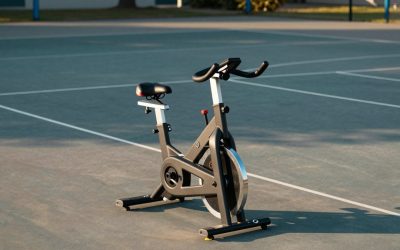
Choose a compact exercise bike if you prefer cycling and have room for separate cardio equipment.
Choose an under desk treadmill if walking while working is more important than dedicated cycling workouts.
Key Factors to Compare Before Buying
After choosing an equipment category, the next step is evaluating specifications and practical requirements.
The following factors matter across most compact cardio equipment types.
1. Available Floor Space
Measure the actual operating footprint, including moving components and manufacturer-required clearance.
A treadmill generally needs more length than a compact desk pedal device.
However, a desk bike or elliptical may require greater vertical clearance beneath the workstation.
Never assume that smaller external dimensions guarantee better compatibility.
2. Working Posture and Ergonomics
Consider how the equipment changes your relationship to the desk.
For treadmill walking, verify desktop height, monitor position, keyboard reach, and balance.
For seated pedal devices, check chair height, knee clearance, and foot positioning.
Poor equipment fit can make work uncomfortable even when the exercise mechanism itself functions correctly.
3. Noise and Floor Vibration
All motorized and mechanical exercise equipment can generate some sound.
Under desk treadmills produce motor and belt noise as well as footsteps.
Desk bikes and ellipticals may produce mechanical noise from pedals, bearings, or resistance mechanisms.
Noise levels depend on the exact product, operating settings, user, and flooring.
Do not assume any category is completely silent.
4. Stability and Safety
Under desk treadmills introduce moving-belt hazards and require balance while walking.
Desk bikes and ellipticals require stable placement and sufficient clearance for their moving parts.
Check maximum user weight, assembly instructions, approved operating positions, and stopping mechanisms.
If you need physical support while walking, a rail-free treadmill may be inappropriate.
5. Maintenance Requirements
Treadmills may require belt inspection, cleaning, lubrication, and occasional tracking adjustments according to the manufacturer.
Pedal machines may require inspection of moving components and resistance systems.
Maintenance requirements vary by design.
Choose equipment with clear instructions, accessible customer support, and reasonably available replacement parts.
6. Budget and Long-Term Value
Different equipment types can overlap in price.
A simple under desk pedal device may cost less than a motorized treadmill, but category alone does not establish value.
Consider purchase cost, durability evidence, warranty coverage, maintenance supplies, replacement parts, and whether the machine actually fits your intended use.
A less expensive device that goes unused is not necessarily a better purchase.
Under Desk Treadmill vs Alternatives: Cost and Ownership Comparison
Ownership involves more than buying the equipment.
The following table compares major cost considerations without assuming fixed prices or maintenance intervals.
| Equipment | Main Ownership Considerations | Potential Ongoing Costs |
|---|---|---|
| Under desk treadmill | Motor, belt, controls, duty cycle | Lubrication where required, replacement components, electricity |
| Walking pad | Compact belt and motor system | Belt care, replacement parts, electricity |
| Folding treadmill | Motor, running deck, folding mechanism | Belt and deck maintenance, repairs, electricity |
| Under desk bike | Pedals, resistance unit, frame | Mechanical servicing or replacement components |
| Under desk elliptical | Pedal mechanism, resistance system | Component maintenance or repairs |
| Standing desk | Lifting mechanism, frame, controls | Electrical or mechanical servicing |
| Compact exercise bike | Drivetrain, resistance unit, seat | Replacement wear components and servicing |
A longer warranty can be valuable, but examine what it actually covers.
Some warranties distinguish between the frame, motor, electronics, and wear components.
Also check whether the manufacturer provides service in the United States.
Common Mistakes When Comparing Under Desk Exercise Equipment
Choosing an exercise device without considering workstation compatibility can lead to an inconvenient setup.
Several mistakes are particularly common.
Assuming All Walking Pads Work Under a Desk
Some walking pads are designed for general home walking rather than workstation use.
Check deck height, control positioning, speed range, and the manufacturer’s permitted usage.
Ignoring Desk Height
An under desk treadmill raises your standing position.
A desk that is comfortable without the treadmill may become too low when you stand on the deck.
Measure the required adjustment before purchasing.
Choosing Equipment Based Only on Maximum Speed
A higher top speed does not make a treadmill more suitable for office use.
Low-speed control, belt dimensions, stability, and safe stopping are often more relevant.
Overlooking Pedal Clearance
Under desk bikes and ellipticals require enough space for the complete pedaling motion.
Insufficient knee clearance can make even a compact unit impractical.
Expecting to Exercise During Every Work Task
Walking or pedaling may be manageable during some activities but distracting during others.
Work requiring precise movement, intense concentration, or sensitive communication may be easier when stationary.
Ignoring Operating Limits
Not all compact motorized equipment is intended for uninterrupted operation throughout a full workday.
Check the documented duty cycle and required cooling intervals.
Which Under Desk Exercise Option Is Best for You?
The best choice depends on your daily activities, space, and preferred movement.
Best for Walking While Working: Under Desk Treadmill
An under desk treadmill is the most direct option for combining walking with a suitable standing-desk workstation.
Choose a model with appropriate belt dimensions, reliable low-speed control, accessible stopping features, and a documented operating duty cycle.
Best for Compact Walking: Walking Pad
A general walking pad may provide similar walking functionality with convenient low-profile storage.
It is a strong option when home walking matters more than permanent integration with a desk.
Verify workstation compatibility separately if desk use is planned.
Best for Dedicated Cardio: Folding Treadmill
A folding treadmill may be preferable for focused walking, jogging, or running sessions.
Choose a model explicitly designed for your intended activity and large enough to accommodate your stride.
Best for Seated Computer Work: Under Desk Bike
An under desk bike can allow movement while remaining seated.
Prioritize knee clearance, stable positioning, comfortable pedal geometry, and appropriate resistance adjustment.
Best for Seated Compact Movement: Under Desk Elliptical
An under desk elliptical offers an alternative seated movement pattern.
It may appeal to users who prefer its pedal motion over cycling or walking.
Best for Simple Workstation Flexibility: Standing Desk
A standing desk is the simpler option for alternating work postures without incorporating moving exercise equipment.
It can be useful independently or as part of a future treadmill-compatible setup.
Frequently Asked Questions
Is an Under Desk Treadmill Better Than a Walking Pad?
Not necessarily. Many under desk treadmills are themselves walking pads.
The more important distinction is whether a specific model provides the dimensions, deck height, controls, and operating characteristics required for your intended use.
An ordinary walking pad may be equally appropriate if it is designed for use beneath a standing desk.
Is an Under Desk Treadmill Better Than an Under Desk Bike?
An under desk treadmill is more appropriate for people who prefer walking while working.
An under desk bike is often more convenient for users who want to remain seated.
The better option depends on your workstation, physical capabilities, and whether walking or pedaling interferes with your tasks.
Can You Use an Under Desk Treadmill All Day?
Not every treadmill is approved for continuous all-day operation.
Some models have specific limits on operating duration and require cooling periods.
Users should also take breaks and adjust activity according to comfort and ability.
Follow the manufacturer’s duty-cycle instructions rather than assuming that under desk marketing implies unlimited operation.
Are Under Desk Treadmills Noisy?
Under desk treadmills generate motor, belt, and footstep sounds.
Noise levels depend on construction, walking speed, user weight, flooring, and building characteristics.
A treadmill-compatible mat may reduce some vibration but cannot guarantee quiet operation.
Which Is Better for a Small Apartment: A Treadmill or an Elliptical?
An under desk elliptical may use less floor length and support seated activity.
An under desk treadmill enables walking but generally requires additional operating space and safety clearance.
The better option depends on available room, desk compatibility, noise considerations, and preferred movement.
Can an Under Desk Treadmill Replace Regular Exercise?
An under desk treadmill can provide additional walking opportunities, but it should not automatically be considered a complete substitute for other physical activities.
Walking while working differs from dedicated strength training, higher-intensity cardio, and other forms of exercise.
Choose an activity routine that matches your abilities and goals rather than relying on a single piece of equipment for every purpose.
Conclusion
When comparing an under desk treadmill vs alternatives, the most important factors are your preferred movement, workstation configuration, available space, and safety requirements. Under desk treadmills are well suited to walking during compatible computer tasks, while desk bikes and ellipticals offer seated movement and folding treadmills provide greater potential for dedicated cardio workouts. A walking pad may be equally practical if it meets your desk requirements. Choose the equipment that supports your actual daily routine rather than the one with the longest feature list.
Write Your Review
No reviews yet. Be the first to share your experience!