
Key takeaways
-
Folded length
-
Folded width
-
Folded height
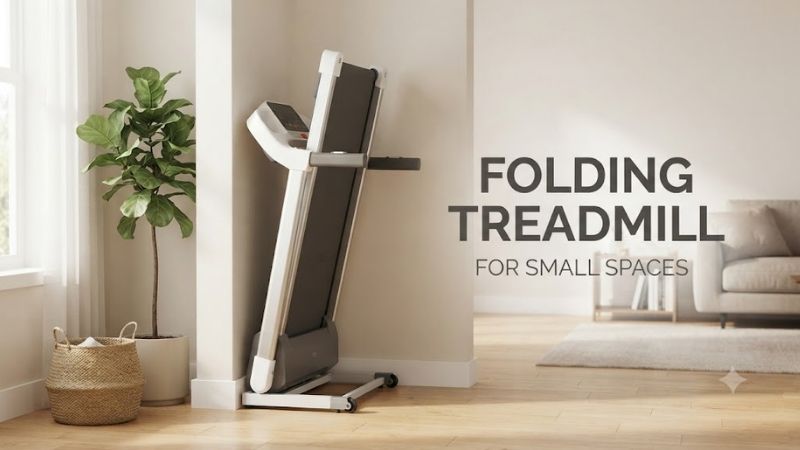
A folding treadmill for small spaces can provide convenient home cardio without permanently occupying an entire room. However, compact dimensions alone do not guarantee comfortable workouts or practical storage. This guide explains how to compare folding mechanisms, running surfaces, motor specifications, safety features, and room requirements to choose a treadmill that fits your home and exercise routine.
What Makes a Folding Treadmill Suitable for Small Spaces?
A folding treadmill is designed to reduce its storage footprint by folding part of the machine when it is not in use. Depending on its construction, the running deck may lift toward the console, fold in half, or remain flat while the handrails collapse.
The best configuration depends on your available space, preferred exercise, storage location, and physical ability to move the equipment.
For small homes, buyers should consider three dimensions rather than focusing on a single advertised footprint: the treadmill’s operating dimensions, folded dimensions, and required safety clearance.
Folding Treadmill vs. Regular Treadmill
Conventional treadmills typically maintain a fixed deck position, although some models also incorporate folding mechanisms.
Folding machines offer storage flexibility but can introduce compromises involving frame construction, moving joints, running surface dimensions, and total weight.
| Feature | Folding Treadmill | Non-Folding Treadmill |
|---|---|---|
| Storage footprint | Often reduced when folded | Usually remains unchanged |
| Running surface | Varies from compact to full-size | Varies by model |
| Folding mechanism | Requires hinges or moving components | Generally fewer folding components |
| Portability | Some models include transport wheels | Often heavier to reposition |
| Stability | Depends on frame and design | Depends on frame and design |
| Setup | May require unfolding and locking | Generally remains ready for use |
| Small-room suitability | Often more flexible | Requires permanent floor space |
Folding does not automatically mean a treadmill is less stable or less durable. Construction quality, structural design, and manufacturer specifications matter more than the presence of a folding mechanism alone.
Folding Treadmill vs. Walking Pad
Walking pads and folding treadmills overlap in size and functionality, but they are not necessarily interchangeable.
Walking pads usually prioritize low-profile construction, slow walking, and convenient storage. Folding treadmills may accommodate faster walking, jogging, or running, depending on their design.
A walking pad can be the better option for someone who primarily wants gentle walking while working at a standing desk.
A folding treadmill may be preferable when the user wants a larger walking surface, supportive handrails, incline options, or equipment specifically designed for running.
Always check the manufacturer’s permitted activities rather than assuming that every machine advertised as a treadmill supports running.
Who Should Choose a Folding Treadmill?
Folding treadmills can be useful for apartment residents, homeowners with limited exercise areas, occasional walkers, and people who want a machine that can be stored between workouts.
They can also serve runners who need a full-length running deck but cannot dedicate permanent floor space to exercise equipment.
However, a folding treadmill may be less appropriate if the storage mechanism is difficult to operate, the machine cannot be positioned safely, or the available space does not meet operating clearance requirements.
How to Measure Your Space Before Buying
Accurate measurements are essential when selecting a folding treadmill for a small room.
A machine may technically fit into a bedroom or office while leaving insufficient room for safe operation.
Measure the complete exercise area before evaluating specific products.
Measure the Unfolded Footprint
The unfolded footprint represents the treadmill’s external length and width while ready for exercise.
Manufacturers may publish dimensions in inches, feet, or centimeters.
For planning purposes, many home treadmills occupy a footprint several feet long and roughly 2–3 feet wide, although specific models can be considerably smaller or larger.
Measure the available floor area and compare it with the exact machine dimensions.
Then account for manufacturer-required clearance around the treadmill.
Do not assume that the treadmill can be operated safely simply because its frame fits between two pieces of furniture.
Check the Folded Dimensions
Folded dimensions may differ substantially between treadmill designs.
Some machines reduce the floor space they occupy by lifting the running deck vertically. Others reduce their length by folding the deck or console components.
Compare all three stored dimensions:
-
Folded length
-
Folded width
-
Folded height
For vertical folding models, ceiling height and nearby furniture are particularly important.
For horizontal folding models, the remaining deck thickness may determine whether the machine fits beneath a bed.
Also consider whether you can access the locking mechanism and move the treadmill safely after folding.
Account for Safety Clearance
A treadmill requires unobstructed space around its moving belt.
The exact clearance depends on the manufacturer and applicable safety instructions.
As a conservative planning reference, widely used treadmill safety guidance recommends substantial open space behind the machine, often approximately 6.5 feet (2 meters) or more, along with lateral clearance. Some manufacturers require different or greater distances.
Use the applicable instructions for the exact machine, and do not substitute a generic estimate for its published requirements.
The rear of a treadmill should never be positioned tightly against a wall or large piece of furniture.
Consider Ceiling Height
Ceiling height becomes important when the treadmill includes an elevated deck or incline function.
The user’s effective standing height increases by the deck height, footwear, and any additional elevation created by incline.
Running also involves vertical body movement.
Check whether the ceiling provides sufficient headroom during the intended activity.
This is particularly important in basements, converted attics, and rooms with low overhead structures.
Types of Folding Treadmills for Small Spaces
Different folding mechanisms offer different storage benefits.
Understanding these configurations helps buyers select equipment that matches their living environment.
Vertical Folding Treadmills
Vertical folding treadmills typically lift the running deck toward the upright frame.
This design reduces the machine’s floor footprint when stored.
Advantages:
-
Often retains a longer usable running deck.
-
Can free up floor space between workouts.
-
May provide conventional treadmill controls and handrails.
Limitations:
-
Requires sufficient vertical clearance.
-
The folded machine may remain relatively bulky.
-
Folding and unfolding may require physical effort.
Vertical folding designs are suitable for rooms where floor space is limited but ceiling height is sufficient.
Flat-Folding Treadmills
Flat-folding models generally lower the handrails or console assembly to create a thinner storage profile.
Some are designed to fit beneath furniture when folded.
Advantages:
-
Relatively low stored height.
-
Can be practical for bedrooms and small apartments.
-
Some models offer convenient transport wheels.
Limitations:
-
May have smaller belts than conventional treadmills.
-
Certain designs support walking but not running.
-
Folding controls and handrails must be secured properly.
These treadmills are worth considering when storage beneath a bed or furniture is a priority.
Fold-in-Half Treadmills
Some treadmills fold the deck itself, reducing the stored length.
This approach differs from designs that only raise the running deck or collapse the handrails.
Advantages:
-
Can reduce storage length significantly.
-
May be practical where closet depth is limited.
-
Can offer flexible storage arrangements.
Limitations:
-
Includes additional folding structures.
-
Requires correct locking and unfolding.
-
Storage thickness may increase.
The folded deck should be operated and maintained strictly according to the manufacturer’s instructions.
Compact Folding Treadmills With Handrails
Certain compact treadmills use folding handrails while retaining a relatively small deck.
These designs may provide a middle ground between walking pads and conventional folding treadmills.
They can suit buyers who want a compact machine with some physical support.
However, handrail strength, intended purpose, and permitted speeds vary. A folding handle should not be assumed suitable for supporting full body weight.
Essential Folding Treadmill Specifications
Specifications determine whether a folding treadmill can safely accommodate your walking or running routine.
The most important factors include belt dimensions, motor ratings, speed capability, weight capacity, and frame construction.
Running Belt Length and Width
The usable belt dimensions directly influence stride comfort and foot-placement freedom.
A belt that feels acceptable during slow walking may be restrictive during running.
The following are general buying reference points rather than universal ergonomic standards.
| Usable Belt Length | Potential Suitability |
|---|---|
| Under 40 inches | Primarily low-speed walking for some users |
| 40–44 inches | Compact walking applications |
| 45–49 inches | Walking and potentially some jogging, depending on design |
| 50–54 inches | Worth considering for jogging and shorter running strides |
| 55–60 inches | Often preferable for regular running |
| Over 60 inches | Additional room for longer strides |
Belt width also matters.
A 16–18-inch-wide belt may be adequate for certain walking applications, while a width around 20 inches or more is often preferable for running.
These dimensions do not independently establish safety or suitability. Consider user height, stride length, speed, and the manufacturer’s approved activities.
For dedicated running, sacrificing too much belt length to save storage space can undermine the usefulness of the treadmill.
Motor Power and Continuous Performance
Folding treadmills typically use electric motors to move the running belt.
Manufacturers may advertise motor output in horsepower, continuous-duty horsepower, or watts.
These measurements must be interpreted carefully.
Peak horsepower represents a different operating condition from continuous-duty output. Marketing figures without defined measurement conditions are difficult to compare reliably.
Motor requirements depend on factors including user weight, belt friction, walking or running speed, and intended session duration.
Instead of relying on horsepower alone, evaluate:
-
Published continuous motor ratings, if available
-
Manufacturer-approved walking and running use
-
Maximum supported speed
-
User weight capacity
-
Continuous operating limits
-
Cooling requirements
-
Motor warranty coverage
-
Availability of maintenance and technical support
A higher advertised horsepower figure does not guarantee better long-term durability.
Speed Range
A folding treadmill’s maximum speed should match your planned activity.
| Speed Range | Typical Application |
|---|---|
| 0.5–2 mph | Slow walking |
| 2–3.5 mph | General walking |
| 3.5–5 mph | Fast walking or jogging for some users |
| 5–7 mph | Jogging or running |
| 7–10 mph | Faster running |
| Above 10 mph | Higher-speed training for suitable users |
These categories are approximate. Whether a particular speed constitutes walking, jogging, or running depends on the individual.
Some compact machines advertise relatively high maximum speeds despite having short belts.
Do not choose a treadmill for running based on maximum speed alone. The machine’s running surface, frame, and approved operating use must also be appropriate.
Maximum User Weight Capacity
Check the manufacturer’s published maximum user weight for the exact treadmill model.
The rating should accommodate the intended user without exceeding the specified limit.
A higher weight capacity may be a useful comparison factor, but it does not independently verify stability or durability.
Frame construction, deck support, assembly quality, and operating conditions also affect how a treadmill behaves.
Avoid relying on weight capacity claims that cannot be confirmed through reliable product documentation.
Incline Range
Incline changes the running deck’s angle and can provide additional workout variety.
Some folding treadmills have no incline function. Others offer manual settings or motorized adjustments.
Incline mechanisms may affect:
-
Maximum deck height
-
Storage configuration
-
Machine weight
-
Mechanical complexity
-
Maintenance requirements
For small spaces, consider whether incline is an important feature or an unnecessary addition.
A basic flat treadmill may be sufficient for regular walking, while a compatible incline treadmill can provide more varied workouts.
Stability, Frame Construction, and Folding Mechanisms
A compact treadmill needs to remain stable throughout its approved operating speed range.
Folding mechanisms introduce additional engineering considerations because the machine must maintain structural integrity when unfolded.
Frame Rigidity
The frame supports the running deck, motor assembly, and user during exercise.
Structural stability depends on design, materials, manufacturing quality, assembly, and floor contact.
A lightweight frame can make transport easier, but light weight alone is not evidence of poor stability.
Likewise, a heavy machine is not automatically well constructed.
Look for a secure assembled structure without unusual movement, rattling, or visible misalignment.
Folding Locks and Hinges
A folding mechanism should include a secure method of holding the treadmill in its intended operating or storage position.
Depending on the design, components may include mechanical locks, hydraulic supports, hinges, and release levers.
Check that the manufacturer provides clear instructions for locking, unlocking, folding, and unfolding.
Never operate a treadmill when required locks are not engaged.
Hydraulic Folding Assistance
Some vertical folding treadmills incorporate hydraulic assistance to control movement of the deck.
This can make folding or lowering the deck more manageable, but its effectiveness depends on the exact mechanism.
Do not assume that every hydraulic-equipped treadmill lowers automatically or safely without guidance.
Follow the operating instructions and keep hands, feet, children, and pets clear of moving components.
Transport Wheels and Mobility
Transport wheels can simplify movement across suitable flooring.
However, a treadmill may still require lifting or tilting to engage those wheels.
Review the machine’s total weight and the manufacturer’s transport procedure.
If you plan to move the treadmill daily, consider how easily it can travel through doorways and around furniture.
A treadmill that is technically portable may still be inconvenient in a crowded apartment.
Noise and Vibration in Apartments
Noise should be considered carefully when buying a folding treadmill for an apartment or shared household.
Motor sound, belt movement, footsteps, and structural vibration contribute to the overall experience.
Why Treadmills Produce Noise
The motor and rollers generate mechanical sound while the belt moves.
Foot impacts produce additional noise and vibration.
Running usually creates a different impact pattern from slow walking, but actual noise levels depend on the person, machine, flooring, and building.
A treadmill advertised as quiet may still be disruptive in a room directly above another living space.
Understanding Noise Ratings
Some manufacturers publish decibel values, but their relevance depends on testing conditions.
A useful noise measurement should specify distance, operating speed, load conditions, and measurement environment.
Without consistent methods, advertised values from different manufacturers cannot establish which treadmill will be quieter in your home.
Treadmill Mats and Floor Protection
A manufacturer-approved equipment mat may protect certain flooring materials and reduce some transmitted vibration.
Choose a mat suitable for the treadmill’s size, weight, and intended floor surface.
Avoid overly compressible materials that could compromise stability.
No mat can guarantee that neighbors will not hear or feel treadmill operation.
Apartment-Friendly Usage Considerations
If you live in a shared building, check any building restrictions affecting treadmill use.
Consider the location of neighboring bedrooms and living areas.
A walking-focused machine may be more compatible with noise-sensitive environments than a treadmill intended for repeated high-impact running sessions.
However, suitability ultimately depends on the building and the specific equipment.
Folding Treadmill Safety Features
Safety features are particularly important on compact machines because buyers may be tempted to operate them in restricted spaces.
Regardless of treadmill size, the moving belt presents potential fall, entrapment, and friction hazards.
Emergency Stop and Safety Key
Many conventional treadmills include a safety key with a clip intended to stop belt movement when the user moves away from the console.
Other designs use dedicated stop controls or remote-operated systems.
Review the exact stopping mechanism and follow the manufacturer’s instructions for correct use.
An accessible stopping method should be a high purchasing priority.
Folding Lock Safety
The folding mechanism must be fully secured before operation.
Never use a treadmill that has damaged hinges, loose locking components, or unusual movement.
Do not attempt to force a folding mechanism that is obstructed or malfunctioning.
If folding supports or locking parts show signs of damage, discontinue use until the machine has been properly evaluated.
Rear Clearance and Safe Exit
Provide the required unobstructed clearance behind and around the treadmill.
Do not place the machine directly against walls, beds, desks, or cabinets.
Maintain clear access to the controls and a safe route away from the equipment.
Children and Pets
Keep children and pets away from the treadmill during operation.
Store the machine according to the manufacturer’s instructions and prevent unauthorized use.
Unplug the treadmill when appropriate, secure the safety key if supplied, and avoid leaving the belt accessible to unsupervised children.
Electrical Requirements
Check the treadmill’s rated voltage, power draw, plug type, grounding instructions, and circuit requirements.
Some machines require a dedicated electrical circuit.
Do not assume that an ordinary extension cord or power strip is acceptable.
Follow the manufacturer’s requirements for electrical connections and ventilation.
Comfort and Workout Features Worth Considering
Comfort affects whether a treadmill is pleasant enough to use regularly.
However, manufacturers’ descriptions of cushioning, quiet motors, or advanced technology should not replace evaluation of fundamental specifications.
Deck Cushioning
Some folding treadmills incorporate cushioning components intended to influence how the deck responds to foot impact.
Cushioning systems vary in design, stiffness, and durability.
A softer-feeling deck is not automatically more comfortable or suitable for everyone.
Consider the user’s preferences, running technique, and the manufacturer’s documented design.
Do not interpret marketing claims about joint protection as evidence of medical outcomes.
Console and Display
A basic treadmill console may display:
-
Walking or running speed
-
Elapsed time
-
Distance
-
Incline setting
-
Estimated calories
-
Heart-rate information, where supported
Choose controls that remain readable and accessible while exercising.
Estimated calorie and heart-rate displays have accuracy limitations and should not be treated as clinical measurements.
Workout Programs
Preset programs may automatically vary speed or incline within the treadmill’s permitted limits.
These can add convenience, but they are not essential for basic walking or running.
Beginners may prefer straightforward manual controls before exploring automated workouts.
Bluetooth and App Connectivity
Connected features may support workout logging, entertainment, or compatible fitness applications.
However, they can introduce software, subscription, and compatibility requirements.
Before paying extra, confirm which functions operate independently of an app or internet connection.
For small-space buyers, reliable folding and safe operation generally deserve greater priority than connected entertainment.
How Much Should You Spend on a Folding Treadmill?
A folding treadmill’s value depends on whether its features, construction, and support meet your intended use.
A cheaper machine may be perfectly appropriate for occasional walking but unsuitable for frequent running.
Budget Folding Treadmills
Budget models often prioritize compact design and basic speed control.
They may offer fewer incline options, simpler consoles, and smaller running surfaces.
Evaluate belt dimensions, safety controls, rated capacity, and warranty support carefully.
A low price does not compensate for a machine that cannot safely accommodate your intended activity.
Midrange Folding Treadmills
Midrange models may provide larger running surfaces, more substantial folding mechanisms, and additional workout features.
For users who plan regular jogging or running, improvements in usable belt size and support may be more valuable than extra digital programs.
Compare the exact product specifications rather than assuming that price corresponds directly to durability.
Premium Folding Treadmills
Higher-priced folding treadmills may offer advanced incline systems, elaborate displays, connected programming, or more sophisticated folding mechanisms.
These additions can be useful when they directly match the user’s goals.
However, premium features are unnecessary for someone who primarily needs straightforward walking workouts.
Long-Term Ownership Costs
Consider potential costs beyond the initial purchase.
These can include maintenance supplies, replacement belts, professional service, electricity, accessory mats, and optional software subscriptions.
Warranty coverage and replacement-part availability can influence ownership value over time.
How to Choose a Folding Treadmill for Different Needs
Different buyers should prioritize different equipment characteristics.
A machine that works well for occasional walking may be an unsuitable choice for regular distance running.
| Buyer Type | Priority Features | Potential Compromise |
|---|---|---|
| Small-apartment resident | Compact folded footprint, noise considerations | Smaller deck or fewer features |
| Casual walker | Comfortable belt, simple controls | Limited higher-speed capability |
| Home-office user | Low profile, predictable speed control | Fewer running features |
| Beginner jogger | Appropriate deck length, accessible safety controls | Larger machine footprint |
| Regular runner | Longer belt, documented running suitability | More space and weight |
| Tall user | Longer usable deck | Reduced storage compactness |
| Frequent storage user | Manageable folding mechanism, transport wheels | Potential limitations in machine size |
| Shared household | Easy controls, safe storage, manageable noise | Restrictions on placement and usage |
Best Features for Small Apartments
Apartment residents should focus on an appropriate operating footprint, practical storage, suitable flooring, and noise considerations.
A compact machine with simple controls can be useful for daily walking.
For running, make sure the building environment and available floor space are appropriate for the intended activity.
Best Features for Regular Running
Running generally places greater demands on usable belt length, speed capability, and machine construction.
Choose a treadmill explicitly rated for running, with an adequately sized belt and operating limits suitable for your workout routine.
Do not sacrifice essential running space solely to achieve a smaller stored footprint.
Best Features for Beginners
Beginners should prioritize intuitive controls, gradual speed adjustments, accessible stopping systems, and a comfortable deck.
A folding treadmill with appropriate handrails may offer advantages over a minimal rail-free design.
Start at manageable speeds and learn the machine’s operation before progressing to more demanding workouts.
Best Features for Frequent Folding and Storage
If the treadmill will be folded after every use, the mechanism should be manageable and clearly documented.
Check the machine’s weight, lifting requirements, locking system, and transport wheels.
A slightly larger treadmill with convenient handling may be preferable to a smaller model that is difficult to move.
Common Mistakes When Buying a Folding Treadmill
Avoiding several common mistakes can improve long-term satisfaction.
Choosing Based Only on Folded Size
A compact stored footprint is useful, but it should not come at the expense of an appropriate running surface or required safety clearance.
Evaluate the treadmill in both its operating and stored configurations.
Ignoring Running Belt Dimensions
Some compact treadmills use short belts that are uncomfortable for longer strides.
Check usable belt measurements rather than relying on external dimensions.
Assuming Every Folding Model Supports Running
Some folding machines are intended only for walking.
Confirm the permitted activity and maximum operating speed in the manufacturer’s documentation.
Overlooking Machine Weight
A folding treadmill can remain heavy even after its deck is raised.
Check the weight and transportation requirements before choosing a machine that must be repositioned frequently.
Confusing Motor Ratings
Peak power claims do not necessarily represent continuous operating capability.
Compare documented motor specifications and permitted operating conditions wherever possible.
Forgetting About Maintenance
Folding mechanisms, belts, rollers, and motors may require inspection or service.
Choose a machine with understandable instructions and accessible support rather than assuming it will remain maintenance-free.
Folding Treadmill Maintenance and Storage
Proper maintenance helps preserve function and identify problems before they become serious.
Cleaning the Belt and Deck
Remove dust and debris according to the manufacturer’s maintenance instructions.
Keep ventilation openings clear and avoid getting liquids inside electrical components.
Disconnect power before cleaning accessible areas unless the manual explicitly instructs otherwise.
Belt Lubrication
Some treadmills require periodic belt lubrication. Others use belt and deck systems with different maintenance requirements.
Follow the manufacturer’s specific lubricant type, quantity, and interval.
Using an inappropriate lubricant or applying excessive amounts can create additional problems.
Inspecting the Folding Mechanism
Periodically check hinges, locking components, and supports for visible damage or abnormal movement.
Do not continue operating a machine with a compromised folding system.
Follow manufacturer instructions for any adjustment or service.
Storing the Treadmill Safely
Store the treadmill only in an approved orientation.
Confirm that locking mechanisms are engaged and the stored machine cannot fall or roll unexpectedly.
Keep it away from excessive moisture and environmental conditions outside the manufacturer’s specified limits.
Folding Treadmill Buying Checklist
Use this checklist before selecting a specific model.
| Buying Factor | What to Verify | Priority |
|---|---|---|
| Intended exercise | Walking, jogging, or running approval | Essential |
| Usable belt dimensions | Appropriate for stride length and speed | Essential |
| User weight rating | Meets the intended user’s requirements | Essential |
| Emergency stopping | Accessible and reliable stopping method | Essential |
| Operating footprint | Fits the designated room | Essential |
| Safety clearance | Meets manufacturer requirements | Essential |
| Electrical compatibility | Correct power connection and circuit | Essential |
| Folding locks | Secure operation and storage mechanisms | Essential |
| Folded dimensions | Fits the planned storage location | High |
| Ceiling height | Adequate clearance for exercise | High |
| Machine weight | Manageable lifting and movement | High |
| Motor duty cycle | Appropriate for workout duration | High |
| Running speed | Supports intended workouts | High |
| Floor compatibility | Suitable and stable installation | High |
| Noise and vibration | Appropriate for household environment | High |
| Maintenance | Clear instructions and serviceability | High |
| Warranty | Meaningful coverage and support | High |
| Incline | Useful for intended training | Optional |
| Workout programs | Relevant to exercise preferences | Optional |
| App connectivity | Offers useful additional functionality | Optional |
Frequently Asked Questions
Are Folding Treadmills Good for Small Apartments?
Yes, folding treadmills can be practical for small apartments when their unfolded dimensions, operating clearances, flooring requirements, and noise characteristics are suitable.
A machine’s folded size alone is not enough to establish apartment compatibility.
Can You Run on a Folding Treadmill?
Yes, some folding treadmills are designed for running.
However, others are limited to walking or light jogging.
Confirm that the exact model supports running and offers an appropriate belt length, width, speed range, and user weight capacity.
Are Folding Treadmills Less Stable Than Regular Treadmills?
Not necessarily.
Stability depends on frame construction, folding-lock design, assembly, floor contact, and intended operating conditions.
A properly designed folding treadmill can be stable within its published limits. The folding mechanism itself does not establish inferior performance.
Can You Store a Folding Treadmill Under a Bed?
Certain flat-folding models are designed for under-bed storage.
Vertical folding treadmills generally use a different storage arrangement.
Check folded dimensions, furniture clearance, transport requirements, and the manufacturer’s approved storage position.
How Much Space Does a Folding Treadmill Need?
The required space depends on the machine’s external dimensions and manufacturer-specified operating clearance.
Measure the full operating area, not just the treadmill’s footprint.
Leave sufficient unobstructed space around the moving belt and maintain access to safe entry and exit.
How Long Do Folding Treadmills Last?
There is no universal lifespan for folding treadmills.
Service life depends on design, construction, operating load, exercise frequency, maintenance, and repair availability.
Follow the manufacturer’s maintenance schedule and inspect the folding mechanism regularly.
Conclusion
The best folding treadmill for small spaces is one that balances storage convenience with a safe, comfortable workout experience. Prioritize usable belt dimensions, manufacturer-approved exercise capability, weight capacity, folding stability, and required operating clearance before comparing optional features. A compact treadmill that fits your room but restricts your stride or cannot be stored conveniently is a poor long-term choice. Select a machine that meets your exercise needs in its unfolded position and your household requirements when stored.
Write Your Review
No reviews yet. Be the first to share your experience!