
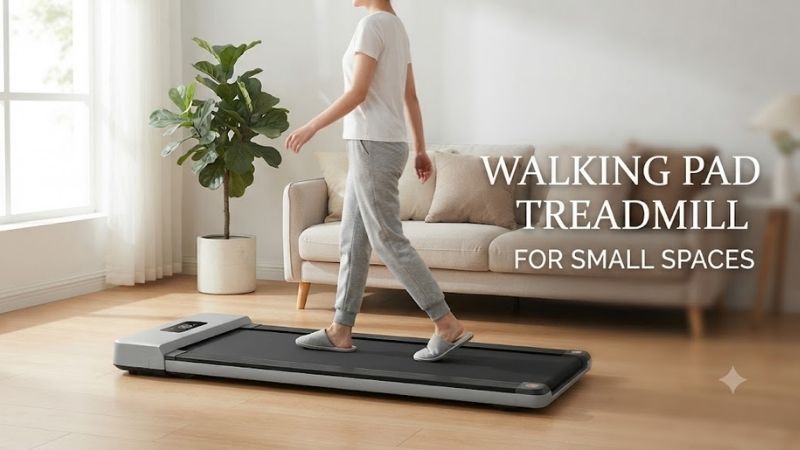
A walking pad treadmill for small spaces can make daily walking more convenient without requiring a dedicated home gym. The right model should fit your available floor area, slide into a practical storage location, and support your walking habits safely. This guide explains how to compare compact designs, essential specifications, noise considerations, and long-term value.
How to Choose a Walking Pad for a Small Space
The best walking pad for a small apartment, bedroom, or home office is not necessarily the smallest machine available. It is the one that provides sufficient walking room, stable operation, convenient storage, and appropriate safety features within your actual living environment.
Before comparing products, establish four requirements:
-
Available floor space: Measure the area where the machine will operate, not just where it will be stored.
-
Storage location: Check the clearance under furniture, inside closets, or against a wall.
-
Walking purpose: Decide whether you need casual walking, desk walking, or a faster walking pace.
-
User requirements: Consider body weight, height, stride length, balance, and preferred walking duration.
A compact treadmill that meets these requirements will generally be more useful than one selected solely for its advertised dimensions.
Decide Between a Walking Pad and a Compact Treadmill
Walking pads and compact treadmills often overlap, but their intended uses can differ.
A traditional walking pad usually has a low-profile deck, limited controls, and no permanent upright console. Many models are intended for low-speed walking, including use beneath standing desks.
Compact treadmills may incorporate handrails, higher maximum speeds, or larger running surfaces. These additions can improve versatility but increase their operating and storage requirements.
Choose a walking pad if your primary goal is low-speed walking and convenient storage. Consider a compact treadmill with a handrail if you require additional balance support or intend to walk at faster speeds.
Identify Your Main Walking Environment
Different rooms create different purchasing priorities.
| Location | Main Priority | Important Consideration |
|---|---|---|
| Small apartment | Noise and vibration | Shared floors and nearby neighbors |
| Home office | Low deck height | Standing desk height and monitor positioning |
| Bedroom | Storage convenience | Under-bed clearance and furniture access |
| Living room | Portability | Moving the unit between uses |
| Shared workspace | Sound and controls | Interruptions and safe operation |
| Studio apartment | Overall footprint | Keeping walkways and exits unobstructed |
A machine suitable for occasional living-room exercise may not be the best choice for several hours of intermittent walking at a workstation.
Walking Pad Dimensions and Storage Requirements
Size is one of the most important buying considerations, but product listings frequently emphasize dimensions that do not fully explain how much room a walking pad requires.
Buyers should distinguish the machine’s overall footprint from its usable walking surface, storage profile, and operating clearance.
Overall Length and Width
A walking pad’s external dimensions determine whether it fits between furniture, underneath a desk, or along a wall.
Compact walking pads commonly occupy a footprint measuring several feet in length and approximately 2 feet in width, although dimensions vary considerably by model.
When checking a product listing, look for:
-
Overall machine length
-
Overall machine width
-
Total deck height
-
Dimensions with any handrail raised
-
Folded or stored dimensions, where applicable
Do not assume that the walking surface occupies the entire external footprint. Motor housings, side rails, and front and rear rollers consume additional space.
For example, a machine measuring 48 inches long may provide a noticeably shorter usable walking belt.
Walking Belt Length and Width
Belt dimensions affect stride comfort more directly than overall treadmill dimensions.
A short belt may feel manageable during slow walking but increasingly restrictive as pace and stride length increase. Taller users and people with naturally longer strides may need additional belt length.
As general shopping reference points, not universal fit standards:
| Usable Belt Dimension | Practical Consideration |
|---|---|
| Under 35 inches long | Potentially restrictive even for some slow walkers |
| 35–39 inches long | Worth considering for shorter strides at low speeds |
| 40–44 inches long | More room for many casual walking patterns |
| 45 inches or longer | Potentially more comfortable for longer strides |
| Under 15 inches wide | Requires more deliberate foot placement |
| 16–18 inches wide | Offers greater lateral walking room |
These ranges are shopping guidelines rather than guarantees. Walking comfort depends on stride length, speed, gait, and individual preferences.
When possible, select a belt that accommodates your natural stride without requiring you to shorten your steps or concentrate constantly on foot placement.
Under-Bed and Under-Couch Storage
Under-furniture storage is one of the biggest advantages of a low-profile walking pad.
However, furniture clearance can be more restrictive than expected.
Measure the vertical gap between the floor and the lowest point of the bed frame or couch. Compare that measurement with the walking pad’s maximum stored height, including wheels, housings, and protruding components.
A reasonable planning practice is to allow extra clearance rather than expecting a perfect dimensional fit.
Consider whether:
-
Support legs obstruct the storage path.
-
The walking pad can slide fully beneath the furniture.
-
Its wheels work in the intended direction.
-
Carpet makes movement more difficult.
-
You can retrieve the machine without awkward lifting.
Some models must remain flat during storage, while others permit upright positioning or folding. Follow the manufacturer’s approved storage orientation.
Foldable vs. Non-Foldable Walking Pads
A folding design may reduce storage length, but it does not automatically make a machine easier to store.
| Feature | Non-Foldable Walking Pad | Foldable Walking Pad |
|---|---|---|
| Setup | Usually ready after positioning | May require unfolding |
| Storage length | Remains full length | May become shorter |
| Stored thickness | Often relatively low | May increase when folded |
| Moving parts | Fewer folding components | Additional hinge or locking mechanisms |
| Under-desk suitability | Depends on deck height | Depends on model configuration |
| Maintenance | Basic belt and motor care | May also require hinge inspection |
For under-bed storage, a thin non-folding machine may be preferable. For a closet with limited depth, a properly designed folding model may be more practical.
Neither design is universally superior.
Essential Walking Pad Specifications to Compare
A walking pad’s technical specifications determine whether it can accommodate the intended user and walking routine.
Dimensions alone are insufficient because two similarly sized machines may have different capacity ratings, speed ranges, control systems, and maintenance requirements.
Motor Power and Continuous Operation
Walking pads are typically powered by electric motors that move the belt at controlled speeds.
Manufacturers may advertise motor output using horsepower or watts. However, ratings can refer to different measurement conditions.
Peak horsepower and continuous-duty horsepower are not interchangeable. A high advertised peak rating does not establish how long a machine can operate at a particular load.
Instead of choosing based on motor power alone, investigate:
-
The manufacturer’s stated duty cycle
-
Recommended session duration
-
Cooling or rest requirements
-
Weight capacity
-
Speed range under normal use
-
Warranty coverage for the motor
-
Documented overheating protections
This is especially important for users planning repeated walking sessions throughout the workday.
A machine marketed for under-desk walking is not automatically approved for continuous operation over an entire eight-hour workday.
Walking Speed Range
Speed range determines how well a walking pad accommodates different walking activities.
| Walking Speed | Approximate Pace | Typical Use |
|---|---|---|
| 1.0 mph | 60 min/mile | Very slow walking |
| 1.5 mph | 40 min/mile | Gentle walking or desk use |
| 2.0 mph | 30 min/mile | Comfortable walking for some users |
| 2.5 mph | 24 min/mile | Purposeful walking |
| 3.0 mph | 20 min/mile | Brisk walking for some users |
| 3.5 mph | 17.1 min/mile | Fast walking |
These are mathematical pace equivalents, not guaranteed comfort or training levels. The same speed can feel different depending on the person.
For a standing desk, lower speeds often make it easier to operate a keyboard or mouse. However, balance and attention may still be affected.
Buyers who want dedicated walking workouts rather than desk walking may benefit from a machine supporting a wider usable speed range and an appropriately long belt.
Never assume that a walking pad is safe for jogging or running simply because its motor can reach a higher speed.
Weight Capacity and Stability
Weight capacity is a fundamental safety specification.
Check the manufacturer’s published user-weight rating for the exact model and configuration. Do not rely on ratings quoted for similar-looking products.
The capacity rating should meet or exceed the intended user’s weight. A comfortable margin can be useful when choosing between machines, but it does not substitute for the manufacturer’s load requirements.
Stability also depends on factors that a capacity rating alone cannot reveal, including:
-
Frame construction
-
Deck stiffness
-
Contact with the floor
-
Belt alignment
-
User movement
-
Placement on an appropriate surface
A narrow, lightweight machine may be convenient to move while offering less room for variations in foot placement.
If balance support is necessary, consider equipment with a manufacturer-designed, load-rated handrail rather than assuming a nearby desk can serve as a support.
Machine Weight and Transport Wheels
Portable walking pads should be evaluated according to how they actually move.
A product with built-in wheels may be easy to tilt and roll on a hard surface yet difficult to maneuver over thick carpeting or raised thresholds.
Before purchasing, evaluate the machine’s listed weight and whether it can be repositioned safely by the intended user.
Check wheel placement, available handholds, and whether the machine must be lifted before it can roll. Never assume that a lightweight appearance means effortless transport.
Controls and Display Features
Common walking pad controls include wireless remotes, onboard buttons, and connected applications.
A basic display may show speed, elapsed time, distance, or estimated calories.
For practical purchasing decisions, prioritize controls that are easy to operate and clearly indicate the machine’s current state.
Useful features include gradual speed adjustments, visible speed readings, accessible stop controls, and a reliable way to operate the unit without reaching awkwardly toward the moving belt.
Calorie estimates should be treated as rough calculations rather than precise measurements.
For app-dependent models, check whether basic operation remains possible if the phone is unavailable or the application stops receiving updates.
Noise and Vibration in Apartments and Home Offices
Noise is a major consideration when selecting a walking pad treadmill for small spaces, particularly in shared buildings.
Two machines with similar motors may produce noticeably different sounds depending on their construction, the user’s walking pattern, and the surface underneath.
Motor Noise vs. Footstep Noise
Walking pads generate several types of sound.
Motor noise comes from the drive system. Belt noise results from contact between moving components, while footstep noise comes from the impact of each step on the deck.
These sounds may travel differently through a building. A machine that sounds relatively quiet inside an apartment can still transmit vibration into the structure below.
Manufacturers sometimes publish decibel ratings, but these figures may not specify walking speed, user weight, testing distance, or floor type.
Therefore, do not assume that a low advertised noise rating guarantees quiet operation in every apartment.
Floor Mats and Vibration Control
A treadmill-compatible equipment mat may help protect the floor and reduce some vibration transmission.
Look for a mat that:
-
Is approved for the machine and flooring type.
-
Extends sufficiently beneath its support points.
-
Provides stable contact without rocking.
-
Does not obstruct ventilation openings.
-
Is suitable for the manufacturer’s intended installation surface.
A thick, soft mat is not automatically better. Excessively compressible material may reduce stability.
For apartments with downstairs neighbors, consider the building’s construction and household noise restrictions. No mat can guarantee that walking vibration will become inaudible.
Can You Use a Walking Pad on Carpet?
Some walking pads are intended primarily for hard, level flooring.
Carpeting can affect ventilation, stability, and movement, especially when the machine has openings or cooling components close to the floor.
Follow the manufacturer’s flooring requirements. Where carpet installation is prohibited, do not assume that placing an ordinary exercise mat underneath makes it acceptable.
A rigid support surface may be permitted for certain models, but only when consistent with their installation instructions.
Safety Features Worth Prioritizing
Compact size should never take priority over safe operation.
Walking pads often have fewer physical controls and less hand support than conventional treadmills. Consumer Reports has identified potential safety concerns during evaluations of under-desk treadmills, making machine-specific safety features particularly important.
Emergency Stop and Accessible Controls
Before purchasing, determine exactly how the walking pad stops.
Some designs rely on a wireless remote, others have physical buttons, and certain models include safety keys or additional stopping mechanisms.
Consider whether you can stop the machine immediately without bending toward the moving belt.
A remote control alone should not be assumed equivalent to an emergency-stop system.
Check whether the machine provides:
-
An accessible stop control
-
Gradual speed changes
-
Clear operating status
-
Documented fault protections
-
Manufacturer-approved emergency stopping procedures
Avoid products with unclear operating instructions or unreliable control behavior.
In April 2026, the U.S. Consumer Product Safety Commission warned consumers to stop using specified Sperax walking pads and treadmills, including Pro, Q1, RM-01, and RM-02 models, because of reported unexpected speed changes, abrupt stops, and thermal hazards.
Check the exact model number against current safety warnings before purchasing, particularly when buying used or from unfamiliar sellers.
Rear and Side Clearance
A walking pad requires sufficient unobstructed space around the moving belt.
The rear of the machine should not be positioned tightly against a wall, furniture, or other obstacle.
Exact required clearances depend on the manufacturer’s instructions. There is no single universal rear-clearance figure that can safely be applied to every model.
Plan the entire operating area, including the space needed to step on, step off, and recover from an unexpected stop.
Do not position the machine where it blocks exits or creates tripping hazards.
Electrical and Household Safety
Walking pads are electrical equipment and should be used according to the manufacturer’s power requirements.
Check the rated voltage, plug type, grounding instructions, and permitted power connection.
Avoid routing cables across the walking area or beneath moving components. Use extension cords or power strips only if specifically permitted by the manufacturer.
Keep children and pets away from the equipment during operation. Unplug and secure the machine when it is not in use, following the product manual.
Using a Walking Pad Under a Standing Desk
An under-desk walking pad combines light walking with computer-based tasks. However, successful use depends on more than fitting the machine beneath a desk.
Standing Desk Height and Ergonomics
Walking on a treadmill raises the user’s feet above the room’s floor level.
Consequently, a standing desk that is comfortable when standing directly on the floor may become too low when walking on a raised deck.
To evaluate compatibility, consider:
-
The treadmill deck’s standing height
-
Your height while wearing walking shoes
-
Your preferred elbow and keyboard position
-
Monitor placement
-
The desk’s maximum height adjustment
-
Clearance between the desk frame and moving equipment
The desk should allow a comfortable working position without forcing the user to bend forward or elevate the shoulders excessively.
Test the arrangement at the intended walking speed before relying on it for long work sessions.
Walking While Typing
Typing while walking requires more coordination than standing at a desk.
Begin at a low walking speed and determine whether you can maintain balance and accurately operate your keyboard or mouse.
Activities such as listening to meetings or reading may be easier than tasks requiring precise cursor movement.
Avoid walking while performing work that demands intense visual attention if it interferes with awareness of the moving belt.
A standing desk should not be used as an improvised balance rail unless its manufacturer specifically approves that use.
Session Duration and Breaks
A walking pad can support short bouts of movement throughout the day, but the appropriate session duration depends on the user and machine.
Start with manageable sessions and increase activity gradually according to comfort, ability, and the equipment’s instructions.
Alternate between walking, standing, and sitting as needed.
Check whether the walking pad has limits on continuous operating time. Some machines require cooling intervals, regardless of whether the user feels comfortable continuing.
Walking Pad Features: Which Are Worth Paying For?
Not every additional feature provides meaningful value in a small home.
The most useful features are those that improve compatibility, safety, operating convenience, or durability.
| Feature | Potential Benefit | Main Trade-Off |
|---|---|---|
| Foldable deck | Shorter stored length | Additional moving mechanisms |
| Transport wheels | Easier repositioning | May still require lifting |
| Handrail | Additional balance support | Larger footprint |
| Remote control | Convenient speed adjustments | Battery and connectivity dependency |
| Automatic speed control | Potentially convenient operation | Requires careful familiarization |
| App connectivity | Activity tracking and settings | Software dependency |
| Incline function | Additional walking variation | Greater mechanical complexity |
| Integrated display | Easier monitoring | May increase bulk |
| Low-profile deck | Improved desk compatibility | May limit certain structural designs |
Is an Incline Walking Pad Worth It?
Incline changes the walking angle and may make walking feel more demanding at the same belt speed.
However, an incline mechanism may increase the machine’s height, stored dimensions, and mechanical complexity.
For a small apartment primarily used for desk walking, a simple flat walking pad may be more suitable.
If incline walking is an important priority, choose a machine explicitly designed and rated for that purpose. Avoid placing objects beneath an ordinary walking pad to create an improvised incline.
Are Smart Features Necessary?
Bluetooth connections, companion apps, workout programs, and activity records can be useful for users who enjoy tracking exercise.
However, they are secondary to safe controls, appropriate capacity, sufficient belt space, and reliable basic operation.
Before paying extra for app integration, check whether the walking pad can still start, adjust speed, and stop through its own approved control system.
Also review the manufacturer’s software support and whether advertised features require a subscription.
Budget: What Makes a Walking Pad Good Value?
The least expensive walking pad may not offer the lowest overall ownership cost.
A low purchase price becomes less attractive if the machine is unsuitable for the user’s stride, cannot be stored conveniently, or has limited replacement-part support.
Prioritize the Specifications That Matter
For buyers on a limited budget, consider this purchasing order:
-
Suitable weight capacity and documented safety features
-
Walking belt dimensions
-
Overall footprint and storage compatibility
-
Speed range appropriate for the intended activity
-
Clear operating and maintenance instructions
-
Warranty and customer support
-
Convenience features and connected applications
This order helps prevent unnecessary spending on digital features while overlooking essential equipment requirements.
Warranty and Replacement Parts
A walking pad contains moving components that may require maintenance or eventual replacement.
Before purchasing, review the written warranty and confirm which components are covered.
Pay particular attention to the motor, deck, belt, electronics, and any folding mechanism.
Also investigate replacement-belt availability, lubrication requirements, and whether the manufacturer provides technical support in the United States.
A long advertised warranty has limited practical value if its exclusions, shipping requirements, or service procedures make support difficult to obtain.
New vs. Used Walking Pads
Used equipment can reduce upfront spending, but additional inspection is important.
Verify the exact model number, operating condition, original power requirements, and whether safety warnings affect the product.
If permitted and safe to operate, check for smooth belt movement, normal speed adjustment, functioning controls, and unusual noise.
Do not purchase or operate a machine subject to a stop-use warning simply because it is inexpensive.
How to Measure Your Room Before Buying
Accurate measurements can prevent many of the most common purchasing mistakes.
A small walking pad that technically fits between furniture may still leave insufficient operating clearance.
Step 1: Measure the Operating Area
Identify a level surface where the walking pad can remain stable.
Measure its length and width, including the area required for safe access and manufacturer-specified clearance.
Account for nearby walls, furniture, doors, and electrical outlets.
Do not confuse the machine’s advertised footprint with its complete operating space.
Step 2: Measure the Intended Storage Location
If you plan to place the walking pad beneath a bed, check height clearance at several points along the storage path.
If storing it in a closet, measure the available depth, width, and height.
For folding models, use the manufacturer’s published folded dimensions rather than assuming that folding reduces every dimension.
Step 3: Check the Route Between Storage and Use
Consider how the machine moves from its storage location to its operating position.
A walking pad may fit beneath a couch yet be difficult to remove because of nearby furniture, carpeting, or limited hand access.
Check for thresholds, tight corners, and changes in floor level.
If the machine requires frequent lifting, confirm that its actual weight and handling instructions are manageable.
Step 4: Confirm Electrical and Desk Compatibility
Identify a suitable outlet that meets the machine’s power requirements.
If using a standing desk, calculate the additional standing height created by the walking pad deck.
Ensure the desk can accommodate your working posture without obstructing the machine or compromising required clearances.
Step 5: Compare the Exact Product Manual
Once a model meets the initial measurements, verify its specifications against the manual for the correct version.
This final check should include operating clearance, storage orientation, floor requirements, weight capacity, duty cycle, and electrical safety instructions.
Common Walking Pad Buying Mistakes
Many unsuitable purchases result from overlooking practical details rather than choosing an inherently poor product.
Choosing the Smallest Belt Available
Smaller dimensions can make storage easier, but an excessively short or narrow belt may interfere with natural walking.
Consider your actual stride and walking speed before selecting an ultra-compact design.
Ignoring Storage Weight
A walking pad that fits under a bed may still be inconvenient if it is difficult to lift or maneuver.
If you intend to store it after every session, portability should receive nearly as much attention as stored dimensions.
Assuming Every Walking Pad Is Quiet
Motor sound, footsteps, floor construction, and walking speed all affect noise.
Do not treat an unqualified decibel claim as proof that a machine will be suitable for a shared apartment.
Overlooking Continuous-Use Limits
A walking pad marketed for home-office use may still have specified operating and cooling limits.
Ignoring these requirements can contribute to overheating, abnormal wear, or equipment failure.
Purchasing Without Checking Safety Notices
Search the exact brand and model for current safety warnings or recalls before buying.
This is particularly important for secondhand equipment and unfamiliar marketplace brands.
Neglecting Maintenance Requirements
Walking pads require periodic inspection, cleaning, and maintenance.
Belt lubrication, where required, reduces friction between the belt and deck. Use only the lubricant and procedure approved for the specific model.
Never adjust belt tension or perform internal maintenance while the machine is powered or moving.
How to Maintain a Compact Walking Pad
Routine care can help preserve operating quality and identify problems before they become more serious.
Clean the Belt and Surrounding Area
Dust, hair, and debris can accumulate around a walking pad, especially when it is stored beneath furniture.
With the machine unplugged, clean accessible exterior surfaces according to the manufacturer’s instructions.
Keep ventilation openings free of obstruction and check that debris has not collected around the belt edges.
Avoid spraying liquid cleaners directly into the motor housing or electrical controls.
Lubricate the Deck When Required
Some walking pads require periodic lubrication, while maintenance instructions vary among manufacturers.
Use the specified treadmill-compatible lubricant and follow the recommended interval and application procedure.
Do not assume that household oil or a general-purpose spray is suitable.
Excessive or incorrect lubrication can create additional problems rather than improving operation.
Monitor Belt Alignment and Wear
Inspect the belt for visible damage, unusual movement, or repeated tracking toward one side.
Stop using the machine if the belt slips, jerks, or behaves unexpectedly.
Adjust belt tracking or tension only when the manufacturer’s instructions clearly explain the procedure and it can be completed safely.
If a machine develops repeated errors, a burning smell, abnormal heat, or unexpected speed changes, stop using it and seek qualified support.
Walking Pad Buying Checklist
Use the following checklist to evaluate a specific machine before purchasing.
| Buying Criterion | What to Verify | Priority |
|---|---|---|
| User weight capacity | Rated for the intended user | Essential |
| Safety controls | Accessible and documented stopping method | Essential |
| Walking belt | Suitable length and width for your stride | Essential |
| Operating clearance | Meets the manufacturer’s requirements | Essential |
| Electrical compatibility | Correct voltage and approved connection | Essential |
| Continuous operation | Suitable duty cycle for intended sessions | Essential |
| Machine footprint | Fits the available exercise area | High |
| Stored dimensions | Fits the intended storage location | High |
| Equipment weight | Manageable transportation and handling | High |
| Floor compatibility | Approved for the intended surface | High |
| Speed range | Matches preferred walking activities | High |
| Warranty | Clear written coverage and exclusions | High |
| Maintenance | Documented lubrication and cleaning procedures | High |
| Noise information | Credible evidence relevant to actual use | Moderate |
| Foldability | Useful for the available storage space | Optional |
| App connectivity | Adds meaningful convenience | Optional |
| Incline | Needed for intended walking activities | Optional |
No single feature should compensate for deficiencies in essential safety or suitability requirements.
Frequently Asked Questions
What Is the Best Walking Pad Treadmill for a Small Apartment?
The best choice is a compact walking pad with an appropriately sized belt, verified safety features, manageable storage dimensions, and a speed range matching your intended use.
For an apartment, also prioritize floor compatibility, vibration considerations, and convenient movement between operating and storage locations.
A low-profile model may be appropriate for desk walking, while a model with a handrail may better suit users requiring additional support.
Can a Walking Pad Fit Under a Bed?
Yes, certain low-profile walking pads can fit beneath beds with sufficient clearance.
Compare the machine’s full stored height against the available space beneath the furniture. Account for protruding components and obstacles along the storage path.
Only store the unit in orientations approved by its manufacturer.
Is a Walking Pad Better Than a Treadmill for Small Spaces?
A walking pad can be more practical when storage convenience and low-speed walking are the main priorities.
A compact treadmill may provide a larger belt, handrails, or higher-speed capability, but typically requires additional operating room.
Choose according to intended use rather than assuming one category is universally better.
Can You Walk on a Walking Pad Every Day?
Daily walking may be practical if the activity is appropriate for the user and the equipment is operated within its specified limits.
Session duration and frequency should reflect individual comfort, physical ability, and the manufacturer’s duty-cycle requirements.
A machine designed for occasional walking should not be assumed suitable for prolonged continuous operation.
How Much Space Do You Need Behind a Walking Pad?
Required clearance varies by model.
Use the manufacturer’s documented rear and side clearance requirements, and ensure there is sufficient unobstructed space to enter, exit, and stop safely.
Do not install the machine tightly against a wall or obstacle simply to reduce its footprint.
Are Walking Pads Suitable for Tall People?
Some are, but taller buyers should pay particular attention to usable belt length.
Height alone does not determine stride length, and comfortable walking space also depends on speed and gait.
A very short belt may require unnatural stride adjustments, so prioritize belt dimensions and, when possible, a practical fit assessment.
Conclusion
The right walking pad treadmill for small spaces should balance compact dimensions with comfortable walking room, reliable controls, appropriate capacity, and manageable storage. Measure your operating and storage areas first, then compare belt dimensions, safety features, duty-cycle limits, and maintenance requirements. For most small-space buyers focused on everyday walking, a stable, low-profile machine that fits their routine is a more practical investment than one offering extra features they rarely use.
Write Your Review
No reviews yet. Be the first to share your experience!