
Key takeaways
-
Choose a walking pad for low-speed indoor walking, under-desk movement, and compact storage.
-
Choose a traditional treadmill for running, incline walking, and more varied workouts.
-
Choose a treadmill with a walking desk when you want a dedicated workstation with a larger walking platform.
-
Choose an exercise bike for seated cardio and workouts that do not require continuous weight-bearing.
-
Choose an elliptical for standing cardio with guided foot movement and, on some machines, upper-body involvement.
-
Choose an under-desk pedal exerciser when seated movement and a small equipment footprint matter most.
Choosing a walking pad treadmill vs alternatives comes down to how you exercise, how much floor space you have, and whether you need walking or running capability. Walking pads favor compact storage and low-speed movement, while traditional treadmills, bikes, and ellipticals offer different workout options. This comparison helps you choose the right equipment for your home.
Quick Verdict: Is a Walking Pad Better Than Other Equipment?
A walking pad treadmill is a practical choice for people who primarily want to walk indoors without dedicating a permanent room to cardio equipment. Its compact design makes it attractive for apartments, home offices, and shared living spaces.
However, a walking pad is not automatically the best home cardio machine. The alternatives can be more suitable depending on workout intensity, available space, balance requirements, and personal preferences.
-
Choose a walking pad for low-speed indoor walking, under-desk movement, and compact storage.
-
Choose a traditional treadmill for running, incline walking, and more varied workouts.
-
Choose a treadmill with a walking desk when you want a dedicated workstation with a larger walking platform.
-
Choose an exercise bike for seated cardio and workouts that do not require continuous weight-bearing.
-
Choose an elliptical for standing cardio with guided foot movement and, on some machines, upper-body involvement.
-
Choose an under-desk pedal exerciser when seated movement and a small equipment footprint matter most.
The right choice depends on the actual specifications of the equipment, not simply its category.
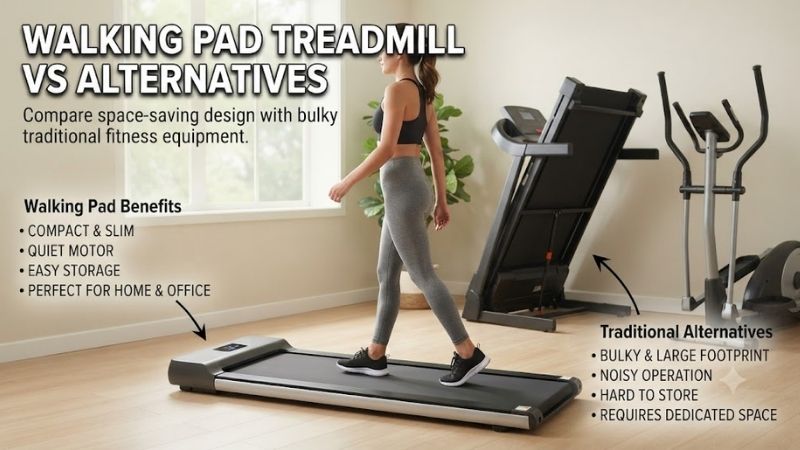
Walking Pad Treadmill vs Alternatives: Quick Comparison
| Equipment | Main Use | Space Requirement | Key Advantage | Main Limitation |
|---|---|---|---|---|
| Walking pad treadmill | Indoor walking | Usually compact | Easy to integrate into small spaces | Limited speed and walking surface on many models |
| Traditional treadmill | Walking, jogging, running | Usually larger | Broader speed and incline options | Higher storage and operating-space demands |
| Folding treadmill | Walking and running, model-dependent | Variable | Running capability with potential storage flexibility | Folded dimensions may still be substantial |
| Treadmill desk | Walking while working | Workstation-sized | Integrated walking and desk setup | Requires a dedicated working area |
| Exercise bike | Seated cycling | Compact to moderate | Seated exercise with adjustable resistance | Does not reproduce walking movement |
| Elliptical trainer | Standing cardio | Moderate to large | Guided stride and adjustable resistance | Larger mechanism and more space needed |
| Under-desk pedal exerciser | Seated pedaling | Usually small | Fits some desk and chair arrangements | Limited workout range and no walking |
These are general equipment-category differences. Individual machines vary considerably in dimensions, features, stability, and storage requirements.
Walking Pad vs Traditional Treadmill: Key Differences
Walking Speed and Running Capability
The main distinction between a walking pad and a traditional treadmill is the range of activities each is intended to support.
Most walking pads are designed primarily for walking. Their compact frames and shorter decks are often less suitable for jogging or running, especially when the user has a longer stride.
Traditional treadmills commonly offer broader speed ranges and running-oriented designs. Many also provide handrails, larger consoles, and incline adjustments.
A traditional treadmill is generally more versatile for users who want to progress from walking into running.
Some products marketed as walking pads support higher speeds, but that does not automatically make them suitable for every running user. The manufacturer’s stated intended use, deck dimensions, stability, and operating instructions should determine how the equipment is used.
Walking Deck Size and Stride Comfort
A walking pad often has a narrower and shorter usable belt than a full-size treadmill.
For low-speed walking, a smaller surface may be adequate if it accommodates the user’s natural stride. As walking speed increases, limited deck length can make foot placement more demanding.
A conventional treadmill generally provides more room for longer strides, although not every treadmill has a running-appropriate deck.
Buyers should examine the usable belt width and length rather than relying on the product’s overall exterior dimensions.
Incline and Workout Variety
Traditional treadmills are more likely to include adjustable incline features, structured workout programs, and higher-speed settings.
Walking pads commonly prioritize simplicity. Some include manual or powered incline functions, but these should be checked model by model.
If incline walking is central to your exercise routine, confirm the adjustment mechanism, available incline range, and operating restrictions before purchasing.
Portability and Storage
Walking pads have an advantage when they can fit beneath appropriate furniture or be moved into storage after use.
However, not every walking pad is lightweight, and not every model is intended to be stored upright.
Traditional folding treadmills may reduce their stored footprint, but folding a running deck does not necessarily make the machine easy to lift or maneuver.
Winner: A walking pad for compact walking setups; a traditional treadmill for broader exercise capability.
Walking Pad vs Folding Treadmill: Which Saves More Space?
Folded Dimensions vs Actual Floor Space
A product described as foldable is not necessarily space-saving in every room.
Some walking pads have low-profile designs that allow horizontal storage beneath a bed with sufficient clearance. Others use folding decks to shorten their storage length.
Folding treadmills commonly raise their running decks vertically, reducing floor area while increasing stored height.
For buyers with limited space, the correct comparison is between the actual storage dimensions of each model and the available storage location.
Portability and Everyday Setup
A walking pad may be easier to move between a home office and living room if it has convenient transport wheels and manageable weight.
A folding treadmill can provide a more substantial workout platform, but the larger frame and folding mechanism may complicate daily repositioning.
Before choosing, consider whether you will realistically unfold, position, and store the equipment every day.
A machine that is inconvenient to access may be used less frequently, even if it has superior specifications.
Which Is Better for Apartment Living?
Walking pads are often more compatible with apartments because they require less permanent floor space.
Nevertheless, compact size does not guarantee quiet operation. Footfalls, belt movement, vibration, floor construction, and walking technique can all influence noise transmitted to neighboring rooms.
A folding treadmill may still be suitable for an apartment with adequate clearance and an appropriate floor setup.
Winner: A compact walking pad for routine walking and frequent storage; a folding treadmill when running capability justifies the larger machine.
Walking Pad vs Under-Desk Treadmill Desk
Separate Walking Pad and Standing Desk
A walking pad paired with an adjustable standing desk gives users flexibility to alternate between seated work, standing work, and walking.
The walking pad can potentially be removed from the workstation when it is not needed. This arrangement makes sense for users who already own a height-adjustable desk or want to select their desk and treadmill independently.
However, walking changes the user’s height relative to the desktop. A desk adjusted for standing directly on the floor may need additional height to maintain comfortable arm and wrist positioning while walking.
Integrated Treadmill Desk
An integrated treadmill desk combines a walking platform with a purpose-designed workstation.
The advantage is a coordinated desk and walking setup. Depending on its design, it may provide a larger work surface or a more permanent arrangement.
The disadvantage is reduced flexibility and potentially greater floor-space requirements.
An integrated desk may also be harder to relocate than a separate compact walking pad.
Working Comfort and Productivity
Walking while working is not suitable for every task.
Slow walking may be practical during calls, reading, or routine computer work. Activities involving detailed mouse control, precision typing, or sustained concentration can be more challenging while moving.
Desk stability, display positioning, cable management, and the user’s ability to maintain safe foot placement all matter.
A walking workstation should provide sufficient room to step off safely and access emergency controls.
Winner: A separate walking pad for a flexible home office; an integrated treadmill desk for a dedicated walking workstation.
Walking Pad vs Exercise Bike: Which Is Better for Home Cardio?
Walking vs Seated Exercise
The most important difference is body position.
A walking pad requires upright, weight-bearing movement. Users support their body weight while performing a familiar walking pattern.
An exercise bike provides seated cardio through repeated pedaling. The seat supports part of the user’s weight, while adjustable resistance lets the user change workout difficulty.
Cycling may be preferable for people who want seated exercise, although saddle comfort, knee positioning, and proper bike adjustment remain important.
Neither option is universally better for joint comfort. Individual movement tolerance and equipment setup matter.
Workout Intensity and Resistance
Walking pads commonly emphasize steady, lower-speed exercise rather than high-intensity training.
Exercise bikes can offer a wider range of resistance-based workouts without requiring running speeds.
A bike may be better suited to structured cycling intervals when the machine provides suitable resistance adjustment.
However, exercise intensity depends on resistance, cadence, walking speed, incline, fitness level, and duration. It is not possible to reliably claim that cycling always burns more calories than walking.
Space and Equipment Setup
Walking pads can often be stored horizontally, making them attractive for users with limited floor space.
Exercise bikes vary from compact upright designs to larger recumbent configurations. Some folding upright bikes can reduce their storage footprint.
Both require adequate clearance for comfortable, safe operation.
Which Is Better for Beginners?
Walking pads are intuitive for users who are comfortable walking without assistance.
Exercise bikes may offer an alternative for people who prefer seated movement or want to avoid continuous standing during exercise.
Someone with balance limitations should not assume a rail-free walking pad is appropriate simply because its top speed is low.
Winner: A walking pad for walking-based activity; an exercise bike for seated cardio with adjustable resistance.
Walking Pad vs Elliptical: Which Offers More Workout Variety?
Movement Mechanics
A walking pad reproduces treadmill walking through a moving belt.
An elliptical guides the feet along a repeated curved path. The feet generally remain in contact with the pedals throughout the movement, which differs from normal walking.
Some ellipticals include moving handles for coordinated upper- and lower-body activity.
The two machines therefore provide different movement patterns, rather than interchangeable versions of the same exercise.
Resistance and Exercise Progression
Many ellipticals offer adjustable resistance. Some also include incline adjustment or multiple preset workout programs.
This allows users to increase exercise difficulty without necessarily increasing their stepping speed.
Most compact walking pads offer fewer workout adjustments, although certain models include incline capability.
For users who enjoy resistance-based progression, an elliptical may offer more options.
Balance, Coordination, and Stability
Ellipticals typically provide stationary or moving handlebars, although handle configurations differ.
A rail-free walking pad offers no equivalent support structure.
Nevertheless, an elliptical is not automatically safer for someone with limited balance. Mounting the pedals, coordinating movement, and stepping off require adequate control.
Users should choose equipment compatible with their mobility, coordination, and comfort.
Storage and Maintenance
Ellipticals generally occupy more space than compact walking pads, even when the machine is not being used.
They also contain pedal linkages, resistance systems, and other moving components that may require inspection and maintenance.
Walking pads have their own maintenance needs, including belt condition, tracking, cleaning, and lubrication where specified by the manufacturer.
Winner: A walking pad for compact indoor walking; an elliptical for guided, resistance-adjustable standing cardio.
Walking Pad vs Under-Desk Pedal Exerciser
Standing Movement vs Seated Movement
An under-desk pedal exerciser is a compact device designed for seated pedaling.
Unlike a walking pad, it does not require the user to stand or move along a treadmill belt.
That difference makes pedal exercisers suitable for users who prefer to remain seated while performing light leg movement.
However, pedal exercisers do not replicate a normal walking gait.
Desk Clearance and Compatibility
A pedal exerciser may appear easier to fit beneath a desk because its equipment footprint is small.
In practice, pedaling requires enough vertical clearance for the knees throughout the movement.
The combination of chair height, desk height, pedal position, and leg length determines whether the setup works comfortably.
Walking pads instead require sufficient standing height, desk adjustability, and unobstructed walking clearance.
Exercise Capability
Many compact pedal exercisers offer adjustable resistance, although the resistance range and stability differ across models.
Some are intended for light seated activity rather than demanding cycling workouts.
For users seeking substantial cardio intensity, a full-size exercise bike may be more appropriate than a small pedal unit.
Winner: A walking pad for upright walking; an under-desk pedal exerciser for seated desk activity and minimal equipment storage.
Important Specifications to Compare Before Buying
1. Usable Walking Surface
A walking pad’s usable belt dimensions are more important than its exterior dimensions alone.
Check whether the belt provides comfortable room for natural foot placement and stride movement.
A short or narrow belt may require more concentration, especially as speed increases.
Traditional treadmills can offer more room, but buyers should still verify actual belt dimensions rather than assuming every larger machine is suitable for running.
2. Speed Range and Intended Use
Check both minimum and maximum operating speeds.
A low minimum speed can be useful for walking while working, whereas a higher maximum speed matters only when the equipment is designed for that use.
Do not assume that a machine marketed as a 2-in-1 treadmill is suitable for high-speed running in every configuration.
Some machines permit different speeds depending on whether a handrail is raised or lowered.
Follow the manufacturer’s operating instructions.
3. User Weight Capacity and Stability
Every powered exercise machine should be evaluated against its manufacturer’s stated user weight limit.
The rated capacity is not a direct measurement of overall stability, durability, or workout performance.
For walking pads, examine the platform design, available handrails, belt dimensions, and intended operating conditions.
For bikes and ellipticals, consider frame stability, adjustment range, and user fit.
4. Stored Footprint vs Operating Footprint
Measure the equipment in two configurations.
| Measurement | Why It Matters |
|---|---|
| Operating length | Determines whether the machine fits in the workout area |
| Operating width | Affects passageways and side clearance |
| Overall operating height | Important for desk use and low ceilings |
| Stored dimensions | Determines fit beneath furniture or in closets |
| Equipment weight | Affects relocation and storage |
| Required safety clearance | Provides room for safe operation and dismounting |
Leave the clearance required by the specific user manual, even when the machine itself appears to fit.
5. Noise and Vibration
Exercise equipment produces different types of sound.
Walking pads may generate belt noise, motor noise, footfall impacts, and vibration transmitted through the floor.
Traditional treadmills can produce additional impact noise during running.
Exercise bikes and ellipticals avoid treadmill belt footfalls but may produce mechanical noise from resistance systems, pedals, and moving components.
Actual sound levels depend on equipment condition, exercise intensity, construction, flooring, and placement.
Do not rely solely on unverified claims such as “silent motor” or “apartment-proof.”
6. Safety Controls and Emergency Stopping
Evaluate the safety arrangement before considering extra features.
A walking pad may have no full-length handrails, which changes how users maintain balance and respond to a misstep.
Look for clearly documented emergency stopping functions, compatible safety controls, and accessible operating buttons.
Some under-desk treadmills have raised safety concerns in published consumer evaluations, so a compact design should not be treated as inherently safe.
Keep children and pets away from moving equipment, and disconnect or secure it when not in use.
7. Maintenance Requirements
Walking pads and traditional treadmills may require periodic belt inspection, tracking adjustment, cleaning, and lubrication, depending on the design.
Exercise bikes require attention to pedals, fasteners, resistance mechanisms, and other model-specific components.
Ellipticals may need inspections of linkages, rails, and drive components.
Compare maintenance requirements using the actual manufacturer manual rather than assuming one equipment type is maintenance-free.
8. Overall Cost of Ownership
Purchase price is only one part of the buying decision.
Consider delivery, assembly, flooring protection, maintenance supplies, warranty coverage, replacement parts, and return conditions.
A less expensive walking pad may be reasonable for light home use. A more substantial treadmill may provide better suitability if the buyer genuinely needs running capability.
The more valuable purchase is the machine that matches intended use without requiring unnecessary features or unsafe compromises.
Pros and Cons of Walking Pad Treadmills
Advantages
-
Usually smaller than traditional treadmills
-
Suitable for everyday indoor walking
-
Many models work with standing desks
-
Some support compact storage
-
Simple walking-focused operation
-
Useful for homes without dedicated gym rooms
Disadvantages
-
Limited running capability on many models
-
Smaller usable belts
-
Fewer workout adjustments
-
Some models lack handrails
-
Noise and vibration remain possible
-
Frequent storage can become inconvenient
Who Should Choose Each Alternative?
Best for Remote Workers: Walking Pad
A walking pad can suit someone who spends much of the day at an adjustable standing desk and wants occasional slow walking.
Prioritize a comfortable belt, low minimum speed, stable desk configuration, and accessible stopping controls.
Best for Runners: Traditional Treadmill
Choose a running-oriented treadmill if jogging, running, or incline training is a major goal.
A larger deck and model-appropriate running features are more relevant than compact storage alone.
Best for Apartment Residents: Compact Walking Pad or Folding Bike
A walking pad may be easier to store in a small apartment.
A folding upright exercise bike is worth considering when seated cardio is preferred.
The best choice depends on room dimensions, flooring, storage access, and noise sensitivity.
Best for Seated Exercise: Stationary Bike
A stationary bike is a logical alternative for users who prefer exercising while seated.
Compare upright and recumbent designs based on comfort, seat support, equipment dimensions, and adjustment range.
Best for Resistance-Based Standing Cardio: Elliptical
An elliptical can offer a standing workout with adjustable resistance and guided foot movement.
It is more appropriate when dedicated exercise space is available and the user enjoys the elliptical movement pattern.
Best for Minimal Desk Equipment: Pedal Exerciser
An under-desk pedal exerciser makes sense when the goal is light seated movement without a standing workstation.
The key limitation is that it does not replace walking or offer the same capabilities as a full-size stationary bike.
Frequently Asked Questions
Is a Walking Pad as Good as a Regular Treadmill?
A walking pad can be just as suitable for basic indoor walking when its belt size, speed range, weight capacity, and safety features match the user’s needs.
A regular treadmill is generally more capable when running, incline adjustment, and broader training options are priorities.
Can a Walking Pad Replace an Exercise Bike?
A walking pad can replace a bike as someone’s preferred home cardio equipment, but it does not reproduce seated cycling.
Walking and cycling involve different movement patterns and equipment requirements.
Choose based on preferred exercise, comfort, balance, and intended intensity rather than assuming the two machines provide identical workouts.
Is a Walking Pad Better Than an Elliptical for Small Spaces?
Usually, a compact walking pad has a smaller storage requirement than a conventional elliptical.
However, actual dimensions vary. A buyer should compare the specific products’ operating and stored footprints before making a decision.
Can You Run on a Walking Pad?
Only if the manufacturer explicitly identifies the model and configuration as suitable for running.
Many walking pads are designed for walking alone, and higher belt speeds do not necessarily mean the machine provides a suitable running platform.
Are Walking Pads Suitable for Upstairs Apartments?
They can be, but suitability depends on floor construction, vibration transmission, available clearance, equipment weight, and building rules.
A floor mat may help protect flooring and reduce some vibration, but it cannot guarantee that sound will not travel to another unit.
Is a Walking Pad Worth Buying if You Already Walk Outdoors?
A walking pad may still be useful when weather, daylight, or scheduling makes outdoor walking inconvenient.
However, if you already have consistent access to comfortable, safe walking routes and do not need an indoor alternative, additional equipment may provide limited value.
Conclusion
For most buyers comparing a walking pad treadmill vs alternatives, the deciding factor is the type of exercise they actually intend to perform. A walking pad is a practical choice for compact indoor walking and compatible home-office setups. Traditional treadmills offer greater versatility for running, while exercise bikes, ellipticals, and pedal exercisers serve different movement preferences. Choose the equipment whose verified dimensions, intended use, stability, and safety features fit your space and routine.
Write Your Review
No reviews yet. Be the first to share your experience!