
Key takeaways
-
Whether motor power is rated continuously or at peak output
-
Manufacturer-recommended session duration
-
Required cooling intervals
-
Rated user weight capacity
-
Supported speed range
-
Documented motor protection features
-
Motor warranty and available service
Choosing a walking pad involves more than finding a compact treadmill at an attractive price. Belt dimensions, speed range, motor performance, user weight capacity, and safety features all affect everyday usability. This walking pad treadmill buying guide explains what to compare, which features matter most, and how to select a machine for your home or office.
What Is a Walking Pad Treadmill?
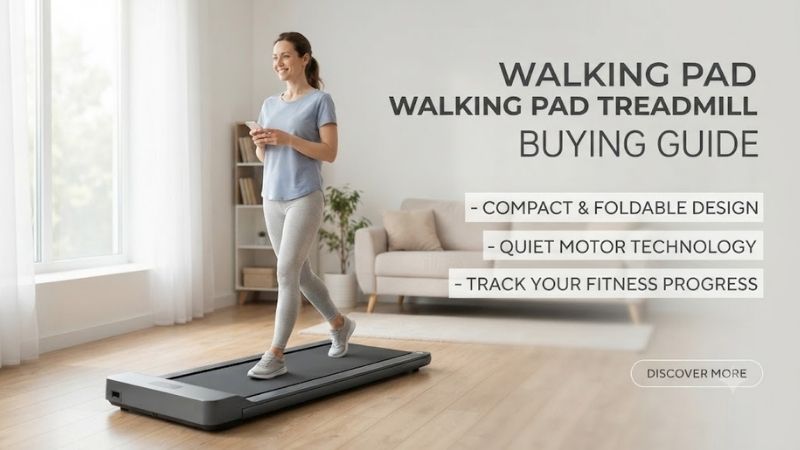
A walking pad treadmill is a compact, motorized exercise machine primarily designed for walking rather than high-speed running. Many models use a low-profile deck without the large upright console found on conventional treadmills.
Walking pads are commonly used in apartments, home offices, bedrooms, and other areas where a full-size treadmill may be impractical.
Their appeal comes from combining a relatively small footprint with convenient low-speed exercise. However, walking pads differ considerably in usable belt dimensions, supported speeds, weight capacity, controls, and storage options.
How Does a Walking Pad Work?
A typical walking pad uses an electric motor to move a continuous belt across a deck. Users adjust the belt speed through an onboard control panel, wireless remote, or compatible application.
Unlike nonmotorized treadmills, motorized walking pads control belt movement independently of the user’s walking pace.
Depending on the design, a walking pad may offer speed presets, distance tracking, elapsed-time displays, or automatic speed adjustments.
The machine’s operating characteristics depend on its motor, belt, frame, control system, and manufacturer-specified load limits.
Walking Pad vs. Traditional Treadmill
Although walking pads and treadmills use similar basic mechanisms, they are often intended for different activities.
| Feature | Walking Pad | Traditional Treadmill |
|---|---|---|
| Primary activity | Walking | Walking, jogging, running |
| Machine size | Usually compact | Generally larger |
| Handrails | Often absent or minimal | Commonly included |
| Speed range | Usually lower | Often broader |
| Walking surface | Typically shorter and narrower | Usually larger |
| Storage | Many low-profile options | Varies by design |
| Controls | Remote, onboard, or app | Usually console-based |
| Best suited for | Casual walking and desk use | More varied cardio workouts |
A walking pad is generally more suitable when space efficiency and low-speed walking are the priorities.
A traditional treadmill is worth considering if you need a larger running deck, dedicated balance support, or equipment designed for higher-speed workouts.
Who Should Buy a Walking Pad?
Walking pads can serve several types of buyers.
Home-office workers may want a low-profile model compatible with an adjustable standing desk.
Apartment residents may prioritize manageable dimensions, floor compatibility, and reduced vibration.
Beginners may prefer straightforward controls, gradual speed adjustments, and a comfortable walking surface.
Older adults or users with balance concerns should prioritize appropriate support and accessible safety controls. A conventional treadmill with suitable handrails may be preferable to a rail-free walking pad.
Space-conscious households may benefit from machines that can be moved and stored between sessions.
The correct machine should match the user’s abilities and actual walking routine rather than simply fitting a broad buyer category.
Essential Specifications to Check Before Buying
Walking pad specifications provide the foundation for comparing models.
However, advertised figures are only useful when buyers understand what they measure and how they affect real-world operation.
1. Walking Belt Length and Width
The walking belt is the usable surface on which your feet land.
Belt dimensions are more important for walking comfort than the machine’s overall length and width.
A short belt may restrict a longer stride, while a narrow belt leaves less room for lateral foot placement.
The following measurements are general shopping reference points, not universal ergonomic requirements.
| Belt Length | Buying Consideration |
|---|---|
| Under 35 inches | May feel restrictive for many adult users |
| 35–39 inches | More appropriate to evaluate for slow, shorter-stride walking |
| 40–44 inches | Offers additional room for many casual walking patterns |
| 45 inches or more | Worth considering for longer strides and faster walking |
Belt width also matters. Walking surfaces under 15 inches wide can require more precise foot positioning. Widths around 16–18 inches provide additional lateral room, although individual comfort varies.
Taller users should consider their natural stride length, intended walking speed, and ability to remain centered comfortably.
Do not assume a longer external frame always means a longer usable belt.
2. Motor Power and Duty Cycle
Walking pad motors are commonly advertised using horsepower or wattage ratings.
Some manufacturers emphasize peak horsepower, while others publish continuous operating ratings.
These figures are not directly interchangeable.
A peak motor rating does not establish how effectively a machine handles sustained walking under load.
When comparing products, investigate:
-
Whether motor power is rated continuously or at peak output
-
Manufacturer-recommended session duration
-
Required cooling intervals
-
Rated user weight capacity
-
Supported speed range
-
Documented motor protection features
-
Motor warranty and available service
A motor with a higher advertised rating is not automatically quieter, more durable, or better suited to your intended use.
For repeated walking sessions during the workday, manufacturer-specified operating limits are particularly important.
3. Walking Speed Range
Speed range determines whether a walking pad accommodates slow desk walking, relaxed exercise, or a brisker walking pace.
| Speed | Approximate Pace | Potential Application |
|---|---|---|
| 0.5–1.0 mph | Very slow | Initial familiarization |
| 1.0–1.5 mph | Slow | Some desk-walking activities |
| 1.5–2.0 mph | Gentle to moderate | Casual walking |
| 2.0–2.5 mph | Moderate for some users | Dedicated walking sessions |
| 2.5–3.0 mph | Purposeful | Faster walking |
| 3.0–3.5 mph | Brisk for some users | More demanding walking |
Walking intensity is individual, so these descriptions are not fixed exercise classifications.
An under-desk user may place greater value on smooth adjustments at low speeds than on a high maximum speed.
Buyers seeking dedicated walking workouts may prefer a broader range, provided the belt dimensions and machine design safely support their intended pace.
Do not use a walking-only machine for running unless the manufacturer explicitly permits it.
4. Maximum User Weight Capacity
User weight capacity is a manufacturer-specified operating limit.
Choose a machine rated for at least the intended user’s weight, and do not exceed that rating.
A higher capacity can be worth considering, but it does not independently prove better stability, motor reliability, or construction quality.
Weight ratings should always be checked for the exact model and configuration.
Factors such as deck construction, frame stiffness, floor contact, and walking movement also influence stability.
5. Deck Height and Ground Clearance
Walking pads often have lower decks than conventional treadmills, but actual standing height varies.
Deck height affects standing-desk compatibility, ease of stepping onto the machine, and certain storage arrangements.
For desk walking, remember that standing on the treadmill elevates your feet relative to the desk.
The additional height can change your keyboard and monitor positioning.
When choosing a walking pad for an office, compare deck height with the standing desk’s available adjustment range.
6. Machine Weight and Portability
Compact does not necessarily mean lightweight.
A walking pad may be convenient to store but difficult to lift or reposition regularly.
Review the machine’s listed weight and determine whether it has transport wheels or practical carrying points.
If you expect to move the equipment every day, consider the entire route between its storage and operating locations.
Carpet, raised thresholds, furniture, and tight corners can make moving a machine more difficult.
Walking Pad Types and Their Advantages
Walking pads are available in several configurations. Understanding these designs can simplify the buying decision.
Under-Desk Walking Pads
Under-desk walking pads are intended for low-speed use beneath suitable adjustable desks.
They generally emphasize a low deck, compact dimensions, and accessible speed controls.
Advantages: Space-efficient construction, compatibility with some standing desks, and convenient low-speed walking.
Limitations: Often narrower belts, limited upper speeds, and minimal physical support.
Choose this type if walking while performing suitable computer tasks is your main priority.
Foldable Walking Pads
Foldable models incorporate a mechanism that reduces at least one storage dimension.
Some designs fold the deck, while others fold only the handrail or console.
Advantages: Potentially shorter storage length and greater flexibility in certain closets or rooms.
Limitations: Hinges, joints, and locking systems add components that require proper operation and inspection.
Check the exact folded dimensions rather than assuming every folding model stores more compactly.
Walking Pads With Handrails
Some compact treadmills include permanent or folding handrails.
Handrails may provide additional support when used as directed by the manufacturer.
Advantages: More support options and potentially greater suitability for users who are uncomfortable on rail-free machines.
Limitations: More complex storage, greater height requirements, and a potentially larger operating footprint.
A handrail must be designed and rated for its intended use. Never treat a lightweight display bar or nearby desk as a substitute for proper balance support.
Incline Walking Pads
Incline walking pads alter the walking surface angle to provide a different walking experience.
Depending on the design, incline may be manually adjustable or motorized.
Advantages: Additional walking variety and adjustable exercise demands.
Limitations: Increased deck height, added mechanical complexity, and possible limitations on storage or desk compatibility.
Only use incline settings and configurations explicitly approved by the manufacturer.
How to Choose a Walking Pad for Your Home
A walking pad should fit both the user and the environment.
Consider how often it will be used, where it will operate, and whether it must be stored between sessions.
Measure Your Available Space
Begin by measuring the intended operating area.
Include the machine’s external footprint, access space, and all manufacturer-required clearances.
Do not position the walking pad tightly against furniture or walls merely because the machine itself fits.
Adequate unobstructed space is important for mounting, dismounting, and responding to unexpected belt movement.
Also confirm that its location does not block doors, hallways, or emergency exits.
Evaluate Storage Requirements
Common storage locations include beneath beds, inside closets, and designated sections of a room.
Measure the complete storage area, including height restrictions, furniture supports, and the route needed to move the machine.
Some walking pads must remain horizontal when stored. Others permit upright storage or folding.
Never assume a machine can safely be leaned against a wall without manufacturer approval.
Check Your Flooring Type
Walking pads require a suitable and stable supporting surface.
Hard, level floors are frequently preferable, but manufacturer requirements vary.
Carpet can affect machine stability, ventilation, and transport-wheel operation.
Before choosing a model, check its instructions for acceptable flooring and whether a protective mat is recommended.
Avoid thick or unstable padding that could cause rocking or interfere with cooling.
Consider Other Household Members
Walking pads contain moving belts and electrical components.
Children and pets should be kept away during operation.
The machine should also be secured against unintended activation when not in use.
If multiple adults will share the equipment, select a model appropriate for the heaviest user and the longest intended stride.
Noise, Vibration, and Apartment Compatibility
Noise is frequently a deciding factor for walking pad buyers.
However, manufacturers’ descriptions of quiet operation should be evaluated carefully.
Motor Noise vs. Footstep Impact
Noise can originate from the motor, belt, rollers, and interaction between the user’s feet and the walking surface.
Motor sound and footstep vibration are different issues.
A treadmill may sound relatively quiet to its user while still transmitting noticeable vibration through the floor.
Walking speed, user weight, flooring, and building construction all influence the result.
Understanding Advertised Decibel Ratings
Some product listings publish noise levels in decibels.
These figures are difficult to compare without consistent testing conditions.
Meaningful comparisons require information about measurement distance, walking speed, background noise, and whether a person was walking on the machine.
Treat unspecified noise ratings as limited evidence rather than guaranteed apartment performance.
Do Treadmill Mats Reduce Noise?
An appropriate equipment mat may reduce some vibration transmission and protect certain floor surfaces.
However, its effectiveness depends on material, thickness, floor construction, and machine characteristics.
Select a mat compatible with the treadmill and flooring.
A mat cannot guarantee silent operation or eliminate all vibration reaching neighboring rooms.
Important Walking Pad Safety Features
Safety should be a nonnegotiable part of the buying process.
Walking pads are compact, but they contain the same basic moving-belt hazards as larger treadmills.
Accessible Stop Controls
Identify how the machine stops before purchasing.
Depending on the product, controls may include a wireless remote, onboard stop button, or safety-key mechanism.
Prioritize a design that allows the user to stop the belt quickly and reliably.
Do not assume a wireless remote provides the same protection as a dedicated emergency-stop system.
Check the manual for the manufacturer’s approved stopping procedure.
Speed Adjustment and Startup Behavior
Smooth speed adjustments can make walking easier to manage.
Review how the machine starts, whether speed increases gradually, and how controls respond during operation.
Some walking pads include automatic speed adjustment. This may add convenience, but users should understand how the system detects movement and responds.
Unexpected speed changes should never be dismissed as normal operation.
Overheating and Electrical Protection
Walking pads use electrical components that generate heat during operation.
Select a product with clear operating limits and appropriate documented protections.
Follow the manufacturer’s voltage, grounding, power connection, ventilation, and maintenance instructions.
Keep liquids away from electrical components and avoid obstructing cooling openings.
Stop using the equipment if it develops abnormal heat, smoke, burning odors, or electrical faults.
Product Recalls and Safety Warnings
Before purchasing, check whether the exact product model has been recalled or is subject to a safety warning.
This matters particularly for secondhand purchases, models sold under multiple brand names, and products from unfamiliar manufacturers.
Model numbers and revisions are important because a warning may apply to specific configurations rather than an entire brand.
Features Worth Paying Extra For
Additional features can improve convenience, but they should not take priority over essential specifications.
| Feature | Main Benefit | Purchase Priority |
|---|---|---|
| Accessible stop control | Safer operation | Essential |
| Suitable belt dimensions | Comfortable walking | Essential |
| Appropriate capacity | Manufacturer-rated load suitability | Essential |
| Stable speed adjustments | Easier pace control | High |
| Transport wheels | Convenient movement | High if frequently stored |
| Foldable design | Reduced storage length | Depends on available space |
| Clear display | Basic activity monitoring | Moderate |
| Incline adjustment | Walking variety | Optional |
| Bluetooth connectivity | Device integration | Optional |
| Companion app | Additional records and settings | Optional |
| Built-in programs | Preset walking sessions | Optional |
Remote Control vs. App Control
A remote can make speed adjustments convenient without requiring access to an onboard console.
However, remote controls introduce battery and connectivity considerations.
Application controls may offer additional features, but the buyer should investigate whether essential functions remain available without the app.
For most users, dependable basic controls matter more than extensive connectivity.
Display and Activity Tracking
Walking pads may display elapsed time, speed, distance, estimated steps, and calories.
These figures can be convenient for monitoring activity, but their accuracy varies.
Calorie estimates in particular should not be interpreted as precise measurements.
Choose an easy-to-read display rather than paying extra solely for a large collection of estimated metrics.
Automatic Speed Adjustment
Certain machines attempt to adjust belt speed according to user position or movement.
This can reduce manual interaction, but the control behavior may require familiarization.
Confirm that the feature is suitable for your intended walking activity and that the machine provides a dependable stopping method.
For users who prefer predictable operation, straightforward manual speed control may be more practical.
How Much Should You Spend on a Walking Pad?
Walking pad prices vary according to construction, specifications, manufacturer support, and included features.
Instead of selecting an arbitrary price tier, determine which capabilities are necessary for your intended use.
Budget Walking Pads
Budget models commonly focus on basic walking functions.
They may be suitable for occasional walking if their dimensions, safety provisions, and rated operating limits meet your requirements.
Important checks include belt size, weight capacity, control reliability, and warranty terms.
Avoid overlooking these essentials in favor of a low advertised price.
Midrange Walking Pads
Midrange options may provide a more convenient combination of portability, storage design, controls, and walking features.
However, a higher price does not automatically establish greater durability.
Compare exact specifications, documented user requirements, warranty coverage, and replacement-part support.
Premium Walking Pads
Premium models may add folding mechanisms, incline systems, connected controls, or more elaborate displays.
These features can be useful for particular buyers.
Nevertheless, purchasing the most expensive model is unnecessary when a simpler machine meets the user’s requirements.
The best value comes from matching the machine to your walking routine and expected ownership conditions.
Long-Term Reliability and Maintenance
Maintenance requirements should influence buying decisions because even a compact treadmill contains parts subject to friction and wear.
Belt Lubrication
Some walking pads require periodic lubrication between the belt and deck.
The required lubricant, amount, and maintenance interval vary by model.
Use only the manufacturer’s approved procedure and products.
Do not assume that all walking pads require the same schedule or lubricant.
Belt Alignment and Tension
A walking belt may require adjustment if it repeatedly drifts toward one side or slips.
Incorrect tension can contribute to wear or unreliable operation.
Follow the specific manual, and do not attempt adjustments while the machine is moving unless the manufacturer explicitly prescribes a controlled service procedure.
If the machine behaves unexpectedly, stop using it until the cause has been properly addressed.
Cleaning and Storage
Dust and debris can accumulate around rollers, belts, and ventilation openings.
With the machine unplugged, clean accessible surfaces according to the manual.
Store the walking pad in a dry environment away from conditions that could damage electrical or mechanical components.
Follow manufacturer instructions regarding folding, upright storage, and transportation.
Warranty and Customer Support
Before buying, review warranty coverage for the motor, belt, frame, electronics, and folding components.
Pay attention to exclusions and whether service requires shipping the complete machine.
Replacement-part availability and responsive technical support may matter more over time than convenience features.
Common Mistakes When Buying a Walking Pad
Several recurring mistakes can lead to a machine that is uncomfortable, inconvenient, or unsuitable.
Buying Based Only on Motor Horsepower
Advertised motor power does not provide a complete picture of sustained performance.
Consider continuous-use requirements, rated capacity, speed range, and manufacturer support alongside motor specifications.
Ignoring the Usable Walking Surface
External dimensions can conceal a short or narrow belt.
Check the actual belt dimensions, especially if you have a longer stride or intend to walk at faster speeds.
Choosing a Model Without Suitable Support
Rail-free walking pads are not appropriate for every user.
If additional balance support is necessary, investigate equipment specifically designed to provide it.
Assuming Compact Means Easy to Store
A compact machine may still be heavy or awkward to move.
Compare stored dimensions, weight, wheels, and the available transport path.
Overlooking the Continuous Operating Limit
Not every under-desk machine is designed for uninterrupted use during a full workday.
Check the duty cycle and required rest intervals before establishing a walking schedule.
Paying Extra for Unnecessary Features
Incline settings, advanced apps, and workout programs may add cost without improving the experience for someone who only needs simple low-speed walking.
Prioritize your essential use case.
How to Choose the Right Walking Pad for Your Needs
The following scenarios illustrate how different priorities affect the purchasing decision.
| Buyer Type | Features to Prioritize | Main Trade-Off |
|---|---|---|
| Home-office worker | Low deck height, low-speed control, desk compatibility | Limited higher-speed use |
| Apartment resident | Stable construction, floor compatibility, manageable vibration | Noise cannot be completely eliminated |
| Beginner | Simple controls, comfortable belt, gradual speed adjustment | Fewer advanced features |
| Tall user | Longer usable belt, sufficient width | Larger overall footprint |
| Small-space homeowner | Suitable storage dimensions, portability | Potentially smaller walking surface |
| Frequent walker | Documented duty cycle, maintainability, service support | May require a larger or heavier machine |
| Buyer needing balance support | Properly rated handrails and accessible controls | Less compact equipment |
For Working at a Standing Desk
Look for a walking pad that operates comfortably at low speeds and fits beneath your desk without obstructing its structure.
Verify that the desk adjusts high enough for the additional deck height.
Walking while typing requires coordination, so begin slowly and avoid activities that compromise attention or balance.
For General Home Walking
Prioritize usable belt dimensions, comfortable speeds, straightforward controls, and appropriate weight capacity.
A slightly larger machine may provide a better experience than the smallest available design.
If storage is not a concern, do not sacrifice walking comfort merely to obtain folding capability.
For Frequent or Longer Walking Sessions
Check manufacturer-recommended operating duration, cooling requirements, maintenance procedures, and warranty support.
A walking pad intended for short sessions may be unsuitable for prolonged use even if it has an appealing motor rating.
Consider a conventional treadmill if your expected sessions exceed the limitations of compact walking equipment.
Walking Pad Buying Checklist
Before purchasing, evaluate the exact model against these essential criteria.
| Category | Question to Answer |
|---|---|
| Intended activity | Is the machine designed for my walking speed and routine? |
| Belt dimensions | Can I walk naturally without shortening my stride? |
| Weight capacity | Does the published rating accommodate my weight? |
| Safety | Can I stop the machine quickly and reliably? |
| Floor space | Does the complete operating area fit? |
| Storage | Can the machine be stored in an approved position? |
| Portability | Can I move it safely when necessary? |
| Desk compatibility | Does the deck height work with my workstation? |
| Noise | Is there credible information relevant to my flooring? |
| Duty cycle | Are the operating limits suitable for my sessions? |
| Electrical requirements | Is the machine compatible with my intended power supply? |
| Maintenance | Are instructions and necessary supplies available? |
| Warranty | Are coverage and exclusions clearly documented? |
| Replacement parts | Is servicing reasonably practical? |
| Safety history | Are there applicable recalls or stop-use warnings? |
If essential specifications are missing or contradictory, obtain reliable documentation before purchasing.
Frequently Asked Questions
Is a Walking Pad Worth Buying?
A walking pad can be worthwhile for people who want convenient low-speed walking without dedicating significant floor space to a conventional treadmill.
Its value depends on how well it fits your routine, available room, and physical requirements.
If you primarily want running workouts or require substantial handrail support, a different treadmill design may be more appropriate.
What Is a Good Speed for a Walking Pad?
A suitable speed depends on the user and activity.
For some desk-related tasks, approximately 1–2 mph may be manageable, while dedicated walking sessions may involve faster speeds.
Start slowly and select a pace that allows stable, comfortable walking without compromising attention.
Can You Use a Walking Pad Every Day?
Daily use may be appropriate when the walking activity suits the user and the machine is operated within its documented limits.
Follow the manufacturer’s session-duration and maintenance instructions.
Adjust your routine according to your comfort and physical ability.
Is a Walking Pad Good for Beginners?
A walking pad can provide straightforward low-speed walking, but beginners should prioritize accessible controls, sufficient belt dimensions, and stability.
Machines without handrails may be inappropriate for users who need physical support.
Begin at a low speed and become familiar with starting, stopping, and stepping off safely.
How Long Does a Walking Pad Last?
There is no reliable universal lifespan for walking pads.
Service life depends on construction, usage conditions, maintenance, electrical and mechanical loads, and the availability of repairs.
Warranty duration should not be treated as a guaranteed operating lifespan.
Can You Run on a Walking Pad?
Some compact treadmills are designed for both walking and running, but many walking pads are not.
Use the equipment only for activities explicitly permitted by its manufacturer.
A high maximum speed alone does not establish running suitability. Deck length, width, structural design, and safety features also matter.
Conclusion
A well-chosen walking pad should provide enough belt space for comfortable walking, a suitable speed range, appropriate weight capacity, accessible safety controls, and practical storage. This walking pad treadmill buying guide emphasizes evaluating verified specifications and real household requirements over advertised features alone. Prioritize equipment that matches your intended walking routine, and choose dependable construction and manufacturer support before paying extra for convenience features.
Write Your Review
No reviews yet. Be the first to share your experience!