
Key takeaways
-
Choose a recumbent exercise bike if supported seating, a backrest, and relatively straightforward seated pedaling are your priorities.
-
Choose an upright exercise bike if you want a more compact machine with a conventional bicycle-style riding position.
-
Choose an indoor cycling bike if you prefer sport-oriented cycling geometry and want equipment designed for more varied riding techniques.
-
Choose an air bike if you want resistance that responds to pedaling effort and, on suitable models, coordinated upper- and lower-body movement.
-
Choose a folding exercise bike if the machine must be stored after workouts and reduced storage dimensions matter more than a traditional recumbent position.
Choosing a recumbent exercise bike vs alternatives means comparing more than seat comfort. Upright, indoor cycling, air, and folding bikes differ in riding posture, resistance, accessibility, and workout capabilities. This guide examines those trade-offs to help you choose equipment that fits your body, available space, and training goals.
Quick Verdict: When Is a Recumbent Exercise Bike the Better Choice?
A recumbent exercise bike places the rider in a supported, seated position with the pedals located forward of the hips. Most conventional designs include a relatively wide seat and an integrated backrest, giving them a fundamentally different riding configuration from upright or indoor cycling bikes.
This arrangement can appeal to people who prefer back support, a chair-like seat, and a relatively stable upper-body position during exercise. However, a recumbent bike is not automatically more comfortable or more suitable for everyone. Seat geometry, leg extension, individual anatomy, and the intended workout still matter.
Upright bikes usually occupy less floor length and provide a more conventional cycling posture. Indoor cycling bikes may offer greater riding-position flexibility for people who enjoy sport-oriented sessions. Air bikes often combine pedaling with moving handles, while folding bikes prioritize storage convenience.
The most useful starting recommendations are:
-
Choose a recumbent exercise bike if supported seating, a backrest, and relatively straightforward seated pedaling are your priorities.
-
Choose an upright exercise bike if you want a more compact machine with a conventional bicycle-style riding position.
-
Choose an indoor cycling bike if you prefer sport-oriented cycling geometry and want equipment designed for more varied riding techniques.
-
Choose an air bike if you want resistance that responds to pedaling effort and, on suitable models, coordinated upper- and lower-body movement.
-
Choose a folding exercise bike if the machine must be stored after workouts and reduced storage dimensions matter more than a traditional recumbent position.
The best machine should accommodate your body, support your intended exercise intensity, and fit your home without creating difficult entry, exit, or storage conditions.
Quick Comparison Table
| Feature | Recumbent bike | Upright bike | Indoor cycling bike | Air bike | Folding bike |
|---|---|---|---|---|---|
| Riding position | Reclined, supported | Relatively upright | Generally forward-leaning | Upright, model-dependent | Upright or semi-recumbent |
| Seat | Wider seat with backrest | Bicycle-style saddle | Sport-oriented saddle | Model-dependent | Often compact saddle |
| Pedal location | Forward of the seat | Generally beneath the rider | Beneath the rider | Generally beneath the rider | Varies |
| Upper-body support | Integrated backrest | Handlebars | Handlebars | Often moving handles | Varies |
| Resistance | Commonly magnetic | Commonly magnetic | Magnetic or friction | Primarily air on conventional models | Often magnetic |
| Standing pedaling | Not intended | Usually not intended | Supported by certain models | Model-dependent | Generally not intended |
| Operating footprint | Usually longer | Often shorter | Model-dependent | Often substantial | Model-dependent |
| Storage | Usually fixed-frame | Usually fixed-frame | Usually fixed-frame | Usually fixed-frame | Reduced when folded |
| Main advantage | Supported seated posture | Space-efficient cycling | Cycling-oriented training | Effort-responsive exercise | Storage flexibility |
| Main limitation | Longer frame | Saddle and posture comfort | Fit and riding technique | Fan noise and moving components | Mechanical compromises |
These are general design differences, not universal specifications. Individual products may use different frame arrangements and resistance systems.
Understanding the Mechanical Differences Between Exercise Bikes
A meaningful comparison begins with how the rider’s body is positioned relative to the seat, crank, pedals, and handlebars.
Two exercise bikes can generate similar cardiovascular workloads while placing different demands on posture and movement.
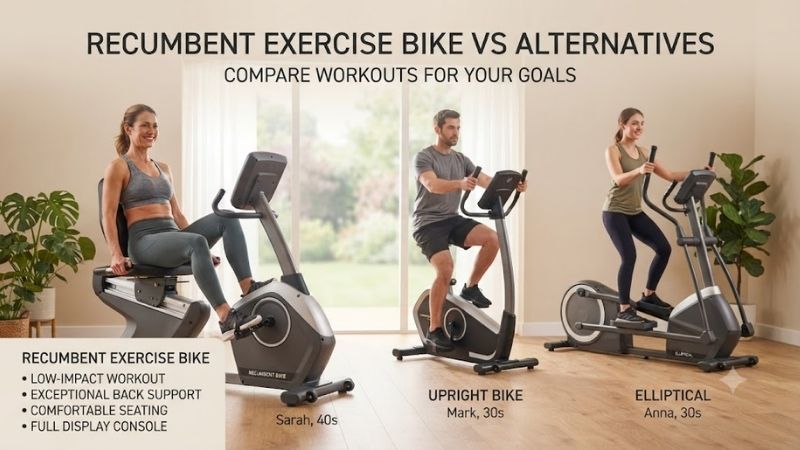
Recumbent Bike Geometry and Pedal Placement
A conventional recumbent exercise bike positions the rider behind the crank assembly. The legs extend forward during the pedaling cycle, while a backrest supports the torso.
This arrangement changes the relationship between the hips, knees, and pedals.
Because the seat supports the upper body, the rider generally does not need to lean forward toward handlebars to maintain their normal exercise position.
However, the backrest does not eliminate the need for proper alignment. If the seat is too close to the pedals, the knees may remain excessively bent. If the seat is too far away, the rider may reach with the legs or shift forward from the backrest.
Correct seat adjustment remains essential.
Recumbent bikes commonly use sliding seat rails, although the range and mechanism differ among products. A suitable model should accommodate the intended rider without forcing an unnatural pedaling position.
Upright Bike Geometry and Rider Support
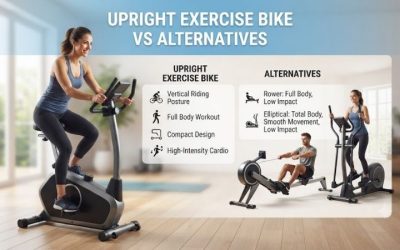
An upright exercise bike places the saddle above the crank area, creating a posture closer to ordinary bicycle riding.
The pedals rotate below the body rather than far in front of it.
The user generally maintains torso position through the saddle, handlebars, and postural muscles.
This arrangement can be comfortable for riders accustomed to upright cycling, but saddle selection and handlebar positioning matter.
A narrow saddle is not necessarily uncomfortable when matched to the rider. Likewise, a wide padded saddle is not automatically more supportive.
Rider fit depends on pelvic position, seat height, reach, and how body weight is distributed.
For buyers choosing between recumbent and upright bikes, posture preference is more useful than assuming one category is universally ergonomic.
Indoor Cycling Bike Geometry
Indoor cycling bikes often provide a more sport-oriented position.
The handlebars may be lower or farther forward, and the saddle commonly supports multiple adjustments.
This can accommodate users who want to simulate aspects of outdoor cycling.
Some indoor cycling machines also support standing pedaling and riding-position changes, but only when the manufacturer expressly permits those activities.
The additional adjustment options may be valuable to an experienced cyclist who has specific fit preferences.
However, the forward-leaning position may not appeal to someone seeking a relaxed, supported seated workout.
A recumbent bike is usually the more directly relevant category when integrated back support is essential.
Air Bike Mechanics
An air bike normally uses a fan flywheel connected to the pedals and, on many models, moving handlebars.
The fan produces aerodynamic resistance as it rotates.
Increasing pedaling or handle effort generally increases flywheel speed and resistance.
This differs from the selectable magnetic resistance commonly found in recumbent bikes.
Air bikes may also involve more upper-body participation because the handles can move through a coordinated pattern.
However, the amount of upper-body contribution depends on the machine and how it is used.
For someone who wants straightforward seated pedaling without moving handles, a recumbent bike may be simpler.
Folding Bike Geometry
Folding exercise bikes are designed around storage requirements.
Many use an X-frame arrangement that can change shape when folded.
Some advertise recumbent-style or semi-recumbent seating.
However, a semi-recumbent folding model should not automatically be treated as mechanically equivalent to a dedicated recumbent bike.
Its pedal position, backrest, seat adjustment, and overall frame geometry may differ considerably.
A buyer who requires a specific supported riding position should verify the actual seating arrangement instead of relying on marketing labels.
Recumbent Exercise Bike vs. Upright Bike
The recumbent-versus-upright decision is often primarily about posture, space, and preferred exercise experience.
Seating Comfort and Pressure Distribution
A recumbent bike generally uses a broad seat and a backrest. These distribute contact across different parts of the body than a conventional bicycle saddle.
For riders who dislike narrow saddles, this can be appealing.
However, a recumbent seat can still become uncomfortable if its contour, firmness, or dimensions do not match the person.
A wide seat may not suit everyone equally, and thick cushioning can sometimes create unwanted pressure distribution.
Upright bikes use narrower saddles because the rider’s posture and pelvic support differ.
The correct comparison should consider actual seat fit rather than judging comfort solely from photographs.
Choose recumbent if you strongly prefer an integrated backrest and chair-like support.
Choose upright if you are comfortable with a bicycle-style saddle and prefer a more conventional cycling position.
Back Support and Torso Position
A recumbent backrest supports the torso during pedaling.
This can reduce the need to maintain a forward-leaning cycling posture.
However, back support should not be confused with treatment for back pain or a guarantee that exercise will be comfortable for someone with a particular medical condition.
Individual symptoms, posture, and fitness matter.
An upright bike allows more variation in torso position, depending on handlebar design.
Some riders prefer this flexibility.
Others find a relatively stationary, supported torso more comfortable.
Neither arrangement is inherently medically superior.
Leg Extension and Joint Position
The different pedal positions influence how the hips and knees move through the cycling stroke.
Both machines should allow appropriate leg extension.
A useful general fitting principle is to avoid fully locking the knee at the farthest pedal position while maintaining stable body positioning.
However, the appropriate measurement and adjustment process depend on the manufacturer.
Recumbent bikes typically adjust the seat horizontally.
Upright bikes usually adjust the saddle vertically, sometimes with a fore-aft adjustment.
The best design is the one that accommodates the rider’s body proportions.
Entry and Exit Accessibility
A recumbent bike may include an open step-through frame.
This can make it easier for some users to approach the seat without lifting a leg over a high frame section.
The seat may also provide convenient handholds, depending on the design.
Upright bikes can require a different mounting movement because the saddle sits above the pedals.
However, the seat height and frame geometry vary.
A step-through recumbent model should not automatically be considered universally accessible.
If entry and exit are important, inspect seat height, handhold positioning, and the clearance around the frame.
Floor Space Requirements
Recumbent bikes are generally longer because the seat sits behind the pedal assembly.
An upright bike can often accommodate similar pedaling functionality within a shorter frame.
For a documented example, the Schwinn 290 recumbent bike measures approximately 66.4 inches long, 28 inches wide, and 47 inches high.
Its manufacturer lists an assembled weight of 107.6 pounds and a maximum user weight of 330 pounds.
Those dimensions show why a conventional recumbent machine needs meaningful permanent floor space.
They should not be generalized to every recumbent bike.
A buyer with a narrow home office may prefer an upright bike simply because a recumbent machine would block furniture or access routes.
Workout Intensity
Both types can support gentle or demanding cycling, depending on the model’s resistance capabilities and the rider’s effort.
A recumbent bike is not inherently limited to easy exercise.
Likewise, an upright bike is not automatically a high-intensity machine.
The resistance mechanism, workload range, and user effort determine training intensity.
For meaningful comparison, look at documented resistance capabilities rather than assuming that posture determines fitness results.
Recumbent Exercise Bike vs. Indoor Cycling Bike
Indoor cycling bikes are often marketed to people who enjoy cycling-style workouts, while recumbent bikes appeal to those seeking supported seated exercise.
Riding Style and Technique
Indoor cycling bikes generally place the rider in a posture that more closely resembles a road or studio cycling setup.
Some support different hand positions and standing intervals.
A recumbent bike keeps the rider supported in a seated position throughout normal use.
These differences affect how exercises can be performed.
A person who enjoys changing riding positions may find an indoor cycling bike more engaging.
Someone who wants to remain seated comfortably while watching television may prefer a recumbent model.
Resistance and Flywheel Behavior
Many indoor cycling bikes use magnetic or friction resistance.
Recumbent bikes commonly use magnetic resistance, although other arrangements are possible.
A heavy flywheel may influence pedaling inertia, but flywheel weight alone does not establish workout quality.
Drive ratio, frame geometry, braking design, and resistance control all matter.
Therefore, comparing a recumbent bike’s 25 resistance levels with another bike’s resistance settings is not a meaningful direct measurement.
Standing Pedaling
Some indoor cycling bikes are designed to accommodate standing pedaling.
This changes the forces applied to the machine and the user’s posture.
Recumbent bikes are not intended for standing cycling.
Buyers who specifically want standing intervals should select equipment designed for them.
Never attempt standing exercises on a bike whose manufacturer limits it to seated use.
Workout Data
Indoor cycling bikes may provide cadence, resistance settings, or power information.
Recumbent machines can also include advanced consoles.
For example, the Schwinn 590R lists 25 magnetic resistance levels, Bluetooth FTMS support, and compatibility with selected connected training applications.
Its stated power-measurement precision and app capabilities are model-specific. They do not establish that all recumbent bikes offer the same functionality.
Schwinn Global
A buyer interested in performance metrics should compare actual data compatibility, measurement methods, and whether an external device is required.
Who Should Choose Which?
Choose recumbent if the supported posture is central to the purchase.
Choose indoor cycling if the priority is cycling-style movement, adjustment flexibility, and potentially standing riding positions.
Avoid paying for an indoor cycling bike solely because it appears more athletic or challenging.
The equipment must match the actual workout you intend to perform.
Recumbent Exercise Bike vs. Air Bike
Air bikes offer an exercise experience that differs more substantially from a traditional recumbent machine.
Effort-Responsive Resistance
An air bike’s fan produces resistance that responds to flywheel speed.
The harder the user drives the system, the greater the aerodynamic drag generally becomes.
A conventional recumbent bike often allows selection of magnetic resistance levels.
That difference changes how the user controls workload.
An air bike may be appealing for intervals where intensity is varied through effort.
A recumbent bike may be preferable when repeatable resistance settings and a supported riding position are priorities.
Upper-Body Participation
Many air bikes include moving handles.
These can involve the arms and torso in addition to the legs.
A recumbent bike generally has stationary handles used for positioning or support.
Therefore, the air bike can offer a different movement pattern.
However, a moving-handle system does not automatically produce better training results.
The relevance of upper-body involvement depends on the user’s exercise goals.
Noise Differences
Air fans generate airflow sound.
The amount depends on flywheel speed and design.
A magnetic recumbent bike may avoid the characteristic fan noise, but belts, bearings, and other components still produce mechanical sound.
In an apartment, noise tolerance may favor a suitable magnetic recumbent bike.
However, the actual difference should be confirmed for the products being compared.
Space and Stability
Air bikes may require additional space around moving handles.
Recumbent bikes may be longer but usually have less moving upper-body equipment.
Which occupies more practical room depends on actual dimensions and operating clearance.
Which Is Better for Intervals?
Both can support interval training if the machines have suitable workload capabilities.
An air bike allows resistance to rise with effort.
A recumbent bike may support intervals by changing resistance settings or pedaling intensity.
The better choice depends on preferred movement, comfort, and resistance design.
Recumbent Exercise Bike vs. Folding Bike
Folding exercise bikes can be attractive for people who cannot dedicate permanent space to equipment.
Storage Convenience
A folding bike may reduce its depth or overall footprint when collapsed.
However, folded height and width still matter.
A machine that fits inside a closet when folded may nevertheless be difficult to maneuver through the door.
By contrast, conventional recumbent bikes usually remain assembled and occupy permanent floor space.
Riding Position Differences
Some folding bikes include a backrest and advertise semi-recumbent operation.
However, their pedal positions may differ from dedicated recumbent machines.
The resulting posture can feel more upright.
If a buyer specifically wants forward pedal placement and a broad supported seat, a folding semi-recumbent design may not meet expectations.
Frame Stability
Folding bikes contain hinges or other movable structural connections.
Those components must lock securely before use.
Folding capability does not necessarily mean poor stability, but the machine should be evaluated under its intended operating conditions.
Fit and Adjustment
Compact folding frames may provide limited adjustment travel.
A taller rider may struggle to achieve comfortable leg extension.
Shorter riders may also find some models unsuitable.
Check manufacturer height guidance and usable pedal-to-seat distance.
Daily Use
A fixed recumbent bike is ready for exercise once positioned.
A folding bike may require setup and storage after each session.
For frequent users, that difference can influence convenience.
The right choice depends on whether the space saved justifies the extra handling.
Resistance Systems Compared
Resistance type influences pedaling characteristics but does not define the entire machine.
Manual Magnetic Resistance
Manual magnetic systems generally allow resistance changes through a mechanical control.
They may be convenient for simple home workouts.
Electronically Controlled Magnetic Resistance
Electronic controls may support preset programs and connected training.
However, these features can require household power and additional electronics.
Friction Resistance
Friction systems create resistance through mechanical contact.
They may require contact-surface maintenance.
Air Resistance
Air systems respond dynamically to fan speed.
They can support varied effort but produce airflow sound.
Resistance-Level Counts
A larger number of levels does not necessarily mean higher maximum resistance.
For example, a recumbent bike offering 25 levels cannot be assumed to provide more workload than an unrelated bike advertising 16 levels.
The systems may use different scales.
Measuring Training Workload
Power measurement can provide more useful information when accuracy and methodology are documented.
However, consumer exercise-bike consoles vary.
Avoid treating displayed watts, distance, or calorie estimates from unrelated machines as directly equivalent.
Comfort, Ergonomics, and Rider Fit
Seat Adjustment Range
For a recumbent bike, horizontal seat adjustment is central to proper fit.
The seat should allow appropriate leg extension without hip movement or excessive reaching.
Backrest Geometry
Backrest angle, shape, ventilation, and cushioning affect comfort.
A large backrest is not automatically better if it does not align with the rider.
Seat Width
Seat width should accommodate the rider without interfering with normal leg movement.
Pedal Support
Pedals should provide secure foot placement.
Straps and pedal dimensions vary.
Multiple Household Users
Shared equipment needs a sufficient adjustment range for each user.
A simple, secure seat adjustment system may be more valuable than an advanced console.
Weight Capacity
Manufacturer weight ratings are operating limits.
They should not be treated as complete measures of construction quality.
Noise, Storage, and Home Placement
Mechanical Sound
Even a magnetic recumbent bike contains moving components.
Drive belts, bearings, and pedals may generate sound.
Floor Vibration
Repeated pedaling transfers some forces through the frame.
A suitable mat may protect flooring and reduce some vibration.
Transport Wheels
Many stationary bikes include transport wheels.
However, a heavy recumbent bike can remain difficult to move through narrow spaces.
Electrical Access
Some recumbent bikes require wall power.
Plan cable routing to avoid tripping hazards.
Operating Clearance
Leave sufficient room for entering and exiting the bike, adjusting the seat, and accessing surrounding furniture.
Long-Term Placement
A permanent exercise corner may be convenient, but the machine should not obstruct walkways, doors, or storage cabinets.
Maintenance and Long-Term Ownership
Magnetic Drive Maintenance
Check pedals, bearings, fasteners, and drivetrain components according to the manual.
Seat and Rail Maintenance
Sliding seat mechanisms should remain secure and operate as intended.
Console and Electronics
Electronic systems may require power supplies, sensors, or firmware support.
Upholstery and Backrests
Seat coverings and backrest materials should be cleaned according to manufacturer guidance.
Replacement Parts
Check the availability of pedals, seats, electronics, and drivetrain components.
Warranty Coverage
Review frame, mechanical parts, electronics, and labor separately where applicable.
The Schwinn 290, for example, specifies different warranty periods for these categories, illustrating why a single advertised warranty number can be misleading.
Choosing for Different Buyers
Beginners
A recumbent bike can be suitable when the user prefers supported seated exercise and simple controls.
However, proper fit remains essential.
Older Adults
Seat height, step-through access, stable handholds, and controls may matter.
A recumbent design may be worth considering, but suitability depends on individual capability.
Taller Riders
Long seat travel and appropriate leg extension are important.
Do not assume every recumbent model accommodates taller users.
Apartment Residents
Check noise, permanent footprint, electrical needs, and floor suitability.
Experienced Cyclists
A conventional upright or indoor cycling machine may offer riding geometry more closely aligned with sport-oriented cycling preferences.
People Sharing Equipment
Prioritize quick seat adjustment and a broad fit range.
How to Choose the Right Bike: Three Buying Scenarios
Scenario 1: A Dedicated Bedroom Exercise Corner
Suppose you have enough space for a 67-inch-long bike and want to pedal while watching television.
A recumbent machine may be a practical option if the seat is comfortable, the entry route is clear, and the room supports its full assembled footprint.
A folding bike would save storage space but might offer little benefit if the machine can remain permanently positioned.
The deciding factor is whether supported seating matters more than minimizing the footprint.
Scenario 2: A Multipurpose Home Office
If the machine must be removed after every workout, a folding bike or compact upright model may be more convenient.
A conventional recumbent bike could interfere with desk-chair movement or access to drawers.
In this situation, storage and movement requirements may outweigh the benefits of the wider supported seat.
Scenario 3: A Rider Who Wants Cycling-Style Workouts
If your priority is sport-oriented cycling with multiple riding positions, a dedicated indoor cycling bike may be more appropriate.
A recumbent bike still supports cardiovascular exercise, but it does not reproduce the same posture or standing-riding options.
Choose based on the movement you intend to perform, not solely on the amount of resistance advertised.
Frequently Asked Questions
Is a Recumbent Exercise Bike Better Than an Upright Bike?
Neither is universally better. Recumbent bikes provide integrated back support and forward pedal placement, while upright bikes offer a more conventional cycling posture and often a smaller footprint.
Can a Recumbent Bike Provide a Challenging Workout?
Yes, if the machine provides appropriate resistance and the rider applies sufficient effort. Workout intensity depends on the equipment and user, not simply the seating position.
Are Recumbent Bikes Suitable for Small Apartments?
Some are, but conventional models can be relatively long. Check assembled dimensions, access clearance, noise, and storage requirements before purchasing.
Is an Indoor Cycling Bike Better for Experienced Cyclists?
It may be preferable when the rider values sport-oriented geometry, handlebar adjustment, and supported riding-position changes. However, experience alone does not determine the best equipment.
Do Recumbent Bikes Require Electricity?
Some manually controlled machines operate without wall power for resistance. Electronically controlled models may require an outlet. Check the exact specifications.
Are Recumbent Bikes Easier to Maintain Than Air Bikes?
Maintenance depends on the model. Magnetic recumbent bikes may avoid fan-related cleaning, while air bikes have their own drivetrain and resistance-system requirements. Neither category is maintenance-free.
Conclusion
When comparing a recumbent exercise bike vs alternatives, supported seating and riding comfort are the strongest reasons to choose a recumbent design. Upright bikes offer a more compact cycling position, indoor cycling bikes favor sport-oriented workouts, air bikes provide effort-responsive movement, and folding bikes improve storage flexibility. Prioritize rider fit, resistance capabilities, and operating space before buying.


Write Your Review
No reviews yet. Be the first to share your experience!