
Key takeaways
-
Choose a folding rower when storage space is limited and the folding process is safe and convenient.
-
Choose a fixed-frame rower when you have permanent workout space and prefer not to handle folding mechanisms.
-
Choose a separable rower when you want a conventional rowing frame but can store the machine in multiple sections.
-
Choose an upright-storage rower when there is sufficient vertical clearance and the manufacturer approves that storage orientation.
-
Choose a compact hydraulic rower when a full-length rowing machine cannot fit during operation, provided the different movement mechanics meet your expectations.
Choosing between a foldable rowing machine vs alternatives depends on both storage space and the quality of the rowing experience. Folding frames can free valuable floor area, but they also introduce hinges, locking mechanisms, and setup requirements. This comparison explains when folding makes sense and when fixed-frame, separable, or upright-storage rowers may be better choices.
Quick Verdict: Is a Foldable Rowing Machine Worth Buying?
A foldable rowing machine is designed to reduce its storage dimensions when not in use.
This can be valuable for people living in apartments, small houses, or multipurpose rooms where a permanent rowing machine would interfere with daily activities.
However, folding does not necessarily reduce the floor area required during exercise.
A rower may occupy substantial length when assembled but become significantly shorter or taller when stored.
The most important buying question is not whether a machine folds.
It is whether the specific storage design solves a real space problem without creating unacceptable compromises in stability, comfort, durability, or convenience.
Other rowing machines use alternative storage methods.
Some separate into components without tools. Others are designed for upright storage. Certain compact hydraulic rowers use shorter frames and may not require folding at all.
The practical recommendations are:
-
Choose a folding rower when storage space is limited and the folding process is safe and convenient.
-
Choose a fixed-frame rower when you have permanent workout space and prefer not to handle folding mechanisms.
-
Choose a separable rower when you want a conventional rowing frame but can store the machine in multiple sections.
-
Choose an upright-storage rower when there is sufficient vertical clearance and the manufacturer approves that storage orientation.
-
Choose a compact hydraulic rower when a full-length rowing machine cannot fit during operation, provided the different movement mechanics meet your expectations.
Storage convenience should not come at the expense of correct rowing position or secure frame construction.
Quick Comparison Table
| Configuration | Operating space | Storage method | Main advantage | Main trade-off |
|---|---|---|---|---|
| Folding rower | Usually full rowing length | Hinged frame or rail | Reduced stored footprint | Hinges and locks require attention |
| Fixed-frame rower | Full rowing length | Remains assembled | Consistent setup | Permanent floor space |
| Separable rower | Full rowing length | Frame divides into sections | Storage without a folding hinge | Components must be handled |
| Upright-storage rower | Full rowing length | Approved vertical position | Small stored floor footprint | Height and tipping considerations |
| Compact hydraulic rower | Model-dependent | Often compact as assembled | Potentially shorter overall frame | Different stroke mechanics |
Understanding Foldable Rowing Machine Designs
The word foldable can describe several distinct mechanisms.
These differences affect usability, structural design, and storage convenience.
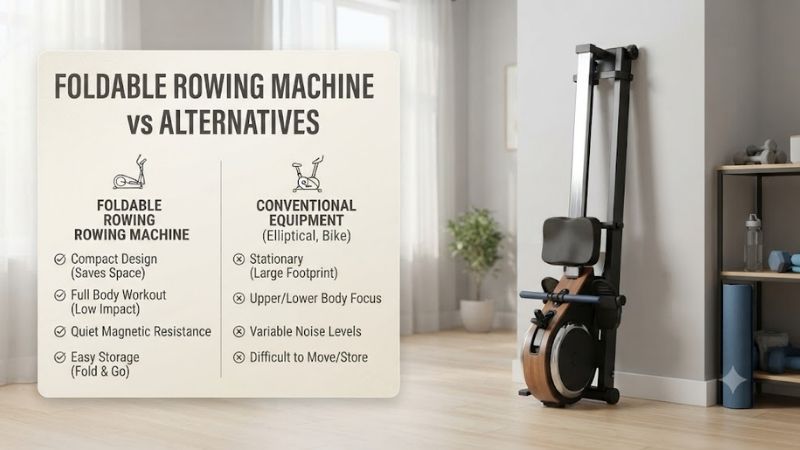
Hinged-Rail Folding Rowers
Some rowing machines have a hinged rail that folds upward.
The seat rail may become nearly vertical while the resistance assembly remains near the floor.
This can significantly reduce stored length.
However, the folding joint is part of the machine’s structure.
Its alignment and locking system must be maintained according to the manufacturer’s instructions.
A folding rail should not move or flex abnormally during rowing.
Folding Frame Machines
Other machines use more elaborate folding arrangements.
These may allow sections of the frame to collapse or rotate.
The storage configuration can be compact, but the mechanism may involve several locks or adjustment points.
More folding joints are not automatically a disadvantage.
However, they increase the number of components that must function correctly.
Buyers should evaluate ease of operation and safety rather than choosing the most complicated mechanism.
Separable Rowers
A separable machine divides into sections for storage.
The Concept2 RowErg is a documented example.
Its frame can separate into two pieces without tools.
This differs mechanically from folding a continuous rail around a hinge.
The advantage is that the sections can be stored in a compact arrangement.
The trade-off is that the user must handle and reconnect separate components.
For someone who exercises every day, repeated separation may be inconvenient.
Upright-Storage Rowers
Some rowing machines are designed to stand vertically during storage.
This can reduce the required floor footprint dramatically.
However, it increases the importance of ceiling height and storage stability.
Not every rowing machine is approved for upright storage.
The manufacturer must specifically support the intended orientation.
Compact Nonfolding Rowers
Some compact rowing machines are short enough that folding is unnecessary.
Hydraulic designs are a common example.
However, their operating movement may differ from traditional sliding-seat ergometers.
A short frame is only beneficial if the exercise mechanics remain appropriate for the user.
Operating Footprint vs. Storage Footprint
A common buying mistake is evaluating only the folded dimensions.
Why Full-Length Operating Space Matters
During rowing, the seat moves along the rail while the user’s legs extend and bend.
The handle also travels through a repeated motion.
The machine must provide enough space for the entire stroke.
A rower that stores compactly may still require eight feet or more of usable length.
Measuring the Exercise Area
Start with the complete assembled dimensions.
Next, account for the manufacturer’s recommended operating clearance.
This includes access to the seat, handle movement, and safe entry and exit.
Avoid placing the machine tightly between furniture.
Measuring the Storage Area
Measure the folded or separated dimensions independently.
Consider width, depth, and height.
A machine that folds upward may require more vertical clearance than expected.
Ceiling Height
A tall folded machine may not fit beneath shelving or a low ceiling.
Check whether the frame can be folded in the intended location without striking overhead objects.
Doorways and Hallways
Some machines must be moved between rooms.
Measure the complete route.
A folded rower may still be wide or awkward to maneuver.
Example: Concept2 RowErg
The standard Concept2 RowErg measures approximately 96 × 24 inches when assembled.
Its manufacturer recommends an exercise space around 9 × 4 feet.
When separated for storage, the standard-leg configuration occupies approximately 25 × 33 × 54 inches.
This illustrates how storage dimensions can differ substantially from operating dimensions.
However, the machine still requires its full exercise area whenever used.
Folding Mechanisms and Frame Stability
Folding convenience is worthwhile only when the machine remains structurally secure during exercise.
Hinges and Structural Connections
Folding mechanisms introduce joints between frame sections.
These joints transmit exercise forces when the machine is assembled.
A correctly designed hinge should operate within the manufacturer’s intended limits.
However, poor assembly, damage, or loose hardware can create problems.
Locking Pins and Latches
Many folding machines use locking pins, latches, or similar mechanisms.
These must be engaged before rowing.
Do not assume that a rail is secure merely because it appears aligned.
Follow the complete locking procedure.
Frame Flex
All structures can deform slightly under load.
The important question is whether movement remains within the machine’s intended operating characteristics.
Unexpected twisting, rocking, or hinge movement requires attention.
Resistance Unit Stability
The resistance assembly must remain secure.
Its weight distribution can influence the machine’s stability during storage and operation.
Seat Rail Alignment
A folding joint may affect rail alignment if damaged or incorrectly locked.
A poorly aligned rail can influence seat movement.
Inspect the mechanism if the seat begins catching or moving unevenly.
Maximum User Weight
The manufacturer’s user weight rating applies under specified conditions.
Never exceed the limit.
A high rating does not automatically establish superior hinge quality.
Foldable vs. Fixed-Frame Rowing Machines
The main advantage of a fixed-frame rower is that it remains ready for use.
Convenience During Daily Workouts
A fixed machine eliminates unfolding and locking procedures.
This can make regular use more convenient.
A folding machine may require several preparation steps.
The significance of those steps depends on how frequently the equipment is used.
Mechanical Complexity
Fixed frames may avoid some folding joints.
However, a fixed machine can still contain many moving components.
The absence of hinges does not automatically guarantee greater durability.
Storage Space
A fixed rower generally needs permanent room unless it supports another approved storage method.
A folding model can free floor space between sessions.
Purchase Price
Folding does not necessarily make a machine more expensive.
Prices depend on construction, resistance, electronics, and product positioning.
Best Use Cases
A fixed-frame rower may suit a dedicated home gym.
A folding machine may be preferable in a studio apartment or shared living room.
Foldable vs. Separable Rowing Machines
Separable designs offer an alternative way to reduce storage size.
Storage Mechanics
A folding machine rotates connected sections.
A separable machine disconnects components.
The correct system depends on available space and handling preferences.
Setup Time and Convenience
Both systems require preparation.
A folding model may involve unlocking, rotating, and securing the frame.
A separable model requires joining sections correctly.
Neither is always faster or more convenient.
Component Handling
A separated rower has multiple pieces that must be stored securely.
These can be awkward to carry.
A folding rower remains one connected unit but may be relatively heavy.
Structural Considerations
Both designs require secure connections.
Neither storage mechanism should be assumed superior without evaluating the specific engineering.
Long-Term Durability
Wear may occur at folding joints or separable connections.
Inspection and maintenance matter.
Which Should You Choose?
Choose based on the actual storage location and the safest, most manageable setup process.
Foldable vs. Upright-Storage Rowers
Upright storage is another common space-saving approach.
Floor Space Savings
An approved vertically stored rower may occupy relatively little floor area.
However, the stored height can be substantial.
Water Rower Example
The WaterRower Original has an in-use length of approximately 82 inches.
Its documented stored configuration is about 17.25 inches deep and 81.5 inches high.
The model supports upright storage without draining the tank when used according to manufacturer instructions.
This can be practical for homes with sufficient ceiling height.
Storage Stability
Vertical storage requires a stable, manufacturer-approved position.
Improvised storage can create tipping hazards.
Weight Distribution
A filled water rower may be heavy.
The WaterRower Original weighs approximately 100.5 pounds when filled to 17 liters, according to its published specifications.
That is important when evaluating the ease of moving the machine.
Safety Around Children and Pets
Stored equipment should not be accessible in a way that creates a tipping or entrapment hazard.
Follow the manufacturer’s guidance.
Choosing Between Folding and Upright Storage
A folding model may suit low storage spaces if its folded height permits.
An upright rower may be appropriate where vertical clearance is generous but floor space is limited.
Foldable Magnetic vs. Air vs. Water Rowers
The folding mechanism and resistance system are separate design characteristics.
Folding Magnetic Rowers
Magnetic rowers may combine foldable rails with selectable resistance.
They can be attractive for apartment use.
However, magnetic resistance does not guarantee quiet operation or suitable maximum workload.
Folding Air Rowers
Some air rowers offer folding or separable frames.
They can be useful for performance-oriented users who need flexible storage.
Fan noise and operating length remain considerations.
Folding Water Rowers
Some water-rowing designs provide folding or alternative storage configurations.
However, tank orientation and handling requirements vary.
Never assume a water-filled machine can be folded or rotated freely.
Hydraulic Designs
Some hydraulic rowers are compact without conventional folding rails.
These can be practical in restricted areas but may use different movement mechanics.
Choosing Resistance Separately
First identify the resistance system appropriate for the intended workout.
Then determine which available storage configuration best fits the room.
Selecting folding capability first may lead to a machine that stores well but feels unsuitable during exercise.
Comfort and Rider Fit
Storage convenience does not replace the importance of proper rowing geometry.
Rail Travel
A rail must accommodate the rider’s leg extension.
Taller users should check inseam compatibility.
Seat Height
Seat height influences entry and exit.
A low seat may be acceptable for some users but inconvenient for others.
Foot Placement
Foot stretchers should support suitable positioning.
Check adjustment options.
Handle Reach
The user should be able to complete the rowing stroke without awkward reaching.
Seat Comfort
Padding, seat contour, and roller movement influence comfort.
A thick cushion is not automatically superior.
Shared Household Use
If several people will use the rower, ensure the adjustment range accommodates everyone.
Noise and Apartment Compatibility
Resistance Noise
Air systems create fan sound.
Water systems produce water movement sound.
Magnetic systems may avoid some of these sounds but still generate mechanical noise.
Folding Joint Noise
Loose or damaged folding connections can create unwanted sounds.
Inspect the locking mechanism.
Seat Rollers
Seat rollers and rail contact can generate noise.
Cleaning and maintenance may help.
Floor Vibration
Rowing transfers movement forces into the floor.
A suitable mat may protect the surface and reduce some vibration.
Shared Housing
Consider neighboring rooms and building conditions.
A foldable rower is not inherently quieter than a fixed machine.
Maintenance and Ownership
Folding Lock Inspection
Check all locks before exercise.
Hinge Maintenance
Follow the manufacturer’s inspection and lubrication requirements.
Resistance-System Maintenance
Air, magnetic, water, and hydraulic systems have different needs.
Rail and Seat Care
Keep the rail clean and inspect seat components.
Storage-Related Wear
Repeated moving, folding, or separating can place wear on connections.
Replacement Parts
Check whether hinges, locks, rollers, and other components are serviceable.
Warranty
Review whether folding mechanisms receive the same coverage as other structural components.
Choosing a Foldable Rower for Your Budget
Budget Folding Rowers
Basic folding machines can be attractive for limited-space households.
However, inspect the frame mechanism and user fit carefully.
Midrange Machines
Midrange equipment may offer improved resistance controls, more convenient storage, or stronger monitoring.
Premium Machines
Higher-priced machines may include connected workouts, sophisticated resistance, or specialized frame designs.
Additional Costs
Consider equipment mats, subscriptions, and replacement components.
Long-Term Value
A durable, easy-to-store machine may justify a higher purchase price if its convenience supports regular use.
However, folding equipment is poor value when its rowing mechanics do not meet the user’s needs.
Buying for Specific Living Situations
Studio Apartments
Folding may be essential where the exercise area serves several purposes.
Measure the complete room layout.
Bedrooms
Check furniture access and folded height.
Do not block doors or walkways.
Living Rooms
A machine that stores compactly may preserve usable living space.
Consider appearance and movement convenience.
Home Offices
A folding rower can be stored after exercise.
However, the unfolded machine must not interfere with office furniture.
Garages
A garage may accommodate a fixed-frame rower, making folding less important.
Frequent Users
Daily users should consider whether repeated folding becomes inconvenient.
How to Evaluate Storage Convenience Before Buying
Identify the Permanent Storage Location
Determine exactly where the machine will be kept.
Measure the Complete Folded Shape
Include handles, wheels, and protruding components.
Check Movement Route
Confirm that the machine can be transported safely between storage and exercise locations.
Review the Folding Procedure
Determine how many steps are involved and whether lifting is required.
Consider Machine Weight
A compact folded shape may still be heavy.
Verify Storage Stability
Use only approved orientations.
Think About Daily Routine
A convenient storage system should make regular workouts easier rather than creating unnecessary effort.
Frequently Asked Questions
Are Foldable Rowing Machines Less Stable Than Fixed Rowers?
Not necessarily. Stability depends on frame design, locking mechanisms, assembly, and operating conditions. Folding capability alone does not establish instability.
Do Foldable Rowers Save Space During Exercise?
Usually not. They still require enough room for the complete rowing stroke. Their main advantage is reduced storage dimensions.
Is Folding Better Than Upright Storage?
Neither is universally better. Folding can suit some storage spaces, while upright storage may be useful when vertical clearance is available.
Can Air Rowers Be Folded?
Some air rowers have folding or separable storage arrangements. The Concept2 RowErg, for example, separates into two pieces rather than folding around a conventional hinge.
Are Foldable Magnetic Rowers Good for Apartments?
They can be, provided the resistance system, sound characteristics, fit, and operating dimensions suit the apartment.
How Do You Maintain a Folding Mechanism?
Follow the manufacturer’s instructions for inspecting hinges, pins, locks, and structural connections. Never operate a machine with an insecure folding joint.
Conclusion
When comparing a foldable rowing machine vs alternatives, storage convenience should be weighed against stability, rowing comfort, setup effort, and long-term durability. A folding rower is often practical for multipurpose rooms, while fixed-frame, separable, and upright-storage machines may offer better solutions for other layouts. Choose the design that fits both the complete workout area and the actual storage space.


Write Your Review
No reviews yet. Be the first to share your experience!