
Choosing a water rowing machine vs alternatives requires understanding how fluid resistance differs from air, magnetic, and hydraulic systems. A water rower offers a distinctive pulling sensation and sound, but it also introduces tank maintenance and storage considerations. This comparison helps you evaluate performance, practicality, and long-term ownership before buying.
Quick Verdict: Is a Water Rowing Machine Better Than Other Rowers?
A water rowing machine uses a tank containing water and a rotating paddle or related mechanism to create resistance. As the user pulls the handle, the drivetrain moves the paddles through the water, producing a load that depends on the interaction between the moving mechanism and the fluid.
This design can offer a smooth, continuous rowing sensation. Many buyers also appreciate the audible movement of water and the appearance of wooden-frame machines.
However, water resistance is not automatically superior to air, magnetic, or hydraulic resistance.
Air rowers offer effort-responsive flywheel loading and, in selected models, highly developed workout tracking systems. Magnetic rowers provide convenient resistance adjustments and may suit households sensitive to mechanical noise. Hydraulic rowers sometimes offer compact, budget-oriented designs, although their movement patterns and operating characteristics vary.
For most buyers, the decision should reflect how the machine will actually be used.
Choose a water rower when fluid resistance, the experience of rowing, and design aesthetics are priorities.
Choose an air rower when performance tracking, structured intervals, and repeatable training data are especially important.
Choose a magnetic rower when selectable resistance, electronic control, or relatively quiet operation matters more.
Choose a hydraulic rower only after confirming that its movement mechanism, stability, and operating limits meet your needs.
Quick Comparison Table
| Criteria | Water rower | Air rower | Magnetic rower | Hydraulic rower |
|---|---|---|---|---|
| Resistance | Paddles move through water | Fan rotates through air | Magnetic braking | Hydraulic cylinders |
| Response to effort | Dynamic, design-dependent | Dynamic, effort-responsive | Depends on selected setting and drivetrain | Temperature- and mechanism-dependent |
| Main sound | Moving water | Airflow | Drivetrain and mechanical components | Cylinders and joints |
| Adjustable resistance | Water volume and model-specific features | Damper and pulling effort | Commonly selectable settings | Model-dependent |
| Water maintenance | Yes | No | No | No tank maintenance |
| Electrical requirements | Often none for resistance | Often none for resistance | Varies | Often none |
| Storage | Upright on approved designs | Separation or other model-specific methods | Folding or upright on selected models | Compact configurations possible |
| Performance data | Depends on monitoring system | Strong on certain established ergometers | Varies widely | Frequently limited |
| Ideal buyer | Fluid-resistance preference | Structured performance training | Controlled indoor workouts | Space- or budget-focused use |
These differences describe broad categories. Specific model construction and measurement systems determine actual performance.
How Water Rowing Machines Work
Understanding the resistance mechanism is essential because water rowers are often promoted using descriptions such as natural, realistic, and self-adjusting.
Those descriptions have some mechanical basis, but they should not replace an explanation of how the system operates.
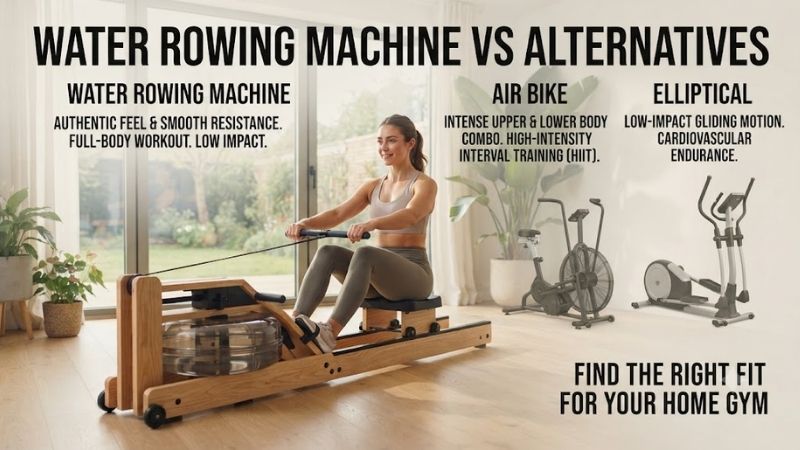
Water Flywheel Mechanics
A conventional water rower contains paddles attached to a rotating assembly inside a water-filled tank.
When the user pulls the handle, force travels through the drivetrain and turns the paddles.
The water resists their movement, creating the workload felt at the handle.
The amount of force depends on paddle geometry, rotational speed, tank configuration, water behavior, and the overall drivetrain.
The system does not work like lifting a fixed weight.
Instead, resistance changes during the movement as the rotating assembly interacts with the water.
This distinction helps explain why water rowers can accommodate a range of exercise intensities without requiring a conventional resistance selector.
Why Pulling Harder Changes Resistance
As the paddles move faster through the water, they encounter greater fluid resistance.
The exact relationship depends on the mechanism and flow conditions.
Consequently, stronger strokes generally require the user to overcome greater resistance.
This is similar in broad principle to air-resistance systems, although the fluid, mechanism, and detailed resistance behavior differ.
A water rower can therefore support gentle and demanding workouts without necessarily changing the tank’s water volume.
This is important because beginners sometimes assume they must increase water level every time they want a harder workout.
That is not how most conventional water-resistance systems are intended to be adjusted during ordinary sessions.
What Water Level Actually Changes
Water level can affect the behavior of a water-resistance machine.
However, manufacturers may provide specific filling ranges, reference markings, and instructions for choosing water volume.
Changing the water level may influence inertia and resistance characteristics, but it should not be treated as adding a standardized number of pounds of load.
A tank containing more water does not simply turn the rower into a weight machine.
For a WaterRower Original, follow the manufacturer’s specified filling instructions and recommended limits.
Adding excessive water can create operating and maintenance problems.
Is Water Resistance More Realistic?
A water rower uses fluid resistance, which creates a meaningful mechanical connection to rowing through water.
However, a stationary rowing machine does not reproduce every aspect of moving a boat.
On-water rowing involves blade entry, water interaction, hull acceleration, balance, and changing environmental conditions.
A water tank captures only some aspects of fluid loading.
Therefore, a water rower may feel enjoyable or intuitive without being universally more mechanically accurate than an air ergometer.
The suitability of the movement should be judged through its resistance behavior, stroke geometry, and intended training use.
Water Rowing Machine vs. Air Rower
Water and air rowers are often compared because both use fluid resistance rather than a conventional fixed resistance selector.
However, their mechanisms create important differences.
Resistance Response
Air rowers use fan blades moving through air.
Water rowers use paddles moving through water.
Both generally respond to increases in pulling effort, but the specific resistance curves depend on machine design.
The user should not assume that an air rower and water rower with similar handles and rails require identical force throughout the stroke.
Flywheel inertia, paddle geometry, transmission design, and monitor calculations influence the experience.
For general cardiovascular workouts, either design can be suitable.
For structured performance comparisons, the measurement system may be more important than subjective resistance feel.
Performance Tracking and Workout Data
The Concept2 RowErg illustrates the potential advantage of an established air-ergometer monitoring system.
Its PM5 monitor records rowing metrics within a defined performance ecosystem.
This is useful for athletes who want to repeat sessions, compare training results, or participate in workouts based on standardized equipment.
Water rowers can also provide meaningful workout data.
The WaterRower Original, for example, offers connected performance technology, including compatible S4 monitoring configurations.
However, values from different rowing systems should not automatically be compared as equivalent.
Distance, power, and pace may be calculated differently.
A buyer who wants to compare training results with other people should determine which equipment and monitoring system those comparisons use.
Resistance Adjustment
Some air rowers have adjustable dampers.
These control airflow characteristics rather than adding a fixed resistance weight.
Water rowers may permit changes to water volume, but this is generally less convenient as an exercise-to-exercise adjustment than turning a damper.
The user can still control workout intensity through pulling effort on either machine.
For frequent interval sessions, resistance responsiveness and monitor functionality are likely more relevant than how often the user changes a damper or tank level.
Noise Differences
An air rower produces airflow noise.
A water rower produces water movement sound.
These sounds have different characteristics, but subjective preferences vary.
A person may enjoy the water sound and find the air fan distracting.
Someone else may prefer the consistent mechanical character of an air rower.
Neither is inherently silent.
Seat rollers, chains, belts, and frame components also contribute to the complete sound experience.
For apartment use, examine actual model-specific sound information instead of relying on broad claims.
Maintenance
Air rowers generally require drivetrain and flywheel maintenance according to the manufacturer.
Water rowers require similar mechanical care plus water-tank maintenance.
Tank care may involve approved purification treatments, water changes under specified conditions, and inspection of seals.
For a buyer who wants to minimize fluid-related maintenance, the air rower may be more convenient.
For someone willing to follow tank-care instructions, the additional tasks may be acceptable.
Who Should Choose Water Over Air?
A water rower makes sense when you strongly prefer the fluid-resistance sensation, appreciate the sound, and are comfortable maintaining a tank.
An air rower may be more suitable when repeatable performance data, established training benchmarks, and mechanically straightforward resistance changes take priority.
Neither is universally better for cardiovascular exercise.
Water Rowing Machine vs. Magnetic Rower
The comparison between water and magnetic rowing machines is often most relevant to people equipping an apartment or living room.
Dynamic vs. Selectable Resistance
Water resistance responds naturally to paddle movement.
Magnetic machines commonly provide selectable resistance settings.
This creates different ways to manage exercise intensity.
On a water rower, the user controls much of the workload by changing the force and speed of the rowing stroke.
On a magnetic machine, the user may also adjust the resistance mechanism directly through a dial or electronic control.
Neither approach guarantees a better workout.
The buyer should consider whether they prefer effort-driven resistance or explicit settings.
Smoothness of the Rowing Stroke
Water machines are often described as smooth because the paddles interact continuously with fluid.
However, magnetic machines can also provide smooth movement when properly engineered.
Actual smoothness depends on drivetrain design, flywheel inertia, handle connection, and manufacturing quality.
A resistance-system label alone cannot prove which machine is smoother.
A useful comparison would examine the force behavior during the drive and recovery phases under equivalent conditions.
Without such measurements, general claims that one system always feels better should be treated cautiously.
Noise in Shared Living Spaces
Magnetic systems often avoid the pronounced fan noise of air rowers and the water movement sound of tank-based machines.
However, this does not make all magnetic rowers silent.
Seat rollers, belts, pulleys, and frame connections remain sources of sound.
The practical question is whether the complete machine operates at an acceptable noise level in the intended home.
If quietness is a primary buying criterion, evaluate the specific model rather than choosing solely by resistance type.
Maintenance and Convenience
Magnetic rowers eliminate the need for water treatment.
This may simplify ownership.
However, electronically controlled magnetic machines can introduce components such as power adapters, sensors, and control boards.
A manually adjusted magnetic rower may have different maintenance requirements from an electronic model.
A water rower has a tank, but its resistance system may not require electricity.
The better choice depends on which tasks and potential service needs the user prefers.
Which Is Better for Longer Sessions?
Either machine can support longer workouts if it is designed and rated for the intended use.
Seat comfort, rail length, resistance characteristics, and user fit all matter.
A comfortable water rower may be preferable to a poorly designed magnetic rower.
Likewise, a well-built magnetic machine can be more suitable than a water rower with an incompatible seat or rail.
The resistance type is only one factor in sustained comfort.
Water Rowing Machine vs. Hydraulic Rower
Hydraulic rowing machines differ from water rowers more substantially than their names might suggest.
Rowing Movement
Water rowers commonly use a central handle and sliding seat.
Some hydraulic rowers use independent arms.
This can change the rowing motion.
A buyer wanting a conventional central-handle rowing stroke may prefer the water rower.
A buyer with restricted room dimensions may find a compact hydraulic design more practical.
Resistance Characteristics
Water resistance responds to the paddles moving through fluid.
Hydraulic resistance depends on cylinder operation.
The hydraulic mechanism may respond to changes in temperature and stroke speed.
Some models specify continuous operating limits.
Water rowers also have maintenance needs, but their operating restrictions are different.
Storage and Footprint
A compact hydraulic machine may be easier to store than a full-length water rower.
However, certain hydraulic designs require additional side clearance for moving arms.
Conversely, some water rowers permit upright storage.
A direct comparison requires actual use and storage dimensions.
Long-Term Service
Water rowers may require tank care and replacement of mechanical components.
Hydraulic machines may require cylinder or pivot maintenance.
Service availability varies widely.
The initial price should be considered alongside replacement-part support.
Water Rower Design, Construction, and Durability
Water rowing machines vary considerably in frame materials and structural arrangements.
Wooden Frames
Some water rowers use hardwood construction.
WaterRower’s Original series includes solid-wood frame designs.
These may be appealing in homes where exercise equipment remains visible.
However, wooden construction requires appropriate care.
The finish should be maintained according to manufacturer instructions, and the frame should not be exposed to unsuitable environmental conditions.
The mere presence of hardwood does not establish structural superiority.
Metal Frames
Other water rowers use steel, aluminum, or combinations of materials.
Metal construction may support different designs and adjustment mechanisms.
However, frame quality depends on engineering, joints, manufacturing, and intended loading.
Material choice should be one comparison criterion rather than the sole deciding factor.
Tank Construction
The tank is a critical component because it contains the resistance medium.
Its material, seals, and assembly influence long-term reliability.
Check the manufacturer’s filling and maintenance instructions.
Avoid placing the tank where it could be struck by heavy objects.
Handle and Drivetrain
The connection between the handle and resistance system may use a belt, strap, or another transmission mechanism.
These components should be inspected for wear.
A smooth resistance mechanism cannot compensate for an uncomfortable handle or poorly functioning drivetrain.
Seat and Rail
Seat movement is central to rowing comfort.
Rail geometry, seat height, roller design, and maximum travel determine whether the machine accommodates different body dimensions.
Tall users should confirm inseam compatibility.
A machine that fits the room but not the rider is not a suitable purchase.
Space Requirements and Upright Storage
Water rowers can be attractive for small homes when they support safe vertical storage.
However, operating and stored dimensions are different.
Real-World Dimensions
The WaterRower Original is approximately 82 inches long, 22.25 inches wide, and 20 inches high during use.
Its documented upright storage configuration is approximately 17.25 inches deep, 22.25 inches wide, and 81.5 inches high.
The manufacturer recommends an exercise area of approximately 8.5 × 3.5 feet.
This illustrates the difference between a relatively narrow machine and the larger area needed for full rowing movement.
Storage With Water in the Tank
Certain WaterRower configurations support vertical storage without draining the tank.
However, this should never be generalized to all water rowing machines.
The tank and frame must be designed for the approved storage orientation.
Improvised vertical storage can create tipping or leakage risks.
Filled vs. Empty Machine Weight
A water rower becomes heavier when filled.
For the WaterRower Original, the manufacturer specifies approximately 63.5 pounds dry and 100.5 pounds when filled to 17 liters.
This difference matters when repositioning the equipment.
A person may find the dry machine manageable but struggle with the filled configuration.
Transport wheels and manufacturer-approved handling procedures can make movement easier.
Ceiling Height and Storage Safety
Upright storage requires sufficient ceiling clearance.
The machine must also remain in a safe location away from obstacles.
If there are children or pets in the home, tipping prevention deserves particular attention.
Follow the exact manufacturer’s instructions.
Comparing Water and Air Storage
The Concept2 RowErg can separate into two pieces for storage.
The WaterRower Original supports an upright configuration.
These are different storage strategies.
One may be more convenient than the other depending on room layout, ceiling height, and how often the machine is used.
Performance Tracking and Training Applications
Performance tracking is especially important for buyers who want objective training progress.
Stroke Rate
Stroke rate records the frequency of rowing strokes.
It can help users maintain consistent cadence.
However, the displayed stroke rate should be interpreted with the machine’s other data.
Pace and Distance
Stationary rowing machines calculate simulated distance.
This is not physical travel through water.
Different manufacturers may use different methods.
Therefore, matching distance values across unrelated machines do not necessarily represent identical work.
Power Measurement
Some rowing monitors estimate or measure power using flywheel behavior or additional sensors.
The accuracy depends on the system.
Advanced performance features may be valuable for structured workouts.
However, claims of precise power measurement should be supported by appropriate documentation.
Connected Workouts
Water rowing systems may support connected applications.
Compatibility depends on monitor configuration.
The WaterRower Original is offered with different performance technology options, which illustrates why buyers must check the exact purchased configuration.
Do not assume all models include the same console or connectivity.
Subscription Requirements
Some connected rowing ecosystems offer premium training services.
These may require ongoing payments.
Before buying, determine which functions are available without a subscription.
Noise, Floor Protection, and Apartment Use
Water Sound
Water movement produces a distinctive sound.
Its character changes with rowing effort and tank design.
Some users find it enjoyable; others prefer quieter mechanical operation.
Seat and Rail Noise
Seat rollers can contribute to operating sound.
Maintenance and construction influence this noise.
Floor Vibration
Rowing transfers forces through the frame into the floor.
Use a suitable surface and follow placement instructions.
A compatible equipment mat may help protect flooring.
Shared Housing
Consider the location of neighboring rooms and any relevant building restrictions.
Even equipment perceived as quiet can transmit vibration.
Choosing for Noise Sensitivity
A magnetic rower may be preferable for buyers seeking to avoid water and fan sounds.
However, model-specific evidence is necessary before claiming one machine is objectively quieter.
Maintenance and Total Ownership Cost
Water Treatment
Follow approved water-treatment procedures.
Do not add arbitrary chemicals to the tank.
Tank Cleaning
Use the manufacturer’s instructions for cleaning and filling.
Improper maintenance can affect water condition and components.
Seals and Leaks
Inspect the tank for damage or leakage.
Stop using equipment with significant tank problems until repaired.
Drivetrain Maintenance
Belts, straps, rollers, and pulleys may require inspection.
Frame Care
Wooden and metal frames have different care requirements.
Follow the manufacturer’s guidance.
Replacement Parts
Serviceable parts can support longer ownership.
Check availability before purchase.
Overall Cost
Account for the machine, optional monitor, accessories, maintenance supplies, and potential software subscriptions.
A lower-priced product with limited support may not provide better long-term value.
Choosing a Water Rower for Different Buyers
Choose Water for the Fluid-Resistance Experience
Buyers who value a fluid-based pulling feel may prefer a water rower.
The audible water movement can also influence preference.
Choose Air for Established Training Metrics
An air rower may be preferable when comparable performance data and structured workouts are especially important.
Choose Magnetic for Simple Resistance Adjustment
Magnetic equipment may suit users who want explicit settings and relatively restrained operating noise.
Choose Hydraulic for Particular Space Constraints
A compact hydraulic rower may be practical when a conventional long rail cannot fit.
However, verify movement geometry and operating restrictions.
Choose Based on Fit Before Appearance
A beautiful water rower is a poor purchase if its rail travel is inadequate or its seat is uncomfortable.
Always prioritize usable dimensions and body compatibility.
Frequently Asked Questions
Are Water Rowers Better Than Air Rowers?
Neither is universally better. Water rowers offer fluid-based resistance and a characteristic sound, while air rowers can provide effort-responsive training with established performance monitoring systems. The best choice depends on your priorities.
Are Water Rowing Machines Quieter Than Magnetic Rowers?
Not necessarily. Water rowers produce water movement sound, while magnetic machines can produce mechanical noise. Direct acoustic comparisons require consistent test conditions.
Does Adding More Water Increase Resistance?
Water level can change resistance characteristics, but it does not function like adding a fixed resistance weight. Follow the manufacturer’s fill guidelines.
Can You Store a Water Rower Upright?
Certain models support upright storage, including the WaterRower Original. Always verify the exact machine’s approved storage orientation and safety requirements.
How Often Does Water Need to Be Changed?
Maintenance intervals depend on tank conditions, water treatment, and manufacturer guidance. Follow the instructions for the exact model rather than relying on a universal schedule.
Are Water Rowers Suitable for Beginners?
They can be. Beginners should prioritize suitable rowing technique, manageable effort, seat comfort, and a machine that fits their body dimensions.
Conclusion
When comparing a water rowing machine vs alternatives, the strongest reasons to choose water are its fluid-resistance characteristics, distinctive sound, and certain home-friendly frame and storage designs. Air rowers may better suit performance-focused users, magnetic machines offer convenient resistance settings, and hydraulic options can solve particular space constraints. Choose the resistance system that matches your training priorities and maintenance preferences rather than assuming water is inherently superior.







Write Your Review
No reviews yet. Be the first to share your experience!