
Key takeaways
-
A suitable seat-travel range.
-
A stable frame and secure footplates.
-
A properly designed water tank and impeller.
-
Clear filling and water-treatment instructions.
-
Comfortable handle movement and seat operation.
-
An appropriate maximum user-weight rating.
-
Practical storage options.
-
Accessible replacement parts and warranty support.
A water rowing machine offers naturally responsive resistance and a distinctive rowing experience, but choosing the right model requires more than comparing water tanks and prices. This water rowing machine buying guide explains how resistance works, what specifications matter, how different frames affect ownership, and which features are worth paying for.
Quick Verdict: What Makes a Good Water Rower?
A good water rowing machine should provide comfortable rowing geometry, predictable water resistance, stable construction, adequate user-weight capacity, and reliable workout monitoring.
For most home users, the essential features are:
-
A suitable seat-travel range.
-
A stable frame and secure footplates.
-
A properly designed water tank and impeller.
-
Clear filling and water-treatment instructions.
-
Comfortable handle movement and seat operation.
-
An appropriate maximum user-weight rating.
-
Practical storage options.
-
Accessible replacement parts and warranty support.
Premium screens, hardwood finishes, and connected training platforms can improve the ownership experience, but they do not replace these fundamentals.
How Water Rowing Resistance Works
The Water Tank and Impeller
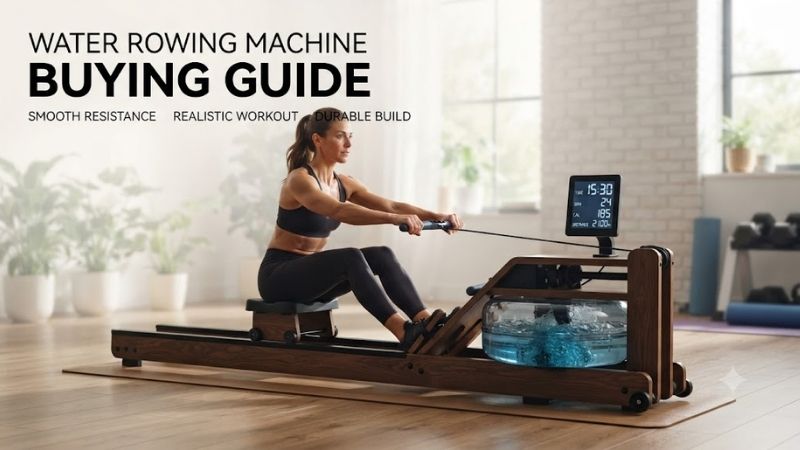
Water rowing machines use an impeller rotating inside a sealed or enclosed water tank.
Pulling the handle transfers force through the drive mechanism, accelerating the impeller against the surrounding water.
The movement of water produces drag, which resists the rotation.
The exact resistance characteristics depend on the tank geometry, impeller design, water quantity, and mechanical transmission.
Why Resistance Changes With Effort
Unlike a traditional weight stack, a water rower’s resistance is not necessarily fixed at one selected load.
When the user drives the handle harder and accelerates the impeller, the water produces greater resistance.
This allows the same machine to accommodate relatively easy strokes and demanding efforts.
However, resistance does not increase according to one identical curve across every water rower.
Different designs behave differently.
Understanding Water Levels
Many manufacturers provide water-fill markings.
Water quantity can influence the resistance characteristics and the perceived rowing feel.
However, a higher water level does not automatically mean the machine produces universally superior exercise resistance.
Never exceed the manufacturer’s approved filling range.
Can You Adjust Resistance During a Workout?
On conventional water-only rowers, resistance is primarily controlled by rowing effort.
Changing water level is not usually a convenient mid-workout adjustment method.
Some hybrid machines add magnetic resistance, allowing additional mechanical adjustment.
Buyers who frequently need selectable resistance changes should consider whether a hybrid water-magnetic system better meets their needs.
Water Versus Magnetic Versus Air Rowing Machines
| Feature | Water Rower | Magnetic Rower | Air Rower |
|---|---|---|---|
| Main resistance mechanism | Impeller moving through water | Magnetic braking | Fan moving air |
| Resistance behavior | Responds to stroke effort | Depends on braking settings and speed | Responds to fan speed and effort |
| Common adjustment | Water fill or effort | Manual or electronic control | Airflow damper or effort |
| Typical sound | Audible water movement | Relatively quiet resistance system | Fan noise |
| Maintenance | Water care and mechanical checks | Mechanical and electrical checks | Fan and drive maintenance |
| Best suited to | Traditional fluid-resistance preference | Quiet home training and controlled adjustment | Performance-focused training and intervals |
These are general category differences. Individual machine designs can vary substantially.
Water Tank Design: What Really Matters?
Tank Construction
The tank must remain securely attached to the machine and resist normal operating loads.
Inspect the manufacturer’s stated materials, maintenance instructions, warranty, and replacement-part support.
A visually impressive tank does not automatically establish better durability.
Impeller Geometry
The impeller moves through water and contributes to the resistance profile.
Different impeller designs create different fluid movement patterns.
Without comparable independent measurements, buyers should not assume that one tank shape necessarily generates more resistance than another.
Tank Position
Many traditional water rowers position the tank near the front of the frame.
Other designs use different arrangements.
Tank placement can influence frame geometry, foot position, maintenance access, and storage.
Filling and Draining
A good water rower should include a clear filling procedure and approved accessories where required.
Check how water is added and removed.
This matters especially if the machine will be moved frequently or stored for extended periods.
Wooden Versus Metal Water Rowing Machines
Hardwood Construction
Wooden water rowers often use oak, cherry, or other hardwood frames.
They appeal to buyers who want exercise equipment that resembles furniture.
However, wood must be maintained according to the manufacturer’s environmental and cleaning guidelines.
Avoid exposing it to excessive moisture or conditions that may damage the finish.
Steel Frames
Steel provides substantial structural strength when properly designed.
However, steel-frame machines vary in construction, weight, and corrosion protection.
A steel frame alone does not guarantee commercial suitability.
Aluminum Frames
Aluminum can provide relatively lightweight structural components.
Its suitability depends on cross-section design, joints, manufacturing quality, and rated loading.
Do not assume that aluminum is automatically less durable than steel or hardwood.
Which Material Is Best?
Choose based on the manufacturer’s rated capacity, frame construction, storage method, dimensions, serviceability, and personal preference.
Frame appearance should not take priority over safe operation.
Rail Length and Rowing Geometry
Why Rail Length Matters
During the rowing stroke, the seat travels along the rail as the legs extend.
A machine must provide enough travel for comfortable body movement.
A short rail may restrict a taller user’s stroke.
Inseam Accommodation
Many manufacturers provide supported inseam guidelines.
These can be more useful than total height alone.
Check the measurement method and whether the published limit applies to the exact model.
Seat Height
A low seat can make mounting and dismounting difficult for some users.
A higher seat may improve convenience, but comfort and stability must still be assessed.
Footplate Adjustment
Footplates should keep the feet secure while allowing appropriate ankle movement.
Adjustable straps and positions help accommodate different footwear.
Handle Position
The handle should allow comfortable extension at the catch and controlled movement toward the lower torso during the drive.
A machine with awkward handle geometry may be difficult to use comfortably.
Seat Comfort and Frame Stability
Seat Construction
A rowing seat should support controlled sliding movement.
Seat shape, padding, and rail alignment influence comfort.
An overly soft seat is not automatically preferable because it may change how pressure is distributed.
Single-Rail and Dual-Rail Systems
Water rowers may use one central rail or two parallel rails.
Both designs can work well when properly engineered.
The important factors are alignment, stability, smooth travel, and maintenance access.
Weight Capacity
The maximum user-weight rating must accommodate the intended user.
Do not exceed the published limit.
Frame Movement
The machine should remain stable on a level surface.
If the frame rocks or shifts unexpectedly, check floor leveling and assembly according to the manufacturer.
Workout Monitoring and Data Quality
Basic Metrics
Most water rowers provide some combination of time, stroke count, stroke rate, distance estimates, and workout intensity information.
These can help organize recreational training.
Understanding Distance Estimates
Indoor-rowing distance is generally calculated by the monitor rather than measured as actual travel through water.
Different machines use different formulas.
This means two water rowers may display different distances for similar physical effort.
Pace and Power
Some monitors calculate 500-meter split and power estimates.
These figures are useful for comparing workouts on the same machine.
However, cross-brand comparisons require evidence that measurement methods are compatible.
Heart-Rate Integration
Some monitors support compatible heart-rate sensors.
This can help users organize workouts based on heart-rate zones.
Check whether the machine supports Bluetooth, ANT+, or another wireless protocol.
Connected Workout Systems
Premium rowers may include interactive classes, games, and training programs.
These can make exercise more engaging for some users.
However, software subscriptions, display support, and long-term compatibility should be evaluated before purchase.
Traditional Versus Connected Water Rowers
Traditional Models
A conventional water rower focuses on the mechanical resistance system and basic monitoring.
It is attractive for people who enjoy independent workouts and want fewer software dependencies.
Connected Models
A connected water rower may use a large integrated screen, structured programs, and recorded training history.
This can improve convenience for users who prefer guided exercise.
Membership Costs
Some connected features require an active membership.
Evaluate the cost of ownership over several years rather than considering only the equipment price.
Software Longevity
Electronic displays and workout applications may depend on software support.
Before purchasing, check which functions remain available without internet access or a subscription.
Water Rowing Machine Storage
Horizontal Storage
A water rower can remain assembled horizontally when sufficient permanent space is available.
This avoids repeated repositioning.
Vertical Storage
Many traditional models support approved upright storage.
However, not all machines can be stored this way.
Follow the exact manufacturer’s storage instructions.
Folding Models
Some water rowers fold at the rail or frame.
This changes the storage dimensions but introduces additional locking mechanisms.
Moving Filled Equipment
Water increases machine weight.
Check whether the manufacturer recommends moving the equipment with water in the tank or draining it first.
Water Rowing Machine Maintenance
Water Treatment
Tank water may require purification or other approved maintenance.
Use only the treatment methods recommended by the manufacturer.
Cleaning the Tank
Some manufacturers provide procedures for draining and cleaning the tank.
Do not disassemble sealed components unless the manual permits it.
Inspecting for Leaks
Check for water around tank connections and seals.
If a leak is found, discontinue use until the issue is addressed.
Drive Mechanism Maintenance
Handle straps, pulleys, belts, and retraction mechanisms should be inspected periodically.
Look for fraying, abnormal movement, or unusual sounds.
Seat and Rail Maintenance
Keep the rail clean according to manufacturer instructions.
Check rollers and seat movement for smooth operation.
Wood and Metal Frame Care
Use the approved cleaning products for the frame material.
Avoid harsh chemicals or excessive moisture where prohibited.
Choosing a Water Rower for Different Users
| Buyer | Priority Features | Main Concern |
|---|---|---|
| Beginner | Comfortable geometry, simple monitor | Avoiding unnecessary complexity |
| Tall user | Long rail and verified inseam accommodation | Restricted stroke travel |
| Apartment resident | Stable footprint, approved upright storage | Sound and vibration |
| Frequent exerciser | Reliable drive and accessible parts | Long-term wear |
| Connected training user | Screen and app compatibility | Membership and software support |
| Budget-conscious buyer | Basic tank mechanism and warranty | Overall ownership cost |
| Shared household | Seat accommodation and rated capacity | Fit for multiple users |
Common Buying Mistakes
Choosing by Appearance Alone
A hardwood rower can look attractive, but it still needs adequate rail length, stable construction, and reliable tank operation.
Assuming More Water Always Means Better Resistance
Stay within the approved fill range and understand the manufacturer’s resistance design.
Ignoring Tank Maintenance
Water treatment and periodic inspection are part of ownership.
Comparing Different Monitors as Identical
Cross-brand pace and distance readings may use different calculations.
Overlooking Operating Space
A machine that stores vertically may still require over six feet of floor length during exercise.
Assuming Connected Workouts Are Necessary
Many users can train effectively with a basic monitor.
Frequently Asked Questions
Is a Water Rowing Machine Good for Beginners?
Yes. Water resistance responds to exercise effort, allowing users to begin with controlled strokes.
Are Water Rowers Better Than Magnetic Rowers?
Water rowers provide effort-responsive fluid resistance and a distinctive sound. Magnetic models generally offer easier resistance adjustment and quieter operation.
How Often Should You Change the Water?
Follow the manufacturer’s specific treatment and maintenance schedule. There is no universal replacement interval suitable for every machine.
Do Water Rowing Machines Need Electricity?
The mechanical water-resistance system does not normally require electricity, but connected consoles and screens may.
Can You Use a Water Rower Every Day?
Regular exercise can be appropriate when training load, technique, and recovery are managed sensibly.
How Long Does a Water Rower Last?
Durability depends on frame construction, usage, maintenance, and replacement-part availability. A specific lifespan should not be assumed without evidence.
Conclusion
The right water rowing machine should combine comfortable rail travel, stable construction, responsive resistance, practical monitoring, and manageable maintenance. Prioritize tank quality, body fit, storage options, manufacturer support, and total ownership cost before paying extra for premium materials or connected training features.





Write Your Review
No reviews yet. Be the first to share your experience!