
Key takeaways
- Confusing 1-inch and 2-inch plates. Standard plates with 1-inch holes do not fit directly onto Olympic 2-inch sleeves, and Olympic plates are too large for a 1-inch standard bar.
- Assuming every 7-foot bar fits every rack. Measure your rack’s hook spacing and compare it with the bar’s distance between inner collars.
- Measuring only the bar length. You need clearance to walk around it, load plates, and safely handle the bar during lifts.
- Ignoring loaded width. Plates, collars, and storage location can make a narrow room feel much tighter than the bare 84-inch bar suggests.
- Using a shorter bar for rack exercises without checking first. A 60-inch bar may not extend far enough past the uprights to rest safely on a full-size rack.
- Buying for maximum capacity without checking the whole setup. The bench, rack, flooring, collars, and plates must all support the intended load—not just the bar.
What's inside
The Short Answer
A “standard” home-gym barbell usually has 1-inch-diameter sleeves for standard weight plates, not the 2-inch sleeves used by Olympic barbells. The most common standard barbell lengths are 5 feet (60 inches), 6 feet (72 inches), and 7 feet (84 inches). Shaft diameter is typically about 1 inch, although the usable grip area can vary slightly by brand and finish.
For most full-size home gyms, a 7-foot standard bar gives the most familiar bench press, squat, and deadlift setup. A 5- or 6-foot bar is more practical for smaller rooms, apartment gyms, and beginner lifting. Before buying, check three measurements: the bar’s overall length, the width between its inner collars, and the diameter of the plates you already own.
As an Amazon Associate we earn from qualifying purchases at no extra cost to you. Product prices and availability are accurate as of the date shown and are subject to change.


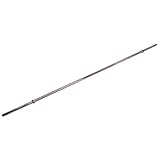
In 2026, standard 1-inch barbells remain a budget-friendly choice for general strength training, especially when paired with cast-iron or vinyl-coated 1-inch-hole plates. They are not automatically interchangeable with Olympic 2-inch plates.
Standard Sizes
There is no single regulated dimension for every standard barbell, so measurements differ somewhat among manufacturers. The sizes below reflect common retail dimensions for straight 1-inch standard bars. Always compare the listed sleeve diameter and usable load length with the plates and rack you plan to use.
| Bar Type | Overall Length | Overall Length | Typical Sleeve Diameter | Typical Bar Weight | Best For |
|---|---|---|---|---|---|
| Compact standard bar | 48 in. | 122 cm | 1 in. / 25.4 mm | 10–12 lb. | Curls, rows, compact training areas |
| 5-foot standard bar | 60 in. | 152 cm | 1 in. / 25.4 mm | 12–15 lb. | Small home gyms and beginner training |
| 6-foot standard bar | 72 in. | 183 cm | 1 in. / 25.4 mm | 14–17 lb. | General lifting in medium-size rooms |
| 7-foot standard bar | 84 in. | 213 cm | 1 in. / 25.4 mm | 15–20 lb. | Bench press, squats, deadlifts, rack work |
| Olympic barbell for comparison | 86–87 in. | 218–221 cm | 2 in. / 50 mm sleeves | 33–45 lb. | Olympic plates and heavier barbell training |
A standard bar’s listed “1-inch diameter” normally refers to the sleeves where the plates slide on. The center shaft may be close to 1 inch as well, but a bar with threaded ends, spin-lock collars, or a thick chrome finish can measure slightly differently. If your plates have a 1-inch center hole, choose a 1-inch standard bar. If the plates have a 2-inch center hole, you need an Olympic bar or an appropriate adapter system.
Typical entry-level standard bars have a stated capacity around 200 to 300 pounds, including the bar’s own weight. That can be sufficient for light-to-moderate bench presses, rows, curls, and beginner squats. Capacity is not standardized, however. A 7-foot chrome bar may be rated for 300 pounds, while another 7-foot bar with similar dimensions may be intended for less. Follow the manufacturer’s stated limit, inspect collars and threads before each workout, and avoid dropping a standard barbell.
How to Measure Your Space
- Measure the clear wall-to-wall width. Use a tape measure at floor level and note the narrowest point, including door trim, radiators, storage cabinets, and posts. For an 84-inch bar, aim for at least 108 inches (9 feet) of clear width so you have about 12 inches of clearance beyond each end.
- Measure the workout zone, not just the room. A barbell needs room to be loaded, lifted, and set down. For a 7-foot bar, a practical open floor area is at least 9 feet wide by 7 feet deep. More space is better if you will deadlift or use a bench.
- Check rack dimensions. Measure the outside width and the J-hook-to-J-hook span on your squat stand or power rack. The bar’s inner collar spacing must sit securely on the hooks. A 5-foot bar can be too narrow for many full-width racks.
- Allow room for plates and collars. Weight plates add width at both ends. A pair of 10-inch-diameter plates does not make the bar longer, but you still need side clearance to load and remove them safely.
- Measure ceiling height for overhead work. For standing presses, add your height, arm reach, and the thickness of the plates. A room with an 8-foot ceiling may be restrictive for tall users performing overhead lifts.
- Plan the storage position. A vertical storage tube needs ceiling clearance greater than the bar length. An 84-inch bar requires more than 7 feet of vertical clearance; horizontal wall storage needs a clear span at least as long as the bar.
By Room or Use Case
Small Apartment, Spare Bedroom, or Multipurpose Room
A 5-foot (60-inch) standard bar is often the easiest fit when floor space is limited. It works well for floor presses, bent-over rows, curls, Romanian deadlifts, and light bench pressing. Expect a usable training area of roughly 7 feet wide by 6 feet deep. The tradeoff is rack compatibility: many standard squat racks and wide bench stands are designed around a 7-foot bar, so verify the distance between the rack hooks before ordering.
A typical 5-foot or basic 6-foot standard bar commonly costs about $18 to $30. This size makes sense when portability and compact storage matter more than maximum loading capacity.
Dedicated Home Gym
Choose a 7-foot (84-inch) standard bar if you have a dedicated workout room and want the closest standard-plate equivalent to a traditional full-length lifting bar. Its wider grip area and longer sleeve layout are more comfortable for squats, bench presses, deadlifts, and standing presses. It is also more likely than a shorter bar to work with a conventional squat stand or bench rack.
Plan for a minimum 9-foot-wide training area, with 10 feet or more being more comfortable. Basic 7-foot chrome standard bars generally fall around $35 to $65, depending on finish, knurling, threaded versus smooth sleeves, and included collars. A low price does not mean the bar is unsuitable, but it does make it especially important to check its stated weight capacity and collar design.
General Strength Training Without a Rack
A 6-foot (72-inch) bar is a useful middle ground for home lifters doing rows, curls, lunges, floor presses, hip thrusts, and deadlifts from the floor. It takes up 12 inches less width than a 7-foot bar while still feeling substantially more stable than a compact 5-foot model. Allow about 8 feet of clear width for comfortable plate changes and movement around the bar.
For this use, prioritize a secure collar system and a textured grip. Diamond knurling can improve hold during rows and deadlifts, but aggressive knurling may feel uncomfortable for high-repetition work without gloves.
Beginner or Light-Weight Training
For users starting with modest loads, the bar’s empty weight matters. Many standard bars weigh 12 to 20 pounds rather than the 45 pounds associated with a men’s Olympic bar. That makes load progression easier: adding two 5-pound plates to a 15-pound bar creates a 25-pound total, a manageable starting point for many exercises.
Do not choose based on length alone. A lighter 5-foot bar may be ideal for controlled training, but it should not be treated as a substitute for a heavier-duty bar if your lifting numbers are approaching its listed capacity.
Common Sizing Mistakes
- Confusing 1-inch and 2-inch plates. Standard plates with 1-inch holes do not fit directly onto Olympic 2-inch sleeves, and Olympic plates are too large for a 1-inch standard bar.
- Assuming every 7-foot bar fits every rack. Measure your rack’s hook spacing and compare it with the bar’s distance between inner collars.
- Measuring only the bar length. You need clearance to walk around it, load plates, and safely handle the bar during lifts.
- Ignoring loaded width. Plates, collars, and storage location can make a narrow room feel much tighter than the bare 84-inch bar suggests.
- Using a shorter bar for rack exercises without checking first. A 60-inch bar may not extend far enough past the uprights to rest safely on a full-size rack.
- Buying for maximum capacity without checking the whole setup. The bench, rack, flooring, collars, and plates must all support the intended load—not just the bar.
FAQ
What is the standard barbell length?
For 1-inch standard home-gym barbells, common lengths are 60 inches, 72 inches, and 84 inches. The 84-inch, or 7-foot, size is the closest match to a full-length gym barbell, although it still uses smaller 1-inch sleeves rather than Olympic 2-inch sleeves.
What is the standard barbell diameter?
A standard barbell typically has 1-inch-diameter sleeves, or about 25.4 mm, designed for 1-inch-hole weight plates. Olympic barbells use 2-inch, or 50 mm, sleeves. Check the sleeve diameter rather than relying only on the word “standard” in a listing.
Will a 5-foot barbell fit a standard squat rack?
Not always. Some compact squat stands accommodate a 5-foot bar, but many full-size racks require a longer 6- or 7-foot bar. Measure the rack’s outside width and hook spacing, then compare those numbers with the bar’s inner-collar measurement before purchase.
How much room do I need for a 7-foot barbell?
For an 84-inch bar, allow at least 108 inches, or 9 feet, of clear width. A 9-by-7-foot open training area is a workable minimum for many home gyms, while 10 feet of width provides more comfortable clearance for loading plates and moving around the bar.


Write Your Review
No reviews yet. Be the first to share your experience!