
Key takeaways
- Measuring only the rack footprint: The cage may fit, but the bar, bench, plates, and walking paths may not.
- Ignoring ceiling obstructions: Fans, lights, beams, and garage hardware can make a seemingly suitable rack unusable.
- Forgetting plate-loading space: Weight pegs and cable stations need clearance for your hands and for plates that may be 14 to 18 inches in diameter.
- Buying by exterior dimensions alone: A cable crossover, rear stabilizer, or low-row attachment may extend beyond the advertised cage depth.
- Leaving no emergency path: Keep at least one clear route out of the training area and do not place the rack where a failed lift could trap you against a wall.
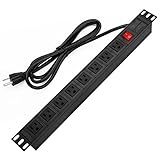
- Confusing a power accessory with a power rack: A rack-mount power strip or tool-storage organizer does not provide lifting support. Use only equipment designed and rated for barbell training.
- Skipping anchoring requirements: Tall racks and heavily loaded systems may need floor or wall anchoring. Check the manufacturer’s instructions before installation.
What's inside
The Short Answer
Most home power racks need about 4 feet wide by 4 to 5 feet deep for the rack itself, plus additional clearance for a barbell, plates, and safe movement. A practical minimum training area is approximately 8 feet wide by 8 feet deep. Full-height racks are usually 80 to 86 inches tall, so a room should have at least 90 inches of ceiling height for comfortable installation and use.
If you are buying a rack with a cable crossover, dual pulley system, weight storage, or multiple attachments, plan on a larger footprint. These systems commonly need 5 to 6 feet of width and 5 to 6 feet of depth, while the usable training area may extend to 10 feet wide by 10 feet deep.
As an Amazon Associate we earn from qualifying purchases at no extra cost to you. Product prices and availability are accurate as of the date shown and are subject to change.



The rack’s listed dimensions are only the starting point. You also need room to load plates, walk around the uprights, lift a barbell without hitting walls, and keep benches or other equipment from creating trip hazards. For a comfortable home gym setup in 2026, more space is better than squeezing a large rack into a small corner.
Standard Sizes
Power rack dimensions vary by brand and attachment package, but most residential models fall into a few predictable size categories. The width usually describes the distance across the front uprights. Depth describes how far the rack extends from front to back, not the complete room needed for lifting.
| Rack type | Typical rack dimensions | Typical room or training area | Best for |
|---|---|---|---|
| Compact power rack | 48–50 in. W × 40–48 in. D × 80–84 in. H (122–127 cm W × 102–122 cm D × 203–213 cm H) |
7 × 7 ft minimum (213 × 213 cm) |
Small rooms and basic barbell training |
| Standard full power rack | 48–52 in. W × 48–55 in. D × 82–86 in. H (122–132 cm W × 122–140 cm D × 208–218 cm H) |
8 × 8 ft recommended (244 × 244 cm) |
Squats, bench presses, pull-ups, and general strength work |
| Half rack | 48–52 in. W × 30–36 in. D × 80–84 in. H (122–132 cm W × 76–91 cm D × 203–213 cm H) |
7 × 6 ft minimum (213 × 183 cm) |
Open layouts and users who need front access |
| Rack with cable crossover | 52–60 in. W × 55–65 in. D × 82–86 in. H (132–152 cm W × 140–165 cm D × 208–218 cm H) |
9 × 9 ft or larger (274 × 274 cm) |
Full-body workouts and multiple users |
Width is especially important if you plan to use a standard Olympic barbell, which is typically 86.6 inches long (220 cm). A rack that is 48 inches wide can fit in a narrow room, but the bar extends far beyond both sides. Leave at least 12 to 18 inches of unobstructed space at each end of the bar. More clearance is preferable near doors, windows, shelves, and other equipment.
Depth also changes depending on how you lift. A rack that is 48 inches deep may work for squats, but a bench inside the rack, plates on storage pegs, or a spotter platform can add several inches. Cable attachments often project beyond the rear of the cage, and weight stacks may require space for their full range of motion.
Ceiling height is another frequent limitation. A pull-up bar mounted at the top of an 84-inch rack may leave little room for your head, hands, or ceiling fan. For comfortable pull-ups, kipping-free bodyweight work, and installation, aim for at least 12 inches of clearance above the highest rack component. A 96-inch ceiling is generally much more comfortable than an 84-inch ceiling.
How to Measure Your Space
- Measure the room’s usable width and depth. Measure between walls, but subtract space occupied by doors, baseboards, radiators, shelves, and permanent furniture. Use the smallest measurement if walls are uneven.
- Measure ceiling height in several places. Check beneath beams, light fixtures, ceiling fans, garage-door tracks, and ductwork. The lowest obstruction determines the maximum rack height.
- Record the rack’s assembled dimensions. Do not rely only on the shipping-box size. Look for the manufacturer’s width, depth, and height after assembly, including pull-up bars and rear stabilizers.
- Add access space. Leave roughly 24 inches behind or beside the rack for walking and adjustment. If you load plates from the side, allow at least 18 to 24 inches next to each storage peg.
- Map the barbell. Place an imaginary 86.6-inch bar across the rack and check both ends. Keep the bar away from walls, glass, shelving, and door swings.
- Account for the bench. A flat or adjustable bench can extend 48 to 55 inches inside the rack. Include room to move the bench in and out, especially if you also perform deadlifts or floor exercises.
- Plan for flooring. Rubber tiles or a lifting platform can raise the rack slightly and may change door clearance. A basic rubber floor is usually 8 to 12 millimeters thick, while a platform can be 1.5 to 3 inches thick.
- Check delivery access. Measure stairs, hallway turns, elevators, and door openings. Many racks arrive in several boxes, and a long upright may require more clearance than the assembled footprint suggests.
By Room or Use Case
Garage gym
A garage is often the easiest place for a power rack because it offers high ceilings and open floor space. A standard rack works well in an area at least 8 by 8 feet. Before buying, check the garage door tracks and opener. A tall rack may fit beneath the ceiling but interfere with the door when it opens.
For a cable crossover or a rack with extensive attachments, reserve approximately 10 by 10 feet. Keep the rack far enough from the parked car that an open door cannot strike the uprights. In an unheated garage, use rust-resistant hardware and protect the floor from moisture.
Basement
Basements often have enough floor area but limited ceiling height. If the ceiling is below 90 inches, choose a short rack measuring 72 to 80 inches tall. A low rack can still support squats and bench presses, but pull-up clearance may be limited.
Measure around ductwork and support posts, not just the finished ceiling. A rack placed near a low beam can make bar positioning awkward even when the main ceiling is high enough. A half rack may also make it easier to preserve walking space in a basement gym.
Spare bedroom
For a bedroom or multipurpose room, a compact rack measuring approximately 48 inches wide by 40 to 48 inches deep is usually the easiest fit. Plan for an 8-by-8-foot workout zone if you want to squat, bench, and move freely.
Consider noise and vibration. A rubber mat can protect the floor, but it will not eliminate sound from dropped weights. Avoid blocking closets, windows, heating vents, and the room’s only exit.
Small apartment or corner gym
A half rack or wall-mounted rack can reduce depth to roughly 18 to 36 inches, depending on the design. However, wall-mounted models require suitable studs, masonry, or structural reinforcement. The folded or stored depth is not the same as the operating depth.
For an apartment, prioritize a rack with adjustable height, compact plate storage, and a controlled lifting area. Avoid assuming that a lower-priced rack is automatically smaller; some full cages with cable systems cost roughly $350 to $650 and occupy more space than their product photos suggest.
Common Sizing Mistakes
- Measuring only the rack footprint: The cage may fit, but the bar, bench, plates, and walking paths may not.
- Ignoring ceiling obstructions: Fans, lights, beams, and garage hardware can make a seemingly suitable rack unusable.
- Forgetting plate-loading space: Weight pegs and cable stations need clearance for your hands and for plates that may be 14 to 18 inches in diameter.
- Buying by exterior dimensions alone: A cable crossover, rear stabilizer, or low-row attachment may extend beyond the advertised cage depth.
- Leaving no emergency path: Keep at least one clear route out of the training area and do not place the rack where a failed lift could trap you against a wall.
- Confusing a power accessory with a power rack: A rack-mount power strip or tool-storage organizer does not provide lifting support. Use only equipment designed and rated for barbell training.
- Skipping anchoring requirements: Tall racks and heavily loaded systems may need floor or wall anchoring. Check the manufacturer’s instructions before installation.
FAQ
Can a power rack fit in a 7-by-7-foot room?
Yes, a compact rack or half rack can fit, but the setup will be tight. Choose a rack no wider than about 50 inches and no deeper than 40 to 48 inches. Confirm that the bar ends, bench, and plate storage do not interfere with walls. An 8-by-8-foot area is more practical for regular training.
How much ceiling height do I need for a power rack?
Measure the rack’s highest point and add at least 12 inches. For an 84-inch rack, a 96-inch ceiling is ideal. If your ceiling is only 84 to 90 inches high, select a short rack and check whether the pull-up bar can be used without contacting lights or the ceiling.
How much space is needed around a power rack?
Leave at least 12 to 18 inches at each end of the bar and approximately 24 inches for walking or plate loading where possible. A standard rack may occupy about 4 by 5 feet, but a safe and comfortable training zone is usually 8 by 8 feet or larger.
Do cable attachments require more room?
Usually. A crossover or dual-pulley system can add 6 to 12 inches of width or depth, while cable handles require open space for their full travel. For a rack with cables, plan on at least a 9-by-9-foot training area and verify the exact assembled dimensions before ordering.


Write Your Review
No reviews yet. Be the first to share your experience!