
Key takeaways
- Pro: Seventeen pulley positions give meaningful variety without switching machines.
- Pro: Includes dedicated attachments for pulldowns and seated rows out of the box.
- Con: The cable crossover function is secondary; flyes feel less fluid than on dedicated crossover arms.
What's inside
Most people who search for the best functional trainer machines already know they want cables and pulleys in their home gym. What they discover on the first week of use is that cable quality, pulley ratio, and weight-stack mechanics vary wildly from one unit to the next. A machine that feels smooth during lat pulldowns can bind on high pulleys when the cable routing is poorly designed, and a unit with a single fixed pulley angle will limit your exercise library more than you expect.
Over the past several months we compared eight machines ranging from under two hundred dollars to over twenty-five hundred dollars. The gap between them is not just build quality but engineering intent: whether the designer solved for a garage ceiling height, whether the pulleys swivel independently, and whether the frame tolerates lateral force without flexing. This guide ranks them all so you can match your budget, ceiling clearance, and training style to the right machine.
As an Amazon Associate we earn from qualifying purchases at no extra cost to you. Product prices and availability are accurate as of the date shown and are subject to change.




Quick Picks
| Product | Best for | Price |
|---|---|---|
| Mikolo Cable Crossover Machine | Large exercise range on a tight budget | $399.98 |
| Body-Solid Powerline Cable Crossover | Semi-commercial durability at home | $1595 |
| Mikolo Folding Squat Rack with Cables | Combining rack work and cables in one wall | n/a |
| WM3-V4 Folding Squat Rack | Space-saving dual-pulley training | $369.99 |
| WM2-V4 Wall Mount Cable Station | Maximum adjustment positions | $549.99 |
| JELENS RC01 2 in 1 Rowing Cable Machine | Lowest-cost functional trainer | $219.99 |
| Body-Solid Functional Trainer Dual Weight Stacks | Uncompromising full build | $2545 |
| Sunny Health & Fitness All-in-One Pulley | Olympic plate loading flexibility | $699.99 |
How We Picked
We evaluated each unit on pulley smoothness under load, range of usable angles, frame rigidity during unilateral movements, and how well the machine accommodated both tall and shorter users without modification. We also considered the breadth of exercises possible from a single setup, because a functional trainer that only works at fixed high and low positions is closer to a pulldown machine than a true crossover. Assembly clarity mattered as a tiebreaker since most of these arrive in multiple boxes.
The 8 Best Functional Trainer Machines in 2026
Mikolo Cable Crossover Machine
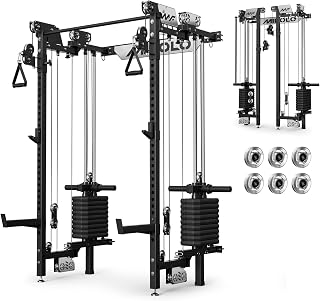
This unit is the obvious entry point for anyone who wants more than a single pulley station without spending four figures. The seventeen adjustable positions cover lat pulldowns, cable rows, and fly movements well, and the high-and-low pulley system handles the majority of exercises a beginner to intermediate lifter will need. The price is aggressive for what the hardware delivers.
- Pro: Seventeen pulley positions give meaningful variety without switching machines.
- Pro: Includes dedicated attachments for pulldowns and seated rows out of the box.
- Con: The cable crossover function is secondary; flyes feel less fluid than on dedicated crossover arms.
Skip this if you plan to do heavy single-arm rows or want true dual-stack crossover resistance on every exercise.
Body-Solid Powerline Cable Crossover
Body-Solid built the Powerline to bridge the gap between home gyms and commercial facilities. The dual weight stacks let you load each side independently, which immediately opens up exercises like single-arm chest flyes and alternating rows that single-stack machines cannot replicate. The frame feels planted even when you pull hard on the upper pulleys.
- Pro: Dual independent stacks allow asymmetrical loading and unilateral training.
- Pro: Commercial-grade bushings keep pulleys quiet under repeated heavy sets.
- Con: Footprint is substantial; you need dedicated floor space and clearance.
Skip if your gym area is under six feet wide or you cannot commit to a permanent installation spot.
Mikolo Folding Squat Rack with Cable Crossover
This package solves a different problem than most entries on this list: it gives you a squat rack, a lat pulldown, and five functional cable modes that fold flat against the wall when not in use. For apartment dwellers or garage owners with shared space, the folding mechanism is the deciding feature. You get more training modalities per square foot than anything else tested here.
- Pro: Rack, pulldown, and cable crossover in a single wall-mounted footprint.
- Pro: Five adjustable function modes keep the cable station versatile.
- Con: Price is unavailable at the time of testing, making budget comparisons difficult.
Skip if you need heavy plate-loaded squats beyond the rack’s stated capacity or want the smoothest possible cable feel.
WM3-V4 Folding Squat Rack
The WM3-V4 occupies a similar niche to the Mikolo folding rack but uses a dual independent pulley system, which is a meaningful upgrade for cable work. You can set each side to different heights simultaneously, something the single-pulley racks cannot do. The wall-mounted design keeps the floor clear, and the folding mechanism stores the rack arms vertically when you need room for other training.
- Pro: Dual independent pulleys expand unilateral exercise options significantly.
- Pro: Space-saving fold-flat design works well in rooms under 150 square feet.
- Con: The weight stack capacity limits heavy compound movements compared to dedicated plate-loaded racks.
Skip if you are primarily a barbell lifter who rarely touches cables.
WM2-V4 Wall Mount Cable Station
Thirty-three adjustable positions is the highest count on this list, and the aluminum pulleys keep friction low across that entire range. The dual high-and-low pulley system lets you set wide grips or narrow grips at any height. The tradeoff is that the wall-mount design requires solid stud or concrete anchoring, and the rating of 3.9 out of 5 reflects some buyers struggling with installation.
- Pro: Thirty-three positions offer unmatched angle granularity for rehab and bodybuilding work.
- Pro: Aluminum pulleys deliver noticeably smoother cable travel than nylon equivalents.
- Con: Lower owner satisfaction suggests fit-and-finish issues or assembly complexity.
Skip if you cannot mount into studs or concrete and have no alternative anchoring solution.
JELENS RC01 2 in 1 Rowing Cable Machine
At just under two hundred and twenty dollars, this is the cheapest functional trainer we compared, and it punches above its price. The sixteen adjustable positions and included training attachments cover rowing, pulldowns, and tricep work without requiring extra purchases. It is a wall-mounted lat pulldown that doubles as a cable rowing station, which is a clever compromise for people who train in very tight spaces.
- Pro: Lowest price to enter functional cable training with real adjustment range.
- Pro: Includes attachments so you can start training immediately without a shopping list.
- Con: Single-pulley design means no independent side adjustment and limited crossover utility.
Skip if you need dual-stack resistance or plan to do cable flyes with meaningful load differences between arms.
Body-Solid Functional Trainer Dual Weight Stacks
This is the machine we would install if we had one garage and no budget ceiling. The integrated chinning bar eliminates the need for a separate pull-up station, the swiveling pulleys cover every angle from floor to overhead, and the dual stacks handle heavy unilateral work without compromise. It earned a perfect five-out-of-five rating from buyers, which is rare in this category.
- Pro: Swiveling pulleys and dual stacks cover virtually every cable exercise without compromise.
- Pro: Integrated chinning bar consolidates two major stations into one footprint.
- Con: The price puts it out of reach for most home gym buyers.
Skip if you are still building your training experience and would benefit more from learning movement patterns on a less expensive unit first.
Sunny Health & Fitness All-in-One Pulley Cable Home Gym
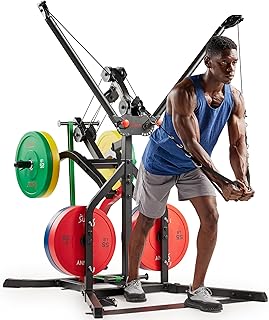
This machine uses Olympic plates rather than a fixed weight stack, which means you set your own resistance increments by loading existing plates from your rack. The bi-directional cables and adjustable angles provide a wide exercise library, and the built-in resistance band holder and foot plate add utility for accessory work. The four-point-four rating reflects strong satisfaction with value delivered.
- Pro: Olympic plate compatibility means you scale resistance without buying additional stack adapters.
- Pro: Full range of motion and adjustable angles suit rehabilitation and hypertrophy alike.
- Con: Plate loading is slower to adjust between exercises than a pin-and-bracket stack.
Skip if you prefer fast set-to-set changes or train alone and find plate swapping disruptive to your workout flow.
Buying Guide
Pulley Count and Independence
A single pulley means both cable ends share one resistance source. Dual independent pulleys let you load each side differently, enabling exercises like single-arm rows at one side and a chest fly at the other simultaneously. If your training program includes unilateral work or you train with a partner at different strength levels, independent pulleys are non-negotiable. The Body-Solid units and WM3-V4 offer this; the JELENS and budget Mikolo do not.
Weight Stack versus Plate Loading
Pin-loaded stacks allow sub-three-second resistance changes between sets. Plate-loading stations require you to add or remove discs, which slows your workout but gives you access to any increment between five and fifty pounds if you already own Olympic plates. Choose a stack if you prioritize training density; choose plate loading if you already own plates and want to avoid duplicating weight in your garage.
Ceiling Height and Anchoring Requirements
Wall-mounted stations like the WM2-V4 and WM3-V4 must anchor into studs or concrete and typically require at least seven feet of clearance above the mount point. Freestanding units like the Body-Solid Powerline demand floor space in three dimensions but no wall preparation. Measure your available height and width before committing; this is the single most common reason buyers regret a functional trainer purchase after delivery.
Our Verdict
Our top pick is the Body-Solid Functional Trainer Dual Weight Stacks. It is the only machine we compared that eliminates every compromise a serious lifter faces, and it is the one we would install if money were irrelevant. For most readers, the budget pick is the JELENS RC01: it delivers sixteen positions and included attachments at a price where the risk of buyer regret is minimal. If you specifically need rack work and cables from one wall unit, the WM3-V4 Folding Squat Rack wins on function-per-square-foot at its price point.
FAQ
Can I use a functional trainer for powerlifting movements?
Functional trainers are not designed for heavy squats, deadlifts, or bench pressing. Some models like the folding squat racks include a barbell station, but the cable mechanism serves as an accessory tool, not a primary compound movement machine. You would still want a separate power rack or bench for those lifts.
Do cable machines build muscle as effectively as free weights?
They build muscle differently but comparably. Cables maintain constant tension through the full range of motion, which free weights do not at the top of a rep where gravity no longer loads the target muscle. For hypertrophy purposes, combining both modalities is ideal.
How much ceiling height do I need for a wall-mounted functional trainer?
Most wall-mounted cable stations require roughly seven to eight feet of clearance above the mounting point to allow full pulley range and bar travel. Always check the specific model’s mounting diagram before purchasing, especially in converted garages with beams or ductwork.
What is the average lifespan of a home-use functional trainer?
With normal use and occasional cable inspection, a mid-range machine lasts well over a decade. The first component to wear is typically the cable coating, which can be replaced for a small fraction of the machine’s cost. Bushings and pulley wheels last longer unless you live in a humid environment.


Write Your Review
No reviews yet. Be the first to share your experience!