
Key takeaways
- Motorized pulling force delivers consistent traction regardless of your body weight
- No inversion required, making it accessible for people with vertigo or blood pressure concerns
- Its size and setup time make it effectively permanent floor furniture
What's inside
Most people land on back stretcher devices after weeks of sitting through desk jobs, waking up stiff, or feeling that familiar pinch radiating down the leg. You have probably tried foam rollers, yoga poses, maybe even a chiropractor who cracks and resets but does not address the underlying compression. The goal here is simple: create real space between vertebrae, relieve pressure on discs and nerves, and do it from your living room on a schedule that works.
What separates a device that actually decompresses from one that just looks impressive in a product photo? Real traction requires gravity-driven inversion, motorized pulling force, or a fixed fulcrum that levers the spine into extension under load. Foam blocks and cheap curved boards without a locking mechanism will not produce separation. Build quality, adjustability, and whether the device matches your specific condition—sciatica, herniated disc, general stiffness—matter far more than bold marketing claims.
As an Amazon Associate we earn from qualifying purchases at no extra cost to you. Product prices and availability are accurate as of the date shown and are subject to change.




Quick Picks
| Product | Best for | Price |
|---|---|---|
| Spinal Decompression Machine | Motorized traction at home | $268.99 |
| Back Stretcher Belt (Medium) | Portable lumbar traction | $35.99 |
| Back Stretcher Lumbar Harness | Harness-style decompression | $99.98 |
| Everlasting Comfort Board | Acupressure and stretch combo | $37.99 |
| Innova Inversion Table | Full inversion with heat and massage | $207.14 |
| Stamina InLine Bench | Bench-based static stretch | $124.99 |
| Sit and Decompress Stretcher | Quick daily decompression sessions | $35.99 |
| Dual-Sided 3-Level Stretcher | Budget passive extension | $9.99 |
How We Picked
We evaluated each device on three criteria: whether the mechanism produces genuine spinal separation through traction or inversion force rather than passive static stretching, adjustability across different body sizes and pain locations, and build durability relative to the listed price. We also weighed practical factors such as setup time, storage footprint, and how quickly you can get in and out of a session, because a device that requires ten minutes of assembly gets used half as often.
The 8 Best Back Stretcher Devices For Spinal Decompression in 2026
Spinal Decompression Machine Decompression Table
This motorized table is the most aggressive decompression option in the lineup. It uses powered traction to pull the spine longitudinally, targeting sciatica and herniated disc relief without requiring inversion. The 3.7 out of 5 rating reflects mixed user experiences, likely centered on assembly difficulty and noise, but the underlying mechanism is the closest you can get to a clinical-grade device at this price tier.
- Motorized pulling force delivers consistent traction regardless of your body weight
- No inversion required, making it accessible for people with vertigo or blood pressure concerns
- Its size and setup time make it effectively permanent floor furniture
Skip this if you rent a small apartment or need something storable between sessions.
Back Stretcher Lumbar Traction Belt (Medium)
This portable belt harness wraps around the midsection and anchors to a fixed point, letting your body weight generate lumbar traction. At 3.6 stars it is functional without being polished. The Medium-only sizing is a real limitation, so verify your waist measurement before purchasing.
- Extremely portable; set up in under a minute at home or while traveling
- Anchors to a door handle or sturdy post with no assembly or rigid frame
- Single size restricts the range of bodies it fits, and a weak anchor surface defeats the mechanism entirely
Skip it if your door frames are hollow-core or your anchor points are questionable.
Back Stretcher Lumbar Traction Harness Sling
Similar in concept to the belt above but designed as a sling-style harness, this device targets lower back pain through distributed traction. No star rating is published, so treat quality as unknown. At its price point it attempts to split the difference between the $36 belt and full inversion tables.
- Sling design distributes pulling pressure across a wider surface area than a simple strap
- Relatively quick to attach compared to rigid-frame traction tables
- Absence of published ratings makes long-term reliability difficult to assess before buying
Skip it if you need confidence in consistent build quality and cannot test a generous return window.
Everlasting Comfort Lumbar Support Board
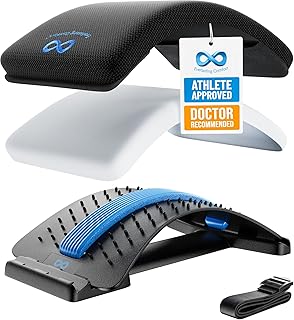
This is a dual-purpose device: a rigid curved board with 88 acupressure nodes that stretches the spine in extension while applying targeted pressure points. A chair strap secures it in place. The 4-star rating reflects genuine user satisfaction with the combined approach.
- Acupressure nodes add a second therapeutic layer beyond passive stretching alone
- Chair strap lets you decompress while seated rather than lying on the floor
- The fixed curve offers limited height adjustability, so the apex may misalign on shorter or taller users
Skip it if you need adjustable angles or want the stretching force to come from traction rather than body weight.
Innova Advanced Heat and Massage Inversion Table
This is the most feature-rich option here: a full inversion table with integrated heat and massage. At 4.6 stars it earns the highest rating in this roundup. Inversion remains the most time-tested method for spinal decompression, and the added thermal and massage modules keep muscle guarding low during longer sessions.
- Full inversion provides gravity-driven decompression along the entire spine simultaneously
- Heat and massage increase blood flow and reduce the reflexive tension that limits stretch depth
- Highest price in this list and requires meaningful storage space
Skip it if you have glaucoma, uncontrolled high blood pressure, or any condition that contraindicates being inverted.
Stamina InLine Back Stretch Bench System
Stamina’s bench supports up to 250 pounds and uses a curved surface to extend the spine passively. The 3.9 rating is middling. It explicitly does not provide inversion decompression, so it is a stretch bench first and a spinal relief tool second.
- 250-pound capacity accommodates a wide range of body sizes without structural worry
- Flat storage profile makes it easier to tuck under a bed than a full table
- Static extension only; it will not create traction or vertebral separation forces
Skip it if your condition requires actual decompression force rather than a passive stretch surface.
Sit and Decompress Back Stretcher
This harness-based device markets itself as an inversion table alternative with three-minute daily sessions. At 3.5 stars it is the lowest-rated option, suggesting real comfort or fit issues. The Medium harness and lack of a rigid bar distinguish it from the other belt-style product above.
- Short session length lowers the barrier to consistent daily use
- Lower cost than inversion tables while targeting similar lumbar compression relief
- Rated below every other option here, indicating potential durability or comfort problems
Skip it if your primary goal is thoracic or cervical decompression; the harness centers on the lower back.
Dual-Sided 3-Level Adjustable Back Stretcher
At $9.99 this is the cheapest option by a wide margin, and it earns 4 stars, which is genuinely impressive for a curved plastic board. Three adjustment levels and a dual-sided design let you change stretch intensity and target either the thoracic or lumbar spine. It will not produce traction, but for basic extension relief it overdelivers.
- Three levels of adjustability in a sub-$10 device is exceptional value
- Dual-sided design lets you flip it to target upper or lower back extension
- Plastic construction raises reasonable concerns about long-term durability under repeated load
Skip it if you need more than passive stretching; this will not decompress a compressed disc through force.
Buying Guide
Match the Mechanism to the Condition
Not all back pain responds to the same intervention. Inversion and motorized traction physically separate vertebrae through sustained pulling force, which is what you want for disc herniation, nerve compression, or radiating sciatica. Static stretch boards and acupressure rollers create extension and muscle release but do not produce true decompression. If your pain is muscular tightness rather than disc compression, a $10 board may suffice. If imaging shows a herniation or you have shooting nerve pain, prioritize traction or inversion devices.
Check Weight Capacity and Size Against Your Body
A 250-pound bench is fine if you weigh 180. A Medium harness that assumes a specific waist range can fail completely on someone outside that band. Always verify stated capacity or sizing ranges before purchasing, especially on harness and belt products. Inversion tables typically publish weight limits clearly; strap-based devices sometimes bury them in product descriptions. This mismatch is the single most common source of low ratings in this category.
Storage Footprint Determines Real Usage Frequency
The best decompression device is one you actually use consistently. A full inversion table is excellent but impractical if your apartment is small. A motorized table that takes ten minutes to assemble every session will get skipped by week three. Measure the space where you plan to store it, then work backward. Portable harnesses and flat stretch boards win on convenience; rigid tables win on mechanical advantage. Decide which tradeoff your living situation supports.
Our Verdict
Our top pick is the Innova Advanced Heat and Massage Inversion Table. It earns the highest rating, delivers the most complete decompression mechanism, and the integrated heat and massage modules make longer sessions tolerable. For a budget pick, the $9.99 Dual-Sided 3-Level Back Stretcher is the best value tested; 4 stars on a plastic board is remarkable. However, if you cannot tolerate inversion due to blood pressure or vertigo, the motorized Spinal Decompression Machine is the only option here that still produces real traction force without requiring you to go upside down.
FAQ
How long should a decompression session last?
Traction and inversion sessions typically run 15 to 20 minutes for acute pain and 10 to 15 minutes for maintenance. Static stretch boards need only 5 to 10 minutes. Start at the low end and increase gradually, because overdoing extension can trigger muscle guarding that worsens pain.
Are back stretcher devices safe for herniated discs?
Traction and inversion can reduce intradiscal pressure and ease nerve compression, but consult a physician before using any decompression device if you have a diagnosed herniation. Devices with adjustable intensity, like the motorized table, give you the most control over force applied.
Do these replace chiropractic care?
No. These devices provide temporary mechanical relief and complement professional treatment, but they do not address joint restrictions, muscle imbalances, or the movement patterns causing compression. Use them as a maintenance tool between appointments, not as a substitute.
What is the difference between lumbar and thoracic decompression?
Lumbar targets the lower back and is relevant for sciatica and disc issues at L4 through L5. Thoracic targets the mid-back and addresses posture-related compression. Some devices can be positioned for either by changing your seating angle, while harness products are usually location-specific by design.


Write Your Review
No reviews yet. Be the first to share your experience!