
Comparing a ski erg machine vs alternatives requires understanding resistance behavior, pulling mechanics, installation, and workout tracking. Rowing machines, air bikes, vertical climbers, and cable trainers all offer different exercise experiences. This guide examines the practical trade-offs to help you choose the right equipment for your training goals.
Quick Verdict: When Does a Ski Erg Make Sense?
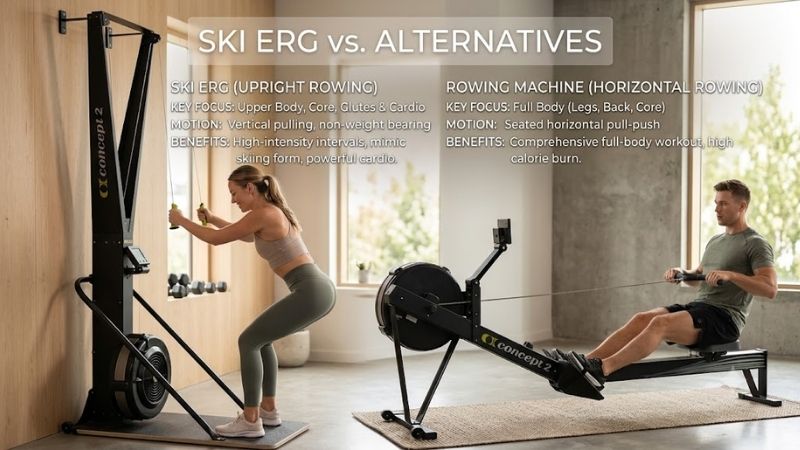
A SkiErg is a stationary exercise machine that simulates aspects of cross-country skiing through repeated pulling movements. The user typically stands in front of a tall frame and pulls two handles downward against a resistance system.
The Concept2 SkiErg is a well-documented example. It uses an air flywheel, high-strength synthetic drive cords, and a PM5 performance monitor. It can be installed on a suitable wall or used with a compatible floor stand.
Its primary advantages are a distinctive pulling movement, effort-responsive resistance, workout tracking, and the possibility of a relatively shallow wall-mounted installation.
However, none of these characteristics automatically makes a SkiErg better than its alternatives.
A rowing machine provides seated movement involving coordinated leg drive and pulling. An air bike offers cycling-based fan resistance and often moving handlebars. A vertical climber guides the user through upright climbing movements. A cable trainer may provide far more exercise variety but uses different loading and measurement systems.
Choose a SkiErg when poling-style movement and measurable workouts are your priorities.
Choose a rower when you want conventional indoor rowing mechanics.
Choose an air bike when you prefer fan resistance through pedaling and coordinated handle movement.
Choose a vertical climber when guided climbing is more appealing than repeated pulling.
Choose a cable machine when exercise variety and selectable strength resistance matter more than ergometer-style conditioning.
The best choice should reflect the activity you actually intend to perform rather than promotional claims about overall fitness benefits.
Ski Erg vs. Alternatives: Comparison Table
| Equipment | Main movement | Resistance | Space requirement | Biggest advantage |
|---|---|---|---|---|
| SkiErg | Repeated downward pulling | Air on conventional models | Tall, wall or floor stand | Pulling-specific exercise and metrics |
| Rowing machine | Seated leg drive and pulling | Air, water, magnetic, hydraulic | Long floor area | Coordinated seated rowing |
| Air bike | Pedaling, often with moving handles | Air | Freestanding floor area | Effort-responsive cycling |
| Vertical climber | Guided arm-and-leg climbing | Bodyweight or adjustable | Tall frame and ceiling clearance | Coordinated climbing movement |
| Cable trainer | Various cable exercises | Weight stacks or other systems | Wide range of sizes | Exercise versatility |
| Exercise bike | Seated circular pedaling | Magnetic, friction, or air | Model-dependent | Straightforward cycling |
| Battle ropes | Rope waves and slams | Rope mass and user effort | Long clear floor area | Freely varied rope movements |
How a Ski Erg Works
Air Flywheel Resistance and Pulling Force
A conventional air-resistance SkiErg uses a fan flywheel connected to the pulling handles through cords and a drivetrain.
When the user pulls, the flywheel accelerates. Moving air produces aerodynamic drag that opposes rotation. Stronger pulls generally produce greater flywheel speed and resistance.
This creates a responsive system where workload changes with effort. The user can perform gentle movements or harder intervals without necessarily changing the damper before each repetition.
However, resistance is not identical across all ski-style trainers. Other machines may use magnetic, mechanical, or electronically controlled systems.
Before buying, verify the resistance mechanism rather than assuming every product labeled ski erg behaves like the Concept2 machine.
Damper Settings and Drag Factor
On the Concept2 SkiErg, the damper adjusts airflow into the flywheel.
It does not operate like a conventional weight-stack selector. A higher damper number changes the flywheel’s characteristics rather than adding a fixed amount of resistance.
The PM5 can display drag factor, which helps describe the flywheel’s effective aerodynamic loading.
This distinction matters when comparing a SkiErg with a cable trainer or exercise bike. A magnetic bike may provide selectable resistance settings, while a cable machine may use externally defined weights.
A SkiErg instead responds dynamically to pulling force.
For many users, this is convenient during interval training. Someone who specifically wants fixed mechanical resistance may prefer another system.
Handle Return and Cord Mechanics
The SkiErg’s paired handles are connected to a cord-and-return arrangement.
The mechanism allows the user to complete a pull and recover for the next repetition.
Smooth cord movement is important because each workout can involve many repeated cycles. Uneven return, unexpected slack, or catching may interfere with technique and signal a maintenance problem.
A rowing machine also uses a pulling handle, but its mechanical arrangement differs. Many conventional rowers use one central handle, while the SkiErg’s separate handles support specific poling movements.
A cable trainer may also use two independent handles, but its resistance curve and intended exercise patterns are not necessarily comparable.
The buyer should therefore evaluate how the handles feel throughout the complete movement, not just whether the equipment uses cables.
Double-Poling and Alternating-Arm Techniques
The Concept2 SkiErg supports double-poling and alternating-arm techniques.
Double-poling involves coordinated downward pulling with both arms. The lower body and torso may contribute according to the manufacturer’s recommended technique.
Alternating-arm movement uses different timing.
This provides some exercise variation within the machine’s intended purpose.
However, those variations do not turn the SkiErg into a general cable training station. Its resistance system and movement geometry remain specialized.
Buyers should select it because they want repeated ski-style pulling, not because they expect it to replace every upper-body resistance exercise.
Ski Erg vs. Rowing Machine
Standing Pulling vs. Seated Rowing
The largest difference is the exercise position and movement sequence.
A rowing machine generally places the user on a sliding seat. The stroke involves leg drive, torso movement, and handle pulling.
A SkiErg usually positions the user standing in front of an upright frame, although certain supported variations can be performed seated.
These arrangements create different movement patterns.
A person interested in rowing-specific training will generally find a rowing machine more appropriate because its mechanics correspond more closely to the conventional indoor rowing stroke.
A person interested in ski-poling movement or repeated downward pulling may prefer the SkiErg.
Neither should be described as universally providing a better total-body workout.
Resistance Behavior
The Concept2 RowErg and SkiErg both use air flywheels.
However, identical resistance principles do not make their workouts mechanically identical.
The RowErg converts force from a rowing stroke into flywheel motion. The SkiErg converts force from repeated pulling movements.
The user’s body position, force application, stroke timing, and movement range differ.
As a result, equivalent displayed distances or paces should not automatically be interpreted as equal exercise effort across the two machines.
For structured training, the buyer should compare metrics within each equipment type and understand how the monitor calculates performance.
Space Requirements
The Concept2 RowErg is approximately 96 inches long in its standard assembled configuration.
Its manufacturer recommends an exercise area around 9 by 4 feet.
The Concept2 SkiErg is about 85 inches tall, and its wall-mounted equipment depth is approximately 16 inches.
With the standard floor stand, its overall footprint is approximately 23.5 by 50 inches.
These dimensions illustrate why a SkiErg can be attractive in rooms where long floor space is limited.
However, its shallow wall-mounted depth is not the full operating area. The user must still have room to stand, bend, pull, and recover.
Workout Monitoring
Both machines can use the PM5 monitor.
This can be attractive for users who want structured sessions, performance records, and compatible training applications.
However, the displayed metrics are equipment-specific.
A SkiErg pace should not be assumed equivalent to a rowing pace in terms of bodily effort.
For buyers seeking standardized training records, the important consideration is using compatible measurements consistently within the chosen activity.
Noise and Maintenance
Both machines create airflow sound.
The rower also has a sliding seat and rail, while the SkiErg relies on paired cords and a retraction mechanism.
Each system requires appropriate maintenance.
A rower may be preferable if you want seated movement. A SkiErg may be preferable when you want a different pulling pattern and a potentially narrower equipment installation.
Ski Erg vs. Air Bike
Pulling Strokes vs. Continuous Pedaling
A SkiErg uses repeated pulls separated by recovery.
An air bike uses continuous crank rotation.
Many air bikes include moving handlebars that allow coordinated upper-body movement.
The distinction affects the exercise rhythm.
Someone who enjoys repeated forceful pulling may prefer the SkiErg. Someone who wants continuous cycling movement may find the air bike more intuitive.
The right choice should be based on preferred mechanics rather than assuming either machine always produces higher intensity.
Effort-Responsive Resistance
Both machines can use air resistance.
As the fan accelerates, aerodynamic drag rises.
However, the resistance is applied through different drivetrains.
A SkiErg transmits pulling force through its cords. An air bike transmits pedaling and, on suitable designs, handle movement through the mechanical system.
Therefore, identical fan-resistance terminology does not mean the same mechanical workload at the hands or pedals.
Upper-Body Involvement
A SkiErg focuses on pulling movements.
An air bike with moving handles allows arm movement coordinated with cycling.
The muscle demands depend on the individual, movement technique, and actual effort.
Neither machine should be purchased solely because it is marketed as a full-body exercise option.
The more useful question is which movement the buyer can perform comfortably and consistently.
Seated Comfort and Balance
An air bike includes a seat.
A SkiErg is often used standing, with the user controlling body position during the pull.
Someone who prefers seated exercise may favor the air bike.
However, approved seated SkiErg variations may also be possible with suitable arrangements.
The exact equipment instructions determine what is supported.
Sound and Apartment Placement
Both machines generate fan noise.
The SkiErg may also transfer forces through a wall mounting system or floor stand.
An air bike transfers forces through its base and moving drivetrain.
The actual effect on neighboring rooms depends on machine design and building construction.
Neither should be assumed universally quieter.
Ski Erg vs. Vertical Climber
Different Upper- and Lower-Body Coordination
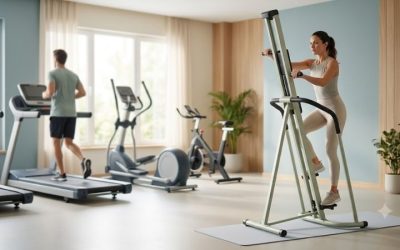
A vertical climber guides the hands and feet through climbing-oriented movements.
A SkiErg uses pulling handles while the feet remain on the floor or another approved support surface.
This creates different coordination demands.
A vertical climber may appeal to someone who enjoys repeated climbing. A SkiErg may be better for someone who wants ski-poling-style pulling.
Although both can involve the arms and legs, the machine mechanisms are not interchangeable.
Resistance Control
Many simple vertical climbers rely substantially on bodyweight and mechanical leverage.
The SkiErg’s air resistance responds to pulling force.
Some climbing machines include adjustable resistance, so the comparison should be based on specific products rather than universal assumptions.
For users who value performance measurement, the SkiErg’s documented monitoring system can be a meaningful advantage.
For users who care primarily about the climbing movement, that advantage may be less important.
Height and Footprint
Both machines are tall.
A vertical climber typically uses a freestanding frame with moving pedals.
A SkiErg may be wall-mounted or placed on a floor stand.
Wall mounting can conserve equipment floor space, but structural installation and pulling clearance are essential.
A renter may prefer a freestanding climber if permanent wall mounting is not allowed, although a SkiErg floor stand is another option.
Balance Requirements
Vertical climbers involve standing on moving pedals.
The SkiErg generally keeps the user’s feet on a stationary surface during conventional use.
That difference may influence comfort and coordination.
However, a SkiErg’s pulling action still requires appropriate body control.
People with specific mobility limitations should select equipment based on individual capabilities and professional advice where relevant.
Ski Erg vs. Cable Trainer
Dynamic Resistance vs. Selected Loads
A cable trainer can use a weight stack, plates, or another resistance system.
The user typically selects resistance and performs exercises through different cable paths.
A SkiErg uses repeated pulling against a responsive resistance mechanism.
These systems are intended for different training styles.
A cable machine may be more versatile for strength-oriented exercises, while a SkiErg is more directly suited to continuous poling-style workouts.
Exercise Variety
A cable trainer can potentially support rows, presses, pulldowns, and other movements, depending on its design.
A SkiErg supports more specialized pulling techniques.
If a buyer wants one machine to accommodate many distinct resistance exercises, a cable trainer may offer better value.
If repeated ski-poling movement is the desired workout, the SkiErg provides a dedicated mechanism and monitoring system.
Resistance Measurement
A cable trainer may identify selected load settings.
A SkiErg’s monitor estimates workout performance based on flywheel behavior.
Those measurements describe different things and should not be treated as equivalent.
The buyer should choose the system corresponding to the intended training goal.
Installation and Space
Both machine categories can include wall-mounted and freestanding arrangements.
However, their structural requirements differ.
The SkiErg’s mounting must support repeated pulling forces, while a cable trainer may experience different loading directions.
Do not assume the installation method for one machine is suitable for another.
Which Is Better Value?
A cable trainer can be better value for someone who wants general resistance exercise variety.
A SkiErg can be better value for someone who frequently uses the poling movement and wants measurable conditioning sessions.
Ski Erg vs. Battle Ropes
Guided Handles vs. Free Rope Movement
Battle ropes involve creating waves, slams, or other movements with long ropes.
The resistance depends on rope mass, geometry, movement speed, and the user’s effort.
A SkiErg uses guided cords connected to a flywheel.
This creates a more standardized movement and allows workout metrics through the console.
Battle ropes offer different freedom of movement but usually less integrated performance measurement.
Space Requirements
Battle ropes require enough floor length for the rope and a secure anchoring arrangement.
A wall-mounted SkiErg can occupy less equipment depth, although the user’s pulling area must still be clear.
For a small home gym, space requirements may favor the SkiErg.
However, the actual comparison depends on rope length and room layout.
Noise and Surface Impact
Battle ropes can produce noise through repeated contact with the floor.
A SkiErg generates airflow and mechanical sound instead.
A shared apartment may have different challenges with each option.
Training Convenience
A SkiErg offers a dedicated setup and built-in workout tracking.
Battle ropes can be simple but require appropriate anchoring and storage.
Choose according to exercise preference and available room.
Wall Mounting vs. Floor Stand: A Critical Purchase Decision
Wall Mounting Requirements
The Concept2 SkiErg can be mounted to a suitable wall.
The manufacturer supplies hardware intended for wood studs with 16-inch spacing and advises consulting a building professional for other wall structures.
Drywall alone should not be assumed adequate.
A safe mounting plan is essential because repeated pulling applies forces through the frame and anchors.
For renters, permission to modify the wall may also be necessary.
Floor Stand Advantages
A compatible floor stand allows the SkiErg to operate without permanent wall attachment.
This can be useful in apartments or shared facilities.
Concept2 offers standard and wider floor-stand configurations.
The standard stand measures about 23.5 by 50 inches, while the wide stand measures approximately 32 by 52 inches.
These options offer flexibility, but they occupy more floor space than a wall-mounted unit.
Ceiling Height and Working Area
The SkiErg is approximately 85 inches tall.
Before buying, measure ceiling height, including overhead obstructions.
Also consider the user’s full pulling motion.
A machine that physically fits beneath the ceiling may still interfere with a light fixture or nearby equipment during use.
Moving and Storage
A floor stand may include wheels for repositioning.
However, the machine must remain stable during exercise.
Wall mounting creates a permanent location and avoids daily moving, but it reduces flexibility.
The better arrangement depends on how the room is used.
Workout Metrics: What Is Actually Worth Tracking?
Pace and Simulated Distance
SkiErg monitors can display pace and distance.
These are calculated ergometer metrics rather than physical travel.
They can help users compare workouts on compatible equipment.
However, they should not be assumed directly equivalent to rowing-machine or air-bike measurements.
Stroke Rate
Stroke rate indicates how frequently pulling cycles occur.
It can be useful for pacing.
However, a higher stroke rate does not automatically mean a more effective workout.
The force applied during each pull and the quality of movement also matter.
Power
Some ergometers report power in watts.
The usefulness of this measurement depends on the calculation system and its consistency.
Buyers should examine actual monitor capabilities rather than assuming every ski-style trainer offers the same measurement quality.
Heart Rate Integration
Compatible heart rate sensors can provide additional workout information.
However, compatibility must be verified.
A chest strap transmitting ANT+ or Bluetooth does not automatically work with every monitor.
Connected Applications
Connected workout records can be useful for people who enjoy analyzing their training.
However, app features and compatibility can change.
Choose equipment that remains useful even if an optional software service is unavailable.
Noise, Maintenance, and Durability
Airflow Noise
Air-resistance SkiErgs produce sound as the fan rotates.
The sound may become more noticeable during harder pulling.
This is a normal characteristic of the resistance system rather than necessarily a mechanical defect.
Cord and Pulley Maintenance
Synthetic cords, pulleys, and return mechanisms are important wear components.
Inspect them according to the manufacturer’s schedule.
Unexpected slack, fraying, or catching requires attention.
Flywheel Cleaning
Dust can collect around the flywheel.
Follow the manufacturer’s cleaning instructions.
Improper disassembly or cleaning methods can create problems.
Mounting Inspection
Wall-mounted machines rely on secure anchors.
Floor stands rely on stable structural connections.
Unexpected movement should be investigated before further use.
Replacement Parts
Availability of cords, handles, and other components can influence long-term ownership.
A machine with serviceable parts may remain practical for longer than one with unsupported proprietary components.
Choosing by Training Goal
General Cardio
A SkiErg can support various exercise intensities, depending on user effort.
However, a bike or rower can also provide cardio exercise.
Choose the movement you prefer.
Rowing-Specific Training
A RowErg is generally more relevant when indoor rowing mechanics are the goal.
The SkiErg does not reproduce the seated rowing stroke.
Cross-Country Skiing Preparation
A SkiErg may be attractive because it simulates aspects of ski poling.
However, it does not reproduce every element of outdoor skiing, such as balance, terrain, and actual locomotion.
Interval Training
The SkiErg’s responsive air resistance and workout monitor can support structured intervals.
However, air bikes and rowers can also provide similar training formats through different movements.
Resistance Exercise Variety
A cable trainer may provide more varied strength exercises.
The SkiErg should not be treated as a replacement for a full resistance-training setup.
Buying Scenarios
Dedicated Home Gym With a Suitable Wall
A wall-mounted SkiErg can be practical if installation requirements and pulling clearance are met.
The equipment can remain ready for use.
Rental Apartment
A floor stand may avoid permanent wall modifications.
However, its larger footprint and potential noise should be considered.
Buyer Who Already Owns a Rower
A SkiErg may add a different pulling movement.
Whether it justifies another machine depends on how often that movement will be used.
Buyer Who Prefers Cycling
An air bike may better match existing exercise preferences.
A SkiErg should not be chosen solely because it offers a different or apparently harder workout.
Buyer Who Wants Strength Exercise Variety
A cable trainer may be the stronger purchase when many exercise movements are important.
Common Buying Mistakes
Treating Damper Settings as Fixed Weights
The damper changes airflow characteristics.
Measuring Only the Frame
The user needs room for the full pulling movement.
Ignoring Mounting Requirements
Structural safety is essential.
Comparing Ergometer Calories as Exact Values
Displayed estimates vary by measurement system.
Assuming Every Ski Trainer Uses Air Resistance
Different manufacturers use different mechanisms.
Buying Without Checking Replacement Parts
Cords and mechanical components can require service.
Frequently Asked Questions
Is a SkiErg Better Than a Rowing Machine?
Neither is universally better. A SkiErg emphasizes pulling, while a conventional rower uses seated leg drive and pulling.
Is a SkiErg Better Than an Air Bike?
They use different movement patterns. The better option depends on whether pulling or cycling-based exercise is preferred.
Can a SkiErg Replace a Cable Machine?
Not completely. Cable machines can provide a wider range of exercises with different loading characteristics.
Does a SkiErg Need Electricity?
The Concept2 SkiErg’s resistance mechanism operates without wall power. Its PM5 monitor uses batteries and draws operating power from the moving flywheel during use.
Is Wall Mounting Required?
No. Certain SkiErgs support approved floor stands.
Are SkiErgs Suitable for Small Apartments?
They can be, but room height, movement clearance, installation, and noise must all be considered.
Conclusion
The right ski erg machine vs alternatives decision depends on whether dedicated pulling exercise suits your goals. SkiErgs provide effort-responsive resistance and measurable poling workouts, while rowers, air bikes, climbers, and cable trainers offer different movement patterns. Prioritize comfortable mechanics, safe installation, space requirements, and serviceability rather than assuming any single machine is universally best.





Write Your Review
No reviews yet. Be the first to share your experience!