
Key takeaways
-
Choose a compact elliptical when you want standing elliptical movement and can accommodate the complete operating footprint.
-
Choose a full-size elliptical when stride length, adjustability, and a larger exercise platform are more important than space savings.
-
Choose an under-desk elliptical when seated movement and a minimal equipment footprint are priorities.
-
Choose an exercise bike when a seated cycling motion is preferred.
-
Choose a mini stair stepper when extremely compact standing equipment is more important than elliptical stride geometry.
-
Choose a walking pad when you specifically want walking rather than guided pedaling.
Comparing a compact elliptical vs alternatives requires evaluating movement quality, stride length, resistance, stability, and space requirements. Compact treadmills, exercise bikes, steppers, and under-desk devices may occupy less room but offer different exercise experiences. This guide explains the important trade-offs and helps you select equipment for your home.
Quick Verdict: Is a Compact Elliptical the Best Choice?
A compact elliptical trainer provides a guided stepping movement in which the feet travel through an elongated path rather than leaving the pedals.
Most conventional standing ellipticals use two foot platforms connected to a mechanical resistance system. Some also include moving handlebars.
Compact designs attempt to provide this movement within a smaller frame than full-sized gym ellipticals.
However, reducing frame size can introduce important compromises.
A shorter frame may limit stride length. A narrower base may require careful stability evaluation. Smaller flywheel or linkage arrangements can affect the feel of the motion.
For users who prefer standing elliptical exercise and have enough room for a stable machine, a compact elliptical can be a suitable compromise.
For people with very limited floor area, alternative equipment may provide a more practical solution.
The main recommendations are:
-
Choose a compact elliptical when you want standing elliptical movement and can accommodate the complete operating footprint.
-
Choose a full-size elliptical when stride length, adjustability, and a larger exercise platform are more important than space savings.
-
Choose an under-desk elliptical when seated movement and a minimal equipment footprint are priorities.
-
Choose an exercise bike when a seated cycling motion is preferred.
-
Choose a mini stair stepper when extremely compact standing equipment is more important than elliptical stride geometry.
-
Choose a walking pad when you specifically want walking rather than guided pedaling.
The central buying question is whether the compact elliptical provides a comfortable movement path for your body.
Quick Comparison Table
| Criteria | Compact elliptical | Full-size elliptical | Under-desk elliptical | Exercise bike | Mini stair stepper | Walking pad |
|---|---|---|---|---|---|---|
| Main movement | Standing elliptical | Standing elliptical | Seated or supported compact elliptical | Seated cycling | Standing stepping | Walking |
| Foot contact | Pedals | Pedals | Small foot platforms | Pedals | Pedals | Moving belt |
| Stride range | Often shorter | May offer longer travel | Short compact motion | Circular pedaling | Short vertical stepping | Natural walking steps |
| Upper-body involvement | Model-dependent | Often moving handles | Usually limited | Usually limited | Usually limited | Natural walking arm movement |
| Resistance | Often magnetic | Magnetic or other systems | Varies | Magnetic, air, or friction | Often hydraulic | Motor-controlled belt |
| Space priority | Reduced standing frame | Larger exercise area | Small equipment footprint | Varies | Very small base | Narrow, longer footprint |
| Main advantage | Standing elliptical movement in less space | Greater geometry options | Seated convenience | Supported or conventional cycling | Minimal equipment area | Walking-specific movement |
| Main limitation | Potential stride compromise | Floor space | Different exercise intensity | No elliptical stride | Balance and short travel | Belt and motor requirements |
Understanding Compact Elliptical Design
The term compact elliptical is not a standardized engineering category.
One manufacturer may describe a shorter conventional elliptical as compact. Another may use the same term for a portable floor device.
Buyers should distinguish full-frame standing ellipticals from mini ellipticals before comparing them.
Full-Frame Compact Ellipticals
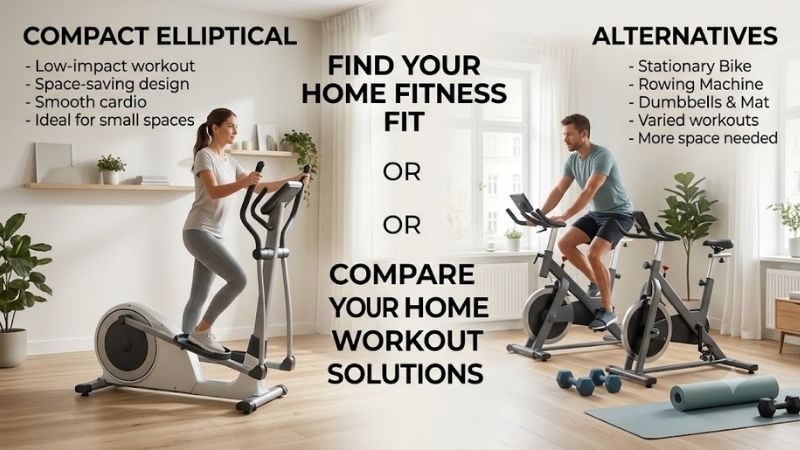
A compact full-frame elliptical generally provides a standing position, two foot platforms, and a guided resistance mechanism.
Some models include stationary or moving handlebars.
Compared with larger ellipticals, the frame may be shorter or narrower.
The main challenge is preserving comfortable stride geometry while reducing physical dimensions.
A machine with inadequate stride length may feel cramped, particularly to taller users.
Therefore, compact dimensions should be evaluated together with stride characteristics.
Portable Mini Ellipticals
Portable mini ellipticals use much smaller mechanisms.
Some support seated operation, while selected designs are also intended for standing use.
For example, the Stamina InMotion E1000 Compact Strider measures approximately 24.5 × 17 × 11.38 inches and weighs 24 pounds, according to the manufacturer.
It provides adjustable resistance and supports seated or standing operation as documented.
However, it does not offer the same movement dimensions or support structure as a conventional full-frame elliptical.
This distinction matters because buyers searching for compact ellipticals may encounter both categories in shopping results.
Front-Drive and Rear-Drive Designs
Elliptical trainers can use different flywheel and linkage positions.
In a front-drive design, major rotating components are located toward the front of the machine.
In a rear-drive design, they sit toward the back.
However, drive position alone does not establish stride comfort or overall quality.
Linkage geometry determines the foot path.
Two front-drive ellipticals may produce substantially different movements.
Buyers should consider the complete design rather than assuming one drive position is inherently superior.
Center-Drive and Alternative Designs
Some compact ellipticals use centrally located mechanisms.
These may help reduce certain frame dimensions.
However, center-drive design does not automatically guarantee a smaller footprint or better ergonomics.
Actual dimensions, pedal spacing, and structural support remain important.
Compact Elliptical vs. Full-Size Elliptical
The strongest differences often involve stride length, adjustability, and operating space.
Stride Length
Stride length affects how far the pedals travel horizontally.
A longer stride can feel more appropriate for certain users, particularly those with longer legs.
However, there is no single ideal stride length for every person.
Stride geometry, body proportions, cadence, and movement preference all matter.
A compact elliptical may use shorter pedal travel to reduce frame length.
This can save space but may create a constrained movement for some riders.
If a machine feels too short, increasing resistance will not correct its geometry.
Pedal Path
An elliptical pedal follows a mechanically guided path.
The ratio of horizontal to vertical movement influences how the exercise feels.
Two machines with the same advertised stride length may still have different pedal paths.
For that reason, stride length is useful but incomplete.
A meaningful comparison should also consider step height, pedal angle, and overall linkage mechanics.
Frame Stability
A full-size machine may have a larger stabilizing base.
However, larger dimensions do not automatically guarantee better construction.
A compact machine can be stable when properly engineered.
The important question is whether the frame remains secure during normal exercise within the manufacturer’s limits.
Handlebar Movement
Some full-size ellipticals include moving handles.
Compact machines may also offer this feature, but not all do.
Moving handles can change exercise coordination.
However, they also affect the operating clearance required around the machine.
Resistance Range
Both full-size and compact ellipticals can use magnetic resistance.
The number of settings is not a standardized performance measurement.
A machine advertising many levels is not necessarily capable of producing greater workload than one with fewer settings.
Which Is Better?
Choose a compact elliptical when its stride and frame fit your body and room.
Choose a full-size machine when the compact design imposes uncomfortable movement restrictions or insufficient adjustment.
Compact Elliptical vs. Under-Desk Elliptical
This comparison involves a fundamental difference between standing and seated exercise.
Movement Position
A compact full-frame elliptical supports a standing user.
An under-desk elliptical is normally used while seated in a separate chair, although some mini models allow both positions.
The support arrangements are therefore different.
A standing elliptical must safely accommodate the user’s body weight and dynamic movement.
A seated device relies on a chair for body support.
Pedal Travel
Full-frame ellipticals generally provide a larger movement path.
Under-desk devices use smaller pedal travel.
This makes them more practical under furniture but changes the movement experience.
The two machines should not automatically be considered equivalent cardio equipment.
Exercise Intensity
A standing elliptical can involve supporting body weight while moving through the exercise pattern.
A seated elliptical provides a different arrangement, with the chair supporting much of the body.
Actual effort depends on resistance, cadence, user characteristics, and the design.
Neither machine guarantees a particular training outcome.
Stability Requirements
Standing ellipticals need secure structural support.
Under-desk machines must remain stable against floor movement and work with a suitable chair.
Some desk users may need to prevent office-chair wheels from rolling.
Desk Compatibility
A full-frame compact elliptical is not normally suitable for conventional seated desk use.
An under-desk device may fit beneath a desk, but knee clearance must still be checked.
Which Should You Buy?
Choose a full-frame compact elliptical when you want standing elliptical exercise.
Choose an under-desk model when seated convenience and small equipment dimensions matter most.
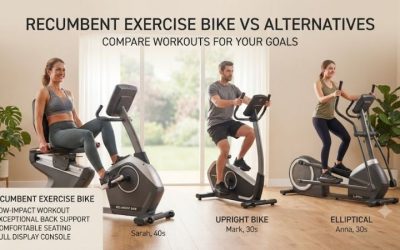
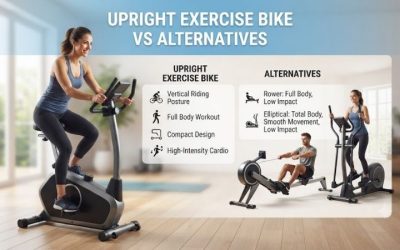
Compact Elliptical vs. Exercise Bike
The movement and body-support arrangements differ substantially.
Standing vs. Seated Position
An elliptical normally supports standing movement.
An exercise bike supports a seated riding position.
The choice may depend on comfort, personal preference, and the intended workout.
Pedal Mechanics
An elliptical uses a guided elongated path.
A bike uses circular crank motion.
The resulting hip, knee, and ankle movements differ.
A person who dislikes one motion may prefer the other.
Upper-Body Involvement
Some ellipticals have moving handlebars.
Exercise bikes generally use stationary handlebars, except for particular air-bike designs.
This can influence the movement pattern.
Foot Placement
Elliptical platforms are commonly larger than bike pedals.
Bike pedals may use straps, cages, or compatible clip-in systems.
Floor Space
Upright bikes can be relatively compact.
Recumbent bikes typically require greater length.
A compact elliptical may occupy more or less floor area depending on the specific model.
Which Should You Buy?
Choose a bike if you prefer seated pedaling.
Choose a compact elliptical if standing elliptical movement is a primary requirement.
Compact Elliptical vs. Mini Stair Stepper
Mini steppers can occupy substantially less floor area than conventional ellipticals.
However, their mechanical movement is different.
Pedal Movement
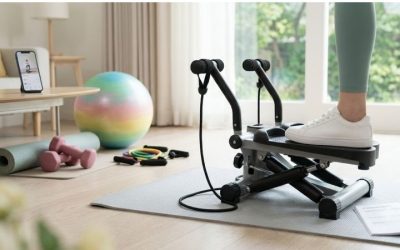
A mini stepper usually provides short vertical or angled stepping motion.
An elliptical uses an elongated pedal trajectory.
This changes the exercise experience.
Balance
Both are standing devices in their conventional configurations.
However, support structures vary.
A compact elliptical may offer fixed handlebars.
A mini stepper often has no integrated hand support.
Resistance
Many mini steppers use hydraulic cylinders.
Compact ellipticals commonly use magnetic or related resistance systems.
Hydraulic resistance may behave differently as temperature changes.
Some steppers specify continuous-use limits.
Operating Duration
A mini stepper should not automatically be treated as suitable for unlimited continuous exercise.
Check manufacturer restrictions.
A compact elliptical also has operating limits, but its resistance arrangement may differ.
Storage
A mini stepper typically has a very small base.
A compact full-frame elliptical may remain relatively tall and bulky even when described as space-saving.
Which Should You Buy?
Choose a mini stepper when equipment footprint is the overriding concern and its movement suits you.
Choose a compact elliptical when a longer guided stride and the available support structure matter more.
Compact Elliptical vs. Walking Pad
Walking pads offer another compact cardio option but serve a different movement preference.
Natural Walking vs. Guided Pedaling
A walking pad uses a moving belt to support walking.
An elliptical guides the feet through a predetermined pedal path.
This changes the movement mechanics.
Foot Impact
Ellipticals generally keep the feet in contact with the pedals.
Walking involves repeated foot contact with a moving surface.
However, the effect on comfort depends on individual circumstances.
Balance and Support
Walking pads require appropriate balance on a moving belt.
Compact ellipticals also require balance but may offer handlebars.
Neither should be assumed suitable for every mobility level.
Motor Requirements
Walking pads generally use electric motors.
Many compact ellipticals can operate through user-powered movement and resistance systems.
Power requirements vary by model.
Noise
Walking pads produce motor and belt sounds along with foot-contact noise.
Ellipticals produce drivetrain and pedal movement sound.
The exact comparison depends on equipment and surroundings.
Which Should You Buy?
Choose a walking pad when walking is the specific activity you want.
Choose a compact elliptical when guided elliptical movement is preferable.
Stride Length, Step Height, and Pedal Geometry
These measurements are central to compact elliptical suitability.
Stride Length
Stride length should accommodate natural movement without feeling cramped.
Manufacturer definitions may vary.
Step Height
Vertical pedal travel influences the movement pattern and overhead clearance.
A compact frame may still require considerable user height during operation.
Pedal Spacing
The lateral distance between pedals affects stance width.
Too wide or too narrow a stance may feel uncomfortable for some users.
Pedal Angle
Pedal angle changes throughout the movement on certain designs.
The effect depends on linkage geometry.
User Height
Taller users may need greater stride travel.
However, inseam and body proportions matter more than height alone.
Multiple Users
Shared equipment should accommodate different body dimensions and movement preferences.
Resistance Systems and Workout Control
Magnetic Resistance
Magnetic resistance is common in elliptical equipment.
It may offer manual or electronic adjustment.
Friction Resistance
Some compact devices use contact-based resistance.
Wear and maintenance requirements vary.
Motorized Mini Ellipticals
Some seated devices use powered pedal movement.
This is not mechanically identical to actively pedaling against resistance.
Resistance-Level Counts
Levels are not standardized across machines.
Do not compare the number alone.
Actual Workout Effort
Effort depends on workload, cadence, movement mechanics, and the individual.
A machine’s console should not be assumed to measure calorie expenditure exactly.
Measuring a Small Room
Floor Dimensions
Measure the assembled machine rather than relying on a compact label.
Pedal and Handle Clearance
Account for all moving components.
Ceiling Height
The user’s body rises above the machine during standing exercise.
Entry and Exit
Leave unobstructed space for mounting and dismounting.
Storage
Measure folded or stored dimensions separately.
Floor Suitability
Follow the manufacturer’s placement instructions.
Stability, Durability, and Maintenance
Frame Construction
Structural quality depends on materials, geometry, and manufacturing.
Maximum User Weight
The manufacturer’s rating is an operating limit.
Moving Joints
Ellipticals often contain several mechanical linkages.
These require appropriate inspection.
Bearings and Rollers
Wear can affect smoothness and noise.
Resistance Components
Maintenance depends on the resistance system.
Replacement Parts
Check whether pedals, rollers, consoles, and linkage components are serviceable.
Warranty
Review mechanical and electronic coverage.
Three Practical Buying Scenarios
Scenario 1: A Small Apartment With Permanent Floor Space
A compact full-frame elliptical may be suitable if the user wants standing exercise and the complete machine fits.
The important requirements are comfortable stride, stability, and manageable noise.
Scenario 2: A Home Office With No Dedicated Gym Area
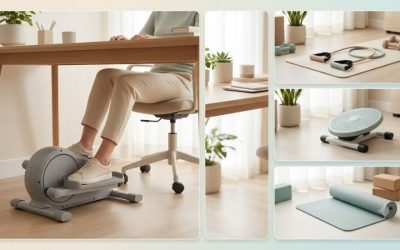
An under-desk elliptical may be more practical because it occupies little floor space and can be moved.
However, seated operation provides a different exercise experience.
Scenario 3: A Buyer Who Primarily Wants Walking
A walking pad may better match the intended activity.
Choosing an elliptical solely because it appears compact would create an unnecessary mismatch with the user’s preferred movement.
Frequently Asked Questions
Are Compact Ellipticals as Good as Full-Size Ellipticals?
They can be suitable for many users, but shorter stride length, limited adjustment, and different frame designs may create compromises.
Is a Compact Elliptical Better Than an Exercise Bike?
Neither is universally better. The decision depends on whether standing elliptical movement or seated cycling is preferred.
Are Mini Ellipticals Suitable for Standing Use?
Some are. For example, Stamina documents seated and standing use for particular InMotion models. Always verify the exact product’s intended operation.
How Much Space Does a Compact Elliptical Need?
Dimensions vary widely. Measure the full assembled footprint, movement clearance, ceiling height, and access area.
Are Compact Ellipticals Quiet?
Noise depends on the drivetrain, resistance system, flooring, and maintenance. Compact size does not guarantee quiet operation.
Can a Compact Elliptical Replace a Walking Pad?
It can serve as an alternative cardio exercise device, but it does not reproduce natural walking mechanics.
Conclusion
When comparing a compact elliptical vs alternatives, the main decision is whether standing elliptical movement justifies the required space and potential stride compromises. Full-size ellipticals offer additional geometry options, under-desk devices prioritize seated convenience, exercise bikes provide cycling, mini steppers save floor area, and walking pads support walking. Choose according to movement comfort, verified dimensions, and realistic training needs.

Write Your Review
No reviews yet. Be the first to share your experience!