
Key takeaways
-
Choose magnetic resistance when adjustable workout intensity, relatively restrained operating noise, and home convenience are your priorities.
-
Choose air resistance when effort-responsive loading, rowing performance metrics, and structured training matter most.
-
Choose water resistance when you prefer fluid-based loading, water movement sound, and potentially attractive furniture-like construction.
-
Choose hydraulic resistance when limited floor space or a modest budget makes a compact mechanism especially attractive.
-
Consider hybrid air-magnetic resistance when you want characteristics of both systems, provided the exact implementation justifies its cost and complexity.
Choosing between a magnetic rowing machine vs alternatives involves more than deciding which resistance system feels best. Air, water, hydraulic, and hybrid rowers differ in resistance response, noise, maintenance, workout tracking, and storage. This comparison explains those differences so you can select the most suitable machine for your home and training goals.
Quick Verdict: Magnetic Rowing Machine vs Alternatives
A magnetic rowing machine is often an attractive choice for home exercisers who value controlled resistance adjustment, relatively low mechanical noise, and straightforward indoor use. However, magnetic resistance does not automatically provide the same rowing sensation, workload range, or performance measurement capabilities as competing systems.
An air rower can be more appropriate for athletes who want resistance to respond dynamically to pulling effort. A water rower offers a different fluid-resistance experience and may appeal to users who value its sound and appearance. Hydraulic rowers can be practical where equipment footprint and initial cost matter, although their movement mechanisms vary substantially.
The important distinction is that resistance type influences how the machine responds to the user, but it does not independently determine overall quality.
A well-engineered magnetic rower may be more useful than a poorly constructed air rower. Likewise, a high-quality air rower may offer more consistent performance tracking than a basic magnetic machine.
For buyers who want a quick starting point:
-
Choose magnetic resistance when adjustable workout intensity, relatively restrained operating noise, and home convenience are your priorities.
-
Choose air resistance when effort-responsive loading, rowing performance metrics, and structured training matter most.
-
Choose water resistance when you prefer fluid-based loading, water movement sound, and potentially attractive furniture-like construction.
-
Choose hydraulic resistance when limited floor space or a modest budget makes a compact mechanism especially attractive.
-
Consider hybrid air-magnetic resistance when you want characteristics of both systems, provided the exact implementation justifies its cost and complexity.
None is universally superior. The best choice depends on how you train, the space available, and which trade-offs you are willing to accept.
Quick Comparison Table
| Criteria | Magnetic rower | Air rower | Water rower | Hydraulic rower |
|---|---|---|---|---|
| Resistance source | Magnets acting on rotating components | Air drag on fan flywheel | Water moving through tank | Hydraulic cylinders |
| Response to harder strokes | Model-dependent; may combine preset load and effort effects | Resistance increases with flywheel speed | Resistance changes with water movement and stroke force | Depends on cylinder mechanics |
| Adjustable settings | Common | Damper settings on many models | Water level or other model-specific adjustments | Model-dependent |
| Operating sound | Often relatively quiet | Noticeable airflow noise | Water movement sound | Mechanical and hydraulic noise |
| Power requirements | Manual or electronic, depending on model | Often mechanically powered | Frequently mechanical | Often mechanical |
| Maintenance | Drivetrain and electronics as applicable | Flywheel, chain/cord, mechanical components | Tank care, seals, drivetrain | Cylinder and pivot inspection |
| Space requirement | Varies widely | Often long frame | Often long frame | Some compact models |
| Performance tracking | Depends on monitor and calibration | Strong on selected ergometers | Depends on sensor system | Frequently basic |
| Main advantage | Resistance control | Effort-responsive training | Fluid-resistance experience | Compact designs |
| Main drawback | Variable rowing feel and performance data | Airflow noise | Water-related maintenance | Movement and heat limitations |
This table compares general resistance-system characteristics. Individual machines can depart substantially from these patterns.
How Magnetic Rowing Machines Work Compared With Alternatives
The resistance mechanism is one of the most important mechanical differences among rowing machines. Understanding it helps explain why two rowers can feel different even when their advertised resistance levels appear similar.
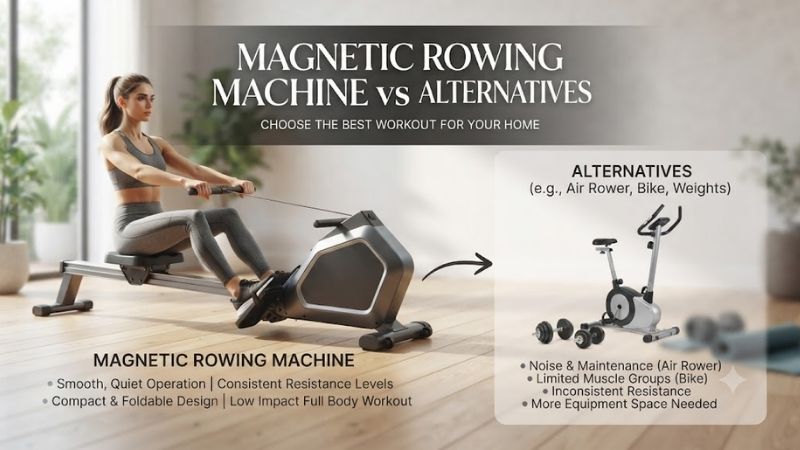
Magnetic Resistance: Controlled Loading Through a Flywheel
A typical magnetic rower uses magnets positioned near a rotating metal component. The magnetic system creates resistance through electromagnetic effects without relying on friction pads rubbing directly against the flywheel.
In many manually adjustable machines, turning a dial changes the magnetic interaction. In electronic systems, the console adjusts resistance through a controlled mechanism.
This provides a means of changing the machine’s resistance characteristics without replacing components or changing fluid levels.
However, the relationship between resistance setting, handle force, and rowing speed depends on the complete drivetrain.
Some magnetic rowers combine magnetic braking with flywheel inertia, and the user may experience different resistance behavior at different stroke speeds. Other designs attempt to simulate broader rowing conditions using electronically controlled resistance profiles.
A major advantage is convenience: the user can generally select a setting and repeat the same nominal adjustment during later workouts.
The limitation is that a displayed resistance level does not represent a standardized workload across brands. Level eight on one machine might feel substantially different from level eight on another.
Buyers should therefore consider documented resistance characteristics and credible performance evaluations rather than relying on resistance-level counts alone.
Air Resistance: Loading That Responds to Pulling Effort
Air rowers use a fan flywheel that moves air as it rotates.
When the user pulls the handle, the drivetrain accelerates the fan. Increasing flywheel speed increases aerodynamic drag, so harder strokes generally create greater resistance.
This creates an effort-responsive workout experience.
The user can row gently with relatively modest effort or accelerate the flywheel more aggressively with stronger strokes.
Many air rowers include a damper controlling airflow.
An important misconception is that the damper works like a fixed weight selector. In reality, it changes the flywheel’s aerodynamic characteristics. On supported machines, this can be described through drag-factor measurements.
The Concept2 RowErg is a useful example of a widely documented air-resistance machine. Its PM5 monitor supports structured workout metrics, while the fan flywheel supplies effort-responsive resistance.
A potential disadvantage is airflow noise, particularly during harder efforts.
For dedicated training, that noise may be acceptable. For an apartment where people are working or sleeping nearby, it can influence the buying decision.
Water Resistance: A Different Form of Fluid Loading
Water rowers use paddles or a related mechanism moving within a water tank.
When the user pulls, the mechanism transfers energy into the water. Resistance depends on the interaction between the paddles, water, and rotating assembly.
As with air systems, harder strokes can produce greater resistance.
However, air and water rowers are not mechanically identical. Their resistance curves, inertia, and subjective movement characteristics depend on the individual designs.
WaterRower’s Original series illustrates a tank-based resistance system where the user can vary effort through the stroke.
Water level may also influence the experience, but increasing water level should not be interpreted as adding a standardized fixed weight.
A major consideration is water maintenance.
Tank systems require appropriate care, including following manufacturer instructions for water treatment, filling, seals, and storage.
For some buyers, the sound of moving water is pleasant. Others may find it distracting.
These preferences are subjective and cannot be settled by the resistance mechanism alone.
Hydraulic Resistance: Compact but Mechanically Different
Hydraulic rowing machines use cylinders to resist movement.
Some compact designs use independent arms, while others have different handle mechanisms.
These machines can occupy less floor space than a conventional long-rail rower, depending on the design.
However, the stroke path may differ significantly from the movement offered by a conventional central-handle machine.
Hydraulic resistance can also respond to temperature and movement speed.
The cylinders may warm during repeated exercise, and certain models specify continuous-use restrictions.
Therefore, a compact hydraulic rower should not automatically be treated as a direct substitute for a magnetic, air, or water ergometer.
It may be suitable for general home exercise, but buyers who want a particular rowing stroke and consistent performance monitoring should examine the mechanism carefully.
Magnetic vs. Air Rowing Machines: Which Is Better?
This comparison is particularly important because magnetic and air machines are among the common choices for indoor cardio equipment.
The right answer depends on whether the buyer values preset resistance control or effort-responsive training.
Resistance Behavior During Steady-State Workouts
During steady-state rowing, the user maintains a relatively consistent pace and effort.
On a magnetic rower, selecting a repeatable resistance setting can be convenient because the machine retains a predictable nominal configuration.
This may help a beginner establish a regular exercise routine.
However, the actual workload still depends on stroke mechanics, speed, and the resistance system.
On an air rower, resistance responds to how the user accelerates the flywheel.
A controlled steady stroke can produce a repeatable training experience, particularly on a machine with a reliable performance monitor.
The major distinction is not that one system provides consistent workouts and the other does not.
Rather, they use different resistance mechanisms, and their suitability depends on how the user intends to regulate effort.
Resistance During High-Intensity Intervals
Air rowers are well suited to efforts in which users intentionally vary pulling force.
During a hard interval, stronger acceleration produces increased aerodynamic drag.
When the user reduces effort, flywheel speed decreases.
This characteristic allows intensity to respond naturally to the stroke.
A magnetic rower may also support demanding intervals, but the result depends on its resistance range and drivetrain.
Some electronic magnetic machines offer programmed intervals and automatic resistance adjustments.
However, the ability to select many resistance levels should not be confused with verified peak workload capability.
For buyers planning frequent high-intensity sessions, credible resistance and performance information is more useful than simply counting settings.
Which System Feels More Like Rowing on Water?
Neither magnetic nor air resistance automatically reproduces the exact forces experienced in a rowing shell.
On-water rowing involves water interaction, boat movement, blade mechanics, and dynamic conditions not fully represented by stationary equipment.
Air rowers can provide a useful effort-responsive training platform.
Magnetic machines may offer a different loading sensation, depending on their engineering.
Some hybrid systems attempt to reproduce particular stroke profiles.
Buyers should be cautious about broad claims of a completely realistic rowing experience unless supported by appropriate evidence.
For most home users, comfortable mechanics, controlled stroke sequencing, and suitable resistance are more important than promotional descriptions of realism.
Which Is Better for Performance Tracking?
Performance tracking is determined by the measurement system, not simply by resistance type.
The Concept2 RowErg uses a PM5 monitor designed to calculate and display rowing performance metrics.
This established monitoring arrangement is useful for users who want consistent workout comparisons.
A basic magnetic rower may display time, estimated distance, stroke count, and calories without the same measurement methodology.
More sophisticated magnetic machines may calculate power or integrate electronically controlled resistance.
When comparing workouts across different brands, the displayed watts or distance may not be directly equivalent.
Buyers who care about training data should verify how each machine calculates performance, whether measurements have been independently evaluated, and whether the monitor supports the intended software.
Which Is Better for Beginners?
Both resistance systems can be appropriate for beginners.
A magnetic rower with simple controls may be easy to operate, particularly when the buyer prefers setting a comfortable resistance level.
An air rower can also accommodate beginners because the user controls much of the effort through stroke intensity.
Beginners should not assume that air resistance is inherently too demanding or that magnetic resistance is always easier.
Seat comfort, foot placement, handle height, correct technique, and manageable resistance are more important.
A well-designed machine that accommodates the rider’s body dimensions will usually be preferable to a poorly fitting machine with an attractive resistance specification.
Magnetic vs. Water Rowing Machines: Which Should You Choose?
Water and magnetic rowing machines can both provide home exercise, but the differences extend beyond sound.
Resistance Adjustment and Everyday Convenience
Magnetic rowers commonly allow adjustment through a knob, button, or console setting.
This can be convenient when users want to change the nominal resistance during a workout.
Water rowers typically depend on the interaction of water and paddles, with some models allowing users to change the tank’s water level.
However, altering water level is not always intended as a frequent workout adjustment.
WaterRower’s fluid-resistance mechanism responds to rowing effort, so a user need not change water volume simply to vary workout intensity.
The practical distinction is that a magnetic machine may provide convenient selectable resistance settings, while a conventional water rower emphasizes resistance generated through fluid movement.
Sound and Household Preferences
Magnetic resistance avoids direct friction-pad contact and can support relatively restrained mechanical sound.
However, the drivetrain, seat rollers, belt, and other components can still produce noise.
Water machines generate audible water movement.
This sound may be appealing to someone who wants a particular atmosphere while exercising.
However, it is not the same as silence.
For shared apartments or bedrooms, both machines should be assessed according to actual sound characteristics, floor vibration, and the intended workout times.
Maintenance and Long-Term Ownership
Magnetic rowing machines generally require mechanical inspection and, depending on their features, electronic maintenance.
Water machines add a tank and water-treatment requirements.
The WaterRower Original, for example, uses a water-filled resistance tank and requires care according to its manufacturer’s instructions.
A water rower may also be heavier when filled than when empty.
That additional weight matters when moving equipment or evaluating storage arrangements.
Magnetic machines eliminate water-treatment tasks, but they are not maintenance-free.
The easiest machine to own is the one whose maintenance requirements match your habits and whose replacement parts remain available.
Aesthetics and Furniture-Like Construction
Some water rowers use wooden frames.
For example, the WaterRower Original is available in solid hardwood finishes, which may appeal to buyers who want exercise equipment that complements home furnishings.
However, wood construction does not automatically indicate better stability or greater durability than a metal frame.
The complete structural design, maintenance requirements, and manufacturer’s specifications are more important than material appearance.
If the rower will remain in a living room, appearance can legitimately influence the purchase.
If the equipment will be used in a dedicated garage gym, mechanical performance and serviceability may matter more.
Magnetic vs. Hydraulic Rowers: Which Offers Better Value?
Hydraulic rowers are sometimes presented as inexpensive alternatives to magnetic machines, but their differences can be substantial.
Comparing the Rowing Motion
A conventional magnetic rower often uses a central handle attached to a belt or cable, with the user moving along a rail.
Some hydraulic rowers use separate rowing arms.
These may create different arm paths and mechanical relationships.
Therefore, buyers should not assume that both machines reproduce the same exercise.
For someone who values a consistent central-handle rowing motion, the magnetic design may be more appropriate.
For someone who simply wants compact seated exercise, a hydraulic machine may still be worth considering.
Resistance Consistency
Magnetic systems can provide repeatable nominal settings.
Hydraulic mechanisms may be affected by temperature, stroke speed, and cylinder design.
This does not automatically make hydraulic machines unsuitable, but it creates additional considerations for prolonged or highly structured workouts.
If a hydraulic model specifies usage and cooling limits, those requirements matter.
A magnetic machine may be the more convenient option for someone who prefers longer continuous sessions, provided its own operating limits permit them.
Footprint and Storage
Some hydraulic rowers are compact because they do not require the same long frame and flywheel arrangement used by conventional rowing machines.
However, not every hydraulic rower is small.
Some use extended rowing arms that require considerable side clearance.
A magnetic rower may have a longer rail but offer folding or upright storage, depending on its design.
Compare actual operating dimensions, not marketing terms such as compact or space-saving.
Price and Long-Term Cost
Hydraulic equipment may offer a lower entry price in some product ranges.
However, a cheaper initial purchase is not always the least expensive long-term option.
Cylinder replacement, component availability, and maintenance should be considered.
A magnetic machine may cost more initially but provide features that are more useful for frequent home exercise.
The better value depends on intended usage and available support.
Noise Comparison: Which Rowing Machine Is Best for Apartments?
Noise is a major consideration for buyers living in apartments, condominiums, and shared housing.
However, resistance type alone does not establish total sound output.
Air Rowers and Fan Noise
Air rowers generate airflow sound as the flywheel rotates.
The noise usually changes with exercise effort and flywheel speed.
A hard interval can sound different from gentle steady-state rowing.
This may be acceptable in a dedicated exercise room but distracting in a shared living space.
Water Rowers and Tank Noise
Water rowers produce the sound of water moving within the resistance tank.
Some users find this pleasant, but the volume and character depend on the design and rowing intensity.
Water movement sound should not be confused with complete acoustic isolation.
Seat rollers and other mechanical components can also create noise.
Magnetic Rowers and Mechanical Noise
Magnetic resistance avoids some continuous contact noise associated with friction mechanisms.
Nevertheless, belts, seat rollers, bearings, and frame connections may still generate sound.
A poorly assembled magnetic rower may be louder than expected.
Therefore, buyers should investigate evidence about the specific model rather than assuming all magnetic rowers are quiet.
Hydraulic Rowers and Cylinder Noise
Hydraulic machines may generate sounds from cylinders, pivots, and mechanical arms.
Their sound characteristics depend on construction and maintenance.
Some models can develop squeaks or other noises when components wear.
Floor Vibration and Noise Transmission
Rowing involves repeated leg drive and seat movement.
These forces can be transmitted through the machine into the floor.
A suitable equipment mat may protect flooring and reduce some vibration, but it cannot guarantee soundproofing.
Building construction also matters.
For noise-sensitive environments, a stable machine, appropriate placement, and suitable operating conditions are essential regardless of resistance type.
Space Requirements and Storage Comparison
The space needed for a rowing machine extends beyond the frame dimensions.
A long rail, handle clearance, seat movement, and safe entry area must all be considered.
Magnetic Rowing Machines
Magnetic rowers vary widely in length.
Some include folding rails, while others use fixed frames.
A folding model may save storage space but still require a substantial operating footprint.
Buyers should confirm assembled dimensions, folded dimensions, and clearance requirements separately.
Air Rowing Machines
The Concept2 RowErg provides a useful documented example.
The standard machine measures 96 inches long and 24 inches wide.
Its manufacturer recommends approximately 9 × 4 feet of clear space for use.
The machine can separate into two sections for storage without tools.
This makes it potentially practical for homes where a long machine can be stored in components.
However, separating equipment after every workout may not suit every household.
Water Rowing Machines
The WaterRower Original measures approximately 82 inches long and 22.25 inches wide during use.
Its published storage configuration is approximately 17.25 inches deep, 22.25 inches wide, and 81.5 inches high.
The manufacturer provides an upright storage configuration without requiring the tank to be emptied, subject to its instructions.
This can make the machine attractive when floor storage space is limited.
However, vertical storage requires sufficient ceiling height and a safe location.
Hydraulic Rowing Machines
Hydraulic machines may offer compact frames, but operating clearance depends on the handle mechanism.
A model with separate rowing arms may require more side space than its frame suggests.
Always measure the full movement area.
What Matters Most in a Small Room?
The most important measurement is the complete workout area.
A machine may store compactly yet require a long, unobstructed area during use.
If the room cannot accommodate a correct rowing stroke, the machine may be unsuitable regardless of its storage configuration.
Choose storage features only after verifying the machine fits in its operating position.
Workout Performance and Training Goals
Different users place different demands on a rowing machine.
A person doing occasional moderate sessions may not require the same capabilities as someone tracking structured intervals or competitive performance.
Beginners and General Cardio
Beginners benefit from comfortable fit, predictable movement, and straightforward controls.
A magnetic machine may be appealing because resistance adjustment is often convenient.
However, an air or water rower can also be suitable when the user controls the stroke appropriately.
The machine should support learning correct rowing mechanics.
Steady-State Endurance
Longer, controlled sessions require a comfortable seat, suitable rail travel, and a resistance mechanism designed for the intended duration.
Air, water, and magnetic rowers can all support this use case, depending on the exact model.
Hydraulic rowers should be checked carefully for continuous-use limits.
Interval Training
Air rowers offer naturally effort-responsive resistance.
This can be useful when alternating between gentle and forceful strokes.
Some magnetic machines support electronically programmed intervals.
Neither approach is automatically superior.
The better choice depends on the desired training format and the machine’s documented capabilities.
Performance-Oriented Rowing
Users comparing scores over time may value established performance monitoring systems.
The Concept2 RowErg is a relevant example because its PM5 monitor is designed for consistent workout metrics.
However, a performance monitor should not be assumed to measure identical values across unrelated machines.
If comparable training data is a priority, staying within the same measurement ecosystem may be useful.
Rehabilitation and Health-Related Exercise
Rowing machines are often described as low-impact equipment, but low impact does not mean universally suitable.
Rowing involves repeated movement of the hips, knees, back, and shoulders.
Individuals with injuries or medical limitations may need professional guidance.
Resistance type alone does not determine whether rowing is appropriate for a specific condition.
Maintenance and Long-Term Reliability
Ownership costs extend beyond the purchase price.
Magnetic Rower Maintenance
Magnetic machines may require inspection of belts, rails, seat rollers, and frame connections.
Electronically controlled models may also contain sensors, wiring, and console components.
The resistance system itself may not require friction-pad replacement, but other components can still wear.
Air Rower Maintenance
Air rowers may require flywheel cleaning, chain or cord inspection, and routine checks of moving parts.
For example, the Concept2 RowErg uses a nickel-plated steel chain, so maintenance requirements differ from belt-driven alternatives.
Follow the exact manufacturer’s service instructions.
Water Rower Maintenance
Water rowers require attention to the tank and water-treatment recommendations.
Seals, paddles, drivetrain components, and seat mechanisms also deserve inspection.
Some manufacturers provide replacement parts and service documentation.
These factors influence long-term ownership value.
Hydraulic Rower Maintenance
Hydraulic cylinders and pivot joints may require inspection.
A leaking or damaged cylinder should be addressed according to manufacturer guidance.
Do not attempt improvised repairs to sealed hydraulic components.
Replacement Parts and Support
Before purchasing, investigate whether the manufacturer offers replacement parts and service information.
A rower with accessible parts may be easier to maintain over time.
However, long warranty periods alone do not guarantee durability.
Price and Value: What Are You Really Paying For?
A meaningful value comparison should consider features, mechanical suitability, maintenance, and expected usage.
Entry-Level Magnetic vs. Hydraulic Rowers
A basic hydraulic machine may cost less than a conventional magnetic rower.
However, it may also provide a different rowing movement and fewer tracking features.
The correct comparison is not simply price against price.
It is whether each machine meets the user’s intended requirements.
Midrange Magnetic vs. Water Rowers
A midrange magnetic machine may offer electronic resistance control and connected features.
A water rower may emphasize fluid resistance and frame construction.
The value of each depends on buyer priorities.
A user who cares about selectable resistance and programmed workouts may favor magnetic equipment.
Someone who values fluid resistance and furniture-like design may prefer water.
Magnetic vs. Premium Air Rowers
A premium air rower may justify its cost through construction, performance monitoring, service support, and training compatibility.
A premium magnetic machine may justify its price through electronically controlled resistance, connected training, or additional comfort features.
Neither type is automatically better value.
Hidden Ownership Costs
Consider subscription requirements, electricity, replacement components, maintenance supplies, and accessories.
Some connected rowing machines require subscriptions for particular features.
The buyer should determine which functions remain available without ongoing payments.
Assessing Total Value
A useful way to compare value is to ask whether the equipment supports the workouts you expect to perform over several years.
The cheapest rower may be poor value if it is uncomfortable or lacks essential features.
An expensive model may also be poor value if its advanced functions remain unused.
Who Should Choose Each Rowing Machine?
Choose a Magnetic Rower If You Want Convenient Resistance Control
A magnetic machine is a strong candidate when you prefer selectable resistance settings and straightforward indoor operation.
It may also be appropriate for noise-sensitive households, although actual sound should be verified for the specific model.
Look for a comfortable rail, reliable controls, adequate resistance range, and suitable warranty support.
Skip magnetic models that do not provide the workload, stroke geometry, or tracking functionality you require.
Choose an Air Rower If You Prioritize Effort-Responsive Training
Air rowers are particularly attractive to users who want resistance to respond to pulling force.
They can be useful for varied workout intensities and structured performance monitoring.
However, fan noise and operating length may be important disadvantages in small homes.
Choose a Water Rower If You Prefer Fluid Resistance and Home-Friendly Design
Water rowers may appeal to buyers who value the feel and sound of a water-based mechanism.
Some models also offer attractive wooden frames and upright storage.
However, tank maintenance, filled weight, and operating dimensions should be considered.
Choose a Hydraulic Rower If Compactness and Simplicity Matter Most
A hydraulic machine may be reasonable for users with limited space and relatively modest exercise requirements.
However, check whether its rowing movement matches your expectations.
Pay close attention to resistance consistency, cylinder maintenance, and continuous-use limits.
Consider a Hybrid Rower If You Need Specific Resistance Features
Hybrid machines may combine air and magnetic systems.
This can provide a different range of resistance characteristics or electronic control.
However, hybrid construction is not inherently superior.
Its benefits must be evaluated for the exact design.
Frequently Asked Questions
Is a Magnetic Rowing Machine Better Than an Air Rower?
Not universally. Magnetic rowers often emphasize selectable resistance and relatively restrained operating noise, while air rowers offer resistance that responds dynamically to pulling effort. The better choice depends on your training style, sound tolerance, and required performance features.
Are Magnetic Rowing Machines Quieter Than Water Rowers?
They can be, but noise varies by machine. Water rowers produce water movement sound, while magnetic machines may still produce noise from their drivetrain and seat mechanism. Direct comparisons require consistent testing conditions.
Can a Magnetic Rower Provide Enough Resistance for Advanced Users?
Some can, but resistance capabilities differ. Advanced users should evaluate documented workload range, stroke mechanics, and training features rather than relying on advertised resistance-level counts.
Are Water Rowers More Realistic Than Magnetic Rowers?
Water resistance provides a fluid-based loading mechanism, but that does not mean every water rower reproduces on-water rowing more accurately. Movement geometry, inertia, and rowing technique all influence the experience.
Which Rowing Machine Is Best for a Small Apartment?
The answer depends on operating space, storage options, and noise tolerance. A folding magnetic rower, a separable air rower, or a vertically storable water rower may each be appropriate in different layouts.
Which Resistance System Requires the Least Maintenance?
Maintenance varies by model. Magnetic machines avoid water-treatment requirements, while air and hydraulic machines have their own mechanical needs. No rowing resistance system makes the entire machine maintenance-free.
Conclusion
For most buyers comparing a magnetic rowing machine vs alternatives, the decision comes down to resistance behavior, noise, available space, and training requirements. Magnetic rowers suit users who value convenient resistance adjustment, air rowers appeal to performance-focused exercisers, water rowers offer fluid-based loading, and hydraulic models may solve specific space or budget constraints. Choose according to verified specifications and the complete workout experience rather than resistance type alone.






Write Your Review
No reviews yet. Be the first to share your experience!