
Key takeaways
-
Mounting configuration: Wall-mounted or freestanding.
-
Machine height: Compatibility with the available ceiling.
-
Operating clearance: Enough room to complete the pulling movement.
-
Installation requirements: Suitable wall construction or a manufacturer-approved floor stand.
-
Resistance system: Appropriate feel and effort characteristics.
-
Frame and cord quality: Durable construction and reliable mechanical operation.
-
Noise: Acceptable sound for the intended environment.
-
Workout monitoring: Useful performance data without unnecessary complexity.
-
Maintenance: Accessible cleaning and inspection procedures.
-
Storage and portability: Practical relocation if the machine cannot remain permanently installed.
Choosing a ski erg machine for small spaces means evaluating more than the equipment’s narrow frame. Wall mounting, floor stands, pulling clearance, and ceiling height determine whether the setup works in your home. This guide explains how to compare compact configurations, assess installation requirements, and select a ski erg that fits your training area.
Quick Verdict: Is a Ski Erg Good for Small Spaces?
A ski erg is a stationary exercise machine designed to simulate aspects of cross-country skiing through repeated downward pulling movements.
Unlike a rowing machine, which typically requires a long floor area for its sliding seat, a ski erg positions the user primarily in front of an upright resistance unit.
This arrangement can make a ski erg practical for home gyms with limited floor length.
Wall-mounted machines are especially appealing because they eliminate the need for a large freestanding base.
However, the equipment still requires sufficient room for the user’s pulling movement, body position, and safe operation.
The best small-space configuration depends on whether permanent wall mounting is feasible.
The main buying priorities are:
-
Mounting configuration: Wall-mounted or freestanding.
-
Machine height: Compatibility with the available ceiling.
-
Operating clearance: Enough room to complete the pulling movement.
-
Installation requirements: Suitable wall construction or a manufacturer-approved floor stand.
-
Resistance system: Appropriate feel and effort characteristics.
-
Frame and cord quality: Durable construction and reliable mechanical operation.
-
Noise: Acceptable sound for the intended environment.
-
Workout monitoring: Useful performance data without unnecessary complexity.
-
Maintenance: Accessible cleaning and inspection procedures.
-
Storage and portability: Practical relocation if the machine cannot remain permanently installed.
For a dedicated training area with appropriate wall construction, a wall-mounted ski erg can provide an efficient use of floor space.
A freestanding configuration is more flexible when wall mounting is not permitted or practical.
Understanding Different Ski Erg Configurations
Ski ergs are available in configurations that affect floor space, installation, and portability.
Wall-Mounted Ski Erg Machines
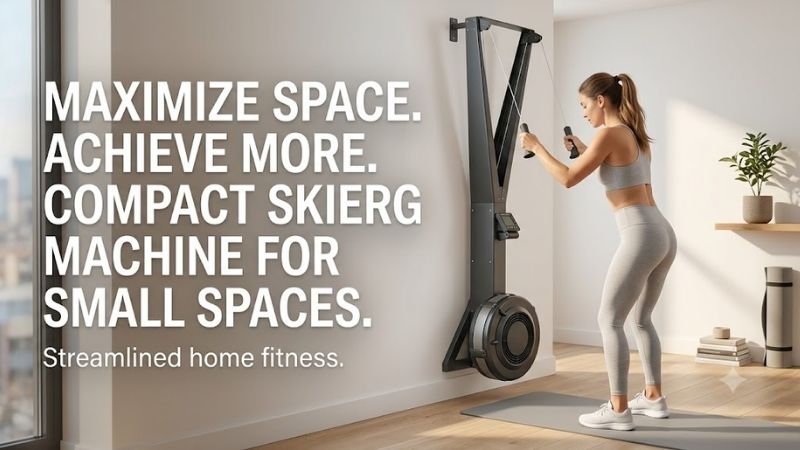
Wall-mounted ski ergs attach directly to a suitable structural wall.
The resistance unit remains upright while the user stands in front and pulls the handles downward.
This arrangement can minimize the floor area occupied by the equipment itself.
However, a small mounted footprint should not be confused with a small operating area.
The user still needs enough floor space for stance, movement, and clearance.
Wall mounting also requires appropriate structural support and correctly specified hardware.
A wall-mounted machine should never be attached to unsuitable construction merely to save floor space.
Freestanding Ski Erg Machines
Freestanding machines use a floor stand or integrated base instead of relying entirely on a wall attachment.
This arrangement can be practical in rental properties or homes where permanent installation is undesirable.
Some floor stands include transport wheels.
However, freestanding designs generally occupy more floor area than wall-mounted configurations.
They must also remain stable during repeated pulling movements.
A floor stand should be approved for the exact ski erg model.
Do not assume that a stand designed for one machine fits another.
Air-Resistance Ski Ergs
Air-resistance machines use a flywheel and fan arrangement.
The user’s pulling effort accelerates the flywheel, creating aerodynamic resistance.
This means workload depends substantially on how forcefully the user pulls.
Some machines also include a damper that changes airflow characteristics.
A damper should not automatically be treated as a standardized resistance-level control.
The relationship between airflow, flywheel speed, and user effort is different from a conventional magnetic resistance selector.
Alternative Resistance Systems
Some ski-style trainers use magnetic, friction-based, or other resistance arrangements.
These may offer different adjustment and operating characteristics.
However, not every machine marketed as a ski trainer uses the same movement path or performance measurement system.
Buyers should verify the resistance mechanism and intended exercise before comparing specifications.
How Much Space Does a Ski Erg Machine Need?
A ski erg can be relatively compact, but actual room compatibility depends on both equipment dimensions and the user’s movement area.
Wall-Mounted Ski Erg Dimensions
The Concept2 SkiErg provides a useful real-world reference.
Its manufacturer lists the wall-mounted configuration at approximately:
-
85 inches tall.
-
19 inches wide at the bottom.
-
20.5 inches wide at the top.
-
16 inches deep.
These are specifications for that particular model, not universal ski erg dimensions.
The mounted unit occupies relatively little floor depth, but the user must stand and move in front of it.
The small machine footprint does not replace the manufacturer’s operating-clearance requirements.
Freestanding Ski Erg Dimensions
The same Concept2 SkiErg, when installed on its standard optional floor stand, has a listed overall footprint of approximately 23.5 × 50 inches and a height of 85 inches.
Its wider stand configuration is approximately 32 × 52 inches at the base.
The standard stand occupies about 8.2 square feet of floor area, before additional operating clearance is considered.
These examples illustrate why wall mounting can save space.
However, the trade-off is that wall installation must be structurally appropriate.
| Configuration | Example dimensions | Main advantage | Key consideration |
|---|---|---|---|
| Concept2 SkiErg, wall-mounted | 85 in high; 19–20.5 in wide; 16 in deep | Minimal equipment floor footprint | Structural mounting |
| Concept2 SkiErg, standard stand | 23.5 × 50 × 85 in | No wall attachment required | Larger floor base |
| Concept2 SkiErg, wide stand | 32 × 52 × 85 in | Alternate freestanding configuration | Greater floor width |
| Other ski-style trainers | Model-dependent | Different features or resistance systems | Verify exact geometry |
These figures illustrate the relationship between mounting options and space requirements. They should not be applied to unrelated models.
Understanding the Training Area
The machine’s outer dimensions do not establish the full usable exercise area.
A ski erg requires enough room for the user to stand, pull the handles, bend at the hips and knees where appropriate, and finish each movement.
The Concept2 SkiErg manual provides a reference free-area recommendation of approximately 48 × 76 inches.
That recommendation is substantially larger than the mounted unit’s physical footprint.
It demonstrates why buyers should separate storage dimensions from operational clearance.
Always use the instructions for the exact machine and installation configuration.
Measuring Ceiling Height
Ski ergs can be relatively tall.
Before purchasing, measure the room from floor to ceiling at the intended position.
Check for beams, soffits, lighting fixtures, and other overhead obstructions.
A machine that is 85 inches tall cannot be assumed to fit in every room with an eight-foot ceiling without additional consideration.
The available height may also affect installation access and the user’s ability to operate the handles comfortably.
Confirm all mounting and movement requirements.
Planning a Small Home Gym Layout
Position the ski erg where the user can move naturally without contacting surrounding equipment.
Avoid placing it directly beside a power rack, bench, or storage unit if those objects interfere with pulling movements.
If the ski erg shares space with other exercise equipment, make sure only compatible activities occur within the overlapping area.
The layout should preserve safe entry, exit, and access to the equipment.
Wall Mounting vs. Floor Stand: Which Is Better?
Mounting configuration is often the most important buying decision for a small-space ski erg.
Advantages of Wall Mounting
Wall mounting reduces the floor area occupied by the equipment base.
It can also provide a permanent, ready-to-use training station.
For compact dedicated home gyms, this is a meaningful advantage.
However, the wall must support the installation according to the manufacturer’s instructions.
Wall Construction Requirements
A ski erg cannot safely be mounted to arbitrary wall finishes.
For example, Concept2 provides mounting hardware intended for a particular wood-stud arrangement and directs users with other wall types to seek appropriate professional guidance.
Drywall alone should not be assumed to provide sufficient structural support.
Concrete, masonry, steel framing, and other construction types may require different mounting solutions.
A qualified installer or building professional may be necessary.
Advantages of a Floor Stand
A manufacturer-approved floor stand avoids permanent wall mounting.
This is convenient for renters, shared training rooms, or anyone who wants flexibility.
Some stands incorporate wheels that assist with repositioning.
However, transport wheels do not mean the machine should be moved during exercise.
The equipment must remain stable and properly positioned while in use.
When a Freestanding Ski Erg Makes Sense
Choose a freestanding configuration when wall construction is unsuitable or permanent installation is not allowed.
It can also be useful if the machine will occasionally move between exercise areas.
However, measure the entire stand footprint and operating space before buying.
A freestanding machine may eliminate installation work but require more valuable floor area.
Understanding Ski Erg Resistance Systems
Resistance determines how effort is translated into the workout.
Ski ergs can use different mechanisms, so buyers should understand the system rather than comparing marketing labels alone.
How Air Resistance Works
Air-resistance ski ergs generally use a fan flywheel.
Pulling the handles causes the flywheel to rotate.
The effort required depends on the interaction between user-applied force, flywheel speed, and aerodynamic drag.
Stronger pulls generally increase flywheel speed and resistance.
This self-regulating behavior differs from systems in which the user chooses a fixed magnetic resistance setting.
What Does the Damper Do?
On machines such as the Concept2 SkiErg, a damper controls airflow into the flywheel housing.
Changing the damper setting changes how the flywheel behaves.
It is not accurate to describe damper numbers as directly equivalent to standardized resistance weights.
A higher damper setting is not automatically better.
The appropriate setting depends on technique, training goals, and individual preference.
Magnetic Resistance Alternatives
Some ski-style trainers incorporate magnetic resistance systems.
These may provide manual or electronically controlled adjustments.
The operating feel can differ from air-resistance machines.
However, magnetic resistance does not automatically guarantee superior smoothness or silence.
The complete mechanical design matters.
Resistance and Workout Intensity
Workout intensity depends on user effort and equipment characteristics.
A beginner can use an air-resistance machine at a manageable effort level, while an experienced athlete can apply greater force.
However, the machine must still be used with appropriate technique.
Do not assume that increasing resistance or pulling harder always produces better results.
Controlled movement and suitable progression are more useful than aggressive effort without proper technique.
Handle Design, Cords, and Pulling Mechanics
The handle and cord system is central to a ski erg’s performance.
Handle Shape and Grip
Ski erg handles should allow secure hand contact during repeated pulling movements.
Grip comfort depends on handle shape, surface, and the user’s hand size.
Some designs support different pulling techniques.
Use only grip positions approved for the machine.
Cord Material and Construction
Many ski ergs use high-strength synthetic cords.
These transmit pulling force to the resistance mechanism.
Cord durability depends on material, routing, maintenance, and operating conditions.
Check whether replacement cords are available.
Cord Travel and User Height
The machine should accommodate the user’s intended pulling range.
A taller user may require more vertical reach than a shorter user.
Check handle height and travel characteristics rather than relying only on frame height.
Smooth Handle Return
The handles should return according to the manufacturer’s intended mechanism.
Unexpected slack, sticking, or uneven return may indicate a mechanical issue.
Stop using the machine if the cords or retraction mechanism behave abnormally.
Alternating and Simultaneous Pulling
Some ski ergs support simultaneous double-pole movement and alternating-arm techniques.
However, not every machine is designed for every pulling style.
Follow the manufacturer’s recommended movements.
Frame Stability and Installation Safety
Stability of Wall-Mounted Machines
A wall-mounted machine depends on appropriate structural attachment.
The installed unit must remain secure under repeated pulling forces.
Never modify mounting hardware without an approved installation plan.
Stability of Floor Stands
A floor stand must provide stable support on a suitable surface.
Check the manufacturer’s floor requirements and installation instructions.
Machine Weight and Handling
Machine weight influences assembly and relocation.
Some units require more than one person for safe installation.
Follow the manufacturer’s handling instructions.
Inspection of Fasteners
Mounting fasteners and structural connections should be inspected as directed.
Any unexpected movement at the mounting point requires immediate attention.
Avoiding Improvised Installations
Do not attach a ski erg to ordinary furniture, lightweight partitions, or unidentified structural members.
Safe installation is more important than achieving the smallest possible footprint.
Noise and Apartment-Friendly Use
Ski erg noise depends on the resistance system, mechanical components, installation, and building environment.
Air Flywheel Noise
Air-resistance flywheels produce airflow noise as they rotate.
The sound can become more noticeable during harder pulls.
An air-resistance ski erg should not be described as silent.
Mechanical Noise
Cords, pulleys, bearings, and handle mechanisms can also generate sound.
Maintenance may help prevent abnormal noise.
Wall Vibration
Wall-mounted equipment can transmit some mechanical forces through its attachment points.
The amount depends on installation and building construction.
Do not assume wall mounting eliminates vibration.
Floor Stand Noise
Freestanding configurations may transmit movement through the base.
A suitable floor surface and correct assembly are important.
Apartment Placement
Consider neighboring rooms, shared walls, flooring, and workout times.
If noise control is a major priority, examine credible information about the exact machine rather than relying on resistance-system labels alone.
Console Features and Workout Tracking
Workout Duration and Pace
Many ski ergs provide time and performance information.
These values can help organize structured sessions.
Power and Performance Metrics
Advanced monitors may calculate power and other workout metrics.
However, meaningful comparisons depend on the measurement system and calibration method.
Avoid treating metrics from unrelated machines as directly interchangeable.
Stroke Rate
Stroke rate indicates pulling frequency.
It can be useful when tracking workout consistency.
Heart Rate Monitoring
Some consoles support compatible external heart rate sensors.
Verify compatibility before buying accessories.
Connected Fitness Applications
Bluetooth or other connectivity features may support workout records.
Check the supported protocols and applications for the exact model.
Choosing a Ski Erg for Your Budget
Entry-Level Ski-Style Trainers
Lower-priced machines may use simpler resistance and monitoring systems.
Evaluate their actual mechanics and specifications carefully.
A lower price does not guarantee equivalent performance to established air-resistance trainers.
Midrange Ski Ergs
Midrange equipment may provide improved monitoring, frame construction, or resistance features.
Consider whether these upgrades support your intended training.
Premium Ski Ergs
Higher-priced machines may offer robust construction, detailed metrics, and specialized training functionality.
These features can be useful for frequent training.
However, verify space and installation requirements before considering advanced electronics.
Installation Costs
Wall mounting may involve professional labor and suitable hardware.
Freestanding configurations may require purchasing a compatible stand.
Compare the complete setup cost rather than the machine price alone.
Buying for Specific Small-Space Situations
Apartments
A freestanding configuration may be preferable if wall mounting is prohibited.
Noise and floor requirements also deserve attention.
Bedrooms
Ceiling height and operating clearance are important.
Avoid placing the machine where it interferes with furniture or room access.
Garage Gyms
A garage may provide suitable wall space, but environmental conditions and wall construction must be assessed.
Follow the manufacturer’s storage and installation requirements.
Home Offices
A ski erg can occupy a narrow area, but the operating movement requires additional clearance.
Do not position it where cords or handles can contact office equipment.
Shared Home Gyms
Multiple users may benefit from accessible controls and consistent performance tracking.
Check suitability for different heights and exercise preferences.
Ski Erg vs. Other Compact Cardio Equipment
| Equipment | Primary movement | Space characteristic | Main consideration |
|---|---|---|---|
| Ski erg | Repeated pulling | Wall mounting possible | Installation and pull clearance |
| Rowing machine | Seated rowing | Long operating footprint | Rail and seat travel |
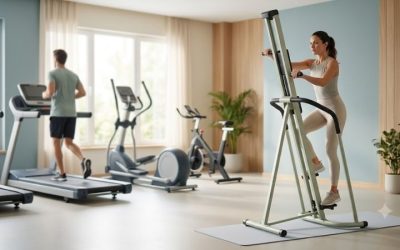
| Vertical climber | Coordinated climbing | Tall upright frame | Ceiling and user fit |
| Mini stair stepper | Standing stepping | Very compact floor area | Balance and stepping mechanics |
| Exercise bike | Seated cycling | Model-dependent footprint | Seat and pedal fit |
Ski Erg vs. Rowing Machine
A ski erg uses repeated pulling while the user generally stands or adopts another approved position.
A rower incorporates seated movement along a rail.
A ski erg may occupy less floor length, especially when wall-mounted.
Ski Erg vs. Vertical Climber
Vertical climbers use coordinated climbing movement.
Ski ergs emphasize pulling through a resistance mechanism.
The machines have different movement patterns and installation needs.
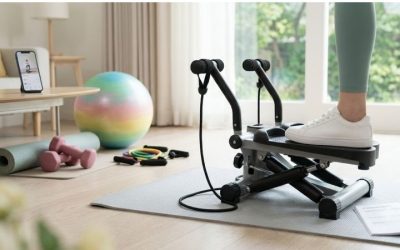
Ski Erg vs. Mini Stair Stepper
Mini steppers emphasize lower-body stepping.
Ski ergs provide a pulling-based exercise movement.
Choose according to preferred training and available space.
Setting Up a Ski Erg Correctly
Measure the Entire Training Area
Check machine dimensions, ceiling height, and movement clearance.
Choose the Mounting Configuration
Select a manufacturer-approved wall or floor stand arrangement.
Install the Equipment Securely
Follow the exact installation instructions.
Seek qualified assistance when wall construction or anchoring is uncertain.
Inspect Handles and Cords
Verify that the pulling system is properly assembled and undamaged.
Begin With Controlled Pulls
Use the manufacturer’s recommended technique and start at manageable effort.
Check Stability
Stop if the machine or mounting structure moves unexpectedly.
Follow Maintenance Instructions
Inspect cords, pulleys, and other components as directed.
Common Mistakes When Buying a Ski Erg
Confusing the Machine Footprint With Operating Space
The user still requires sufficient room for full pulling movements.
Ignoring Wall Construction
Not every wall is suitable for mounting.
Assuming a Floor Stand Is Included
Some manufacturers sell stands separately.
Check the exact package contents.
Treating Damper Numbers as Fixed Resistance Weights
Air-resistance damper settings do not function like standardized weight increments.
Overlooking Noise
Air flywheels and mechanical components can produce noticeable sound.
Comparing Performance Metrics Across Different Systems
Machines may calculate workload and distance differently.
Frequently Asked Questions
Is a Ski Erg Good for a Small Home Gym?
Yes, particularly when wall mounting is feasible. However, ceiling height and operating clearance must meet the machine’s requirements.
Can You Mount a Ski Erg on Drywall?
Drywall alone should not be assumed to provide adequate structural support. Follow the manufacturer’s approved anchoring instructions and consult a qualified professional for uncertain wall construction.
Do Ski Erg Machines Need Electricity?
Some air-resistance machines operate mechanically, with batteries or generated power for their monitors. Requirements vary by model.
Are Ski Ergs Noisy?
Air-resistance machines generate airflow sound during operation, and mechanical components can add noise. Actual sound depends on the machine and environment.
Can a Ski Erg Be Used Without Wall Mounting?
Some models support manufacturer-approved floor stands or freestanding configurations. Check the exact model’s compatibility.
How Much Ceiling Height Does a Ski Erg Need?
Requirements vary. For reference, the Concept2 SkiErg is approximately 85 inches tall. The manufacturer’s operating and installation clearances must also be considered.
Conclusion
The best ski erg machine for small spaces is one that combines a suitable mounting configuration with adequate pulling room, ceiling clearance, and safe installation. Wall-mounted designs can conserve floor area, while freestanding options offer flexibility when permanent mounting is impractical. Prioritize documented dimensions, resistance characteristics, handle mechanics, and long-term serviceability over unnecessary features.







Write Your Review
No reviews yet. Be the first to share your experience!