
A mini stair stepper buying guide should help you evaluate more than price and product appearance. Resistance mechanisms, pedal travel, frame stability, and operating limits determine whether a stepper suits your exercise needs. This guide explains the key specifications, design differences, and practical considerations to review before purchasing.
Quick Verdict: What Should You Look for in a Mini Stair Stepper?
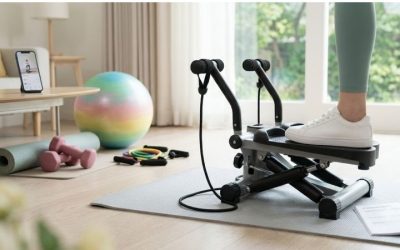
A mini stair stepper is a compact standing exercise device with two foot platforms that move through a repeated stepping pattern.
Most models use a relatively small base and a resistance mechanism, often hydraulic, to control pedal movement.
Unlike full-sized stair-climbing equipment, a mini stepper normally does not provide an integrated staircase or extensive handrail structure.
The most suitable machine depends on the user’s body dimensions, balance, desired stepping motion, and intended exercise frequency.
For straightforward home exercise, a traditional hydraulic mini stepper with stable pedals and clear operating instructions may be sufficient.
Other users may prefer adjustable travel, a twisting mechanism, or additional support features.
Before buying, prioritize:
-
Stepper type: Traditional, twisting, or another documented movement mechanism.
-
Resistance system: Appropriate movement feel and operating characteristics.
-
Pedal dimensions: Secure support for the user’s feet.
-
Step height and travel: Comfortable movement within the machine’s design.
-
Frame stability: Controlled operation on a suitable floor.
-
User weight capacity: Manufacturer-approved loading.
-
Operating duration: Clear guidance regarding continuous use and cooling.
-
Noise: Acceptable mechanical sound for the intended environment.
-
Maintenance: Accessible care instructions and replacement-part support.
-
Warranty: Coverage appropriate to the mechanical components.
A higher price or larger feature list does not necessarily mean better suitability.
Understanding How Mini Stair Steppers Work
A mini stepper converts alternating downward pressure on the pedals into a repeated stepping movement.
The frame supports the pedal assembly while the resistance mechanism controls how the pedals respond.
Different designs produce different movement paths and operating characteristics.
The Basic Stepping Mechanism
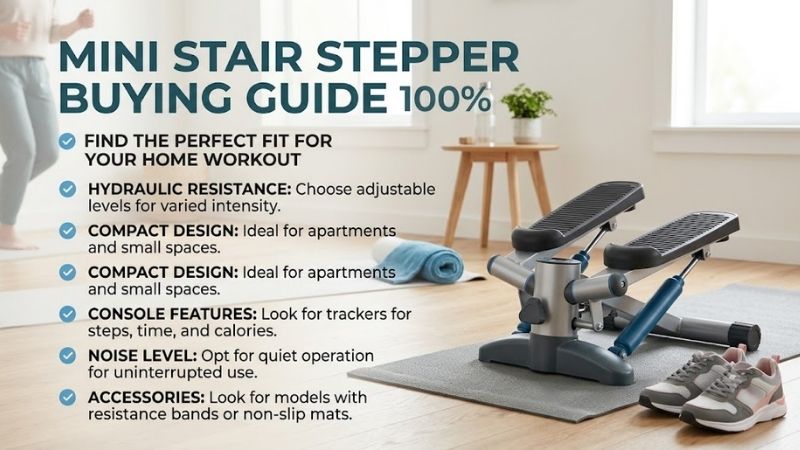
Traditional mini steppers generally consist of two foot platforms connected to mechanical linkages.
As the user presses one pedal downward, the mechanism responds according to the equipment’s design.
Some machines mechanically link the pedals, while others use different movement arrangements.
The exact configuration affects pedal travel, stepping rhythm, and mechanical feel.
Mini steppers should not automatically be treated as equivalent to climbing a real staircase.
The pedal movement may have shorter travel and different biomechanics.
Hydraulic Cylinder Resistance
Many mini steppers use hydraulic cylinders.
These components create resistance through fluid movement and mechanical operation.
Hydraulic systems are attractive for compact equipment because they can provide resistance without a large rotating flywheel.
However, hydraulic cylinders may generate heat during use.
The amount of heat depends on operating conditions and equipment design.
Manufacturers may specify limits on continuous use or required cooling intervals.
Those limits should be treated as essential operating requirements.
Mechanical Linkages and Pedal Movement
The pedal linkage determines how motion is transmitted through the machine.
Some designs guide the feet primarily upward and downward.
Others introduce an angled or rotating component.
Mechanical geometry influences how the motion feels and which movement pattern the user performs.
Buyers should understand the intended pedal path rather than selecting a machine solely from photographs.
Why Mini Steppers Feel Different From Full-Sized Stair Machines
Full-sized stair climbers often use rotating steps or larger climbing mechanisms.
Mini steppers generally have shorter pedal travel and a more compact movement system.
The exercise experience is therefore different.
A mini stepper may be convenient for compact home workouts, but it should not be assumed to reproduce the exact mechanics or resistance range of commercial climbing equipment.
Types of Mini Stair Steppers
Different stepper configurations suit different preferences.
The correct option depends on the desired movement and level of support.
Traditional Hydraulic Mini Steppers
Traditional hydraulic mini steppers use an alternating stepping pattern.
They typically emphasize simple mechanical operation and compact dimensions.
For buyers who want straightforward stepping exercise, this is a practical starting category.
However, resistance characteristics, pedal travel, and operating limits vary among products.
Review the manufacturer’s specifications for the exact model.
Twist Mini Steppers
Twist steppers introduce lateral or rotating movement into the pedal path.
This creates a different motion from conventional vertical stepping.
Some users may enjoy the added movement variety.
Others may prefer a more straightforward stepping pattern.
Twisting movement can affect balance requirements, so it should not automatically be considered an improvement.
Choose based on comfort and intended use.
Mini Steppers With Resistance Bands
Some machines include removable resistance bands for additional arm movements.
These accessories may expand the types of movements performed during a session.
However, band exercises can make balance more challenging.
Check whether the attachments are approved for the intended movements and inspect the bands for wear.
Avoid adding excessive tension or unfamiliar movements while learning to use the stepper.
Mini Steppers With Hand Support
Certain compact steppers incorporate support handles or upright structures.
These may provide convenient hand contact, depending on their design.
However, the frame and handles must be used only as specified by the manufacturer.
Do not assume that every handle can support substantial body weight.
Additional support structures may also increase floor space and storage requirements.
Adjustable Mini Steppers
Some steppers include mechanisms for changing pedal travel or other operating characteristics.
The adjustment method varies.
A control may change stroke geometry rather than directly changing hydraulic resistance.
Verify exactly what each adjustment does.
Hydraulic Resistance vs. Other Resistance Systems
Resistance design influences the character of the workout and the machine’s maintenance requirements.
Advantages of Hydraulic Resistance
Hydraulic systems can fit within small equipment frames.
They may provide controlled resistance without the need for household electrical power.
This makes them practical for straightforward mechanical equipment.
However, resistance feel and performance depend on cylinder design and operating temperature.
A hydraulic mechanism is not automatically smooth, silent, or maintenance-free.
Hydraulic Heat and Cooling Requirements
Repeated stepping can cause hydraulic cylinders to warm.
Some manufacturers specify maximum continuous operating durations.
These restrictions may depend on the resistance mechanism and model.
Never assume that a mini stepper can operate indefinitely.
Consult the manual before planning long sessions.
Do not touch hot cylinders immediately after use.
Fixed Resistance vs. Adjustable Mechanisms
Some mini steppers offer limited adjustment.
Others include controls intended to modify travel or effort.
The meaning of an adjustment setting depends on the design.
Do not compare different models solely by the number of settings.
A machine with adjustable travel may not offer the same kind of resistance adjustment as another device.
Evaluating Resistance Consistency
Resistance may vary with stepping speed, mechanical geometry, and operating temperature.
A consistent exercise experience requires equipment that functions within its specified operating characteristics.
Unexpected sticking, severe unevenness, leaking fluid, or mechanical failure should prompt immediate inspection.
Do not continue using equipment that appears defective.
Choosing the Right Step Height and Pedal Travel
Pedal travel determines the range through which the feet move.
It is an important comfort and usability consideration.
Understanding Step Height
Step height describes a vertical component of the pedal movement, although manufacturer terminology may vary.
Some machines offer longer travel than others.
A longer stroke does not automatically produce a better workout.
Comfortable movement and controlled operation are more important.
Adjustable Pedal Travel
Certain models permit adjustment of the pedal movement.
This can be useful for users who prefer different stepping patterns.
However, the adjustment mechanism must be secure before use.
Always follow the manufacturer’s instructions rather than attempting to modify the linkage.
Short vs. Long Stepping Motions
A shorter movement may feel more manageable to some users.
A longer stroke may provide a different range of movement.
The most suitable option depends on the user’s comfort, balance, and training preferences.
Avoid choosing the largest advertised step height without considering the complete movement.
Maintaining Controlled Movement
Stepping should remain controlled throughout the pedal path.
Abrupt impacts against mechanical stops can produce noise and unnecessary stress.
The rider should not need to exaggerate body movement to operate the machine.
If the motion feels awkward or unstable, review the setup and suitability of the product.
Pedal Design, Foot Support, and Comfort
Pedals must support the feet securely during repeated movement.
Their dimensions and surface design deserve careful evaluation.
Pedal Width and Length
Pedal platforms should accommodate the intended user’s footwear.
A narrow pedal may feel restrictive for someone with larger feet.
A larger platform may offer more placement options, although overall pedal geometry still matters.
Check published dimensions where available.
Anti-Slip Surfaces
Textured surfaces can help limit unintended movement.
However, grip depends on footwear, cleanliness, and operating conditions.
Keep the pedals free from excessive dust or moisture.
Follow the manufacturer’s footwear instructions.
Pedal Angle and Movement
The pedal platform may change angle during stepping.
This depends on the mechanism.
The user’s feet should remain comfortably positioned without awkward twisting or reaching.
Uncomfortable foot placement should not be ignored.
Footwear Compatibility
Suitable athletic footwear may provide a more secure interface with the pedals, depending on manufacturer guidance.
Avoid assuming that barefoot or sock-only operation is supported.
Follow the instructions for the exact machine.
Frame Stability and Build Quality
A mini stepper supports a standing user, making stability a central buying consideration.
Base Design
The frame must support repeated shifts in weight during stepping.
The arrangement of stabilizers, contact feet, and mechanical joints contributes to stability.
A compact base should still operate securely under its intended conditions.
Frame Materials
Metal components are common in stepper construction.
However, material descriptions do not establish overall durability.
Manufacturing quality, frame geometry, component connections, and assembly are all important.
User Weight Capacity
The manufacturer’s maximum user weight should be checked before purchase.
Do not exceed the stated limit.
A high advertised capacity should not be interpreted as an independent durability measurement.
Assembly Quality
Poor assembly can cause unwanted movement, unusual noise, or mechanical problems.
Follow the instructions carefully.
Inspect the frame, pedal connections, and any required hardware before use.
Stability During Faster Stepping
Increasing stepping speed changes the forces transmitted through the machine.
Operate within the manufacturer’s intended range.
Do not assume that a small stepper is suitable for high-speed or jumping movements unless explicitly designed for them.
Noise and Mechanical Performance
Noise is particularly important for home exercise equipment used in shared housing.
Hydraulic Operating Noise
Hydraulic mechanisms may produce sound during movement.
Noise depends on the cylinder design and operating conditions.
The term hydraulic does not guarantee silent operation.
Pedal Pivot Noise
Pedal joints and linkages can produce mechanical sounds.
Loose or worn components may create additional noise.
Inspect the machine according to its maintenance schedule.
Floor Vibration
Repeated stepping transfers forces through the machine into the floor.
A suitable mat may protect the flooring and reduce some vibration.
However, a mat cannot guarantee silent operation.
Identifying Unusual Sounds
Persistent knocking, grinding, excessive squeaking, or new mechanical sounds may indicate wear or assembly problems.
Stop and investigate according to the manual.
Do not continue using a machine with obvious mechanical defects.
Workout Tracking and Electronic Features
Some mini steppers include compact displays.
These may provide basic information about the session.
Step Counters
A step counter can help track pedal movement.
However, the counting method may vary among products.
Check whether the counter records individual pedal movements, complete cycles, or another measurement.
Workout Timers
A timer can be convenient when following a planned session.
For basic exercise, this may be one of the most useful display functions.
Estimated Calories Burned
Calorie estimates are usually approximate.
They may not account accurately for individual characteristics or actual resistance.
Treat these values as general indicators rather than exact measurements.
Electronic Displays and Batteries
Basic electronic monitors may use replaceable batteries.
Check the battery requirements and display accessibility.
An electronic display is not essential for a mechanical stepper to function unless the manufacturer states otherwise.
Are Smart Features Necessary?
Most basic mini stepper use cases do not require smartphone connectivity or advanced programming.
If a particular model offers these functions, verify the supported features.
Do not pay extra for connectivity unless it directly serves your intended routine.
Choosing a Mini Stair Stepper for Your Budget
The most affordable machine is not necessarily the best value.
A useful purchase should combine suitable construction, clear operating instructions, and appropriate functionality.
Budget Mini Steppers
Entry-level equipment commonly focuses on basic stepping functionality.
This may be sufficient for casual home use.
Look for secure pedals, a stable frame, and published operating limits.
Midrange Mini Steppers
Midrange machines may incorporate adjustment mechanisms, improved convenience features, or additional accessories.
These upgrades should be assessed individually.
An adjustable mechanism is valuable only when it improves comfort or usability.
Higher-Priced Compact Steppers
More expensive compact equipment may offer additional movement options or support structures.
However, price does not guarantee superior stepping performance.
Compare dimensions, frame design, operating limitations, and warranty support.
Hidden Ownership Costs
Potential additional costs may include suitable floor protection, replacement components, or maintenance supplies.
Some accessories may also require periodic replacement.
Review the manufacturer’s care requirements before buying.
Durability, Maintenance, and Warranty
Long-term ownership depends on appropriate use and maintenance.
Inspecting Hydraulic Cylinders
Check for visible damage or leakage according to the manufacturer’s instructions.
Do not attempt to disassemble sealed hydraulic components unless specifically authorized and qualified to do so.
Checking Pedals and Linkages
Moving joints should be inspected for unusual looseness, damage, or wear.
Stop using the machine when structural problems are apparent.
Cleaning and Storage
Keep the equipment clean and dry.
Follow recommended storage orientation and environmental conditions.
Do not assume hydraulic equipment can be stored in any position.
Replacing Worn Components
Use replacement parts approved for the exact model.
Improvised substitutes can create compatibility and safety problems.
Understanding Warranty Coverage
Read the warranty terms for structural components, hydraulic mechanisms, and other parts.
Coverage periods and exclusions vary.
Consider customer support and parts availability alongside warranty length.
Choosing the Right Mini Stepper for Different Users
Beginners
Beginners should prioritize stability, straightforward controls, and controlled pedal movement.
A traditional stepping mechanism may be easier to understand than a design with additional movement features.
Apartment Residents
Apartment buyers should consider equipment dimensions, floor suitability, mechanical noise, and vibration.
A compact model can be convenient, but small size alone does not guarantee quiet operation.
Experienced Fitness Enthusiasts
Experienced exercisers should examine resistance characteristics and the intended operating limits.
A mini stepper may complement a broader exercise routine without replacing every other form of cardiovascular training.
Taller Users
Taller users should consider overhead clearance, pedal dimensions, and comfortable body positioning.
The machine’s small size should not force an awkward movement pattern.
Users With Larger Feet
Pedal length and width deserve particular attention.
Secure foot placement matters more than saving a small amount of equipment width.
People With Balance Concerns
A mini stepper requires standing balance and repeated weight shifting.
A support handle should not be assumed to provide full body-weight support.
Users with balance or mobility limitations may need a different exercise option or professional advice.
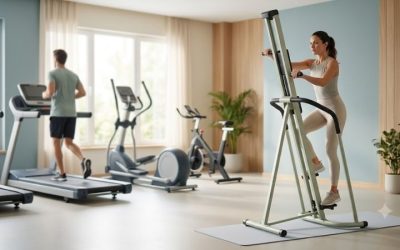
Mini Stair Stepper vs. Other Home Exercise Equipment
| Equipment | Main movement | Resistance arrangement | Main consideration |
|---|---|---|---|
| Traditional mini stepper | Alternating stepping | Often hydraulic | Compact standing exercise |
| Twist mini stepper | Stepping with lateral movement | Model-dependent | Different balance demands |
| Full-size stair climber | Stair-climbing movement | Varies | Much larger equipment |
| Under-desk elliptical | Seated elliptical motion | Often magnetic | Chair and desk compatibility |
| Exercise bike | Seated cycling | Varies | Larger equipment footprint |
| Step platform | Step-up movement | Bodyweight and optional external load | No integrated resistance mechanism |
Mini Stepper vs. Twist Stepper
Traditional steppers emphasize alternating up-and-down movement.
Twist steppers introduce additional directional motion.
Choose based on the movement you prefer and can control comfortably.
Mini Stepper vs. Stair Climber
Full-sized stair climbers generally provide a larger climbing mechanism and require substantially more space.
Mini steppers provide compact alternatives with different mechanical characteristics.
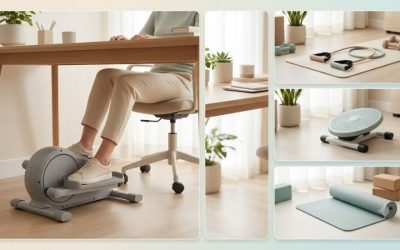
Mini Stepper vs. Under-Desk Elliptical
A mini stepper requires standing.
An under-desk elliptical is usually operated while seated.
The two devices serve different exercise and workspace needs.
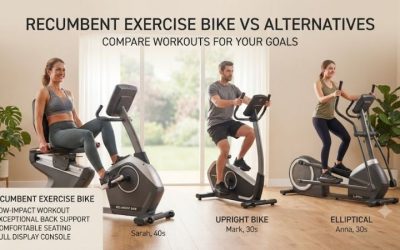
Mini Stepper vs. Exercise Bike
Exercise bikes provide seated cycling and often allow longer continuous sessions depending on the model.
Mini steppers provide standing stepping movement in a smaller equipment footprint.
Choose based on preferred movement, fit, and operating requirements.
Setting Up a Mini Stair Stepper Correctly
Select a Suitable Location
Choose a level surface with adequate floor and overhead clearance.
Avoid locations close to obstacles that could interfere with balance.
Complete Assembly
Follow the manufacturer’s instructions.
Ensure all required hardware is installed and secured.
Inspect the Hydraulic Mechanism
Check for visible damage or signs of leakage.
Do not use the equipment if a critical component appears defective.
Check Foot Position
Place your feet according to the manufacturer’s instructions.
Ensure the pedal surfaces provide secure contact.
Establish Balance Before Stepping
Mount the machine carefully.
Do not begin rapid movement before achieving a stable position.
Begin With Controlled Stepping
Use a manageable rhythm and stay within the intended pedal travel.
Avoid striking the movement limits aggressively.
Follow Operating Limits
Respect manufacturer requirements for maximum usage duration, cooling periods, maintenance, and loading.
Common Mistakes When Buying a Mini Stair Stepper
Comparing Only Price and Appearance
Similar-looking steppers may have different mechanisms and operating limits.
Review the functional specifications.
Assuming Every Adjustment Changes Resistance
Some adjustments influence pedal travel rather than hydraulic resistance.
Read the instructions carefully.
Overlooking Continuous-Use Limits
Hydraulic components may require cooling intervals.
These restrictions can matter significantly for intended workout duration.
Ignoring Pedal Fit
A small pedal platform may be unsuitable for the user’s foot size.
Choosing a Twist Stepper Without Considering Balance
Additional movement may feel less comfortable for some users.
Select according to individual control and preference.
Assuming Included Bands Are Suitable for Every Exercise
Resistance bands must be used within their intended load and movement limits.
Neglecting Replacement-Part Support
Warranty and parts availability can affect the long-term usefulness of the purchase.
Frequently Asked Questions
What Should I Look for When Buying a Mini Stair Stepper?
Prioritize a stable frame, suitable pedals, appropriate resistance, documented user weight capacity, and clear operating instructions.
The intended stepping motion and usage limits are also important.
Is a Hydraulic Mini Stepper Better Than a Magnetic One?
These resistance arrangements operate differently and are not directly interchangeable.
Hydraulic mechanisms are common in compact stepping devices, while magnetic resistance is more common in certain cycling and elliptical machines.
Choose based on the actual equipment design and intended movement.
Can You Adjust the Resistance on a Mini Stair Stepper?
Some models offer adjustments, but the function varies.
A control may alter pedal travel or mechanical geometry rather than directly adjusting hydraulic resistance.
Check the manual.
How Long Can You Continuously Use a Mini Stair Stepper?
There is no universal operating duration.
Some hydraulic models specify continuous-use limits and cooling requirements.
Follow the instructions for the exact machine.
Do Mini Stair Steppers Require Maintenance?
Yes. Inspection, cleaning, hardware checks, and other manufacturer-specified maintenance may be necessary.
Avoid assuming that a simple mechanical design requires no care.
Are Mini Stair Steppers Suitable for Beginners?
They can be appropriate for beginners who can maintain the required standing balance and operate the machine comfortably.
Start with controlled movement and follow all equipment instructions.
Conclusion
A good mini stair stepper buying decision begins with mechanical suitability, stability, and realistic operating expectations. Choose a machine with comfortable pedals, an appropriate stepping pattern, a documented weight rating, and clear hydraulic usage limits. Basic traditional models may be sufficient for straightforward home exercise, while twist, adjustable, or accessory-equipped designs are worthwhile when their additional features meet a specific need.



Write Your Review
No reviews yet. Be the first to share your experience!