
Key takeaways
-
Folding treadmill: Best for walking, jogging, and running when the workout area also serves another purpose.
-
Non-folding treadmill: Best for frequent runners with dedicated exercise space.
-
Walking pad: Best for compact, low-speed indoor walking and certain standing-desk setups.
-
Exercise bike: Best for seated cardio with adjustable resistance.
-
Elliptical trainer: Best for guided standing cardio with adjustable resistance and, on some models, moving handlebars.
-
Rowing machine: Best for seated, coordinated upper- and lower-body exercise.
-
Under-desk pedal exerciser: Best for light seated movement with minimal equipment storage.
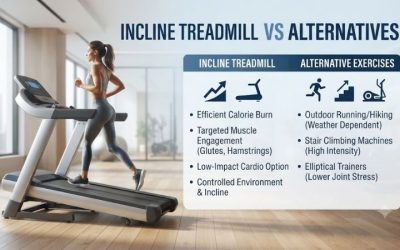
Compare folding treadmill vs alternatives, including regular treadmills, walking pads, exercise bikes, and ellipticals, to choose the best fit for your space.
Choosing a folding treadmill vs alternatives depends on your workout goals, available floor space, storage needs, and budget. Folding treadmills offer walking and running capabilities with space-saving designs, while non-folding treadmills, walking pads, exercise bikes, and ellipticals serve different needs. This guide explains the key differences so you can choose equipment that fits your home and routine.
Quick Verdict: Is a Folding Treadmill the Best Choice?
A folding treadmill is often the most practical compromise between exercise capability and storage flexibility. It can provide a conventional treadmill workout while allowing users to reclaim some floor space afterward.
However, a folding design does not automatically make a treadmill compact, portable, or suitable for every kind of running.
The alternatives may be more appropriate depending on your priorities:
-
Folding treadmill: Best for walking, jogging, and running when the workout area also serves another purpose.
-
Non-folding treadmill: Best for frequent runners with dedicated exercise space.
-
Walking pad: Best for compact, low-speed indoor walking and certain standing-desk setups.
-
Exercise bike: Best for seated cardio with adjustable resistance.
-
Elliptical trainer: Best for guided standing cardio with adjustable resistance and, on some models, moving handlebars.
-
Rowing machine: Best for seated, coordinated upper- and lower-body exercise.
-
Under-desk pedal exerciser: Best for light seated movement with minimal equipment storage.
For most households considering a treadmill primarily for walking and occasional jogging, a well-sized folding model provides a useful balance. Frequent runners should compare the exact deck dimensions and construction of folding and non-folding options before deciding.
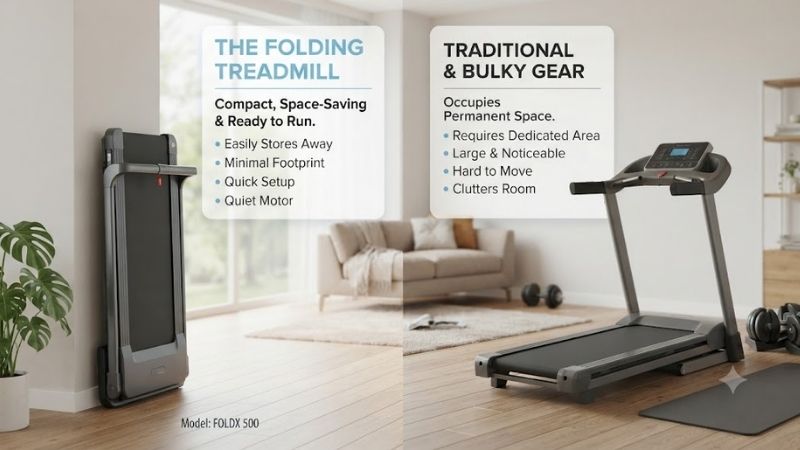
Folding Treadmill vs Alternatives: Quick Comparison Table
| Equipment | Primary Exercise | Storage | Running Capability | Main Trade-Off |
|---|---|---|---|---|
| Folding treadmill | Walking, jogging, running | Deck folds up or flat | Model-dependent | Folding convenience varies |
| Non-folding treadmill | Walking and running | Permanent footprint | Commonly suitable | Greater space commitment |
| Walking pad | Low-speed walking | Often compact | Limited on many models | Shorter walking surface |
| Exercise bike | Seated cycling | Compact to large | No | Does not reproduce walking |
| Elliptical | Guided standing cardio | Usually larger | No | Requires different movement pattern |
| Rowing machine | Seated rowing | Varies; some store upright | No | Technique and clearance requirements |
| Under-desk pedal exerciser | Seated pedaling | Usually compact | No | Limited workout capability |
These are equipment-category comparisons rather than verified specifications for individual models. Product dimensions, weight limits, resistance features, and operating restrictions must be checked separately.
Folding Treadmill vs Non-Folding Treadmill
Design and Structural Differences
The most obvious difference is the frame configuration.
A folding treadmill includes a mechanism that allows the running deck or another major section of the machine to move into a storage position. Conventional folding models typically raise the deck toward the console.
A non-folding treadmill retains a fixed operating footprint.
A fixed frame eliminates the need for a deck-folding hinge. However, this does not mean every non-folding treadmill is automatically stronger or more stable than every folding model.
Frame materials, overall construction, deck supports, assembly quality, and equipment weight all contribute to stability.
Running Performance and Deck Dimensions
Non-folding treadmills are commonly associated with larger running platforms and more substantial construction. Consumer buying guidance identifies these characteristics as advantages for frequent runners.
Folding treadmills vary considerably. Some compact budget models have relatively short and narrow belts, while higher-end folding machines provide running surfaces suitable for more demanding workouts.
The actual usable belt dimensions are more informative than the folding label.
A tall runner with a long stride may find a compact folding treadmill restrictive, even when its advertised maximum speed appears sufficient.
Storage and Floor Space
A folding treadmill can reduce its stored floor footprint, but the storage mechanism changes how space is used rather than eliminating the need for it.
An upright-folding treadmill may occupy less floor area while becoming taller when folded.
A non-folding treadmill needs a dedicated location for its full operating footprint.
In both cases, the workout area must allow the manufacturer-required clearances during exercise.
Maintenance and Long-Term Ownership
A folding mechanism adds components that may include hinges, locking pins, hydraulic assistance, or lift mechanisms.
These components require appropriate handling and inspection under the manufacturer’s instructions.
Non-folding treadmills avoid deck-folding hardware but still require ordinary treadmill maintenance, including belt care and inspection of mechanical and electrical components.
Reliability cannot be determined from folding capability alone.
Which should you choose? A folding treadmill is preferable when you need to reuse the workout area between sessions. A non-folding treadmill deserves consideration when you have permanent space and want a substantial running platform.
Folding Treadmill vs Walking Pad
Size and Intended Workout
A walking pad generally prioritizes compact design and lower-speed movement.
Many walking pads feature low-profile construction, short belts, and minimal consoles. Some are specifically designed for use beneath height-adjustable desks.
Folding treadmills cover a wider range of uses. Conventional models often provide handrails, larger consoles, longer belts, and higher operating speeds.
The distinction is not absolute. Some compact products are marketed as both folding treadmills and walking pads.
The manufacturer’s intended use and actual equipment specifications determine the difference.
Walking and Running Capability
For users interested exclusively in walking, a compact walking pad may offer everything needed.
A folding treadmill provides more flexibility when the user wants to alternate between walking and jogging or progress toward running.
However, treadmill speed alone is insufficient to establish running suitability. The usable belt dimensions, stability, and operating configuration also matter.
Storage and Portability
Walking pads can have an advantage in very small homes because some are low enough for storage beneath suitable furniture.
Conventional folding treadmills usually require more vertical storage room.
Not every walking pad is lightweight, and not every folding treadmill is difficult to move. Compare published machine weight, transport-wheel design, and permitted storage positions.
Working at a Standing Desk
Walking pads are often designed for compatibility with standing desks.
A conventional folding treadmill may have a large console or upright frame that interferes with desk positioning.
If you intend to walk while working, confirm that the equipment supports low-speed operation in the intended configuration and that the desk allows comfortable monitor and keyboard positioning.
Which should you choose? A walking pad is generally more practical for low-speed home-office activity. A folding treadmill is more versatile for dedicated workouts, especially when jogging or running is part of the plan.
Folding Treadmill vs Exercise Bike
Movement and Body Position
A folding treadmill supports upright walking or running.
An exercise bike provides seated pedaling, with the seat supporting part of the user’s body weight.
These different movement patterns matter more than marketing claims about which machine delivers a better workout.
A bike can be attractive to users who prefer seated exercise. A treadmill is more appropriate for someone who specifically wants to maintain a walking or running routine.
Resistance and Workout Progression
Treadmills typically vary workout difficulty through belt speed and, on equipped models, incline.
Exercise bikes adjust resistance to pedaling. Depending on the bike, users can combine resistance changes with cadence changes to vary workout difficulty.
Neither exercise is universally more intense. Workout intensity depends on settings, individual effort, conditioning, and duration.
Space and Noise
A folding treadmill can reduce its stored footprint but still needs a clear operating area.
An upright exercise bike may occupy relatively little floor space even when set up permanently, while recumbent bikes typically require more room.
Some bikes can also fold for storage.
Treadmills produce belt movement and footfall impacts. Bikes avoid treadmill footfall noise but may produce noise from the resistance and drive systems.
Noise performance depends on the specific machine and installation conditions.
Comfort and Practical Suitability
A folding treadmill may suit someone who enjoys walking outdoors but wants an indoor alternative.
A bike may be more comfortable for users who prefer seated exercise, though proper seat position, pedal alignment, and resistance selection are important.
Neither machine should be presented as a universal solution for joint problems or medical conditions.
Which should you choose? Select a folding treadmill for walking and running. Choose an exercise bike when seated cycling is the activity you are most likely to perform consistently.
Folding Treadmill vs Elliptical Trainer
Exercise Movement
A folding treadmill lets users perform a walking or running gait on a moving belt.
An elliptical guides the feet through a repeated pedal path. The feet typically stay in contact with the pedals throughout the motion.
Some elliptical machines include moving handlebars, adding coordinated upper-body involvement.
The movements are different, so personal preference and coordination play a substantial role.
Workout Controls and Variety
Folding treadmills may provide adjustable speed, incline, and preset workout programs.
Ellipticals commonly offer resistance adjustment, with certain models also featuring adjustable incline or stride characteristics.
For someone who enjoys resistance-based standing cardio, an elliptical may offer a satisfying alternative.
For someone training specifically for walking or running, a treadmill is more directly related to that movement.
Stability and Balance
Both machines require users to enter, operate, and exit safely.
Treadmills usually provide a moving belt and some form of emergency stopping system.
Ellipticals involve pedals that follow a guided path, often with available handles.
An elliptical should not automatically be considered safer for every user. Mounting, dismounting, coordination, and individual balance remain important.
Floor Space and Storage
Most conventional ellipticals occupy a substantial fixed area.
Some folding or compact elliptical designs exist, but buyers should compare their actual operating and storage dimensions.
A folding treadmill may be easier to incorporate into a shared room, depending on the specific machine.
Which should you choose? A folding treadmill is preferable for walking and running. An elliptical is worth considering for guided, resistance-based standing cardio when you have sufficient space.
Folding Treadmill vs Rowing Machine
Exercise Mechanics
A rowing machine uses a coordinated seated movement involving the legs, trunk, and arms.
The exercise differs substantially from treadmill walking or running.
Rowing requires technique and rhythm, with resistance provided through mechanisms such as air, water, magnetic, or hydraulic systems.
A folding treadmill is more intuitive for many users because walking is a familiar movement, although appropriate treadmill setup and safe operating habits are still essential.
Workout Variety
A rowing machine provides an alternative for people interested in coordinated upper- and lower-body exercise.
A treadmill supports walking and running with a more specific focus on locomotion.
Neither machine guarantees a superior total-body workout without considering effort, technique, equipment design, and personal capability.
Storage Requirements
Some rowing machines separate into sections, fold, or permit upright storage according to the manufacturer’s instructions.
However, rowing machines need sufficient length for the full rowing motion when in use.
This can be a limitation in narrow rooms, even when the machine stores efficiently.
A folding treadmill also requires operating clearance, but its footprint has different proportions.
Learning Curve
Walking at an appropriate treadmill speed is familiar to many users.
Rowing involves more specific coordination of leg drive, trunk positioning, and arm movement.
New rowing users should learn the correct movement sequence and avoid compensating with excessive back movement.
Which should you choose? A folding treadmill is more appropriate for walking and running. A rowing machine provides a different cardio exercise for users who enjoy seated, coordinated movement.
Folding Treadmill vs Under-Desk Pedal Exerciser
Exercise Capability
An under-desk pedal exerciser is designed for seated pedaling, often while working or performing another stationary activity.
It may fit beneath certain desks, although knee clearance and chair positioning must be checked.
Unlike a folding treadmill, it does not support walking, jogging, or running.
Its appeal lies in simplicity and compact storage rather than the ability to reproduce a full treadmill workout.
Space and Convenience
A pedal exerciser can be easier to store than a folding treadmill.
It may also require less setup, depending on its weight and design.
However, a compact pedal device can slide or shift if it is not appropriately stabilized, and its resistance system may be limited compared with a stationary exercise bike.
Appropriate Users
A pedal exerciser may appeal to someone who prefers light seated movement while working.
A folding treadmill is better suited to someone seeking dedicated upright exercise.
Which should you choose? Select a pedal exerciser for compact seated activity. Choose a folding treadmill for walking or running.
Key Buying Factors: How to Compare Folding Treadmills With Alternatives
1. Available Operating Space
Start with the usable workout area rather than the equipment’s advertised compactness.
For a folding treadmill, measure:
-
Full operating length, width, and height
-
Folded length, width, and height
-
Clearance required around the machine
-
Ceiling clearance, including user height and deck elevation
-
Access through doorways and furniture arrangements
The manufacturer’s operating-clearance instructions take priority over generic room-size estimates.
2. Walking and Running Surface
The usable treadmill belt dimensions directly influence comfort and suitability.
A short belt may be practical for low-speed walking but restrictive for users with longer strides.
A narrow belt can require more careful lateral foot placement.
When comparing folding and non-folding treadmills, check the actual belt length and width rather than the external frame dimensions.
3. Intended Workout Intensity
Identify your main activity before comparing specifications.
| Exercise Goal | Equipment Worth Considering |
|---|---|
| Slow indoor walking | Walking pad, folding treadmill |
| Brisk walking | Folding or non-folding treadmill |
| Regular jogging | Running-capable folding treadmill |
| Frequent running | Substantial folding or non-folding treadmill |
| Seated resistance cardio | Exercise bike |
| Guided standing cardio | Elliptical |
| Coordinated seated cardio | Rowing machine |
| Light movement while seated | Pedal exerciser |
This table identifies appropriate categories to investigate, not a guarantee that every model in a category is suitable.
4. Motor and Resistance Specifications
Treadmills use powered belts, with motors designed for different operating demands.
Manufacturer horsepower figures may represent peak or continuous ratings, which should not be compared as though they are identical measurements.
Exercise bikes, ellipticals, and rowing machines use different resistance systems.
For that reason, a treadmill motor rating cannot be directly compared with bike or rowing resistance levels.
The best approach is to evaluate specifications within the relevant equipment category.
5. Equipment Weight and User Capacity
A compact treadmill may be easier to reposition, but a low machine weight does not automatically guarantee convenient handling.
Transport wheels, balance during movement, grip locations, and storage instructions also matter.
The manufacturer’s published user weight limit should be observed for every type of equipment.
Weight capacity alone does not establish stability or durability.
6. Noise and Vibration
Treadmills produce a combination of motor noise, belt movement, and footfall impact.
Exercise bikes and ellipticals have different sources of mechanical noise.
Rowing machines vary substantially by resistance system.
A machine described as quiet should not be assumed silent in an apartment.
Floor construction, equipment placement, speed, and maintenance all affect the sound experienced by neighbors and other household members.
7. Safety Features
A folding treadmill should have a secure folding mechanism, accessible controls, and an appropriate emergency stopping arrangement.
The machine should never be operated unless its required locking components are correctly positioned.
Keep children and pets away from moving equipment and from folding or lowering mechanisms.
Bikes, ellipticals, and rowing machines have their own safety requirements related to moving components, adjustment mechanisms, and mounting or dismounting.
8. Maintenance and Durability
Folding treadmills may require belt maintenance, lubrication, alignment, and periodic inspection of folding hardware.
Bikes require inspection of pedals, seats, fasteners, and resistance systems.
Ellipticals may need attention to linkages, rails, and drive mechanisms.
Rowing machines require maintenance appropriate to their resistance system.
No equipment category is maintenance-free by default.
9. Total Ownership Cost
Compare more than the initial purchase price.
Delivery, assembly, replacement parts, warranty terms, maintenance requirements, and optional subscriptions can influence the total cost.
A more expensive treadmill may be justified when it offers a suitable running deck and service support.
Conversely, someone interested only in slow walking may not benefit from paying for a large treadmill with advanced running features.
Advantages and Disadvantages of Folding Treadmills
Advantages
-
Can reclaim floor space after workouts
-
Supports familiar walking and running movement
-
Available in compact and full-size configurations
-
Many models include incline and workout programs
-
Often suitable for shared living spaces
-
Can provide more exercise versatility than walking-only pads
Disadvantages
-
Folding does not eliminate storage requirements
-
Some compact models have short or narrow belts
-
Folding hardware adds maintenance considerations
-
Full-frame models can be heavy
-
Belt operation and footfalls produce noise
-
Daily folding may become inconvenient
Who Should Choose Each Type of Equipment?
Best for Small Homes With Mixed Workout Needs: Folding Treadmill
A folding treadmill is a logical choice for people who want walking and jogging capability but cannot dedicate permanent floor space to exercise equipment.
Prioritize usable belt dimensions, folded measurements, and ease of setup.
Best for Dedicated Running Spaces: Non-Folding Treadmill
A non-folding treadmill is worth considering when equipment will remain in one location and frequent running is the main activity.
Focus on running-surface dimensions, stability evidence, rated use, and warranty support.
Best for Walking While Working: Walking Pad
A walking pad is often better suited to an adjustable standing-desk workstation than a conventional treadmill with a large console.
Choose a model explicitly intended for the planned speed and operating configuration.
Best for Seated Cardio: Exercise Bike
An exercise bike suits users who prefer seated exercise and resistance-based workouts.
Proper seat adjustment, leg positioning, and available workout space remain important.
Best for Resistance-Based Standing Workouts: Elliptical
An elliptical may appeal to someone seeking standing cardio with guided foot movement.
It is most practical when its operating footprint can remain available.
Best for Coordinated Full-Body Movement: Rowing Machine
A rowing machine suits users who enjoy rowing mechanics and are willing to learn the movement sequence.
Check the full operating length and permitted storage configuration before purchasing.
Best for Compact Seated Activity: Pedal Exerciser
An under-desk pedal exerciser is suitable for buyers interested in light seated movement rather than dedicated treadmill exercise.
Confirm desk clearance and equipment stability before use.
Frequently Asked Questions
Are Folding Treadmills as Good as Regular Treadmills?
They can be for many home users. High-quality folding treadmills may provide suitable running surfaces and workout capabilities, while some compact models are primarily intended for walking or jogging. Compare actual construction, deck dimensions, and manufacturer specifications rather than assuming one design is universally better.
Is a Folding Treadmill Better Than a Walking Pad?
A folding treadmill is generally more versatile for jogging and running when designed for those activities. A walking pad is often more convenient for low-speed walking and compact storage. The better choice depends on how you intend to exercise and where the equipment will be used.
Are Folding Treadmills Suitable for Apartments?
They can be, provided their operating dimensions, storage configuration, and required safety clearances fit the available space. Noise transmission, flooring, equipment weight, and building restrictions should also be considered. Folding capability does not guarantee quiet operation.
Can You Run Every Day on a Folding Treadmill?
Some folding treadmills are designed for regular running, but suitability depends on the exact model, user, training demands, and manufacturer’s intended use. A larger running deck and appropriate rated performance are important. Training frequency should also account for individual conditioning and recovery.
Do Folding Treadmills Require More Maintenance?
They share the ordinary belt, deck, motor, and cleaning requirements of comparable non-folding treadmills. Folding models additionally have hinges, locks, or assisted-lift components that may require inspection. However, maintenance frequency and reliability depend on the model and manufacturer instructions.
Which Alternative Is Best if I Do Not Like Running?
An exercise bike, elliptical, rowing machine, or walking pad may be more enjoyable depending on your preferred movement. For seated cardio, consider a bike or rowing machine. For standing movement, consider an elliptical or walking-focused treadmill. The best choice is one whose movement, dimensions, and controls suit your routine.
Conclusion
When comparing a folding treadmill vs alternatives, choose based on the activity you will actually perform and the space you can dedicate to it. A folding treadmill offers a useful balance of walking and running capability with storage flexibility, while a non-folding treadmill can be preferable for a permanent running setup. Walking pads, exercise bikes, ellipticals, and rowing machines serve different exercise preferences. Before buying, verify the exact model’s usable dimensions, intended operation, safety features, storage requirements, and long-term ownership costs.
Write Your Review
No reviews yet. Be the first to share your experience!