
Key takeaways
What's inside
Best crossfit jump rope for double unders is less about the brand than about the length. A rope two inches too long trips you at rep twelve regardless of what it cost, and sizing is the one thing nobody does properly.
As an Amazon Associate we earn from qualifying purchases at no extra cost to you. Product prices and availability are accurate as of the date shown and are subject to change.
As an Amazon Associate we earn from qualifying purchases at no extra cost to you. Product prices and availability are accurate as of the date shown and are subject to change.


By Chris Parker
🛒 Best Price Today on Amazon
Prime members get fast, free shipping on everything above, plus member-only deals. New members get a 30-day free trial — cancel anytime.
Start 30-Day Prime Free Trial →See Today’s Amazon DealsSizing the Best CrossFit Jump Rope for Double Unders
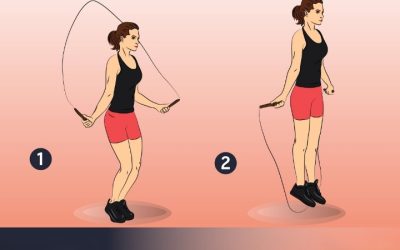
Length is the specification that decides whether a set of double unders holds together. The best crossfit jump rope for double unders is sized shorter than a rope used for single passes, because the cable has to clear your head twice on every jump rather than once.
The Height Chart and How to Read It
As a starting point, add roughly 30 in (76 cm) to your height for a general jumping rope, and about 18-24 in (46-61 cm) for a double-under rope. Someone at 5 ft 10 in (178 cm) usually lands near 8 ft 6 in (259 cm) of total cable.
Treat that as a first setting rather than a final answer. Arm length, jump height and whether you keep your elbows tight all shift the number by several inches, which is why every good rope is adjustable rather than fixed.
The Stand-On-It Test
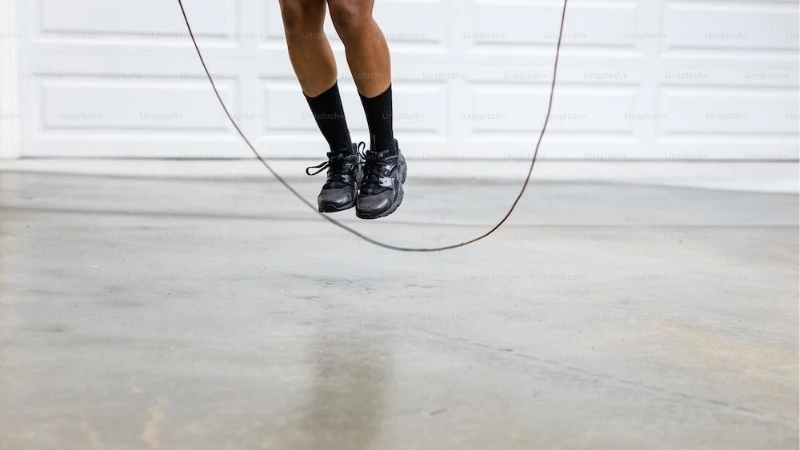
Stand on the middle of the cable with one foot and pull the handles straight up. For double unders the handle tops should reach roughly your sternum. Armpit height is correct for single passes and is too long once you add a second rotation.
If you are still learning, start at armpit height and shorten by an inch every week as the timing improves. Going straight to sternum height before the rhythm exists produces whip marks rather than progress.
Adjustment Mechanisms and Their Failure Points
Screw clamps are the most common and the most likely to slip, which shows as a rope that mysteriously lengthens mid-workout. Check the clamp after the first few sessions and tighten it properly rather than finger-tight.
Cut-to-length ropes cannot slip but cannot be lengthened either, so cut long and take an inch at a time. Tool-free quick-adjust systems sit between the two and suit a rope shared between users of different heights.
Footprint, Ceiling and Surface
Allow around 6 x 6 ft (1.8 x 1.8 m) of clear floor and roughly 9-10 ft (2.7-3 m) of ceiling, since the cable passes overhead twice per jump. Light fittings are the most common casualty in a standard domestic room.
Surface decides cable life more than anything else. Rough concrete abrades a coated cable within weeks; a 1/2 in (12.7 mm) mat or a wooden floor extends it to months. Measure the space and check the surface before ordering.
Resizing as Your Technique Changes
Sizing is not a one-off decision. As the jump gets lower and the elbows tuck closer to the ribs, the same rope effectively becomes longer, which is why a setup that felt right in month one produces trips in month three.
Reassess every few weeks by repeating the stand-on-it test. The best crossfit jump rope for double unders is usually one you have shortened two or three times, not one you set once and left alone.
Market Context for Speed Ropes
This is one category where the mid tier genuinely solves the problem, because sealed bearings and adjustable or interchangeable cables have both moved down from competition pricing into ordinary home budgets over the last few years.
Below that tier the compromises are consistent: bushings instead of sealed bearings, cables that kink permanently, and clamps that loosen under load. The clamp is the component to inspect after the first week rather than the cable.
The useful development is cable packs sold separately, which lets one set of handles carry a heavy learning cable and a thin competition cable. That removes the need to buy two complete ropes as your timing improves.
Top Picks: Best CrossFit Jump Rope for Double Unders
These seven are ranked by how well they handle sizing, since that is the variable that decides whether the rope works. Each entry states the adjustment method and the honest weakness.
| Rope | Adjustment | Cable | Sizing Suits | Note |
|---|---|---|---|---|
| RX Smart Gear Evo | Sized to order | Multiple weights | One dedicated user | Hard to share |
| Elite SRS Fit Rope | Tool-free quick adjust | Interchangeable | Shared households | Cable packs extra |
| WOD Nation Speed Rope | Screw clamp | Standard coated | Budget entry | Clamp can slip |
| RPM Speed Rope | Cut to length | Multiple diameters | Settled technique | Cannot lengthen |
| Crossrope Get Lean Set | Fixed lengths by height | Weighted cables | Conditioning work | No fine tuning |
| Beast Gear APEX | Screw clamp | Standard coated | General fitness | Fixed diameter |
| Spare Cable Pack | Not applicable | 1.8 to 4 mm | Learning to competing | Check handle fit |
RX Smart Gear Evo
Sized to the user at the point of order rather than adjusted afterwards, which removes the most common source of trips entirely. Weighted cable options mean one purchase covers both the learning phase and the competition phase.
Custom sizing makes it awkward to share between users of different heights, and getting the measurement wrong at order time is harder to correct than turning a clamp. It also costs more than adjustable alternatives.
Elite SRS Fit Rope
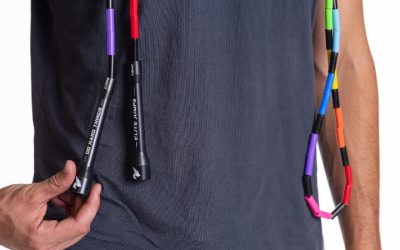
Tool-free adjustment plus interchangeable cables makes this the most flexible option here. A household with two users of different heights can reset the length in seconds, and the same handles run a drag cable or a speed cable.
Cable packs are sold separately, so the complete system costs more than the headline price. Changing cables takes a few minutes, which rules out swapping mid-session between movements.
WOD Nation Speed Rope
The value entry, and adequate for anyone not competing. Ball bearings, a simple screw adjustment and a durable coated cable cover everything most people need from a double-under rope.
The screw clamp is the weak point: it loosens under repeated load, and a rope that lengthens mid-workout feels exactly like a timing fault. Tighten it firmly and recheck after the first few sessions.
RPM Speed Rope
Cut-to-length cables cannot slip, which is the strongest argument for them once your technique has settled. Sealed bearings keep the spin consistent at the speeds double unders require, and multiple cable diameters are available.
Cutting is irreversible, so start long and remove an inch at a time. It also sits at the premium end, and the advantage over a good mid-tier rope only appears once you are stringing sets reliably.
Crossrope Get Lean Set
Fixed lengths chosen by height remove the adjustment question altogether, and the weighted cables suit conditioning work where feedback matters more than raw speed. The quick-connect system makes changing cable weight genuinely fast.
There is no fine tuning, so if you fall between sizes you are stuck with one that is slightly off. The weighted cables are also slower than a thin speed cable, which limits top-end double-under work.
Beast Gear APEX
A straightforward adjustable rope with a clamp that is easier to set than most in its price range. For general fitness where double unders are one movement among many, it does the job without complication.
The cable diameter is fixed, so there is no path from a learning cable to a competition cable. Bearings are adequate rather than sealed and will slow before the cable itself wears out.
Spare Cable Pack
The cheapest upgrade in the category. A 3-4 mm drag cable turns an existing rope into a learning tool, and a 1.8-2.5 mm speed cable turns the same handles into a competition setup once the timing is reliable.
Cable ends are not universal, so a pack bought separately may not fit your handles. Buying from the same manufacturer as the handles avoids that, and checking the end fitting before ordering avoids a wasted purchase.
Frequently Asked Questions
These questions come up whenever someone buys the best crossfit jump rope for double unders they can find, sizes it out of the box, and finds the trips have not stopped.
How much shorter should a double-under rope be?
Roughly 4-6 in (10-15 cm) shorter than a single-pass rope, which usually means sternum height rather than armpit height on the stand-on-it test. That is the difference between clearing the cable once and clearing it twice.
Should I size for now or for later?
For now, with room to shorten. The best crossfit jump rope for double unders at your current level is one you can actually turn, and adjustable or cut-long ropes let you take an inch at a time as the timing improves.
Does taller mean longer, always?
Broadly, but arm length and elbow position shift it. Someone with long arms who keeps the elbows tight to the ribs needs less cable than the height chart suggests, so treat the chart as a starting point and adjust from there.
My rope keeps getting longer during a workout. Why?
The screw clamp is slipping. Tighten it fully rather than finger-tight, and if it continues, a drop of thread locker or a switch to a cut-to-length cable solves it permanently.
See More:
- Ankle weights best
- Best rated ankle weights
- Best home workout equipment budget
- Best resistance bands for men
Final Thoughts
The best crossfit jump rope for double unders is whichever one you can size correctly: sternum height on the stand-on-it test, adjusted an inch at a time as your timing improves. Cut-to-length ropes suit settled technique, quick-adjust ropes suit shared households, and a spare cable pack covers the whole progression cheaply.


Write Your Review
No reviews yet. Be the first to share your experience!